
‘De-Extinction’ Company Says It Hatched Chicks From Artificial Eggs, Paving the Way for Resurrecting Dodos and Other Bygone Birds
Colossal Biosciences announced that 26 live baby chickens have emerged from 3D-printed honeycomb structures. But the company does not plan to detail the system in a paper, and its mission has faced criticism
/https://tf-cmsv2-smithsonianmag-media.s3.amazonaws.com/accounts/headshot/SarahKuta.png)
/https://tf-cmsv2-smithsonianmag-media.s3.amazonaws.com/filer_public/90/36/9036ab78-0397-4d3e-9c62-0917665fd056/colossal_biosciences__colossal_artificial_egg_device_healthy_embryo_hatched_chick_from_device.jpg)
Scientists with the “de-extinction” company Colossal Biosciences say they have successfully hatched live chicks from artificial eggshells, which they claim is an important step toward their controversial goal of resurrecting extinct bird species like the dodo and the South Island giant moa.
On May 19, the Texas-based biotech company announced that 26 live baby chickens hatched from 3D-printed honeycomb structures designed to mimic eggshells. Colossal Biosciences leaders say the system could eventually be scaled up to accommodate extinct bird species that produce much larger eggs.
The South Island giant moa, for instance, which disappeared from New Zealand roughly 600 years ago, laid eggs thought to have been roughly 80 times the volume of a chicken egg and eight times the volume of an emu egg, according to Colossal Biosciences. That gargantuan size would make it difficult for any modern bird to serve as a surrogate.
“There’s no bird on Earth today that could grow a moa embryo inside of one of their eggs,” Trevor Snyder, a bioengineer for Colossal Biosciences, tells NPR’s Rob Stein. “So, we have to come up with artificial eggs to be able to support those embryos. But to understand all the things that the egg needs to do, we’re starting with chicken eggs.”
Scientists designed the artificial eggshell to have a transparent silicone membrane that allows atmospheric oxygen to enter, just like a real eggshell. But they did not incorporate other elements of a real egg, such as the four temporary organs, or “embryonic membranes,” that form to support nutrition, respiration and excretion as the chick develops, reports Adithi Ramakrishnan for the Associated Press.

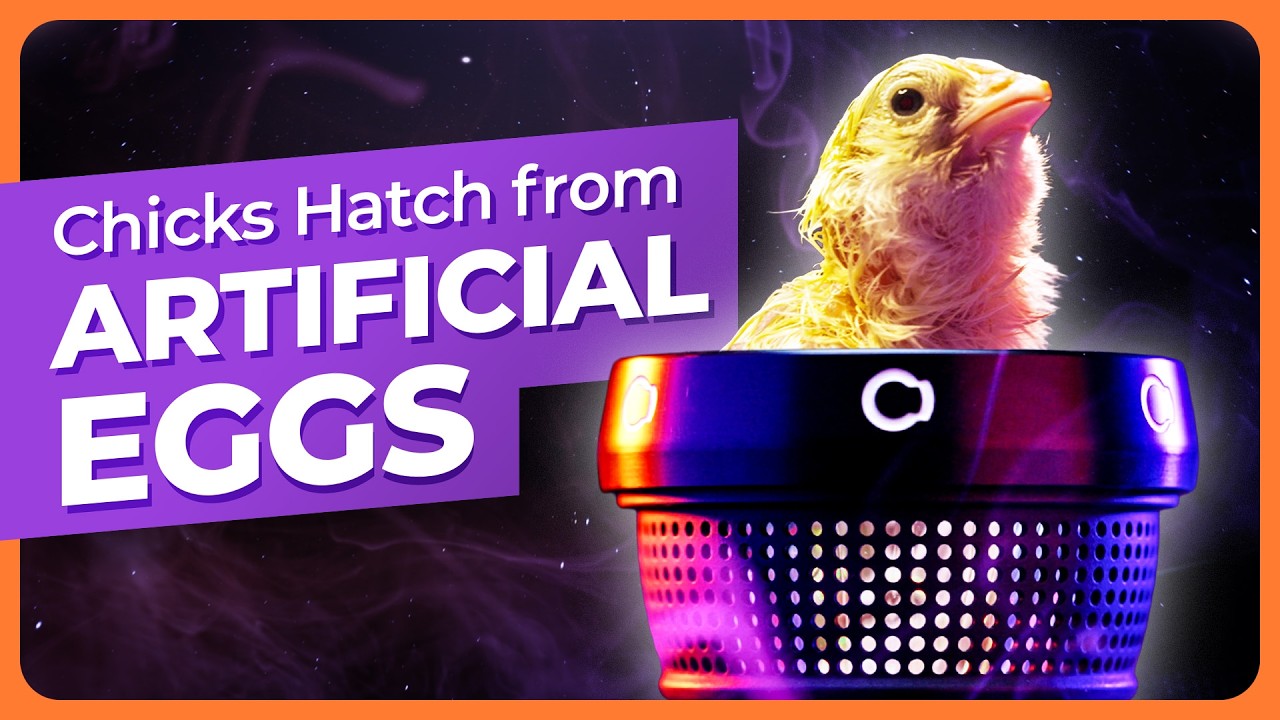
Researchers transferred chicken embryos, egg yolks and egg whites to the artificial shells within 36 to 40 hours after they were laid, reports Nature’s Ewen Callaway. They placed the containers in an incubator and added calcium, which chicks would normally get from a real shell.
Then, they waited. Roughly 18 days later, the chicks started pecking to escape their egg systems and, eventually, emerged from the artificial shells.
In an accompanying video, the company said the hatched chicks will eventually be moved to a large farm. In the future, Colossal Biosciences plans to test the artificial eggs with emu and ostrich embryos.
The company has not shared what proportion of the transferred chicken eggs successfully hatched, per Nature. It also has not published a preprint or peer-reviewed paper on the achievement—nor does it plan to. So, for now, it’s difficult for outside researchers to evaluate the process and outcomes.
“It could be really important, it could be fantabulous,” Paul Mozdziak, a biologist at North Carolina State University who is not involved with the company, tells Nature. “Without data, it’s really impossible to judge what the true impact is.”
Still, other experts are excited by the potential of Colossal Biosciences’ artificial eggshell system.
“There’s an immediate group of people in zoos and conservation breeding facilities that could use this technology,” Ben Novak, an ecologist with the nonprofit Revive & Restore, which is working to resurrect the passenger pigeon, who is not involved with the company, tells Nature.
Neil Gostling, a paleobiologist at the University of Southampton in England, who is also not involved with Colossal Biosciences, was equally enthusiastic. “I’m genuinely blown away by it,” he tells NPR. “This is brilliant. I just think it’s fantastic. It’s the sort of thing of science fiction. It’s remarkable, honestly.”
Quick fact: How many bird species have disappeared?
In a study published in 2023, researchers estimated that at least 1,300 to 1,500 bird species—around 12 percent of the total number—have gone extinct since the late Pleistocene epoch. This geologic age ended about 11,700 years ago, when human civilization began to rise.
This is not the first time scientists have tried producing chicks from artificial shells, per National Geographic’s Christina Larson. For decades, researchers have been experimenting with a variety of containers, including glass vessels, plastic wrap and plastic cups. But those systems require high amounts of supplemental oxygen, which can cause problems for the animals, and the hatching rates “have not been very good,” Mike McGrew, an embryologist at the University of Edinburgh who is a scientific advisor for Colossal Biosciences, tells National Geographic.
The announcement is just the latest headline-making development from Colossal Biosciences, which has faced criticism from scientists and conservationists for its ambitious plans to bring several species back from the dead.
“De-extinction is a fairytale science,” Jeremy Austin, an evolutionary biologist at the University of Adelaide in Australia, who is not involved with the company, told the Sydney Morning Herald’s Liam Mannix in 2022. “It’s pretty clear to people like me that thylacine or mammoth de-extinction is more about media attention for the scientists and less about doing serious science.”
The company previously revealed that it had used gene editing techniques to produce “woolly mice,” or rodents with thick, fluffy, mammoth-like hair, as part of the quest to revive the woolly mammoth. It also claimed to have assembled the most complete genome to date of the thylacine, also known as the Tasmanian tiger, from genetic material recovered from a 110-year-old head preserved in ethanol. Additionally, Colossal Biosciences announced the births of three “dire wolf” pups last year, though some outside experts questioned whether they were just genetically modified gray wolves.
Some scientists are concerned that “de-extinction” is taking energy and resources away from efforts to protect still-living threatened species. Others have animal-welfare concerns, not only for the creatures used during the research, but also for those that might eventually be resurrected.
“The big challenge is, what environment is this animal going to live in?” Arthur Caplan, a bioethicist at New York University’s Grossman School of Medicine, tells the AP.
/https://tf-cmsv2-smithsonianmag-media.s3.amazonaws.com/accounts/headshot/SarahKuta.png)