
A ‘Magical’ Mirror the Powerful Queen of a British Tribe May Have Used Was Discovered in an Enormous Iron Age Hoard, Now on Display
Visitors to the Yorkshire Museum can see artifacts from the Melsonby Hoard, dating to the first century C.E., that rewrite the story of wealth and power in Britain around the time of the Roman invasion
/https://tf-cmsv2-smithsonianmag-media.s3.amazonaws.com/accounts/headshot/Sonja_headshot.png)
/https://tf-cmsv2-smithsonianmag-media.s3.amazonaws.com/filer_public/3a/70/3a703ffc-d058-4edc-8ffe-00b555cd457b/senior-curator-glynn-davis-with-the-block-in-chariots-treasure-and-power-at-the-yorkshire-museu.jpeg)
Five years ago, a metal detectorist scanning a field in northern England hit on some ancient-looking metal, and he alerted archaeologists. Researchers from Durham University excavated some 800 iron and copper-alloy artifacts at the site—including 2,000-year-old horse bridle bits, a feasting cauldron and a mirror signifying female power.
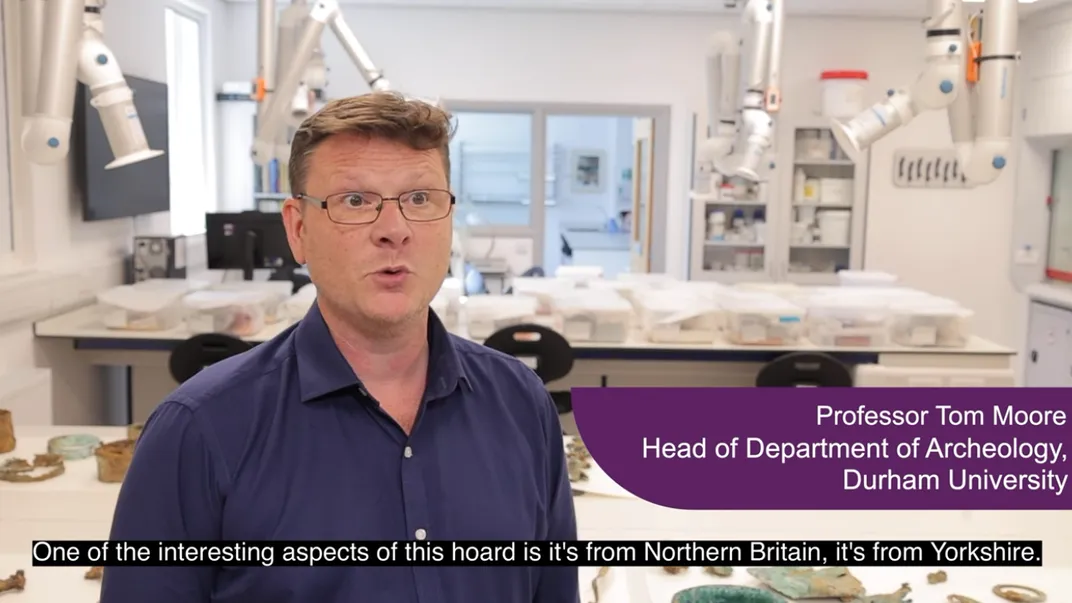
“Finding a hoard or collection of ten objects is unusual, it’s exciting, but finding something of this scale is just unprecedented,” Tom Moore, Durham’s head of archaeology, told the Guardian’s Mark Brown in 2025. “We were just lost for words.”
Nicknamed the Melsonby Hoard, after the nearby Yorkshire village, the trove is the largest collection of Iron Age metalwork ever found in the United Kingdom. Now, after years of preliminary research, it’s going on public display for the first time. “Chariots, Treasure and Power: Secrets of the Melsonby Hoard” at the Yorkshire Museum gives visitors a peek into what life was like during Britain’s age of tribes.
/https://tf-cmsv2-smithsonianmag-media.s3.amazonaws.com/filer_public/8d/f7/8df7d703-69f6-462e-a062-4a4cb650229d/person-looking-at-an-iron-age-wine-mixing-vessel-in-chariots-treasure-and-power-at-the-yorkshir.jpg)
A fraction of the giant hoard is on display in the exhibition, including “the block,” a 330-pound mass of fused-together artifacts. Spearheads, wagon parts and harness pieces are visible from the outside, but “what’s inside is largely a mystery,” the museum’s archaeology curator, Emily North, tells BBC News’ Seb Cheer and Joanita Musisi.
“It is an incredibly tantalizing object,” North tells the Guardian’s Brown. “You can peek through the surface at some of the things that are hidden inside. There’s a stylized boar’s head that’s part of an object and also a man’s face … To see the face of an Iron Age Briton as they depicted themselves is something very, very special.”
The block’s items were wrapped in cloth and buried in one ditch, while the rest of the hoard was found in another. Most of those pieces are related to horse-drawn vehicles. There are 28 stacked iron tires of varying sizes, U-shaped iron brackets, linchpins, yoke fittings, finials, rein rings and more. Researchers think they’re remnants of four-wheeled horse-drawn wagons, constituting the first evidence of such a vehicle in Iron Age Britain.
“Receiving the objects was a little bit like drinking from a fire hose,” Emily Williams, a conservator at Durham University, told National Geographic’s Kelly Faircloth in 2025. “Every surface in my lab was covered in Melsonby objects.”
/https://tf-cmsv2-smithsonianmag-media.s3.amazonaws.com/filer_public/18/7f/187f7b7f-897b-46f0-bd3e-da44b0b10ab2/part_of_the_melsonby_hoard_at_the_yorkshire_museum_-_credit_gareth_buddo.jpeg)
The artifacts constitute an “amount of wealth” that could’ve belonged only to “someone very important,” North tells BBC News. The Melsonby Hoard also contains blue glass beads and a mirror, typically associated during the Iron Age with powerful women.
“The mirror is my absolute favorite object,” North tells the Guardian. “It is the clue that could solve the puzzle of why people buried this hoard.”
Melsonby is located near Stanwick, the site of an Iron Age fort that belonged to a tribe called the Brigantes. The fort was a major power center during the reign of Brigante queen Cartimandua, Britain’s first documented female ruler. She rose to power around 43 C.E., the year the Roman Empire began colonizing Britain. While many of the contemporary tribes fell to Rome, Cartimandua allied with the empire. Her reign continued until 69 C.E.
North tells the Guardian that the mirror couldn’t have belonged to Cartimandua, but that it could’ve belonged to her grandmother or mother. “It is a magical object associated with female power,” she says.
Did you know? Roman invasion
In 43 C.E., the Roman emperor Claudius launched an invasion of Britain. The Roman province Britannia was part of the Roman Empire until the early fifth century C.E.
As for the hoard’s large cauldron and bowl, they were “almost certainly used for feasting,” says Moore in a video from Durham University. The cauldron probably held a stew or other food, while the bowl likely contained wine or beer, he says. The latter is elaborately decorated with carved coral, which the researchers think came from the Mediterranean Sea.
“What that tells us is the kind of links and connections that [these] people had across Europe, to be able to get that material to decorate an object in that way,” Moore says in the video. “This is something that would have impressed anybody in Iron Age Britain.”
Historians previously believed that wealth in Iron Age Britain was focused in England’s southern regions. But the Melsonby Hoard challenges that notion.
“This shows that individuals there had the same quality of materials and wealth and status and networks as people in the south,” Moore told the Guardian in 2025. The artifacts “challenge our way of thinking and show the north is definitely not a backwater in the Iron Age. It is just as interconnected, powerful and wealthy as Iron Age communities in the south.”

As for why so much valuable material ended up underground, the exhibition presents four theories: a feast, festival, fight or funeral, reports BBC News. Much of the material seems to have been damaged before its burial—bent, burned or both. Per the university, pieces of copper alloy are partially melted; the tires’ wood components may have been lit aflame; and the cauldron looks bashed with a rock. As no human remains were found nearby, researchers don’t think the artifacts are grave goods. Instead, they might’ve been disposed of at a commemorative feast.
“It’s an absolute mystery why this vast mass of luxury expensive objects was destroyed and put into the ground,” North tells BBC News. “I doubt I’ll see anything quite like this again in my career.”
“Chariots, Treasure and Power: Secrets of the Melsonby Hoard” is on display at the Yorkshire Museum in England from May 15 through summer 2027.
/https://tf-cmsv2-smithsonianmag-media.s3.amazonaws.com/accounts/headshot/Sonja_headshot.png)