Bats Thrive in a Messy, Noisy World. These Four Discoveries Reveal How They Can Listen and Chatter Through the Din
From eavesdropping to echolocation tricks, science is giving us an inside look into how various bat species weaponize sound

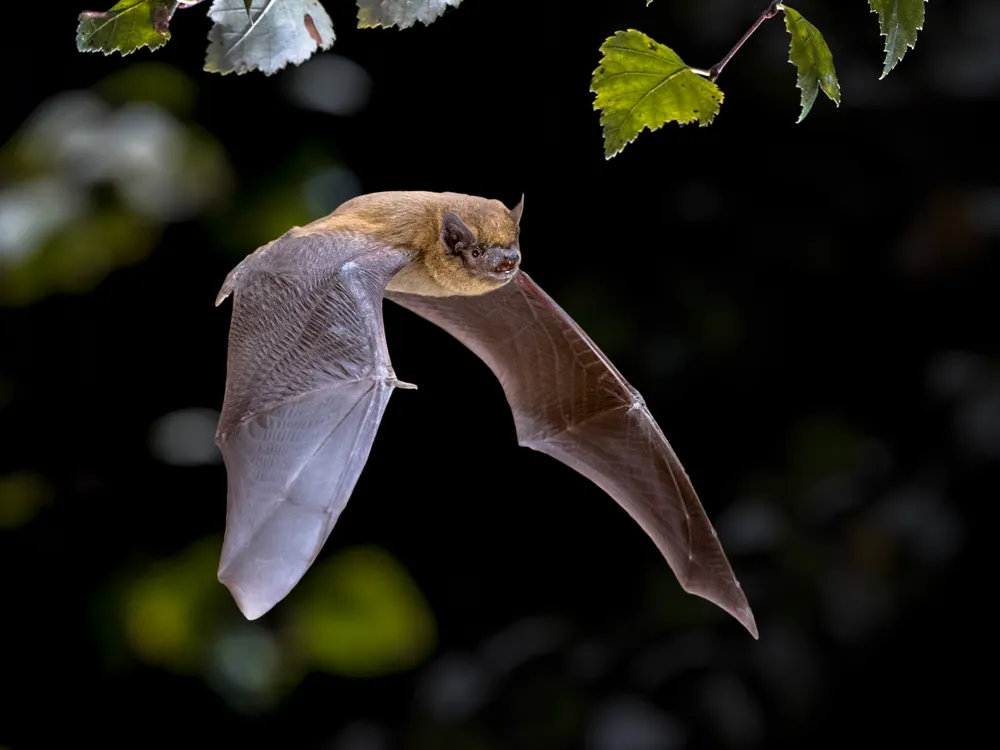
Contrary to popular belief, bats aren’t flying blind. But they do rely heavily on sound—rather than vision—to confidently swoop through the night. They use echolocation to map out their immediate environment, sending out signals and waiting for the sound waves to boomerang back after bouncing off background objects and prey. It’s remarkably effective.
“Bats image the world better than anybody,” says Marc Holderied, a sensory ecologist and bioacoustician at the University of Bristol in England.
The world is a cluttered place, though, and bats don’t want a constant deluge of signals. What they want—and don’t we all—is to chatter with friends and enjoy a tasty meal. So how do they pick out the interesting echoes from the pile of sonic slop? And how can they hear and be heard over the din?
Fun fact: Bat vocalizations
Most bats’ echolocation calls are too high-pitched for humans to hear, putting them in the range of ultrasound. But bats make other sounds to communicate, including purrs, clicks and buzzes that may precede mating.
Researchers are still teasing out exactly how different species of bats use noise to navigate their complex environments. But it’s clear that the creatures are succeeding, thanks to keen manipulations of the rules of physics and a wider web of senses than you may think.
Here are four fascinating ways that recent science has added to our understanding of bats’ sensory soundscapes, revealing how the flying mammals work to make sense of it all.
Pipistrelle bats track the melody of their environment’s echoes and flap their wings accordingly
Many people think of echolocation as a straightforward call and response, says Holderied. A bat sends out one signal, an insect reflects back a tantalizing echo, and dinner is served.
Reality is rather more complicated. The forest is chock-full of things that echo, with trees, rocks and other obstacles constantly sending back conflicting signals. For years, Holderied has been trying to understand how bats make meaning out of their environment’s muddle of echoes. “They can’t afford to crash into whatever tree is out there just because the acoustic scenery is too complex,” he says.
Complicating bat perception even further is the Doppler effect. According to this physical law, sound waves stretch and contract with the listener’s relative motion to the source—think of a siren sounding more high-pitched as it moves toward you. When bats fly toward objects, these objects echo at a higher pitch than they would if the bats were at rest. Some bat species—called Doppler specialists—are known to combat this effect by sending out lower-frequency calls, so that the echoes bounce back at just the right pitch.
Yet many other types of bats thrive despite their environments’ pitch-shifted mix of echoes—which Holderied and his team have dubbed “the Doppler melody.” They wondered, how do bats navigate through this bizarre musical progression?
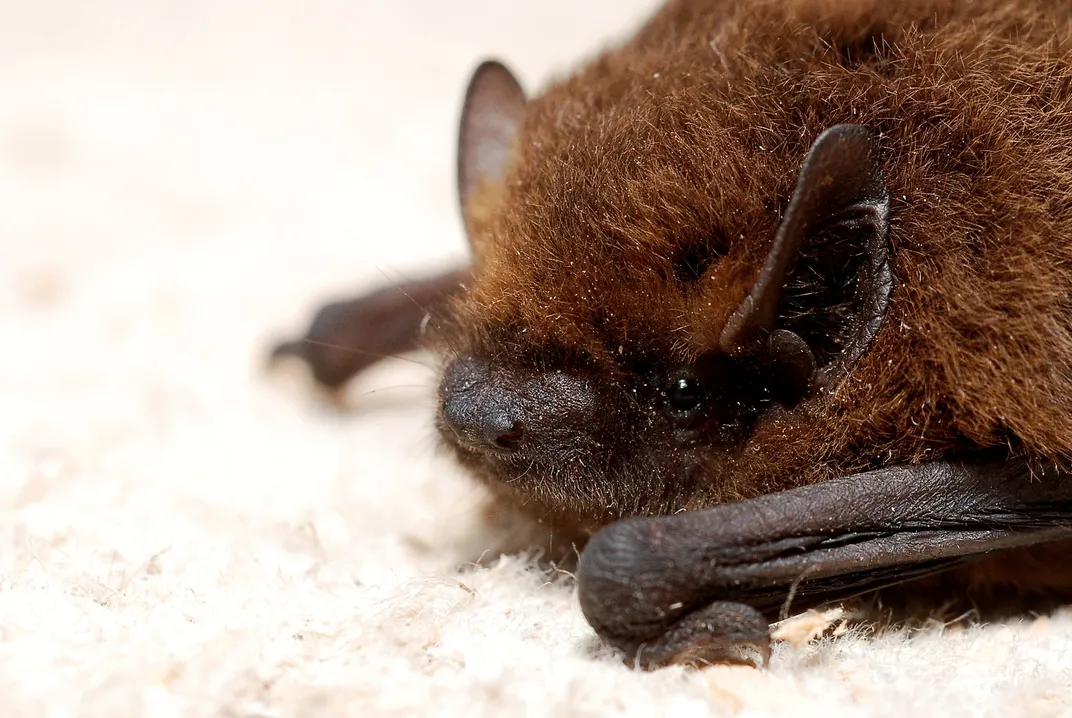
The researchers decided to examine this question by tracking pipistrelle bats—a group of small insect-eaters. They hypothesized that, just like humans, bats rely on the flow of sensory input to understand their own speed. When we walk or run, visual landmarks stream past, an optical signal to our body that we’re moving at a certain pace.
Maybe, the researchers thought, the Doppler melody’s changing tune would give similar clues to bats. “That was a weird and wonderful idea,” says Holderied.
To test this, his team constructed a “bat accelerator”—two opposing conveyor belts packed with 8,000 fake leaves—to serve as a sort of tunnel of artificial hedges. They placed the bat accelerator in a hot spot for pipistrelle bats: a wooded path next to a brook in Bristol. Then, they set these leafy treadmills to various speeds and directions and tracked how quickly the bats flew past.


Reporting in Proceedings of the Royal Society B in January, the researchers found that they could use the relative motion of the bat accelerator to change the speed of passing bats—the first evidence that these bats may, in fact, rely on the Doppler melody to guide their flight.
As the bat accelerator moved toward the bats—against their direction of flight—the animals slowed down. When the bat accelerator barreled in the opposite direction, the bats sped up.
Next, Holderied hopes to investigate whether bats also use the Doppler shift to understand their environment’s contours, mapping out the fine details of hedge angles and random obstacles. “Now, the doors are wide open,” he says.
Horseshoe bats shoot out sonar to dim background noise
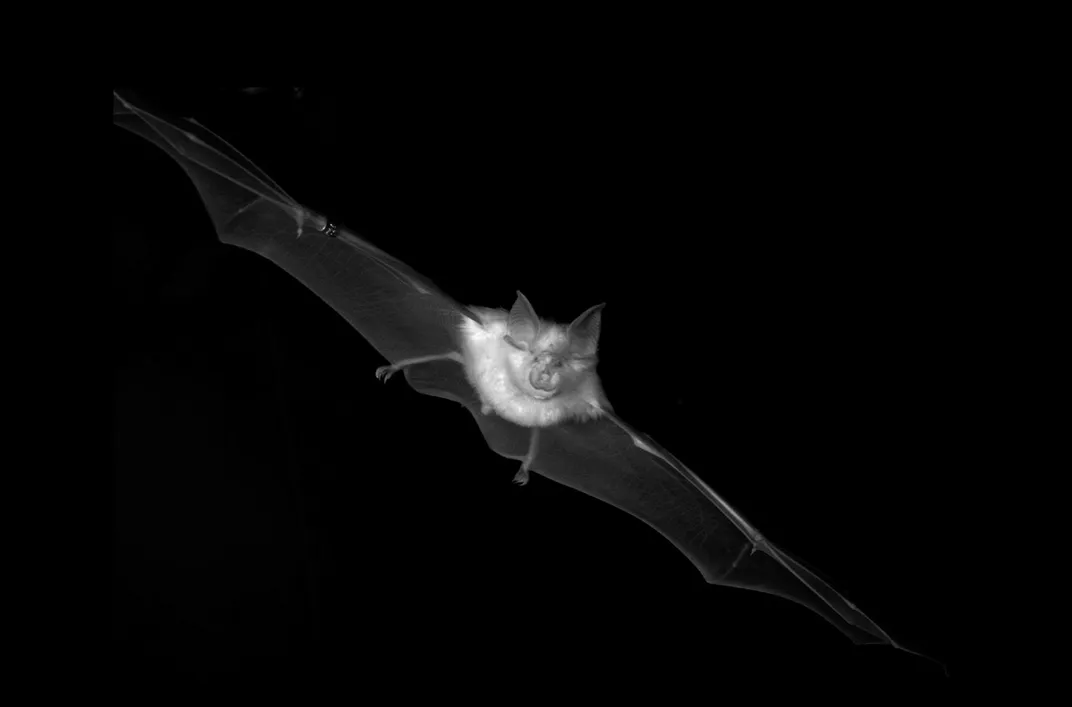
One species already known to weaponize the Doppler effect is the horseshoe bat, named for the horseshoe-shaped fleshy leaf protruding from its nose. Sensory ecologist Soshi Yoshida says the bats are “a bit cute, a bit ugly.”
Regardless of their physical attributes, horseshoe bats are deft predators. When these bats sense nearby flutters of moth wings, they know it’s time to strike. But puzzlingly, they don’t adjust their calls to the shifting Doppler signals of their prey’s motion—even though they often do for stationary background objects. This felt like a paradox to scientists. Why wouldn’t the moving bats hyperfocus on tracking moth movements?
“Prey echo is the most important echo, right?” says Yoshida, who conducted this research while at Doshisha University in Japan. “So I thought it didn’t make sense.”
His team aimed to better understand the predators’ echolocation strategy through a series of experiments on 11 bats. To hear from the bats’ point of view, the researchers stuck microphones on their backs with double-sided tape. “Sometimes the bats had very long hair, so we needed to cut or trim,” Yoshida adds.
Then they recorded how the bats vocalized as they flew toward and attacked moths tethered to the ceiling. In a paper published in Communications Biology in May, Yoshida’s team reported that these bats seemed to use echolocation for an unexpected purpose: to suppress background noise.
Rather than focus on their background’s most common echoes, the bats adjusted their calls to the objects echoing at the highest consistent frequency—even if the signal was weak.
This trick shifted all echoes below a certain frequency, effectively dampening the loudest noises in the environment. Instead, bats’ peak hearing sensitivity now centered on this pitch and the silent zone directly above it. Moths’ fluttering wings, which can pulse in a series of higher frequency echoes, resonated starkly in this range, without much background fuzz.
While the bats could still hear the echoes of lower-frequency background objects, this noise was made fainter. “This allows them to detect prey-related echoes with a better signal-to-noise ratio,” says Yoshida.
Beyond this clever trick, unintended hiccups in the experiment also clarified to Yoshida just how clever the horseshoe bats really are. “They learn many things,” he says.
For example, the bats quickly sussed out that the scientists were the origin of their “snacks,” Yoshida says. So when mechanical problems forced the researchers to pause the experiment—and thus the moth release—the bats took their complaints right to the source, he adds. “They came to us, and sometimes they landed on us.”
Proboscis bats chatter at a pitch others can’t understand
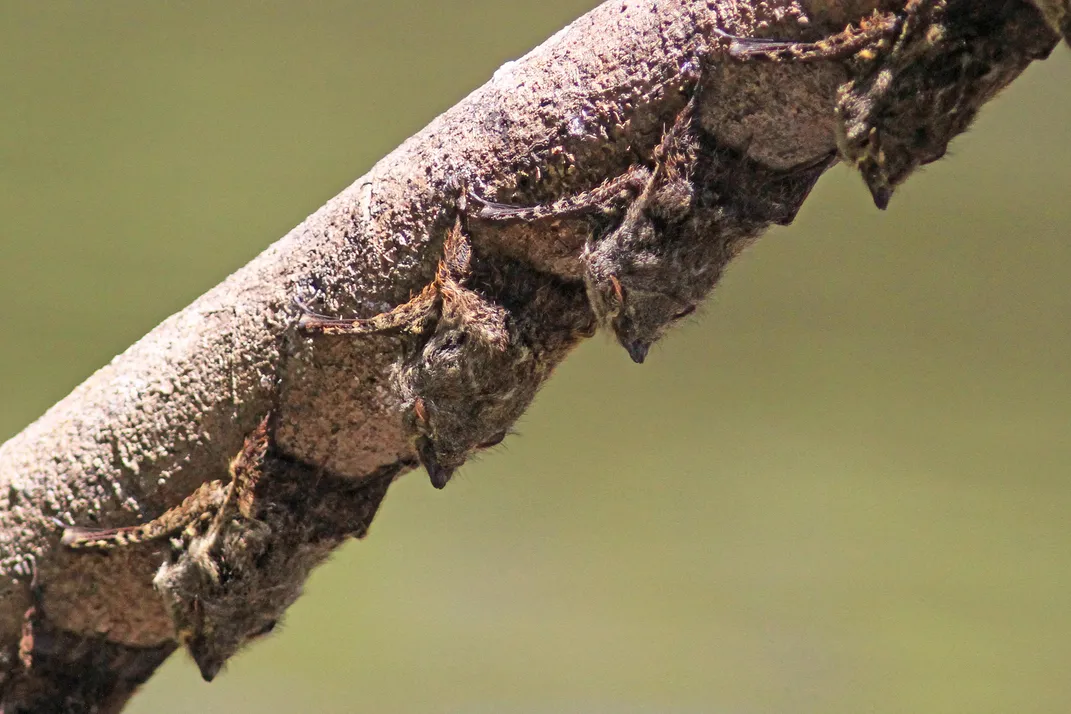
Echolocation isn’t the only reason that bats call. Sometimes they just like to chat—and they do it in all kinds of sophisticated ways.
Proboscis bats are a particularly fascinating example. These itty-bitty creatures—no larger than a house mouse—roost out in the open, camouflaging in trees. This requires extreme care: When one bat needs to move, the others follow suit, like furry synchronous swimmers. (They time their rocking to align with wind gusts to resemble lichens swaying in the breeze.)
Similar caution is required when making noise: “You also want to make sure you’re not eaten when you want to communicate,” behavioral ecologist Lena Dressler, a researcher at Berlin’s Natural History Museum, told Smithsonian magazine in September.
Observing how chatty the bats became during mating season, Dressler’s team decided to further investigate their communication.
The researchers used high-quality methods to analyze the bats’ chatter, says Holderied, who wasn’t involved in the study. They uncovered a complex lexicon made up of 22 syllable types, which bats would utter individually or combine into more complicated vocalizations, according to the paper, published in Annals of the New York Academy of Sciences in July.
Notably, the bats often chattered high above the hearing range of their prey and predators, especially when trying to remain concealed. Even considering the proboscis bats’ slight body size—which often maps to higher signal frequencies—their vocalizations were surprisingly squeaky.
These high-pitched calls helped bats locate prey at a closer distance than other species without being detected, the researchers found. Other calls seemed linked to the specific bats’ identities—a name of sorts, according to Holderied. “I find that electrifying,” he says.
Some of these bats’ best sounds, though, happen at pitches humans can hear. When mating, the bats ensure they’re heard far and wide through lengthy and complex “songs.”
Now, the researchers are drilling further into the proboscis bats’ music. “We want to know how the song is composed, who’s singing, when and why,” Dressler told Smithsonian magazine.
Fringe-lipped bats stop echolocating to eavesdrop
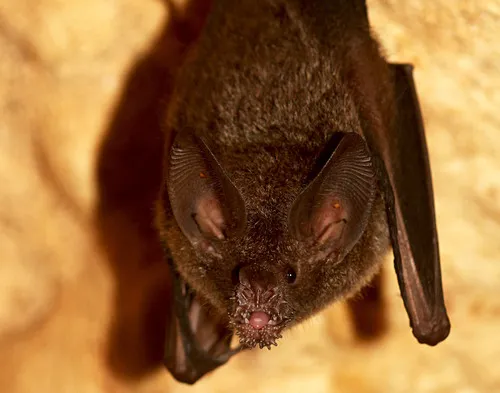
For all their complicated calling strategies, some bats have learned the value in listening. And they have the big ears to prove it.
Different bat species have developed stronger senses based on their prey of choice, says Rachel Page, a behavioral ecologist at the Smithsonian Tropical Research Institute (STRI). Fruit-eating species, for instance, have a sharp sense of smell. And others, like the fringe-lipped bats that Page has long studied in Panama, have especially honed their hearing.
Fringe-lipped bats are frog foodies. Given their prey’s loud ribbits, which the frogs broadcast as they look for mates, the bats often “eavesdrop,” says Page. “To be conspicuous and attractive, those calls often are very loud, and they’re often easily localizable.”
But not all frog species provide the same culinary experience. Some are palatable; some are poisonous. Some are bite-size; others are gigantic. “They can turn the tables and consume the bats,” Page says. So, if you’re a bat picking one call to target, “you want to make the correct decision.”
For a long time, scientists weren’t sure whether bats were born with hardwired knowledge of which sounds come from the safest and tastiest frogs, or whether they learned this over time.
A team of researchers including Page—led by former STRI fellow Logan James—exposed fringe-lipped bats to the mating calls of 15 frogs and toads common to the area. In a series of experiments with 21 adult bats and 19 juvenile bats, they placed each bat in a flight cage, played them the frog calls and recorded their responses.
“The response could be very minor. It could just be like a few brief ear motions,” says Page. “Or it could be like leaving the perch, flying to the speaker and looking for where this frog is within the speaker.”
Their paper, published in Proceedings of the Royal Society B in April 2025, suggested the young bats mostly learn through trial and error. Both adults and juveniles seemed attuned to frog body size, preferring the smaller ones. But the juveniles were more likely to react to poisonous toads and less likely to strike on the desirable species.
This matched the hypothesis that it takes experience to dissuade young bats from lunging for any intriguing frog calls. Either the bats learn, “‘Oof, that’s a bad one, I’m never going back to that again,’” says Page, “or ‘This one was great, I’m adding this to my repertoire.’”
While this experiment was conducted in captivity, Page says new technologies are giving us even more insight into bats’ behaviors in the field. Wearable recording “backpacks” that accompany bats on the hunt are beginning to clue researchers into each noisy step of their predation.
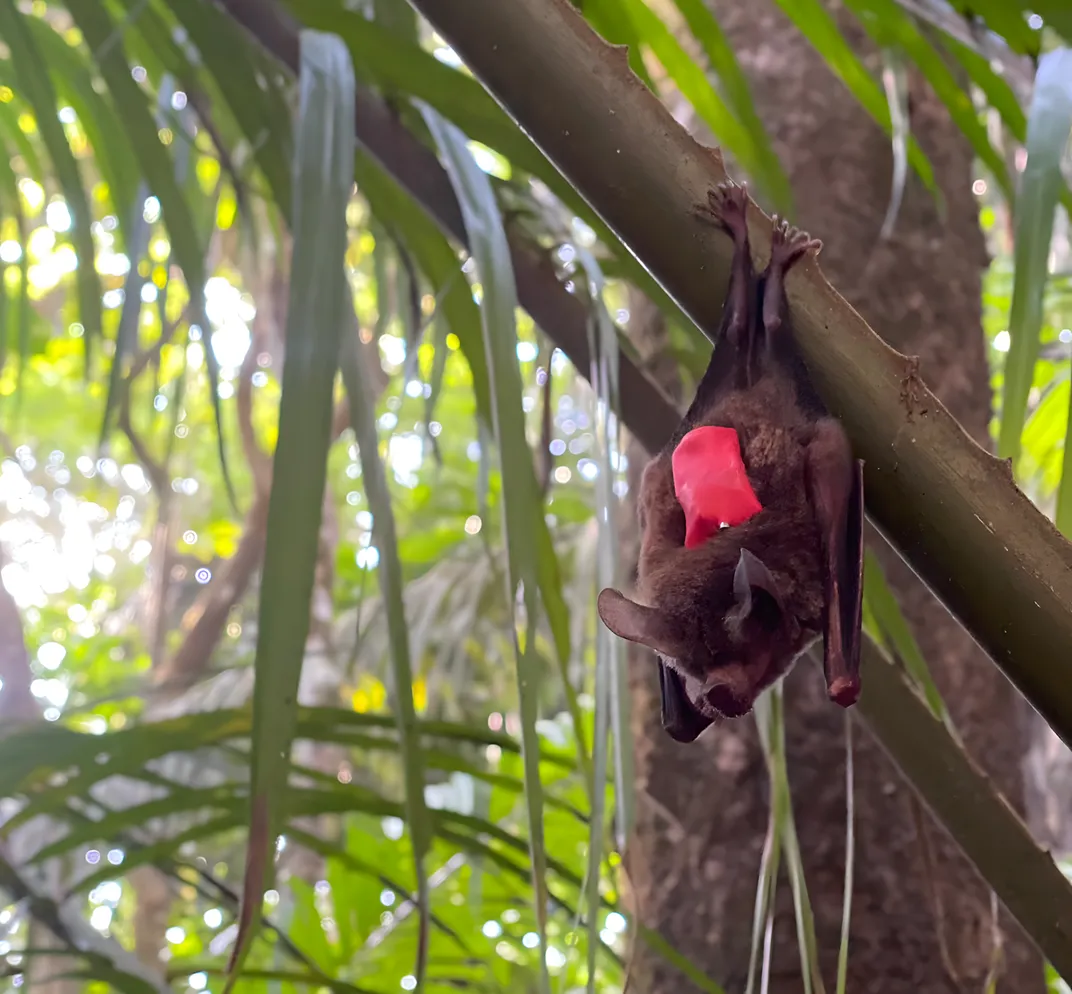
“You can hear the frog calls, you can hear the echolocation calls of the bat, you can hear the crash landing,” says Page. “Then—really key—you hear immediately if it’s a success or not a success, and the successes are always followed by chewing noises.”
This has shown researchers some surprising things about the bats. Namely, that they’re even bolder than we thought. One recording, described in Current Biology in November 2025, showed a bat gnawing on a frog for a whopping 84 minutes. This was “extraordinary,” says Page. “That’s approaching a prey of their own body size.”
With advancements in this technology, Page is looking forward to future research following the noises that comprise bats’ lives. “It just keeps getting better,” she says.