
Two Years After World War II Ended, This Ship Brought the Bodies of 6,251 Fallen Service Members Back Home to America
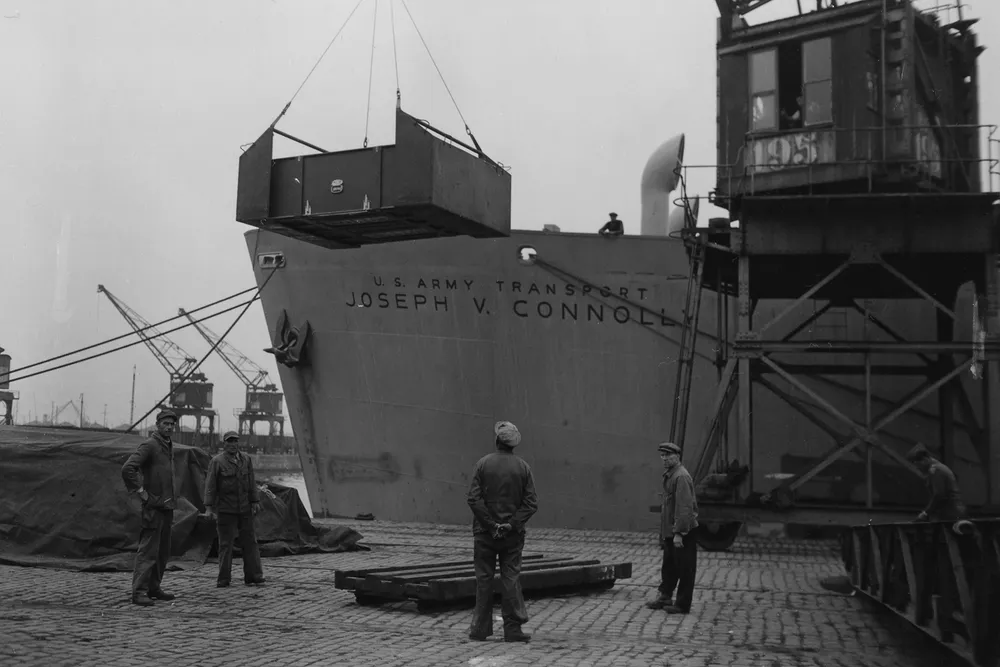
The S.S. “Joseph V. Connolly” arrived in New York City on October 26, 1947. The caskets stored in its holds contained the remains of privates and three-star generals alike
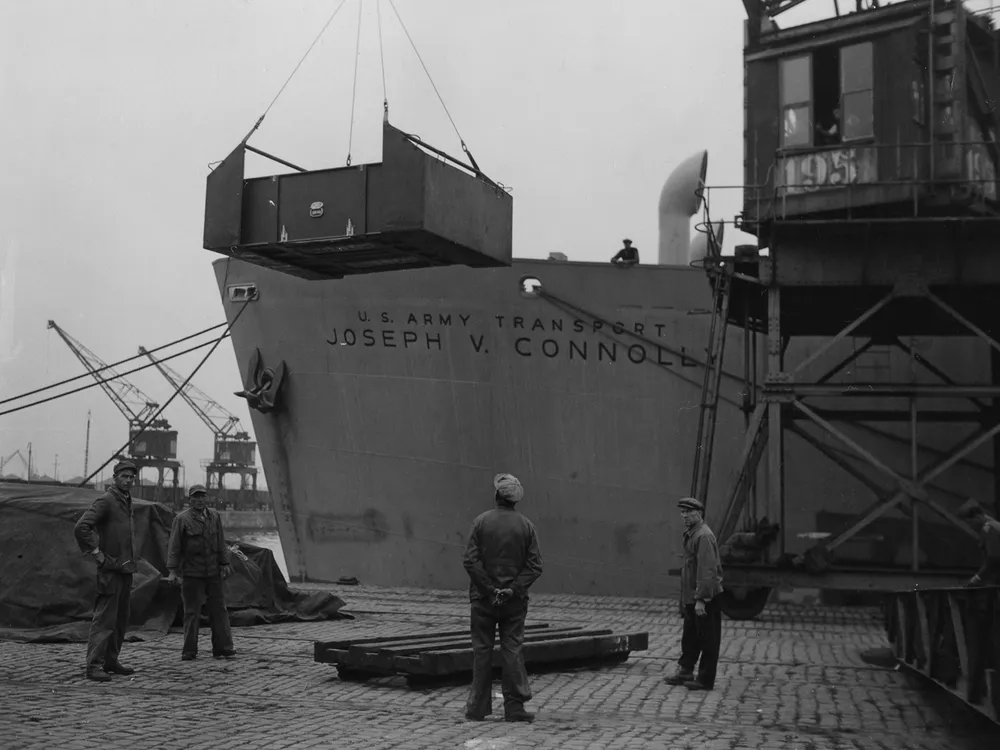
The S.S. Joseph V. Connolly was one of 2,742 Liberty ships built during World War II. At 441.5 feet long and 57 feet wide at the beam, these cavernous vessels could haul 10,800 tons of whatever the United States Army required: ammunition, jeeps, tanks and even locomotives. Immense, rough-edged and clunky, the Liberty class wasn’t known for its looks. President Franklin D. Roosevelt even called the vessel “a real ugly duckling.”
But on the morning of October 26, 1947, as it rolled in the swells just outside of New York Harbor, the Connolly was anything but ugly.
Wreaths and garlands of laurel leaves draped the vessel’s bridge as its American flag snapped in the wind at half-mast. During the previous week at sea, the Connolly’s crew had slapped on a fresh coat of gray paint. As Captain Benjamin A. Bostelman guided his ship into port, U.S. Navy destroyers Beatty and Bristol swung into position ahead, their crews strewing flowers on the Connolly’s path. Meanwhile, a squadron of fighter planes joined the flotilla of police and fireboats in what the New York Times called a “marine escort of honor.” As the Connolly churned past Brooklyn and into Upper New York Bay, artillery pieces at Forts Hamilton, Wadsworth and Jay fired off 21-gun salutes.
Never had a Liberty ship warranted a reception like this one—but technically speaking, the Connolly was no longer a Liberty ship. Following a reconfiguration of its holds earlier that year, the vessel had joined the Army’s newly created mortuary fleet, tasked with transporting the bodies of the fallen. On this unseasonably warm Sunday morning, the Connolly carried the remains of 6,251 war dead from the European theater. (The total number of coffins on board was 6,248; one of the caskets held the bodies of four men killed in an airplane crash in Newfoundland.)
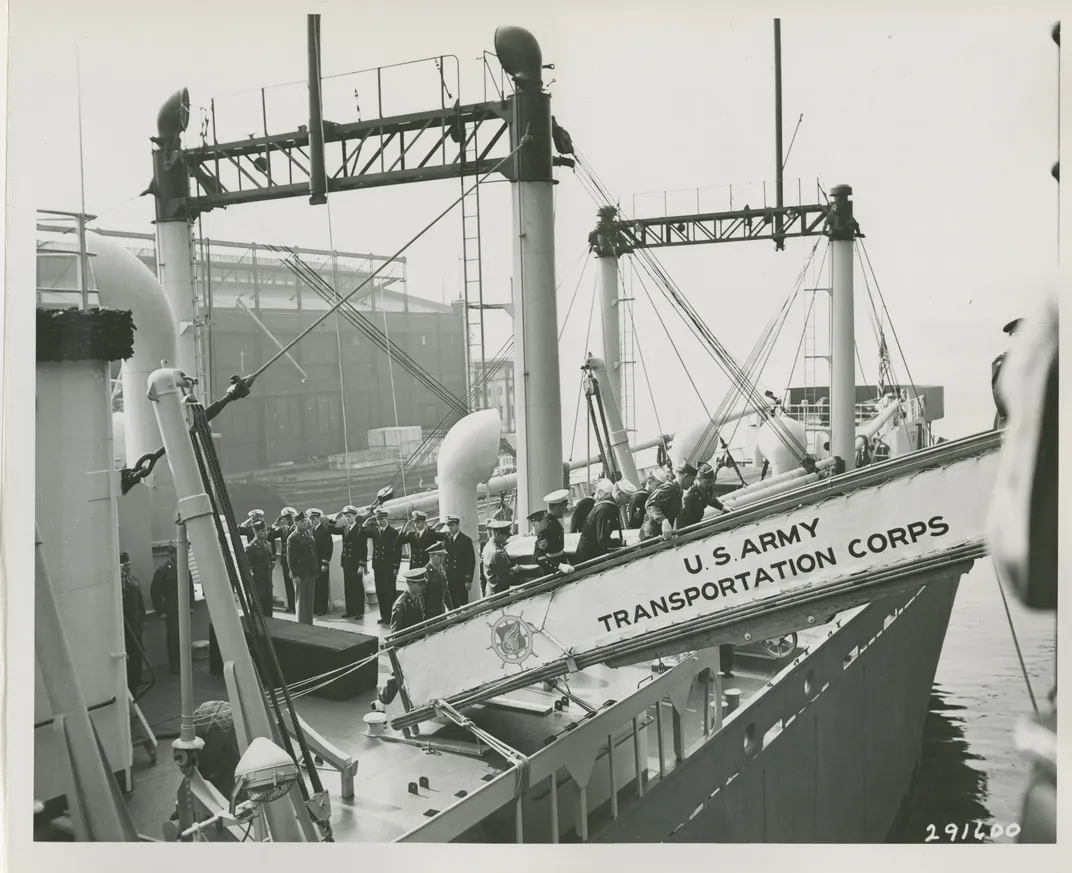
The Connolly’s arrival in New York, 79 years ago on Monday, was more than a day of mourning. It manifested one of the most solemn and arduous tasks that the U.S. government had ever attempted: the repatriation of the remains of every deceased World War II service member whose next of kin requested it.
More than 400,000 American troops died during the conflict. The Army ultimately located the remains of 280,000 of them. Of that number, 171,752 would be returned to the U.S.
“The Return of the World War II Dead Program was just an enormous effort,” says John C. McManus, a military historian at the Missouri University of Science and Technology and the author of more than a dozen books on the war. “It comes from the idea that the average person matters, that the state owes this to their next of kin, and to honor those who have died in the service of the country.”
The Connolly’s journey was the culmination of a process that had begun long before, under circumstances the public could scarcely imagine.
On May 16, 1946, Congress passed a law setting aside some $200 million for the “evacuation and return of the remains” of Americans who’d died in the war. In the weeks that followed, families of the fallen opened their mailboxes to find copies of “Tell Me About My Boy,” a pamphlet whose title was also the request most commonly received by the Army Quartermaster Corps, the office charged with locating, identifying and burying the dead.
“While the war was on, most of these honored dead were buried in temporary United States military cemeteries,” the booklet read. Some of the fallen “were buried in isolated graves,” and these, the corps assured, “are being located as fast as possible.” But the pamphlet’s concise language barely hinted at the difficulty of this task.
During the war, interment teams had followed the fighting, recording the locations of the soldiers they had buried in situ. As the pamphlet had alluded to, many of the fallen had been interred in temporary cemeteries—454 of them, to be exact, in 86 different countries on six continents.
But thousands had been buried without being identified, and after the war ended in 1945, around 13,000 workers assigned to the Graves Registration Service began a worldwide sweep in search of them. In Europe alone, teams would scour 1.5 million square miles. Seeking to connect with anyone who might know the location of a buried infantryman, “jeep-riding propaganda teams” fanned out across France and Germany, the Quartermaster Corps noted in a report. They nailed up posters and placed notices in newspapers. In some cases, conscripted town criers walked through villages, hollering, “The American Army is searching for its dead!”
Ultimately, the American Battle Monuments Commission established 15 military cemeteries for the soldiers slated to be interred near the theaters of battle. But the question of where exactly to bury these young service members began with the Quartermaster Corps’ second mailing to next-of-kin, which included a form titled “Request for Disposition of Remains.”
Did you know? Adopting World War II graves
- Cemeteries across Europe allow locals to “adopt” the graves of U.S. service members killed during World War II.
- Adopters care for the fallen’s gravestones and work to keep their memory alive.
Though the form presented the bereaved with four burial options, the choices for families really boiled down to just two. “The government is asking them, ‘Do you want your boy brought home?’” the Saturday Evening Post noted. “The families must soon say either, ‘Yes, bring him home,’ or, ‘Let him rest where he is.’”
More than 60 percent of families decided that they wanted their loved ones returned to them.
This, then, was the duty that the Connolly fulfilled as it steamed into New York Harbor on that October Sunday. Twenty-two days prior, the ship had cast off from Antwerp, Belgium, with “passengers deceased” (as the Army termed them) disinterred from the Henri-Chapelle American Cemetery near Liège. Cranes had lifted more caskets into the holds during a three-day stopover at Newfoundland’s Naval Station Argentia.
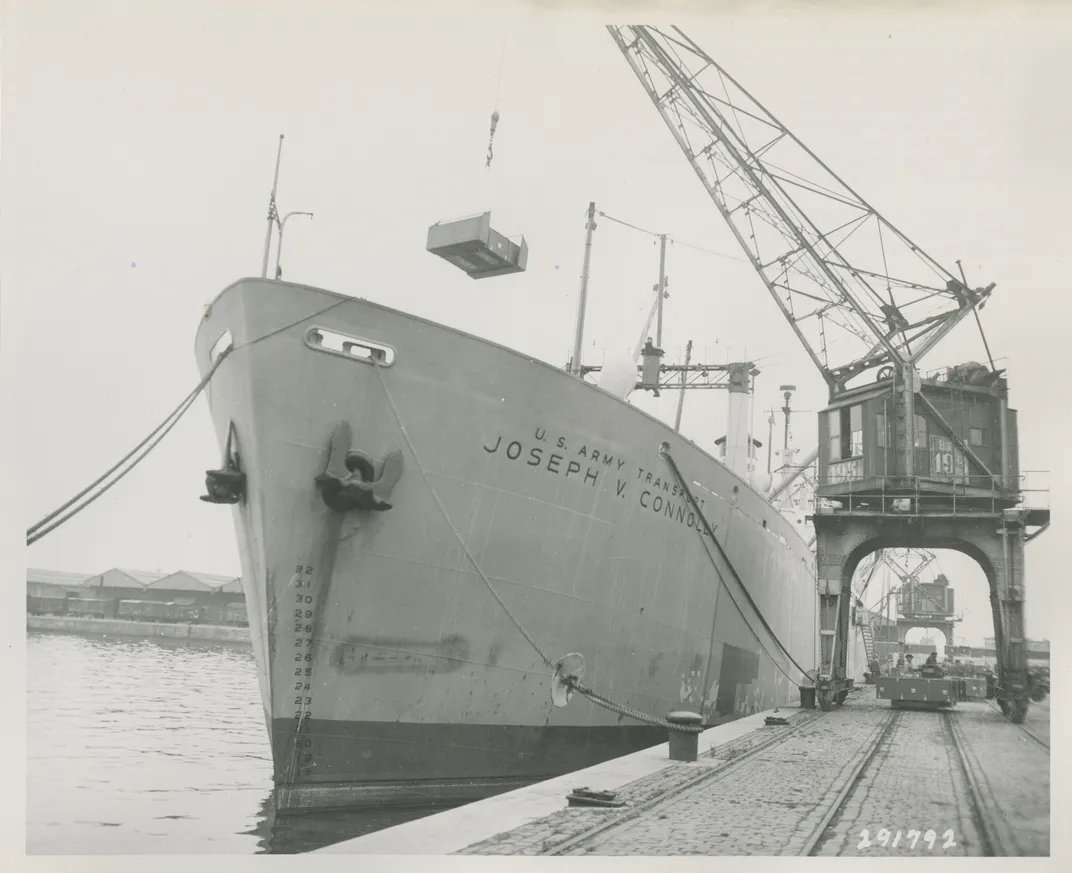
The Connolly wasn’t the first vessel to take up this work. The Honda Knot had arrived in San Francisco on October 10, with 3,027 dead from the Pacific theater. But the Connolly carried double that number, and its arrival in New York—which had sent more troops into battle than any other port of embarkation in the U.S.—drew attention across the country.
Aware of the spotlight about to be placed on the city, local officials planned a procession up Fifth Avenue for a single casket chosen from the Connolly’s holds. Honoring one unidentified soldier to mark the sacrifice of the many was a tradition dated to 1921, when the Tomb of the Unknown Soldier opened at Arlington National Cemetery. In this case, the identity of this soldier was known, although the Army never disclosed his name. The public learned that he was “a Congressional Medal of Honor man”—and that was all.
“Ours is a species that deals with death, the concept, by dealing with our dead,” says poet, essayist and retired mortician Thomas Lynch. “So the wisdom of bringing our dead back home and assigning one of them—unknown to everybody there—was sufficient as an incarnation of the thing itself.”
Saluting a single, emblematic soldier also provided a means of doing justice to the sheer number of the fallen, with their unique stories and their individual acts of heroism.
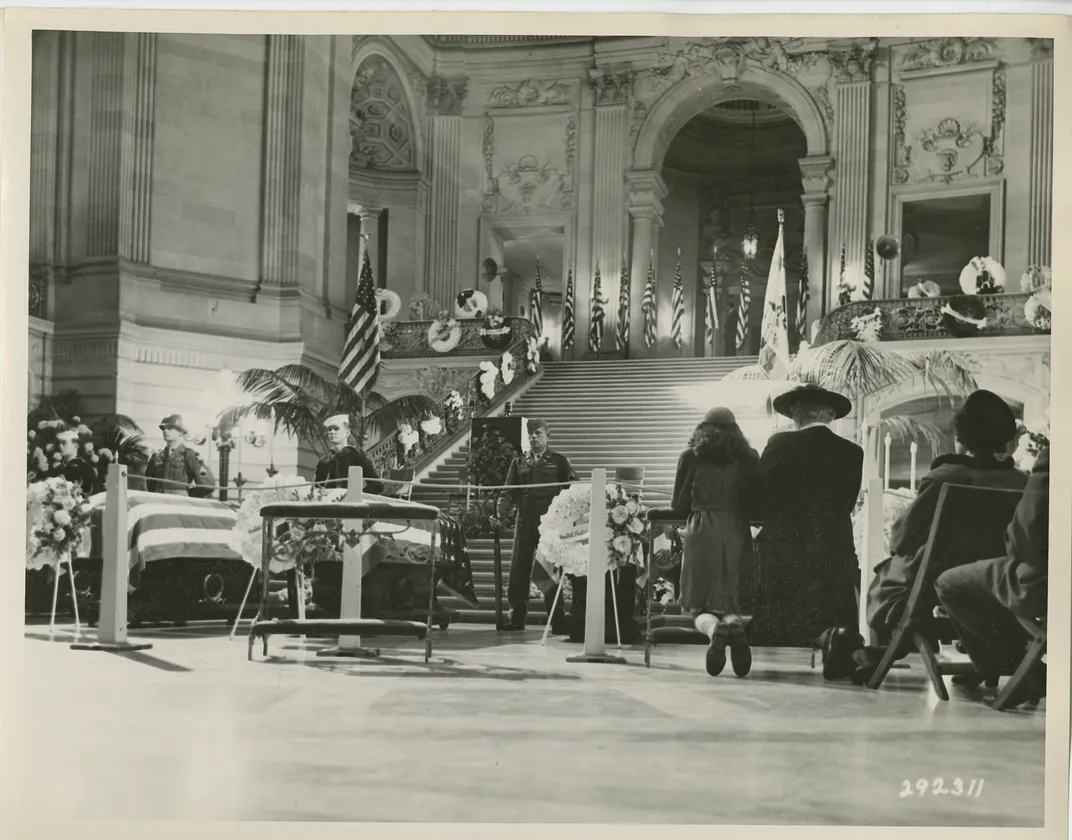
The remains in the Connolly’s holds ranged from privates to three-star generals. They included Petty Officer Oscar A. Chaney, a Navy “flying sailor” who’d attempted to rescue a downed British air crew off the coast of Iceland, only to die of exposure after five days in a raft, as well as First Sergeant Americo Dorazio, who’d raced through a minefield to help an injured friend and lost his life doing it. “Without reservation,” his commanding officer had written to Dorazio’s mother, “your son was one of the finest soldiers I have ever had the privilege to command.”
And then there was Second Lieutenant Frances Slanger, a nurse from Roxbury, Massachusetts, and the sole woman on the Connolly’s manifest. Insisting she be sent into action, Slanger had gone ashore in Normandy soon after D-Day, one of only four nurses to do so. In a field hospital near the Belgian front, Slanger had written an essay for Stars and Stripes about treating young men “brought in bloody, dirty with the earth, mud and grime,” some of them exclaiming at the sight of her: “Holy mackerel, an American woman!”
Hours after Slanger dropped her story in the mail in October 1944, a shell fragment struck and killed her.
Three years later, as New York City Mayor William O’Dwyer walked down the gangplank at Manhattan’s Pier 61, crew members had already positioned the casket on the Connolly’s deck. To the strains of Chopin’s funeral march, an honor guard of soldiers, sailors and marines bore the casket over the water, placing it on a horse-drawn auxiliary wagon for the procession. Still visible on Pier 61, painted over or fading, were the jubilant placards for the troops who’d returned home two years earlier: “Well Done” and “Welcome Home.” One of the Bristol’s ensigns turned to the sailor beside him and, reflecting on the Connolly’s passengers, said, “They came in too late.”
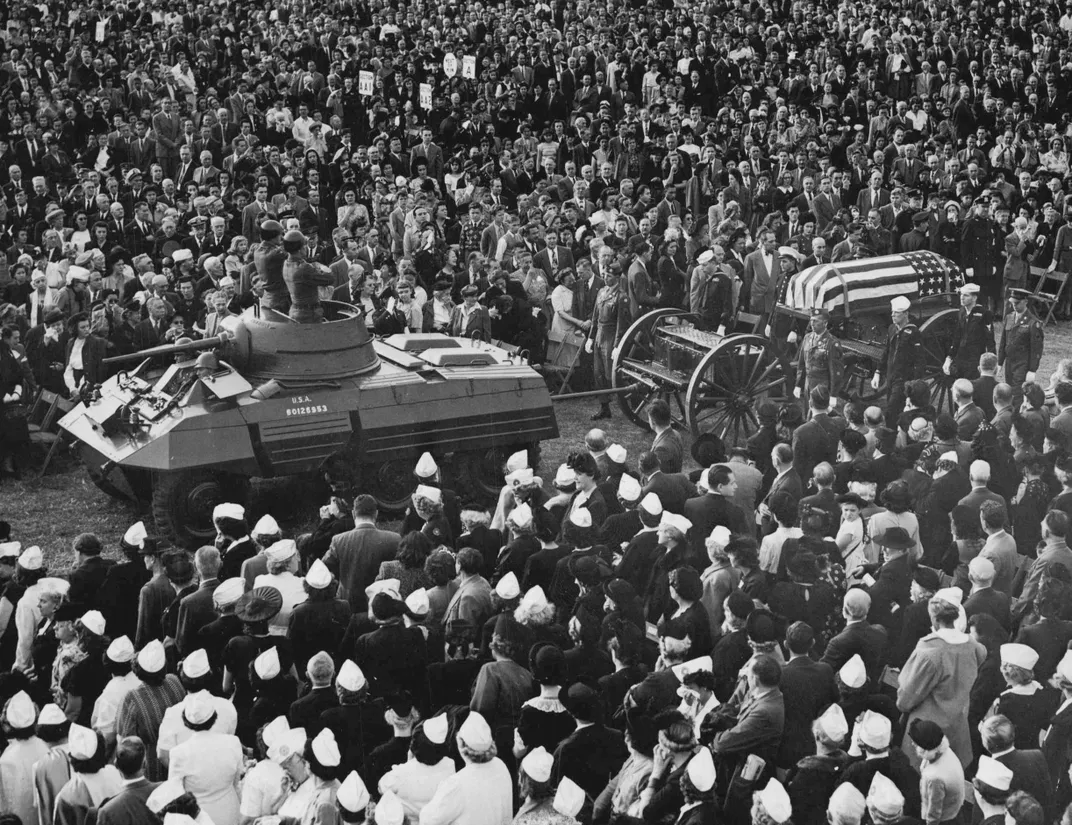
A reconnaissance armored car eased the wagon east on 23rd Street before turning uptown at Fifth Avenue. Leading the procession was General Courtney Hodges, whose sentiments could only be imagined. As the International News Service observed, it was under Hodge’s command that “so many of these 6,200 died in the grueling march from Omaha Beach to the Elbe [River].”
A company from the 325th Glider Infantry marched alongside the casket, forming the core of an honor guard numbering 6,000 and stretching for blocks. They included West Point cadets and midshipmen from the Naval Academy, a Marine company, and a Coast Guard platoon. Mounted police, Army nurses, war veterans and no fewer than eight bands also joined. Even the city’s Sanitation Department dispatched a contingent.
On the sidewalks, packed crowds of onlookers in some places formed a solid mass. Estimates placed the number of spectators at 250,000, with another 150,000 filling Central Park for the memorial ceremony. The International News Service ballparked the total turnout at one million.
“The curbs were crowded, but here, as at sea, the silence was awesome,” the New York Times wrote. “Nobody spoke, not even the children. Eyes were moist, and lips moved in prayer as the flag-draped coffin passed.” World War II had ended more than two years prior, yet the sight of the procession seemed to pull people back into it, opening wounds that had only just begun to heal. Onlookers watched the casket pass, “many of them weeping openly,” the Daily News reported.
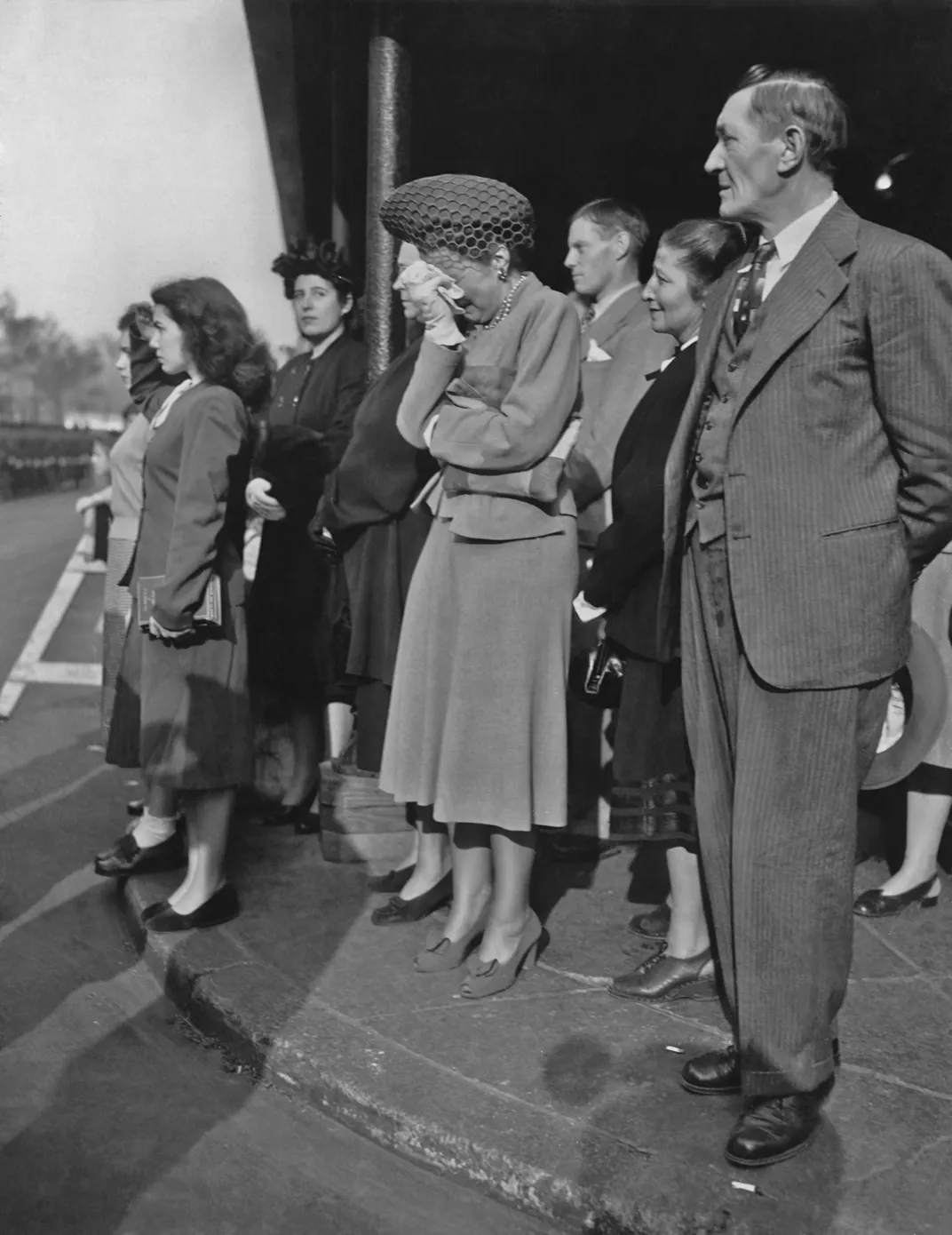
For many on the home front, the losses of the war had taken the form of telegrams and newspaper stories. But with the sight of a coffin, the war’s toll took on an immediacy that demanded attention. “Now it’s tangible—now you’re actually seeing it,” says John Curatola, a senior historian at the National WWII Museum in New Orleans. “For the first time, you see a mass casualty in terms of the actual sacrifice. That’s what’s so significant.”
Emotions ran the highest during the ceremony in Central Park, where “elderly women and small boys and girls, joined by men in and out of uniform, gave way to their grief,” the Associated Press reported. As pallbearers moved the casket to a raised platform, a mother in the front row began to scream her son’s name. “Johnny!” she wailed. “There’s my boy. There’s my boy.”
Officials took turns at the microphone, with New York Governor Thomas Dewey using his time on stage to warn of the growing threat posed by communism: “In Europe, in Asia, all over the world,” he said, “governments are under heavy attack from the agents of the totalitarian left. Their very existence is threatened.” In a fitting riposte from his pulpit, meanwhile, the Reverend Theodore Cuyler Speers suggested that “silence in the presence of the one anonymous coffin would be of greater value than many speeches.”
At 8 a.m. on October 27, the Connolly slipped away from Manhattan and steamed south to its next, and logistically most important, stop.
This was the Brooklyn Army Terminal, a concrete colossus that had packed off 37 million tons of military supplies and 3.2 million troops over the course of the war. The Connolly tied up at Pier 3, where a small memorial service got underway from a temporary stage below the trusses.
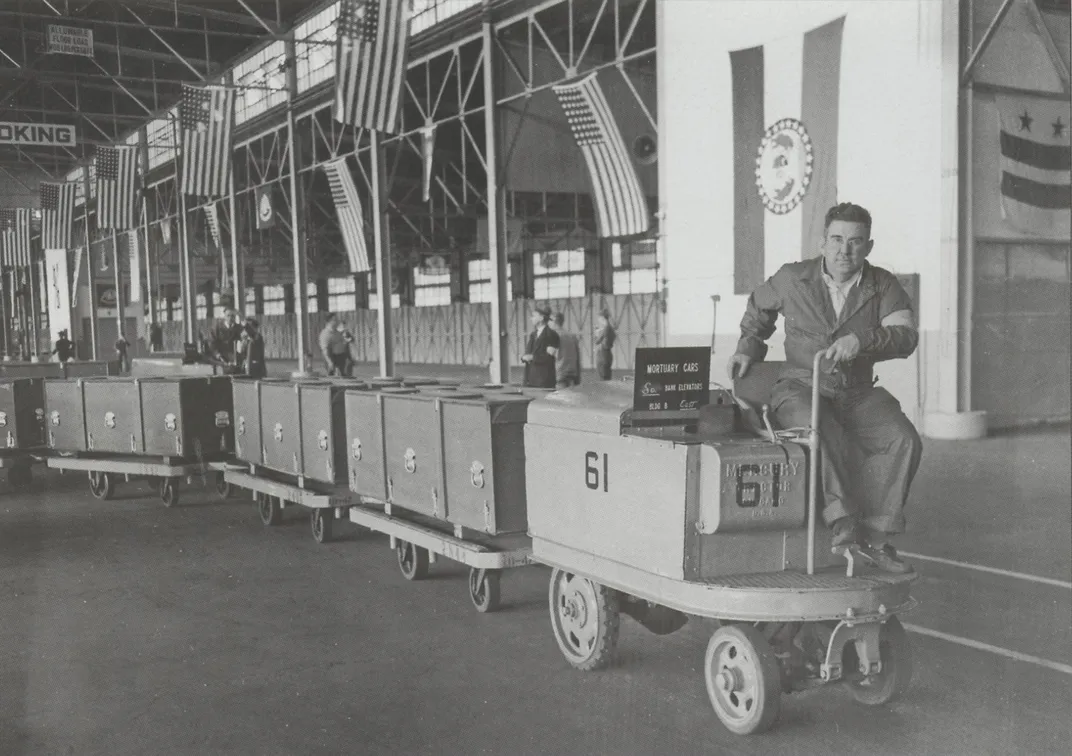
“No matter what you may think about the way things are going today, this would not have been so had the other side won,” Brooklyn Borough President John Cashmore told some 2,500 mourners.
But the time for commemoration was now over, ceding its place to the essential work at hand. As the crowds trickled away, the Connolly’s deck cranes began hoisting the caskets onto the pier, where a kind of industrial ballet of men and machines began.
“You can think about it as all the logistics they’ve done for the war—in reverse,” says Andrew Gustafson, who regularly leads visitors around the Brooklyn complex as the vice president of Turnstile Tours. “These people coming back were the war dead, but they were treated just like they were living service members.”
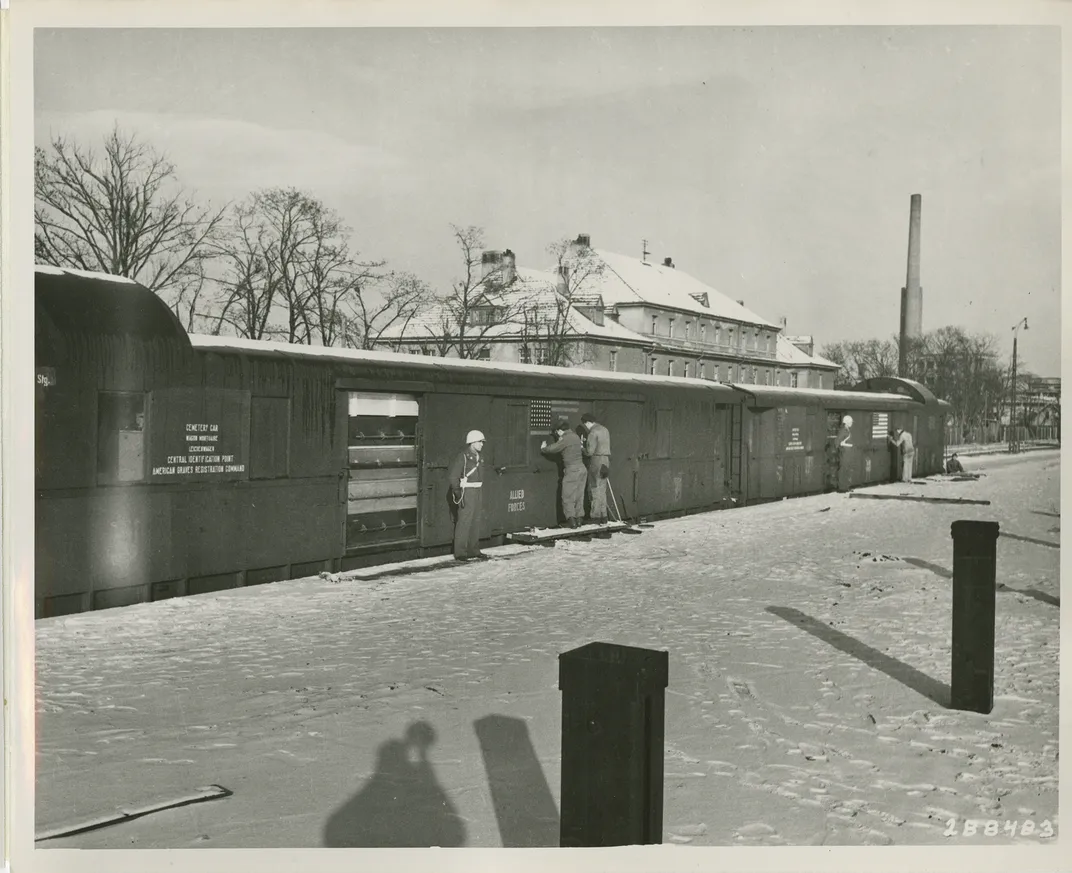
Workers first opened the wooden shipping containers enclosing each casket, checking for and repairing any damage before the Graves Registration Service sent notifications to next-of-kin. Battery-powered tractors then towed the containers over a skybridge to the atrium of a different building, where, 101 feet below the plate-glass roof, teams loaded them onto mortuary cars parked on a pair of railroad tracks. Once assembled, these trains departed the terminal, bound for one of 15 national distribution centers in cities like Atlanta, Fort Worth and Chicago.
Gathered at those destinations were men in immaculate uniforms, with black mourning bands on their left upper sleeves. These were the personal escorts who would accompany the deceased to the final station stops, with one man assigned to each casket. The escorts were the U.S. Army’s finest, each exhibiting “the highest uniform standards, proper comportment, professionalism [and] military courtesy,” McManus says. “They’re literally the face of the United States government.”
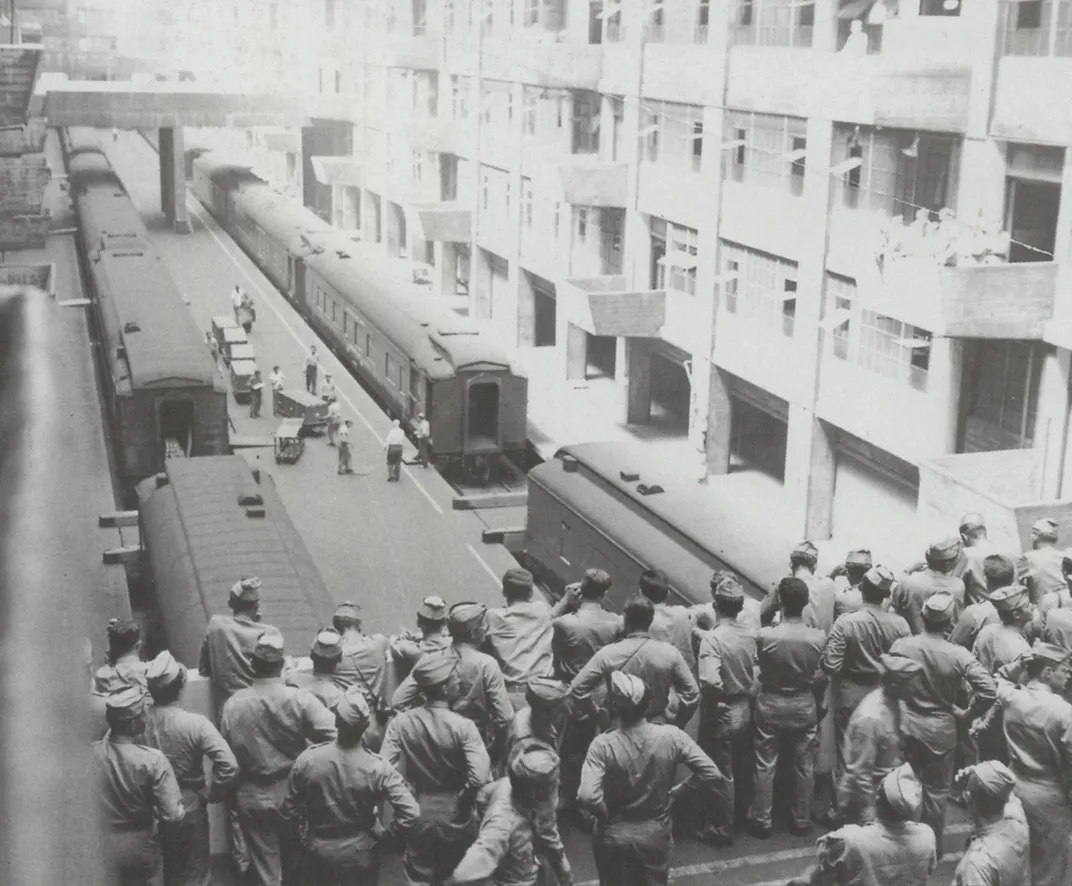
They would also, at times, be the faces that reminded the bereaved of the sons, brothers or husbands they had lost. In the months to come, letters would pour into the terminal from families who’d been consoled in their grief by the escorts. In at least one instance, parents offered to adopt one of the young men.
Venturing into the complex the following year, a Brooklyn Eagle reporter observed the “deep sense of responsibility” the escorts felt for the remains entrusted to them. The author understood why: “His thoughts, particularly if he’s a combat veteran, run something like this: ‘… But for the grace of God, it might have been me.’”
It would take days to unload the Connolly, and even then, when the ship’s holds were finally empty, the work had only just begun. “In the years to come,” the New York Herald Tribune observed, “nearly 100,000 dead soldiers, sailors and Marines still resting below white crosses in Europe will follow this first contingent home.”
But not aboard the Connolly.
In the early hours of January 12, 1948, the ship caught fire 1,000 miles east of New York, en route to Antwerp. Nearby vessels rescued all 46 men on board—including Captain Bostelman—before the Connolly sank with 6,445 caskets still in its holds. Fortunately, all of them were empty.