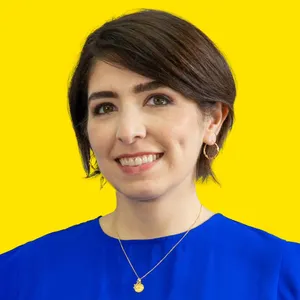
Fungi Expert Is on a Mission to Protect Global Natural Underground Networks
The youngest woman to receive the Tyler Prize for Environmental Achievement, evolutionary biologist Toby Kiers was also the youngest student on Barro Colorado Island when she first burrowed underground into the fascinating and complex world of fungi
:focal(1280x768:1281x769)/https://tf-cmsv2-smithsonianmag-media.s3.amazonaws.com/filer_public/14/49/1449efb2-7a5c-4877-b3eb-2ce55d0de218/invisible_heroes_thumbnail.jpg)
Toby Kiers loves to talk about dirt.
From her childhood traipsing barefoot around the countryside in the northeastern United States looking for morel mushrooms, to gifting a small box of soil to each attendee during her ‘State of the Environment’ address at the Tyler Prize ceremony in Amsterdam, the Netherlands on April 23rd, she wants others to appreciate what is beneath our feet as much as she does.
“Soil is probably the most misunderstood ecosystem on earth, it’s also the most complex. Fifty billion little individual lives in this tiny box, probably ten thousand different species,” said the evolutionary biologist during her address, inviting the attendees to touch, smell, really feel the soil.
:focal(1280x859:1281x860)/https://tf-cmsv2-smithsonianmag-media.s3.amazonaws.com/filer_public/22/df/22dfc64b-820c-4415-ae98-1a2ebb42a3f4/1_4_kt_spun_vikos_gorge_zagori_greece_20251014_1589_copy.jpg)
:focal(1280x859:1281x860)/https://tf-cmsv2-smithsonianmag-media.s3.amazonaws.com/filer_public/62/a7/62a7de5f-9b32-4275-97e7-785ae013545c/1_3_mongolia__dsc0808.jpg)
:focal(1280x859:1281x860)/https://tf-cmsv2-smithsonianmag-media.s3.amazonaws.com/filer_public/8a/e3/8ae32357-56b7-4e6a-8c4d-975194685983/1_2_peru_2025_dsc5844-2.jpg)
:focal(1280x859:1281x860)/https://tf-cmsv2-smithsonianmag-media.s3.amazonaws.com/filer_public/ff/e2/ffe22047-c3d2-43d3-880a-16681a2d015a/1_1_spun-ghana-010.jpg)
The fifty billion individuals she refers to are bacteria and mycorrhizal fungi that live in the soil: microorganisms that, though invisible to the human eye, perform essential functions within the ecosystems. Mycorrhizae are the connections between fungi and plant roots— mycorrhizae translates to ‘fungus root’—, fine filaments that colonize the roots of plant, sometimes connecting them simultaneously, like an underground subway system, through which fungi trade water and nutrients with plants roots in exchange for the carbon that plants capture from the atmosphere during photosynthesis, to build biomass. Around 80 percent of plant species associate with mycorrhizal fungi in this nutrient distribution system that functions almost like a symbiotic market—with carbon as its currency.
Kiers, currently a professor of evolutionary biology and University Research Chair at Vrije Universiteit Amsterdam, has studied these microbial communities and their partnerships with plants and how they have evolved during the last 400 million years. She’s also the co-founder and Executive Director of the Society for the Protection of Underground Networks (SPUN), a non-profit research organization that maps mycorrhizal fungal communities and advocates for their protection.
Her interest in the symbiotic relationship between plants and fungi began in Panama, on the Smithsonian Tropical Research Institute’s Barro Colorado Island Research Station. Kiers was a 19-year-old undergraduate biology student at Bowdoin College in Maine, when she was offered a unique opportunity to do field research at the research station, in 1997.
:focal(1280x859:1281x860)/https://tf-cmsv2-smithsonianmag-media.s3.amazonaws.com/filer_public/44/0e/440eaa7f-617e-4a58-ad4f-d1e59f35ec99/2_4_bci_20230107_srp-069-edit_copy.jpg)
:focal(1280x859:1281x860)/https://tf-cmsv2-smithsonianmag-media.s3.amazonaws.com/filer_public/a5/03/a5035aeb-8c78-4892-92cb-5b9f389726d5/2_3_barro_colorado_20211213_jla-78_copy.jpg)
:focal(1280x859:1281x860)/https://tf-cmsv2-smithsonianmag-media.s3.amazonaws.com/filer_public/c4/ba/c4ba1ff8-cfd2-4896-a7c0-82c832691a31/2_2_barro_colorado_20211213_jla-24_copy.jpg)
:focal(1280x859:1281x860)/https://tf-cmsv2-smithsonianmag-media.s3.amazonaws.com/filer_public/e5/4e/e54ef2f3-dd26-47a0-ab9b-ee8fcdbe169f/2_1_barro_colorado_20211213_jla-131_copy.jpg)
“One of my teachers knew that I wanted to become a field biologist, and she had a friend in Panama, Catherine Lovelock,” she explains. Lovelock, a professor at the University of Queensland and a marine ecologist specializing in coastal ecosystems, was a post-doctoral fellow at STRI at the time: she encouraged Kiers to come to Panama and even helped her to work on a grant proposal to study mycorrhizal fungi.
Kiers obtained the grant and spent approximately a year on Barro Colorado Island (BCI). While most students on the island were PhD students or postdoctoral fellows, Kiers hadn't even gotten her bachelor's degree at the time.
“It was quite special to be the youngest there,” she says. “The visiting scientists took an interest in me, took me out into the into the forest and taught me about all different kinds of organisms. I loved that I was so young and people still took me seriously.”
She even gave a Bambi talk—the weekly seminar where BCI residents share their ongoing research with others—titled An Investigation of Host-Specificity of Vesicular-Arbuscular Mycorrhizae in a lowland Tropical Forest, and later wrote a paper on her research with Lovelock and two other scientists, published in the journal Ecology Letters in 2001.
“BCI was an incredible place to be at the time,” Kiers commented, who presently collaborates with other BCI alum, including mycologist Merlin Sheldrake who works with Kiers at SPUN and VU University, Amsterdam, and evolutionary biologist Stuart West, who is a close collaborator based at Oxford University. “It felt like you were really on the frontier of something, it seemed like people were discovering new things all the time.”
However, Kiers was shocked that so many researchers were studying tropical life aboveground, and not as many people were interested in what was happening below.
:focal(1280x859:1281x860)/https://tf-cmsv2-smithsonianmag-media.s3.amazonaws.com/filer_public/18/8e/188e81df-7bdb-43ec-886f-b146a60c4ec1/3_2_mycorrhizal_fungi_growing_with_a_plant_root_credit_dr_yoshihiro_kobae_1_copy.jpg)
:focal(1280x859:1281x860)/https://tf-cmsv2-smithsonianmag-media.s3.amazonaws.com/filer_public/b4/48/b448cf45-0fa8-4063-82c6-32cb004dadf2/3_1_spun-ghana-128_copy.jpg)
She returned to the U.S. to finish obtaining her bachelor’s degree and attended graduate school at UC Davis in California, obtaining her PhD in 2004. Her interest in the evolution of cooperation and conflict took her to Okinawa, Japan with a grant from the Japanese Society for the Promotion of Science (JSPS), to work on a project to study pollination mutualism with Japanese scientists.
Her innovative approach of combining evolutionary biology, ecology, and biophysics, has helped her understand the relationship between mycorrhizal fungi and carbon flows, and why mycorrhizal networks are the invisible heroes of our ecosystems.
“Mycorrhizae affect our ability to grow food,” Kiers points out. “They affect the ability of plants to access water, and they offer protection from diseases and break down pollutants like heavy metals. I think they really underlie the resilience and health of everything we see aboveground.”
“They also can support us in tackling the biggest challenges facing humanity today,” she explains. “They're key in regulating our climate, because they bring so much carbon below ground through their networks.”
Global forests are a vital carbon sink, sequestering tons of carbon from the atmosphere, and mitigating the effects of environmental change. However, it is estimated that the forest soils are where most of the carbon is stored. Despite this, fungal networks have yet to be more prominently considered in global climate mitigation efforts.
They are also under threat due to human activities.
“Land use change, deforestation, urban development, these are all obviously really dangerous to these networks,” says Kiers. “They need plants to survive, so if you pave over these underground ecosystems, you're going to lose that diversity.”
:focal(1280x859:1281x860)/https://tf-cmsv2-smithsonianmag-media.s3.amazonaws.com/filer_public/5d/4b/5d4bf9ad-e89e-4b11-bafe-08815febd06c/4_5_kt_spun_vikos_gorge_zagori_greece_20251014_1730_copy.jpg)
:focal(1280x859:1281x860)/https://tf-cmsv2-smithsonianmag-media.s3.amazonaws.com/filer_public/87/85/87851103-1b08-4fde-a2ca-24531814489c/4_4_spun-ghana-021_copy.jpg)
:focal(1280x859:1281x860)/https://tf-cmsv2-smithsonianmag-media.s3.amazonaws.com/filer_public/95/f1/95f1bce3-6d98-4f53-9562-58e08a45c7c9/4_3_dsc03463_copy.jpg)
:focal(1280x859:1281x860)/https://tf-cmsv2-smithsonianmag-media.s3.amazonaws.com/filer_public/64/a2/64a24e95-de6d-493c-be31-db00347ad29c/4_2_copy_of_spun-palmyra-14_copy.jpg)
:focal(1280x859:1281x860)/https://tf-cmsv2-smithsonianmag-media.s3.amazonaws.com/filer_public/38/a3/38a3eba3-2682-4ba1-9d8f-3494c41464c1/4_1_kt_spun_vikos_gorge_zagori_greece_20251014_1676_copy.jpg)
Other threats like soil pollution, chemicals and agriculture threaten the balance of fungi-plant exchanges. “Fungi are very resilient. But if you just keep adding pesticides and fertilizers to the soil year after year, you can really change the communities of these mycorrhizal fungi underground,” Kiers adds. “The destruction of these mycorrhizal networks can really disrupt nutrient cycles, it can accelerate biodiversity loss, and it increases global warming.”
Kiers has sought to change that by championing mycorrhizae conservation and developing tools to obtain a global perspective of where they are most threatened. In 2021, she and microbial ecologist Colin Averill from ETH Zürich launched SPUN, a research organization that functions almost like a massive citizen science project. SPUN’s mission: “to map, and advocate for the protection of the mycorrhizal networks that regulate the Earth’s climate and ecosystems.”
“Our work is at two scales,” Kiers explains. “At the very small scale where we're trying to understand the behavior of these mycorrhizal networks. We do robotic imaging, together with Dr. Tom Shimizu at the AMOLF Biophysics Institute in Amsterdam that allows us to study how these networks navigate space, how they move carbon, how they collect nutrients. And then we use that information on a global scale to understand where they are located.”
With technology like high-resolution imaging and sequencing, a group of associated researchers, known as “Underground Astronauts”, have been mapping and monitoring underground communities: they created the Underground Atlas in 2025, a map to track and identify mycorrhizal diversity hotspots around the world.
In the lab, Kiers and collaborators pioneered a method to make the invisible visible: tagging nutrient molecules. Kiers and her team can track nutrient flow dynamics across plant-fungal networks. The flows look otherworldly; during her address at the Tyler Award ceremony, at the Artis Planetarium in Amsterdam, Kiers projected massive images of the fluorescent mycorrhizal networks onto the large dome-shaped screens, making them resemble the galaxies and constellations that the planetarium usually displays.
These data sets can help researchers further understand how these networks function across ecosystems and even make predictions on how they might respond to future environmental changes.
:focal(1280x859:1281x860)/https://tf-cmsv2-smithsonianmag-media.s3.amazonaws.com/filer_public/97/7a/977ae3c9-7baf-4587-8050-feedd54aa9fb/5_3_amolf_c2_2monthsaftercrossing_3dimage_zoomout_greenfireblue_7800x4200.jpg)
:focal(1280x859:1281x860)/https://tf-cmsv2-smithsonianmag-media.s3.amazonaws.com/filer_public/ac/39/ac39a9ef-d2db-4d5b-9f8f-f1228b0bb3b5/5_2_20_credit_loreto_oyarte_galvez_-_vu_amsterdam_amolf_fullplantnetwork_medicago_a5-2_copy.jpg)
:focal(1280x859:1281x860)/https://tf-cmsv2-smithsonianmag-media.s3.amazonaws.com/filer_public/f6/76/f6765c51-360e-4bb5-b767-25553c1260f5/5_1_credit-victor-caldas_caption-high-resolution_mycelium_network_2_copy.jpg)
“If we understand where biodiversity hotspots are below ground, then we can understand how this affects the resilience of forests above ground,” says Kiers.
To find these hotspots around the world, SPUN also depends on building a diverse network of researchers and local communities around the world. SPUN’s Underground Explorers program provides grants to hundreds of scientists around the world, to expand the knowledge of where this mycorrhizal diversity can be found, and how best to protect it. It is also part of SPUN’s mission to de-centralize the science.
“In the four years since it was launched, the program has become very well known in the mycologists community,” says forest ecologist Adriana Corrales, who is the Field Science Lead and Underground Explorers Program Director at SPUN. “We emphasize places that have been unexplored and unsampled and the global South.”
“The idea is to support local scientists in each country, not only with money but to really try to help them overcome the obstacles they face in doing science in the global South, like having access to protocols, sequencing labs, etc.,” she adds. “So far, we have 147 grant recipients from more than 56 countries.”
Like Kiers, Corrales is a STRI alum, having studied fungi in Panama’s Fortuna reserve as a predoctoral fellow in 2011. She is also leading a long-term tropical rewilding program in her native Colombia and studying how fungal communities recover in ecosystems that are being reforested, and how they also help restore biodiversity.
“I think 2026 and 2027 are going to be big years for really understanding and leveraging the role of fungi in ecosystem restoration and rewilding, and advocating to protect underground biodiversity hotspots,” says Kiers, sharing a paper in Nature from 2025, which reveals that 90 percent of mycorrhizal hotspots are outside protected areas.
“There's a lot of work to do to get governments and decision-makers to start paying attention to belowground biodiversity and protect it, working to make fungi a part of climate legislation, and to really educate decision-makers about the role of fungi in getting more carbon below ground,” she explains.
While one of SPUN’s principles is making the data publicly accessible, Kiers and the SPUN core team also translate the science into action and educating the public on how to protect healthy networks.
“It's quite fun to explore ideas for how to get more people interested in fungi,” Kiers adds. “I don't think people realize just how much fungi affect their everyday lives.”
/https://tf-cmsv2-smithsonianmag-media.s3.amazonaws.com/filer_public/48/ef/48efeae7-153a-4672-aa20-cd24ac6c063f/6_tylerprize2026-07377_copy.jpg)
For her part, working with mycorrhizal networks has given Kiers the opportunity to travel the world, exploring different ecosystems, and even bring her two children on expeditions, something she calls “the highlight of her career”, something she explored in a recent op-ed she wrote for the New York Times.
What does Kiers hope her legacy will be?
“I want people to care about what they can't see,” she says with a sigh. “I think it's time for people to start protecting these invisible underground ecosystem engineers that are responsible for so much. My hope is to flip people's perspective.”
About the Smithsonian Tropical Research Institute
Headquartered in Panama City, Panama, STRI is a unit of the Smithsonian Institution. Our mission is to understand tropical biodiversity and its importance to human welfare, to train students to conduct research in the tropics and to promote conservation by increasing public awareness of the beauty and importance of tropical ecosystems. Watch our video, and visit our website, Facebook, X and Instagram for updates.