Cerro La Vieja: Cocoa that Protects Nature, Chocolate that Feeds the Soul
Dedication to protecting key bird habitats and biodiversity made possible the first Bird Friendly cocoa certification in Panama, marking a milestone for conservation
:focal(1280x768:1281x769)/https://tf-cmsv2-smithsonianmag-media.s3.amazonaws.com/filer_public/a4/c1/a4c188d9-9f12-41a0-acc3-800650c076a9/cerro_la_vieja_thumbnail.jpg)
During a long road trip, people need to make stops along the way to rest and eat. Likewise, migratory birds stop during their long journeys north or south, to feed and rest their wings.
From March, when spring approaches in the northern hemisphere, the birds begin their return journey, after escaping an intense winter. Many of these birds pass through Panama, and patches of forest are essential to them, offering them shelter, rest, and food along their journey.
Conserving these patches of forest is part of Smithsonian Bird Friendly's mission, certifying organically and sustainably produced coffee and cocoa to protect birds and biodiversity. The certification, which in 2025 celebrated 25 years since its launch, began in coffee agroforestry growing systems. Now, to qualify through this pathway, coffee or cocoa must be planted under shade, maintaining an average of 40% coverage for coffee and 30% for cocoa, with a minimum of ten different species per hectare, the majority of which (60%) are native trees.
/https://tf-cmsv2-smithsonianmag-media.s3.amazonaws.com/filer_public/8e/0f/8e0f602f-b1b7-41d2-a0c8-73b814947094/1_cerro_la_vieja_-_samuel_y_melissa.jpg)
However, the program opened another certification pathway for conserved forest, launched as a pilot for cocoa plantations in 2023. It was through this new pathway that Cacao Cerro La Vieja became the first farm in Panama to obtain Bird Friendly certification in 2025.
"For us, it is essential to validate that our processes, of organic management and forest conservation, are officially recognized and supervised," says Samuel Valdés, owner of Cacao Cerro La Vieja. "Especially if there is a market that demands sustainable products and a commitment to biodiversity."
Theobroma cacao, the scientific name for the cocoa tree and its fruit—theobromameans "food of the gods" in Greek, and cacao comes from cacahuatl in the Nahuatl language of Mexico—is where ‘cacao en baba’, the raw material of chocolate, comes from: seeds covered with a white pulp contained within large fruits or berries. Panamanian cocoa is grown mainly in the province of Bocas del Toro, where the climate is hot and humid; however, other provinces, such as Colón, Darién and Panamá Este, also produce cocoa.
:focal(1280x853:1281x854)/https://tf-cmsv2-smithsonianmag-media.s3.amazonaws.com/filer_public/c3/32/c332f98e-d709-4a6a-872a-17d27a6b7966/2_4_cerro_la_vieja_-_cacao_-_cosecha_4.jpg)
:focal(1280x859:1281x860)/https://tf-cmsv2-smithsonianmag-media.s3.amazonaws.com/filer_public/2e/42/2e428904-5f61-42fe-82f1-594f0592df30/2_3_cerro_la_vieja_-_cacao_-_cosecha_3.jpg)
:focal(1280x859:1281x860)/https://tf-cmsv2-smithsonianmag-media.s3.amazonaws.com/filer_public/72/93/72934f29-79df-401e-832f-b6e6118823bb/2_2_cerro_la_vieja_-_cacao_-_cosecha_2_copy.jpg)
:focal(1280x859:1281x860)/https://tf-cmsv2-smithsonianmag-media.s3.amazonaws.com/filer_public/4d/29/4d29764e-f315-42e0-91aa-93e69a7271e1/2_1_cerro_la_vieja_-_cacao_-_cosecha_1_copy.jpg)
:focal(1280x859:1281x860)/https://tf-cmsv2-smithsonianmag-media.s3.amazonaws.com/filer_public/d6/0c/d60cb7f5-2e6b-4a4b-aa10-509ee4023f9d/3_4_cerro_la_vieja_-_bosque_4.jpg)
:focal(1280x859:1281x860)/https://tf-cmsv2-smithsonianmag-media.s3.amazonaws.com/filer_public/d2/7c/d27c4708-935b-4594-b5e6-f675c9fb9ccd/3_3_cerro_la_vieja_-_bosque_3.jpg)
:focal(1280x859:1281x860)/https://tf-cmsv2-smithsonianmag-media.s3.amazonaws.com/filer_public/e8/64/e864957d-716e-4ec7-b68b-cadb73c08bc2/3_2_cerro_la_vieja_-_bosque_2.jpg)
:focal(1280x853:1281x854)/https://tf-cmsv2-smithsonianmag-media.s3.amazonaws.com/filer_public/1b/d3/1bd3d4bc-03f1-462a-9253-75dedd9c961f/3_1_cerro_la_vieja_-_bosque_1.jpg)
:focal(1280x859:1281x860)/https://tf-cmsv2-smithsonianmag-media.s3.amazonaws.com/filer_public/a3/73/a3736cca-c8d1-47bd-ad47-5b382865bb41/4_5_cerro_la_vieja_-_aves_-_foto_5_-_whitte-tipped_sicklebill_copy.jpg)
:focal(1280x859:1281x860)/https://tf-cmsv2-smithsonianmag-media.s3.amazonaws.com/filer_public/33/06/33069877-5693-4e75-b0a4-f30376a22d8e/4_4_cerro_la_vieja_-_aves_-_foto_4_-_long-billed_hermit.jpg)
:focal(1280x859:1281x860)/https://tf-cmsv2-smithsonianmag-media.s3.amazonaws.com/filer_public/03/2a/032a0ebf-aa0c-4a1e-8c46-2750e57c7c42/4_3_cerro_la_vieja_-_aves_-_foto_3_-_long-billed_gnatwren_copy.jpg)
:focal(1280x859:1281x860)/https://tf-cmsv2-smithsonianmag-media.s3.amazonaws.com/filer_public/a9/01/a901b4f7-69c9-46d3-8de6-596e1d9ba7f2/4_2_cerro_la_vieja_-_aves_-_foto_2_-_cocoa_woodcreeper.jpg)
:focal(1280x859:1281x860)/https://tf-cmsv2-smithsonianmag-media.s3.amazonaws.com/filer_public/45/aa/45aac951-c089-4d27-ab2c-2f850c469eb1/4_1_cerro_la_vieja_-_aves_-_foto_1_-_chestnut-backed_antbird_copy.jpg)
How to make biodiversity-friendly cocoa
To obtain the Bird Friendly certification, organic farming is essential: the farm must not use pesticides to eliminate insects but rather allow birds to feed on them and thus control pests.
"When people consume Bird Friendly coffee or chocolate, they can trust that the final product was produced on a farm that is conserving biodiversity," says Melissa Mazurkewicz, senior program manager of Smithsonian Bird Friendly in Latin America. "And to achieve this, the use of synthetic chemicals that can harm animals is not allowed."
From the beginning, Valdés wanted to plant cocoa organically, with the goal of certification. "We started with this somewhat romantic idea of proving that you can grow good cocoa in a sustainable, biodiversity- and bird-friendly way," he says. "It's the only way we know how to do things, respecting nature."

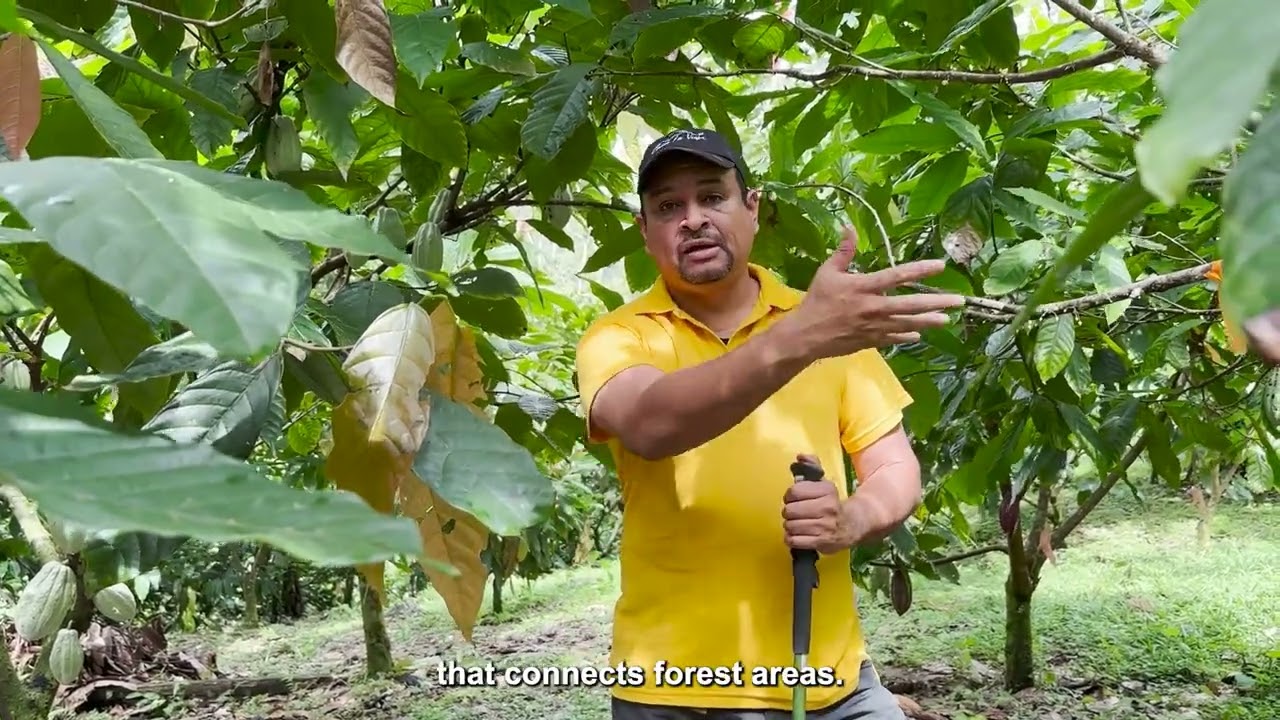
Together with his friend and collaborator Alfonso Jaén, they bought the land where the farm is located. They brought seeds from Bocas del Toro through Orlando Lozada, producer and owner of Finca La Magnita in Changuinola, Bocas del Toro, who also gave them guidance.
In addition to not using pesticides, Valdés shares how they make use of the microorganisms present in the forest leaf litter or mulch and in the soil of the farm to make fertilizer: they mix this leaf litter in barrels with molasses, water, sugars, yeasts and mycorrhizae—the connections between fungi and plant roots to carry nutrients—so that they ferment, and thus create a bacterial broth. Along with bokashi compost, a Japanese method of creating solid organic compost using plant waste, soil, yeast, and molasses, they apply it to the soil and foliage to fertilize and make the plants absorb more nutrients.
Cocoa fruits are ready to harvest when they obtain a deep red color. The harvesters choose the fruits and cut them from the tree, open them and pour the seeds or cacao en baba into buckets to transport them to the fermentation and drying area, located in the facilities of the Cerro La Vieja Butterfly Farm, also owned by Valdés.
/https://tf-cmsv2-smithsonianmag-media.s3.amazonaws.com/filer_public/9f/3b/9f3be401-5dee-4afb-99f2-125a7865cce4/5_cerro_la_vieja_-_cerro.jpg)
"Cacao en baba must reach a certain temperature over 5 to 6 days, to prove that fermentation has occurred," explains Valdés, "for the cocoa to develop its own flavors and smells. We do a controlled fermentation, verifying the temperature until the desired temperature is reached. That guarantees us a homogeneous grain."
The structures where these processes are carried out are also built with sustainable materials, such as bamboo. There is an area with wooden crates for fermentation, a structure for drying, and a storage area.
Before putting the cacao en baba to ferment, they weigh the contents of the buckets, and line the inside of the crates with banana leaves to seal well: the leaves help the fermentation process. They fill the crates, seal them and measure the temperature within throughout the fermentation process: from time to time, they "flip" or “turn” the cocoa to ensure homogeneous fermentation.
:focal(1280x859:1281x860)/https://tf-cmsv2-smithsonianmag-media.s3.amazonaws.com/filer_public/5e/14/5e143564-f108-4737-8c70-ff33f47c9060/6_2_cerro_la_vieja_-_proceso_cacao_2.jpg)
:focal(1280x859:1281x860)/https://tf-cmsv2-smithsonianmag-media.s3.amazonaws.com/filer_public/19/17/1917034e-724d-4a72-b331-16250ccdff25/6_1_cerro_la_vieja_-_proceso_cacao_1.jpg)
"We do three flips," explains David Ovalle, one of the farm workers, "as the crates rise in temperature, until they reach the right temperature."
Once fermented, the cocoa is dried in a wide structure, where it receives indirect sunlight, until it reaches a temperature between 50 and 60 degrees Celsius and a humidity of 7.5%. After this, it is ready to store. The cocoa is for sale in whole beans or chocolate bars, made by the company Proyecto Cacao, which promotes Panamanian artisanal cocoa.
Beyond being organic and Bird Friendly, Valdés also seeks to ensure that his processes result in delicious cocoa.
"It no longer has anything to do with organic management but with the quality of the bean," he says. "That it is a grain that is not only produced in a responsible, sustainable, and organic way, but that it is also a good bean, that it is tasty."
/https://tf-cmsv2-smithsonianmag-media.s3.amazonaws.com/filer_public/09/0e/090e3d0b-5a87-45ab-9adc-21e94ae4bd2f/7_cerro_la_vieja_-_chocolate_bars.jpg)
Abundance of butterflies
In addition to the birds and other animals that visit his cocoa plantations, Valdés seeks to attract and protect some very symbolic insects for Panama, which are also important pollinators and bioindicators of healthy ecosystems: butterflies.
As an entomologist, Valdés was aware of the diversity of species within the order Lepidoptera—which includes butterflies and moths—in the region, and their role in sustainable cocoa. "From the beginning we established host plants within the plantation, flowering plants, and we conserved lianas, vines and other plants that we know attract butterflies," explains Valdés, pointing to the living fence that surrounds the farm, made up of host plants of butterflies such as Erythrina fusca, commonly called gallito.
Valdés also saw an opportunity to do conservation work, involving the surrounding communities, to maintain butterfly populations. Thus began the Mariposario Cerro La Vieja (Cerro La Vieja Butterfly Farm), an ecotourism, conservation and export center, where around 40 local native species of caterpillars and butterflies are bred, such as the blue Morpho (Morpho helenor), the red cracker (Hamadryas amphinome) and the swallowtail (Heraclides thoas), and their host plants. Valdés and his wife Marelys Torres, both biologists, even named their daughter Dione Isabella inspired by two of the first native species they bred en masse in the Mariposario, Dione juno and Eueides isabella.
:focal(1280x859:1281x860)/https://tf-cmsv2-smithsonianmag-media.s3.amazonaws.com/filer_public/08/97/08973316-074e-4f10-bc00-152aef030448/8_3_cerro_la_vieja_-_mariposario_-_mariposa3.jpg)
:focal(1280x859:1281x860)/https://tf-cmsv2-smithsonianmag-media.s3.amazonaws.com/filer_public/56/49/5649c040-f88c-46c5-b411-2bb230464c06/8_2_cerro_la_vieja_-_mariposario_-_mariposa2.jpg)
:focal(1280x859:1281x860)/https://tf-cmsv2-smithsonianmag-media.s3.amazonaws.com/filer_public/bf/83/bf83bbb1-ddef-40f4-b4a6-dad2e0cb8ed9/8_1_cerro_la_vieja_-_mariposario_-_mariposa1.jpg)
Later it also became a training center, where the team shares with people from surrounding rural communities the tools and technical knowledge necessary to rear butterflies for selling, while promoting the conservation of the region's biodiversity and ecosystems.
"The community thus has an alternative for sustainable economic activity, which does not require fumigation, use of insecticides, or cutting down forests," says Valdés.
"If we don't have butterflies, we don't have trees, fruits, flowers, we don't have anything," says Melissa Morán, who comes from one of the surrounding communities and is part of the butterfly farm team, rearing butterflies, as well as the cocoa production team.
Another goal of Valdés is to share his knowledge with others, including his collaborators, about growing cocoa in a sustainable way.
"The community of Cerro La Vieja knows its environment, the soil, the climate, and it was already doing conservation, long before we arrived 15 years ago," says Valdés. "What we brought was the guidance on how to implement productive mechanisms, in this case cocoa, that would also allow them to continue to do conservation."
"The idea is for this to be a pilot project, so that farmers in the region can replicate the model," he adds. "That they learn the techniques of preparing bokashi fertilizer, the use of mycorrhizae and biol to improve the soil and 'immunize' the plantation against pathogenic fungi, and learn how to make a commercial production of cocoa that also conserves biodiversity."
The Bird Friendly certification of Cacao Cerro La Vieja points to the possibility that other cocoa farmers in Panama can achieve important sustainability goals: harvesting quality cocoa while helping to protect important habitats for birds and other animals, and connecting patches of forests that create important biological corridors.
About the Smithsonian Tropical Research InstituteHeadquartered in Panama City, Panama, STRI is a unit of the Smithsonian Institution. Our mission is to understand tropical biodiversity and its importance to human welfare, to train students to conduct research in the tropics and to promote conservation by increasing public awareness of the beauty and importance of tropical ecosystems. Watch our video, and visit our website, Facebook, X and Instagram for updates.