We’re Celebrating What’s Special About Your Corner of the United States. Our New Postcards Are Something to Write Home About
The launch of our new postcard designs offers an opportunity for you to learn about your special part of the United States, across all 56 states, territories and D.C. Each design features specially curated collections of Smithsonian artifacts meaningful to that state, giving each postcard a special meaning to carry with you
:focal(1269x977:1270x978)/https://tf-cmsv2-smithsonianmag-media.s3.amazonaws.com/filer_public/c3/6b/c36b4583-f725-4bca-a314-57b59addbb9e/53705123862_3586cc352a_o.jpg)
As I sat down at my desk on my very first day of work here at the Smithsonian, I spotted a seemingly simple postcard that was about to flood immense joy into my day. Setting my bag down, I picked it up and began to examine: it was a deep navy blue, with yellow cursive lettering that framed the commanding capitalized words in the center. “I found SOUTH CAROLINA at the Smithsonian Institution,” it read, with unique images filling in the letters of the state. As I carefully analyzed each one, I couldn’t control the wide, beaming smile that appeared across my face.
I almost never find my home state represented out in the wild. When I meet someone new and say I’m from South Carolina, they often pass a comment such as, “Oh, nice,” or “That’s cool,” coded with the subtle sentiment of “not much goes on there.” At least, not much that they should care about. Yet it is where I come from, and an inseparable part of how I present myself to my friends, coworkers, my mentors, and every other conceivable relationship where I must meaningfully represent myself. No matter whether someone cares to pay my state any attention or not, it exists and is a core part of who I am.
Seeing my home state recognized like this in such detail, where every letter in its name was filled with something meaningful and relevant to its culture and history—in an official postcard from the Smithsonian no less—gave me the sense that I was valued. That I was seen and recognized because where I come from was seen and recognized, and that someone here took the time to think through how best to represent it. It meant that my little corner of our country mattered. How could that not bring me joy?
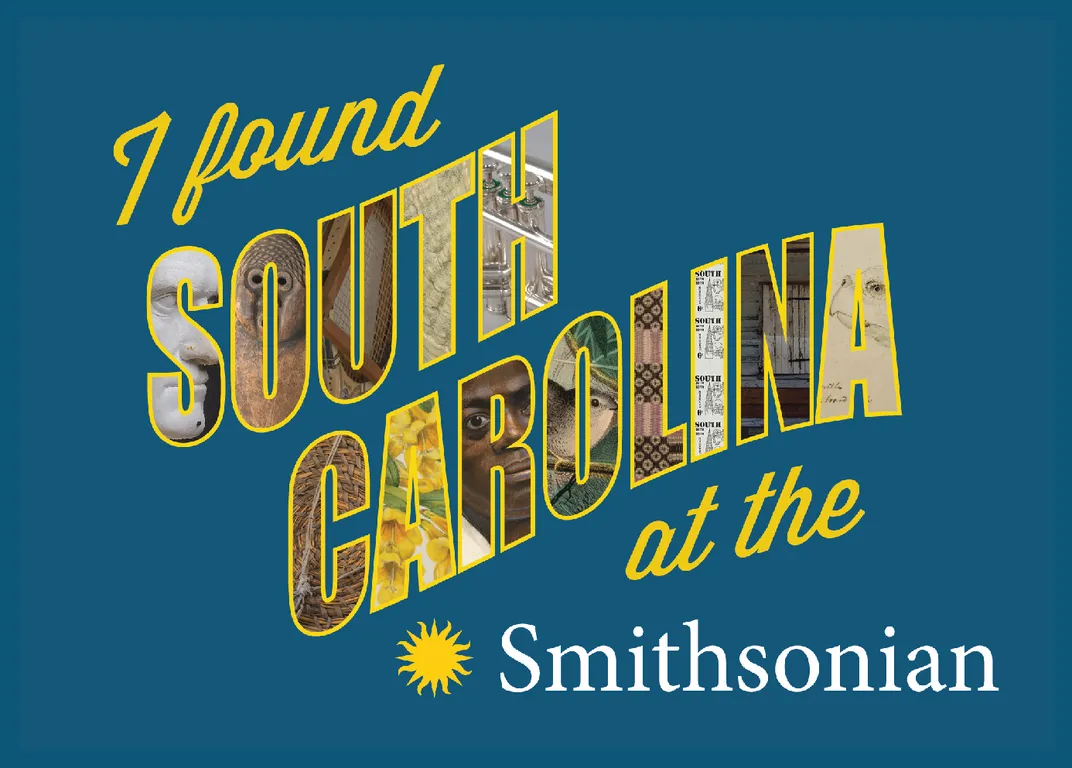
That joy is something we all should be able to experience. And so, we at the Smithsonian’s Office of the Under Secretary for Education (OUSE) are excited to announce that we are publishing a series of printable postcards for all 56 U.S. states and territories, including the District of Columbia, that feature a specially curated Smithsonian collection relevant to their specific cultures and histories.
Creating Something Special for People Across the Country
Inspired by vintage “Greetings from…” style postcards, our team pulled together public domain Creative Commons Zero images (meaning anyone can use, transform, and share them) from across the Smithsonian into colorful, eye-catching designs that highlight examples of objects, photographs, artworks, and more from each state and territory across the Smithsonian’s collections. The result is a design that thoughtfully represents that location, complete with a QR code on the back side to see more of the Smithsonian’s collection pertinent to that state/territory.
Our idea for creating this new collection came out of a moment we shared with educators a few years ago. In 2024, OUSE hosted classroom teachers from across the country, representing every state, as part of the National Teacher of the Year Program. We knew they would have a busy week ahead of them, meeting with Congressional representatives on the Hill, attending workshops in our spaces, and celebrating their work at various recognition events; so, to offer them a moment of joy, reflection, and a special connection, we devised this series of postcards. These teachers then sent their special postcards back home to their loved ones with a personalized message and the message of the card itself: that reminders of their communities could be found even in our nation's capital.
165 Years of Sharing Something Special with Each Other
Postcards are an institution almost as old as the Smithsonian itself, first beginning around the late 1840s with illustrated envelopes. Then, in 1861, John P. Charlton copyrighted the first postcard in the United States, and soon after, transferred his copyright to Hyman L. Lipman, who began selling the first private commercial postcards in the United States in 1870. Shortly after, Congress entered into the postcard business, passing a law in 1872 allowing for the Post Office to manufacture and sell “postal cards” for “short communications” at a “reduced rate of postage,” which then was defined as $0.01 (about $28 in today’s money), and soon after, the first government-issued postal card hit the market on May 1, 1873. Privately printed postcards still remained available to the general public but were more expensive to mail: they cost $0.02 in postage (about $56 in today’s money), as opposed to the Post Office’s cheaper one-cent alternative.
Postal cards immediately exploded in popularity across the nation. In just two months, the Post Office sold 31 million postal cards, and three months later, that number climbed to over 64 million. By 1888, the Post Office was delivering over 370 million postal cards a year, and that figure would only grow with time. Fast forward 25 years to 1898, and Congress would pass a new law that allowed privately printed postal cards to coexist equally with government-printed cards by reducing the postage for a privately printed postcard down to $0.01. In a little over ten years, annual postal card deliveries would jump to over 726 million by 1910—that’s about 8 postcards for every person alive in the U.S. at that time!
The beginning of the 1900s marked the start of the cultural craze for postcards. Developments in delivery methods and photograph printing technologies propelled postcards to become an insanely popular way for tourists and travelers to send messages back home to their loved ones and have them share in the experiences of their travels, even from far away. Places around the country—and the world—began selling postcards with designs relevant to their communities, and even began creating postcards to commemorate any event possible, from weddings to natural disasters and everything in between. In doing so, they created a tangible statement that this event, this place, this thing mattered and was important enough to remember. To tell someone else. To create a snapshot of the joy, struggle, love, mundanity, or whatever it was that made that moment extraordinary.
The Smithsonian’s Special Stamp on History
Even in the digital age, where Instagram posts and text messages dominate how we share our special moments with others, the value of postcards and how they communicate what we value remains. It still means a great deal when we can find something that makes us feel as if someone took the time, care, and intention to recognize a part of who we are. Spreading that special spark was our aim with each of these designs researched and developed by our education team; and if my uncontainable smile on my first day is any indication, I believe we firmly succeeded.
You can download both a printable postcard activity, which makes for an engaging classroom or family activity, or just the design to put on display as a card, poster, flyer, or something else! Each postcard also contains a QR code to the state- and territory-specific collections we’ve specially curated, hosted on our online platform, Smithsonian Learning Lab. I highly encourage you to take the time to go through the collections of your state or territory! You might end up learning something new about the place you come from—I certainly did. And what could be a better way to transform joy than into learning?
The postcard set is available to view and download here, via the Smithsonian Learning Lab.