
/https://tf-cmsv2-smithsonianmag-media.s3.amazonaws.com/filer_public/9f/d2/9fd2d744-dd68-4510-bab9-328fb68bd73d/gettyimages-91137702.jpg)
Dolly Parton Was One of the Biggest Stars in the History of Country Music. She Wanted to Be Remembered as a Songwriter
After growing up in poverty, she became famous for her legendary songs, big heart and larger-than-life style. But the iconic musician insisted that “the songs lead to everything else”
/https://tf-cmsv2-smithsonianmag-media.s3.amazonaws.com/accounts/headshot/Ellen_Wexler.png)
:focal(1908x1308:1909x1309)/https://tf-cmsv2-smithsonianmag-media.s3.amazonaws.com/filer_public/9f/d2/9fd2d744-dd68-4510-bab9-328fb68bd73d/gettyimages-91137702.jpg)
On a snowy day in 1946, a doctor rode his horse to a one-room cabin in Tennessee’s Great Smoky Mountains, where he helped deliver a baby girl. The parents, too poor to pay for his services, handed the man a sack of cornmeal. In exchange, the doctor handed them Dolly Parton.
Later, Parton would frequently reflect on her early years, explaining that her humble beginnings shaped the person she became. Although her parents rarely expressed their love through words, their affection for their children—Parton was one of 12—was abundantly evident. They sang songs, told Bible stories and whittled toy cars out of wooden thread spools.
“There’s a funny thing about mountain folks. There’s an awful lot that is never said out loud,” Parton recalled in her autobiography. Instead of saying “I love you,” for example, a father might give his son a “light punch on the shoulder,” she wrote. “It’s kind of an eye-to-eye and heart-to-heart language.”
Parton was fluent in this kind of communication, but she also wanted to hear the words. Later in life, when she told her father she loved him, “He responded in the usual nonverbal, look-at-the-ground Parton way, and I just couldn’t stand it anymore,” she recalled. “I took his head between my hands and made him look me right in the eye. ‘You tell me you love me,’ I demanded.”
Perhaps unsurprisingly, the artist who wrote “I Will Always Love You,” one of the most famous love songs of all time, never shied away from expressing affection. Parton, who died this week at age 80, was one of the biggest stars in the history of country music, and carefully selecting the right words—the words that would stir the listener—was her specialty.
/https://tf-cmsv2-smithsonianmag-media.s3.amazonaws.com/filer_public/6b/68/6b68c086-a3ad-41a5-b63a-9d5e39bc6665/gettyimages-84879971.jpg)
In songs about family, she focused on small domestic details (“I remember gingerbread my momma used to bake / I remember homemade toys that daddy used to make”). When she sang about working-class life, listeners believed she had lived it (“Tumble out of bed and I stumble to the kitchen / Pour myself a cup of ambition”). She wrote skillfully about both lost love (“Do you ever recall these old memories at all, or do I ever cross your mind?”) and enduring romance (“Love is like a butterfly, as soft and gentle as a sigh / The multicolored moods of love are like its satin wings”).
Parton is beloved for many reasons—for her larger-than-life presence, her collection of more than 350 wigs, her folksy humor, her philanthropy, her ability to transcend genres, her Dollywood theme park. “She’s been around for so long,” says Krystal Klingenberg, a curator of music at the Smithsonian’s National Museum of American History. “She’s offered us so much.” But the talented multihyphenate was always clear about her priorities.
“If I had to choose just one thing to be, I would choose to be a songwriter,” Parton wrote in Dolly Parton, Songteller. “The songs lead to everything else. Everything that I am starts with that song.”
Parton’s mother taught her children church music alongside traditional ballads, which had been passed down from family members who immigrated to America from the British Isles. “Since I have been able to form words, I have been able to rhyme them,” Parton wrote in her autobiography. “I could catch on to anything that had a rhythm and make a song to go with it.” When she was 5, she wrote her first song, “Little Tiny Tasseltop.” It was about a doll that her mother had fashioned from a corn cob:
Little tiny tasseltop
You’re the only friend I’ve got
Hope you never go away
I want you to stay
By the time Parton was 8 or 9, her songs were already becoming increasingly sophisticated. When she got her first guitar, she wrote a tune called “Life Doesn’t Mean Much to Me,” inspired by a conversation she overheard about young men who died in battle. By 10, she was appearing on local radio and TV stations, and she performed at the Grand Ole Opry for the first time at 13.
Quick facts: Singing at the Grand Ole Opry
- On July 25, 1959, Parton gave her debut performance at the famous country music production.
- Johnny Cash introduced her as “a little girl here from up in East Tennessee.”
- “I don’t think I had ever seen 2,000 people in one place before,” Parton later recalled. “I know I had never heard a crowd cheer and shout and clap that way.”
At her high school graduation, when Parton announced that she was “going to Nashville to become a star,” the audience “erupted in laughter,” she recalled. But the very next day, she boarded a Greyhound bus with her guitar, her songs and three paper grocery bags holding her belongings. “I cried nearly all the way,” she wrote in a letter to her parents. “In a way, I wanted to turn around and come back, but you know how I’ve always wanted to move to Nashville and be a singer, and I believe that someday, if I try long and hard enough, I’ll make it.”
Soon after she moved to the city, Parton met Carl Dean, the owner of an asphalt-paving business, outside a laundromat. After Dean completed a brief stint in the Army, the couple married in 1966. Dean famously preferred to live outside the spotlight, and his presence would provide a vital anchor for Parton as her music career took off. (When he died in 2025, they had been together for nearly 60 years—among the longest marriages in the entertainment industry.)
In 1967, Parton joined “The Porter Wagoner Show,” a popular country music program, and released her debut album, Hello, I’m Dolly. The album’s title set the tone for her career: The singer wanted to meet you, and she wanted to tell you her story—and then, somehow, it was also your story.
/https://tf-cmsv2-smithsonianmag-media.s3.amazonaws.com/filer_public/c4/f3/c4f380e7-7199-46ac-8345-3f0e64d73105/gettyimages-74289183.jpg)
Over more than six decades, Parton wrote some 3,000 songs. Like “Little Tiny Tasseltop,” many of her biggest hits drew from her own experience, and she frequently mined her early years in rural Tennessee for material. “Having a humble background and being willing to talk about it—and sing about it—is also what has made her such an approachable figure,” Klingenberg says.
Parton’s favorite was “Coat of Many Colors,” which came to her one day while touring in 1969; she scribbled the lyrics on a dry cleaning receipt. The song describes an incident from Parton’s childhood in which her mother sewed her a coat from a mismatched collection of rags. As she worked, she told her daughter the biblical story of Joseph and his multicolored coat. But when Parton wore the homemade coat to school, her classmates ridiculed her:
And oh, I couldn’t understand it for I felt I was rich
And I told them of the love my mama sewed in every stitch
And I told them all the story mama told me while she sewed
And how my coat of many colors was worth more than all their clothes
Her teacher, noticing the bullying, asked if she wanted to hang her coat in the cloakroom, but she refused. “They would not shake my pride in my coat, my love for my mother, my faith in myself,” Parton wrote. “I would not have it. I would sit there and be hot and wait them out. I would wait until school was over and walk proudly from the building, wearing my coat like a banner of pride. I would walk with my head high into the autumn afternoon and show my coat to God.”

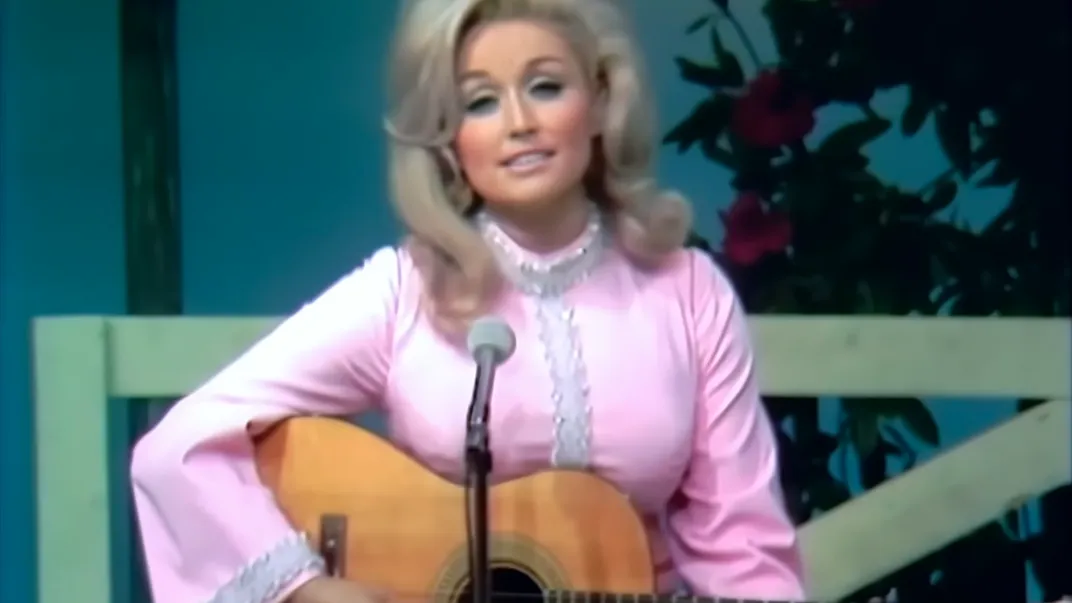
Parton broke into the mainstream in the 1970s, releasing two of her biggest hits, “Jolene” and “I Will Always Love You.” At one point, she claimed to have written both songs on one particularly “good writing day,” though she later clarified that they may have been written a few days apart. “Jolene” endures because “it’s such a concise statement of its point: ‘Jolene, please don’t take my man,’” Klingenberg says. “It is a really beautiful expression of these interpersonal conflicts that we find ourselves in every day.”
Parton also wrote songs that would become big hits for other artists. For instance, the most famous version of “I Will Always Love You” is Whitney Houston’s, released nearly two decades after Parton’s. While the original version is stripped down and “plaintive,” Houston’s, which combines pop and R&B, is “more triumphant,” Klingenberg says. “Good songs are good songs, and the humanity that’s embedded in them can appeal across genres,” she adds. “It’s a deft songwriter that can offer a song that can be seen through so many different prisms of emotion.”
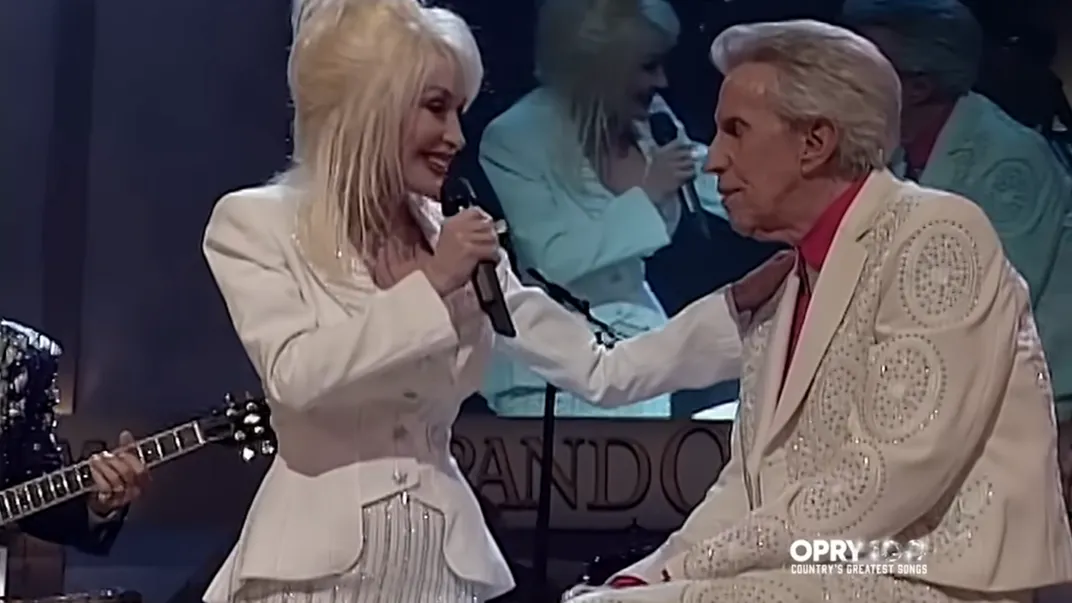
Although Parton rose to fame as a country singer, she experimented with other genres, often crossing over into pop. When critics complained that she was abandoning country music, “I would always reply, ‘I’m not leaving it, I’m taking it with me to new places,’” she wrote. “Abraham Lincoln was great not because he was born in a cabin but because he got out of it.”
Parton’s knack for staying connected to her roots while experimenting beyond genre conventions made her a “transcendent character in the history of country music,” Klingenberg says, adding that she helped pave the way for the artists who followed. “You don’t get a Taylor Swift without a Dolly.”
Parton is consistently described as the only public figure everyone can agree on. “She’s kind of remained above the fray,” Klingenberg says. Fans in Nashville celebrate Dolly Parton Day on August 5. The singer is the namesake of Dolly the sheep and a species of lichen found in the Appalachian Mountains, as well as the subject of numerous artworks, including a portrait currently on display at the Smithsonian’s Renwick Gallery. Created by artist Linda Paulsen, the 2007 work recreates Parton’s “sparkling eyes and warm smile with seeds, using corn husks to represent her signature blonde hair,” the museum writes in an Instagram post. The portrait is on view in “State Fairs: Growing American Craft,” an exhibition closing on September 7.
/https://tf-cmsv2-smithsonianmag-media.s3.amazonaws.com/filer_public/78/ab/78ab4eb2-c1dd-42a2-9d79-96ca015c5344/paulsen_dollyparton.jpeg)
In addition to her more than 50 Grammy nominations, Parton has been inducted into the Country Music Hall of Fame, the Rock and Roll Hall of Fame and the Songwriters Hall of Fame. Beyond the music industry, she has published books, co-written Broadway musicals and even served as an uncredited producer on the television show “Buffy the Vampire Slayer.” Dollywood now draws three million visitors annually to the Tennessee county where the singer grew up.
Parton’s philanthropy included disaster relief, scholarships, pediatric health care and HIV/AIDS research; she even provided early funding for Moderna’s Covid vaccine in 2020. But her biggest philanthropic legacy is Imagination Library, a literacy initiative inspired by her father, who never learned to read or write. The program, which gifts free books to children under the age of 5, has sent out 300 million books since it launched in 1995.
“The only thing I ever saw growing up was poor people in overalls and brogan shoes and ragged clothes,” Parton told Chapter 16 in 2010. “But in my books, I would read about kings and queens, with their velvet clothes and big diamond rings. That’s how I knew there was a world outside the Smoky Mountains.”
/https://tf-cmsv2-smithsonianmag-media.s3.amazonaws.com/accounts/headshot/Ellen_Wexler.png)