Article Tools
Photo Gallery
The Smithsonian Life List
28 Places to See Before You Die
28 Places to See Before You Die—the Taj Mahal, Grand Canyon and More
Smithsonian Magazine Staff
We've traveled the globe and compiled a "life list" of places to visit before taking the ultimate trip to the great beyond
Below the Rim
David Roberts
Humans have roamed the Grand Canyon for more than 8,000 years. But the chasm is only slowly yielding clues to the ancient peoples who lived below the rim
Related Links
Most Popular
- Viewed
- Emailed
- The Ultimate Spy Plane
- Photo Contest Grand Prize Winner - In the early morning, fishermen clean their nets by Erhai Lake
- Catching a Wave, Powering an Electrical Grid?
- Photo Contest Finalist - A mountain dwarfs a passenger boat in the Three Gorges area of the Yangzi River
- Photo Contest Finalist - Ganga Arati
- Photo Contest Finalist - After a hard night's work at sea, a fisherman collects the rope that ties the nets
- Photo Contest Travel Winner - Dining in Gion
- Photo Contest Finalist - Erik in the World’s Greatest Store
- Frank Baum, the Man Behind the Curtain
- Photo Contest Finalist - Michel Frazier plays in the fields next to her trailer
- There Oughta Be a Law
- Frank Baum, the Man Behind the Curtain
- Photo Contest Grand Prize Winner - In the early morning, fishermen clean their nets by Erhai Lake
- Terra Cotta Soldiers on the March
- Catching a Wave, Powering an Electrical Grid?
- High Hopes for a New Kind of Gene
- Up in Arms Over a Co-Ed Plebe Summer
- The Ultimate Spy Plane
- Photo Contest Finalist - Walk on Water
- Photo Contest Finalist - Jujing Village
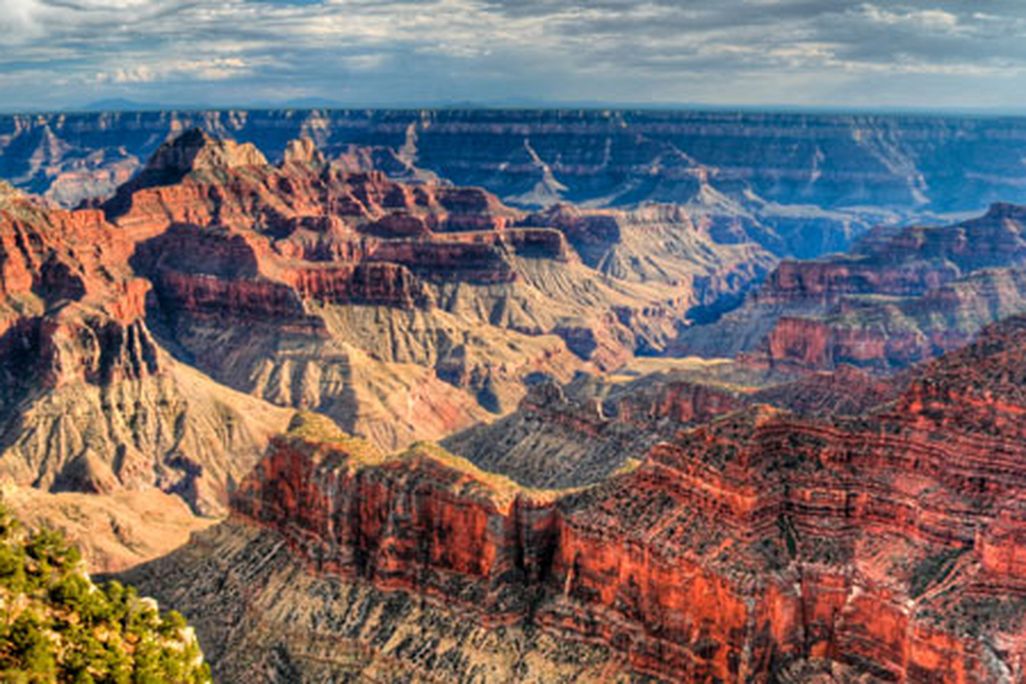
One night last year some friends and I pulled into Mather Campground on the Grand Canyon's South Rim. The 6,000-foot-deep, 277-mile-long and 18-mile-wide chasm nearby looked like an ocean masked by the dark. Come morning, watching the sun rise over the whittled canyon was as mesmerizing as watching waves roll in. But just as you can't grasp the size of the swells without swimming, you can't comprehend the depth of the rust-colored canyon until you venture down into it—and hike rim to rim.
The National Park Service recommends starting at the steeper North Rim, with a seven-mile hike along the North Kaibab Trail to Cottonwood Campground. From there, Day 2 entails a seven-mile hike in the gentler basin to historic Phantom Ranch, the only lodge below the rim. Day 3 bodes a ten-mile push up the Bright Angel Trail to the South Rim.
The three-day odyssey allows time to appreciate the two-billion-year-old cross section of the earth. "Rushing through the canyon is like rollerblading through the Louvre," says David Meyer, general manager of the Phantom Ranch. "You really have to take your time." As you hike, the gradually changing plant life—from the fir- and spruce-covered North Rim to the cactus- and mesquite-lined Colorado River—is the botanical equivalent of trekking from Canada to Mexico. As Mike Buchheit, director of the Grand Canyon Field Institute, says, "I've seen the canyon under a meteor shower, under an eclipse, all its moods and melodies—any one of which would be a memory of a lifetime."
One night last year some friends and I pulled into Mather Campground on the Grand Canyon's South Rim. The 6,000-foot-deep, 277-mile-long and 18-mile-wide chasm nearby looked like an ocean masked by the dark. Come morning, watching the sun rise over the whittled canyon was as mesmerizing as watching waves roll in. But just as you can't grasp the size of the swells without swimming, you can't comprehend the depth of the rust-colored canyon until you venture down into it—and hike rim to rim.
The National Park Service recommends starting at the steeper North Rim, with a seven-mile hike along the North Kaibab Trail to Cottonwood Campground. From there, Day 2 entails a seven-mile hike in the gentler basin to historic Phantom Ranch, the only lodge below the rim. Day 3 bodes a ten-mile push up the Bright Angel Trail to the South Rim.
The three-day odyssey allows time to appreciate the two-billion-year-old cross section of the earth. "Rushing through the canyon is like rollerblading through the Louvre," says David Meyer, general manager of the Phantom Ranch. "You really have to take your time." As you hike, the gradually changing plant life—from the fir- and spruce-covered North Rim to the cactus- and mesquite-lined Colorado River—is the botanical equivalent of trekking from Canada to Mexico. As Mike Buchheit, director of the Grand Canyon Field Institute, says, "I've seen the canyon under a meteor shower, under an eclipse, all its moods and melodies—any one of which would be a memory of a lifetime."

The adjectives "awesome" and "breathtaking" are much over-used today, but gazing out over the Grand Canyon from the South Rim for the first time was so awe-imspiring that it honestly took my breath away.
Posted by John Farrow on December 28,2007 | 09:19AM
To feel the significance of being a part of a world that has carved such greatness contrasted by feeling so insignificantly small in comparison was magnificent and humbling all rolled in to one. Don't miss this experience.
Posted by Charmel Bowden on January 6,2008 | 10:26PM
My 84 year old brother is very interested in geology. He lives in Ireland and always wanted to come to America. I would like to get him a book of photos of the Grand Canyon that includes some information about the history and formation of the Canyon. Can you recommend a good book? Thanks! Mary Rossi
Posted by Mary Rossi on February 20,2008 | 04:56PM
Viewing the Grand Canyon from the South Rim while quite beautiful, simply wasn't enough. I was at the rim for the first time in 2006 for a short day trip. That inspired me to book a rafting trip down the Colorado River. We just returned and are preparing to do it again next year. Though our expectations were very high, it exceeded all of them. Highly recommended.
Posted by David frost on August 15,2008 | 11:43AM
how old is the Grand Canyon
Posted by gabriella marteinez on January 5,2009 | 10:20AM