
A Smithsonian magazine special report
Evolution World Tour: La Brea Tar Pits, California
Just a short drive from the mansions of Beverly Hills lies a site where paleontologists have found over three million fossils
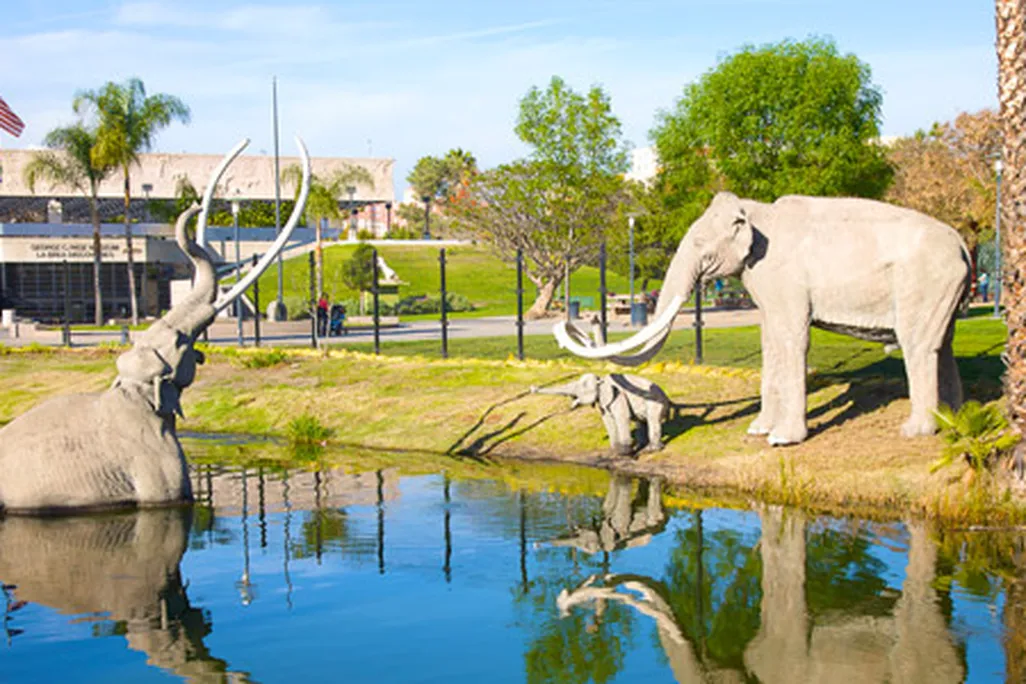
In a city that celebrates glitz and glamour, one of the most popular destinations is a malodorous pool of goo. The La Brea Tar Pits, in a 23-acre park in the heart of Los Angeles and just minutes from Beverly Hills, is the only active urban paleontological excavation site in the United States. Over the past century paleontologists have found more than three million specimens—including saber-toothed cats, giant jaguars, mammoths and dire wolves. La Brea is “one of the richest ice age fossil sites in the world,” says John Harris, chief curator at the onsite George C. Page Museum.
La Brea is essentially an oil field. Some 40,000 years ago, low-grade crude oil, known to geologists as asphalt, began seeping to the surface, forming a black, tarlike ooze that ensnared unsuspecting animals. Unlike a typical ecosystem, in which herbivores outnumber carnivores, roughly 90 percent of the mammal fossils found are predators. Scientists speculate that each successive group of trapped animals attracted other carnivores, but ended up getting stuck themselves. The carnivores, in turn, lured other predators and scavengers.
For Blaire Van Valkenburgh—a paleobiologist and UCLA professor of ecology and evolutionary biology—the huge collection of recovered carnivore bones has meant a unique opportunity to study one of the fiercest animals that had evolved to occupy the apex of the food chain. “Sabertoothed cats were spectacular and very successful predators,” Van Valkenburgh says. “Their fossils show that they had enlarged incisor teeth that they used along with their six- or seven-inch-long canines to make quick slashing kills to the throats of their prey.”
Though many of the small animal species from the era (such as coyotes and mule deer) still exist in California, the large animals died out some 11,000 years ago. Some scientists suggest that rapid climate change reduced habitats, depriving carnivores and large herbivores alike of the expansive ranging areas they needed for hunting and foraging. Other scientists attribute the extinctions to the arrival of a deadly new predator from Asia: human beings.
La Brea continues to yield spectacular specimens. In 2006, while constructing an underground parking garage for the Los Angeles County Museum of Art next door, workers unearthed a cache of 16 asphalt fossil deposits, including a nearly complete skeleton of a Columbian mammoth with curving ten-foot-long tusks. Scientists brought the asphalt to La Brea, and are still meticulously digging and sifting through tens of thousands of pounds of sediment.
Visitors can view their work from behind a fence. Another opportunity to see paleontology in action can be found at the museum’s glass-walled laboratory, where scientists carefully clean asphalt-caked specimens with tiny brushes, solvents and dental picks before examining and cataloging them. Today, small animals such as lizards and pigeons continue to get stuck at La Brea—as many as a dozen gallons of asphalt per day can bubble to the surface. The museum staff marks the spots with traffic cones, or fences them off. Still, Harris warns, “be careful where you step.”