
Evolution World Tour: Burgess Shale, British Columbia, Canada
Located in the Canadian Rockies, the fossil-rich dig site provides clues to scientists investigating how animal life began
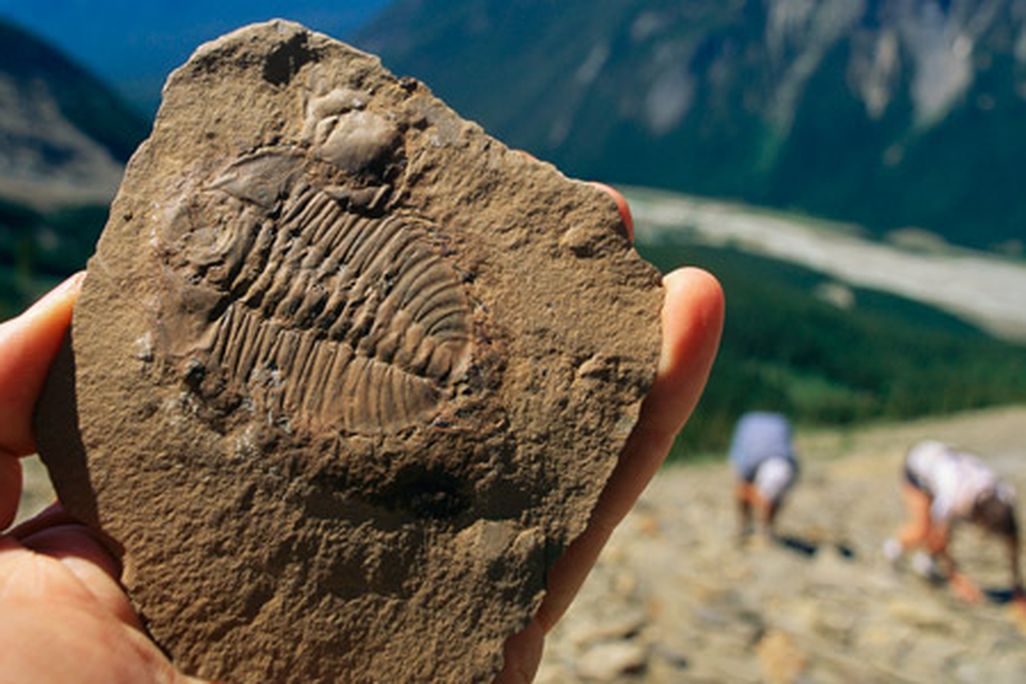
Think of it as biology’s Big Bang.
About 542 million years ago, the earth’s most complex inhabitants were multicellular soft-bodied organisms. Then, over the next 20 million years, an extraordinary diversity of life-forms first appeared. Most of the phyla of the animals that now dominate the world got their start, including arthropods (ancestors of today’s spiders and crustaceans); annelids (worms); and the first chordates, the predecessors of all creatures with a backbone, human beings included. This burst of life (if an event lasting some millions of years can be described as a burst) is known to scientists as the Cambrian Explosion, the defining characteristic of the Cambrian period.
The Burgess Shale, a crumbling slope in Canada’s Rocky Mountains some 50 miles west of the resort town of Banff, is riddled with shrapnel from the Cambrian Explosion. This spot provided our first good look at the rich variety of organisms that flourished then. Though the site today is at an elevation of almost 7,500 feet, 505 million years ago it was a different place entirely. It was beneath the sea, for one thing, and much of today’s Canada was near the Equator. Violent underwater mudslides periodically engulfed the marine ecosystem, instantly killing all sorts of organisms—and preserving them as exquisite fossils. Whereas most soft-bodied animals decay before they can leave a permanent trace, the organisms at the Burgess Shale are so well preserved that, in rare cases, there’s evidence of gut contents.
“Our understanding of Cambrian life without the fossils of the Burgess Shale would be like trying to look at a seascape teeming with life through a keyhole,” says Jean-Bernard Caron, curator of invertebrate paleontology at the Royal Ontario Museum in Toronto, who has been excavating in the area since 1998.
/https://tf-cmsv2-smithsonianmag-media.s3.amazonaws.com/filer/Historic-View-Burgess-Shale-1.jpg)
/https://tf-cmsv2-smithsonianmag-media.s3.amazonaws.com/filer/Historic-View-Burgess-Shale-2.jpg)
/https://tf-cmsv2-smithsonianmag-media.s3.amazonaws.com/filer/Historic-View-Burgess-Shale-3.jpg)
/https://tf-cmsv2-smithsonianmag-media.s3.amazonaws.com/filer/Historic-View-Burgess-Shale-4.jpg)
/https://tf-cmsv2-smithsonianmag-media.s3.amazonaws.com/filer/Historic-View-Burgess-Shale-5.jpg)
/https://tf-cmsv2-smithsonianmag-media.s3.amazonaws.com/filer/Historic-View-Burgess-Shale-6.jpg)
/https://tf-cmsv2-smithsonianmag-media.s3.amazonaws.com/filer/Historic-View-Burgess-Shale-7.jpg)
The paleontologist Charles Walcott, then the Secretary of the Smithsonian Institution, discovered the Burgess Shale in 1909. He categorized the fossils from the Burgess Shale into modern animal groups.
In the 1960s, paleontologist Harry Whittington of Cambridge University and other scientists began studying the collection again. Whittington realized that the oddest creatures found at the Burgess Shale didn’t fall into the standard categories of modern taxonomy or other known fossils; they belonged to groups that had never been seen before. The evolutionary biologist Stephen Jay Gould called them “weird wonders” in his 1989 book Wonderful Life. Some animals look more like plumbing devices, plastic hairbrushes or floor polishers than familiar creatures. The largest animal discovered was the three-foot-long Anomalocaris; its jointed forelimbs resembled shrimp tails and its mouth a square, sharp-toothed nutcracker. More recently, however, scientists have shifted their understanding a bit. They’ve started to think more in terms of shared characteristics between these apparent odd forms and other fossils or extant animals, Caron says, rather than pointing to the unique features. Paleontologists working at the Burgess Shale continue to discover fossils of new species and place them into the tree of life.
The Burgess Shale adds to evidence that evolution proceeded with bouts of rapid diversification interspersed with extinctions. And the shale’s fossils show that a lot of evolution’s early experiments failed to survive in the long term. “It basically tells us—as do many other events in the fossil record—that evolution is much more complex than we understand by studying organisms today,” says Doug Erwin, a paleobiologist at the Smithsonian Museum of Natural History.