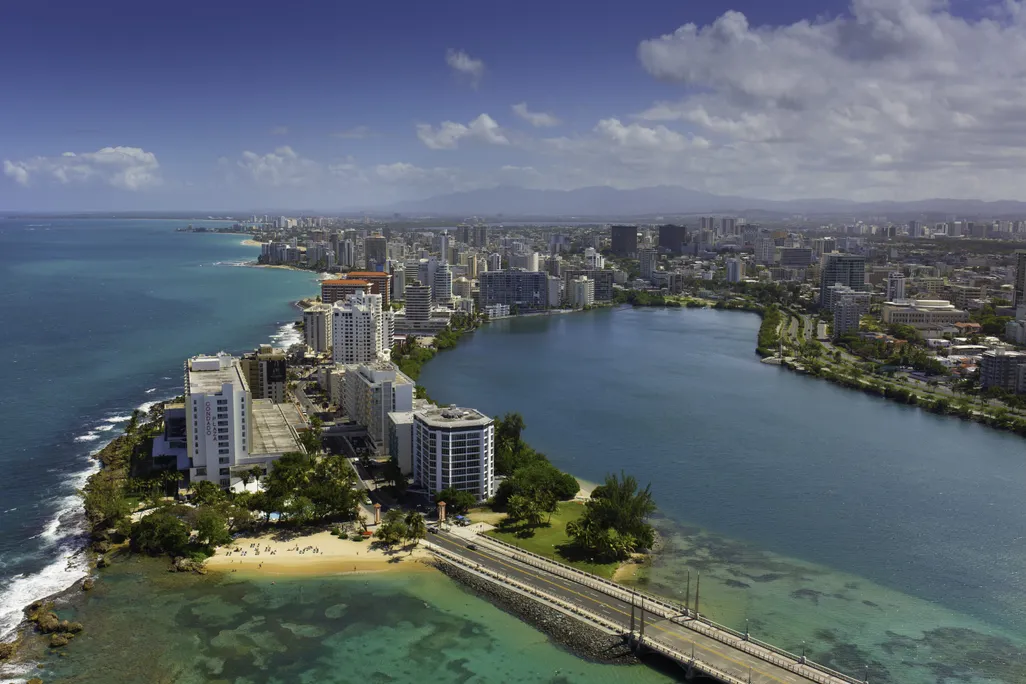
Christopher Columbus arrived at Puerto Rico in 1493. He originally called the island San Juan Bautista, but thanks to the gold in the river, it was soon known as Puerto Rico, or "rich port;" and the capital city took the name San Juan. Soon, Puerto Rico was a Spanish colony on its way to becoming an important military outpost.
Puerto Rico began to produce cattle, sugar cane, coffee and tobacco, which led to the importation of slaves from Africa. As a result, Puerto Rican bloodlines and culture evolved through a mixing of the Spanish, African, and indigenous Taíno and Carib Indian races that shared the island. Today, many Puerto Rican towns retain their Taíno names, such as Utuado, Mayagüez and Caguas.
Over the years numerous unsuccessful attempts were made by the French, Dutch, and English to conquer the island. To guard against these incursions, the Spanish constructed the many forts and ramparts still found on the island. Puerto Rico remained an overseas province of Spain until the Spanish-American war, when U.S. forces invaded the island with a landing at Guánica. Under the Treaty of Paris of 1898, Spain ceded Puerto Rico (along with Cuba, the Philippines and Guam) to the U.S.
As a result, the turn of the century saw Puerto Rico under United States sovereignty. At that time, Puerto Rico's economy relied on its sugar crop, but by the middle of the century, an ambitious industrialization effort, called Operation Bootstrap, was underway. Cheap labor and attractive tax laws attracted American companies, and soon the Puerto Rican economy was firmly grounded in manufacturing and tourism. Today, Puerto Rico is a leading tourist destination and manufacturing center; the island produces high-tech equipment and many top-selling American pharmaceuticals.
Puerto Ricans received U.S. citizenship in 1917 and Puerto Rico officially became a U.S. Commonwealth in 1952. The issue of political status is one under constant debate, with some in favor statehood, others independence, and still others the continuation of commonwealth status.
During World War II, the U.S. Navy purchased two thirds of the island to use as a naval base. The Navy used the area for military exercises and bombing practice for nearly 60 years until a civilian was killed during a bombing exercise in the 1990s. This sparked a wave of protests that finally ended when the base closed in 2003. Since then, the Navy's lands have become wildlife reserves.
Spanish and English are official languages and the currency is the U.S. Dollar.
Subscribe now for more of Smithsonian's coverage on history, science and nature.


Comments (10)
The Navy held 2/3 of an island off Puerto Rico's northeast coast called Vieques. The tiny island was heavily polluted by the Navy & will likely take more than our lifetimes to restore it to its once pristine conditions. The lands & surrounding waters will always belong to the caretakers of this tiny island. The Navy were at best, guests & at their worst, abusive ignorants, but Vieques will go on to thrive as their new status cannot be revoked by any American official including a U.S. President. No doubt, Justice is sweetness to those who have suffered under the hands of injustice and so, the real work begins to protect the only bio-illuminesque bay in North America & precious indigenous flora & fauna. Please help Vieques P.R. However you can. P.R. Lost about $232 Million dollars when the Navy left closing its mainland operations as well as the base on Vieques, P.R. Thank you.
Posted by Cruz Paez on December 9,2012 | 10:45 AM
I LOVE PUERTO RICO
Posted by miguel on November 16,2012 | 08:37 PM
The last paragraph incorrectly states that 2/3 of Puerto Rico was purchased by the U.S. Navy. The fact is: The Navy purchased 2/3 of Vieques which is an island territory of the Commonwealth of Puerto Rico. This content should definitely be changed on the website. An error like this makes everything coming from this website dubitable. It saddens me because, I thought the Smithsonian would be a source of reliable and trusted information.
Posted by Yolanda Castro on September 25,2012 | 06:51 PM
Sorry, Diana that you did not have fun time. Every country someone travels to has it's good and bad experiences. Puerto Rico is not exception.
Posted by angie on July 14,2012 | 12:07 PM
As an introduction the Smithsonian should have mentioned the original inhabitants of Puerto Rico The Taino Indians. In addition how Borinken is the original name of the island before Columbus arrive. In addition of how we address each other as Boriquas. Understanding that Columbus arrived to Puerto Rico however the Taino Indians recieved him and his lost ships with open arms.
Posted by angie on July 14,2012 | 12:04 PM
I DONT LIKE WHAT YOU WROTE HIRE BECOUSE I'VE BEEN THERE SO IT WASENT LIKE THAT GOOD IT WAS NOT FUN
Posted by DIANA on May 30,2012 | 05:44 AM
I am half puerto rican (mixed with african american and cuacajuan also) and at first I didnt know much about this half of my race. this is my first time i have taken the time to study my heritage. its really great to actually read all of this and get information.
Posted by Nakosha Gadddis on January 21,2011 | 02:35 PM
Hola, to clarify, it is Ramey Air Force Base and it is in Punta Borinquen, Aguadilla, PR. Gracias!!!!!!!!!!
Posted by Tony Rodriguez on June 6,2010 | 11:31 PM
English is not an official language in "name only"...University and post graduate level education in Puerto Rico use english textbooks to prepare U.S. certified doctors, engineers, etc. High School students need to pass the same SAT tests to get into US universities and colleges. How else could these students be so successful in getting their degrees? Enlgish is taught in schools from the first grade. The University of Puerto Rico alone has over 60,000 students (including all their regional colleges spread around the island). The US had large bases in Barranquitas (Ramy Air Force Base), in Fajardo Roosvelt Roads (Navy) and several Army installations in addition to Vieques.
Posted by Mercedes McGeehan on April 23,2010 | 10:16 AM
In my 25 years here English is an official language only in name and not in practice. The Navy only purchased two thirds of Vieques to my understanding.
Posted by robin phillips on September 28,2009 | 04:54 PM