
Dominique Dawes’ Guide to Watching Gymnastics
The former gold medalist offers a cheat sheet on her sport’s rules, maneuvers and slang
Introducing the Expert
Name: Dominique Dawes
@dominiquedawes
Games and Medals: Barcelona 1992 (Bronze, Team); Atlanta 1996 (Gold, Team; Bronze, Floor); Sydney 2000 (Bronze, Team)
Key Quote: “I love how gymnastics allowed me to push myself and find out what I was capable of accomplishing.”
Favorite Olympic Moment: “I will always remember the feeling I had when I was standing on the medal stand with the “Magnificent Seven” at the Atlanta 1996 Olympic Games. To represent the country with this special group of girls was such an honor.”
Equipment
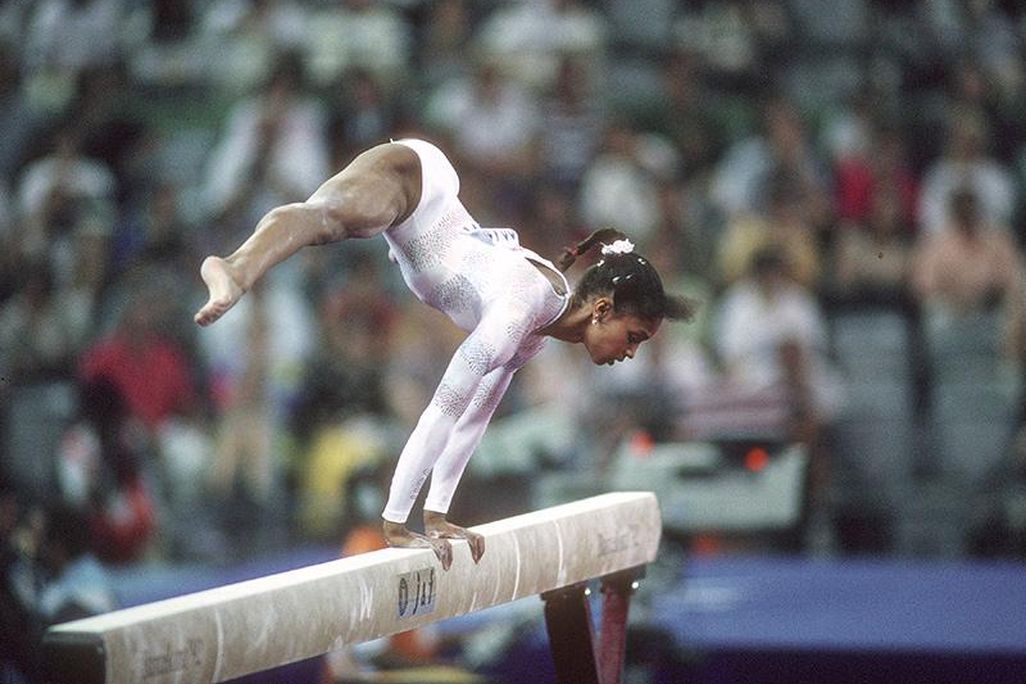
Balance beam – an apparatus consisting of a solid piece of wood four inches wide on which gymnasts perform a routine of acrobatic and dance skills
Bar – an apparatus on which gymnasts perform a routine of swinging maneuvers and release moves
Vaulting table – an apparatus with a wide top surface on which gymnasts place their hands after springing off a springboard
Maneuvers
Overshoot – a release move from the high bar to the low bar in the uneven parallel bars event
Jeté – a ballet term that describes a leap from one leg to the other in the floor exercise event
Dismount – the exit from an apparatus at the end of a routine (typically involving a twist or somersault)
Slang
1. All-around – a category of gymnastic competition that includes all four women’s events (vault, uneven parallel bars, balance beam and floor exercise) or all six men’s events (floor exercise, pommel horse, still rings, vault, parallel bars and horizontal bar)
2. Flic-flac or flip-flop – nickname for a back handspring, in which a gymnast takes off from one or both feet, jumps backwards onto his or her hands and lands on his or her feet
3. Tumbling pass – a sequence of tumbling elements performed in a routine on the floor exercise
Rules
Difficulty Score, or Start Value - A numeric value is placed on a gymnast’s routine prior to his or her performance. It is based on the degree of difficulty of the routine. The more difficult the skills performed in the routine, the higher the start value.
Code of Points - The Code of Points is the official rulebook that defines the scoring system for judging gymnastics skills. A gymnast can receive bonus points if he or she executes a combination of difficult skills. A gymnast can receive zero if he or she fails to perform a necessary element of a routine.
Olympic Order - The order of competition for women is vault, uneven parallel bars, balance beam and floor exercise. The order for men is floor exercise, pommel horse, still rings, vault, parallel bars and horizontal bar.
Game Changers
2001 - The “vaulting table” apparatus replaced the “vaulting horse” apparatus. Due to its longer and wider top surface, the vaulting table allows for better hand placement.
1980s - The distance between the high bar and the lower bar in the women’s uneven parallel bars event began to increase, allowing for the execution of more complex moves.