The Parthenon’s Old World Order
After a recent restoration, the center of the Athenian Acropolis and symbol of Western democracy still inspires
- By Kathleen Burke
- Smithsonian magazine, January 2008, Subscribe
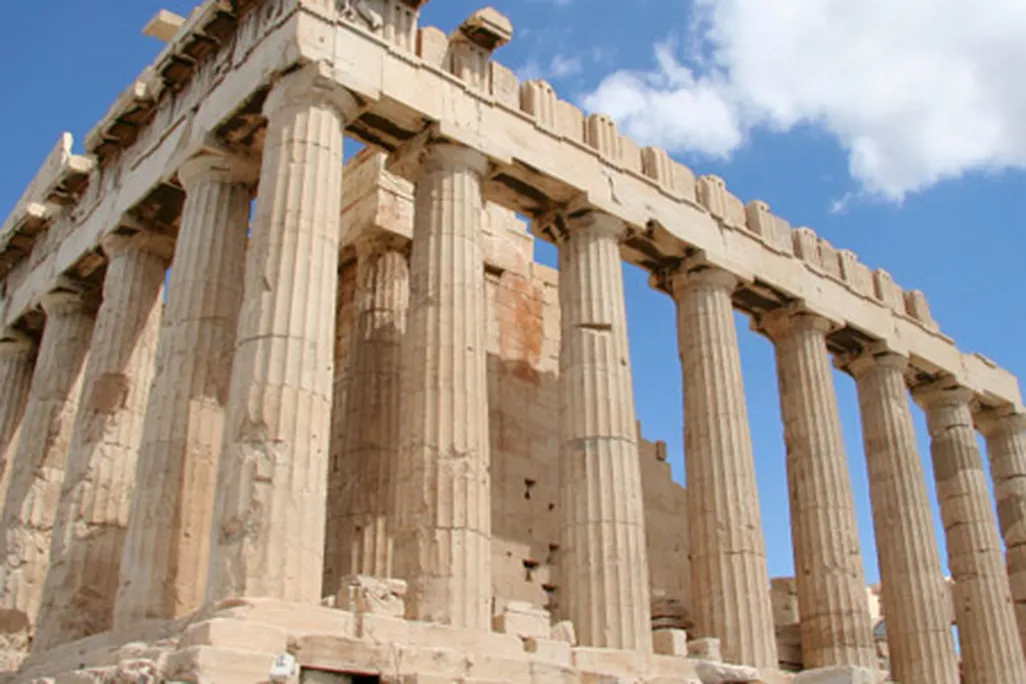
More than 2,400 years after its construction, the Parthenon—the sanctuary to the goddess Athena—still dominates the skyline of the Acropolis in Athens. The structure, originally painted in brilliant shades of red, green and blue, remained largely intact until 1687, when a force of Venetians laying siege to invading Turkish troops ignited a gunpowder magazine stored there. The explosion reduced the sanctuary to near ruins.
Today, the Greek government is overseeing a massive restoration effort. Although the edifice cannot be returned to its pre-1687 condition, the goal is to minimize, as much as possible, damage to what is left. (Replacement marble, for example, is being mined from the classical-era quarry that supplied the original.)
This past October, the final phase began with the creation at the base of the citadel of the Acropolis Museum, which will showcase more than 4,000 ancient statues, friezes and artifacts when it opens in autumn 2008.
One treasure, however, will remain absent—the marble friezes that England's Lord Elgin removed from the site between 1801 and 1803 and sold to the British Museum, where they remain. The designer of the new museum, Bernard Tschumi, has crowned his building with a glass gallery that awaits their return. "My hope," he recently told the Christian Science Monitor, "is that one day the [Elgin] marbles will be reunited and people can know the story all at once, in one single place."
Subscribe now for more of Smithsonian's coverage on history, science and nature.
← Previous![]() Exploring Ancient Ephesus |
Smithsonian Life List: 43 Places to See Before You Die |
Next →![]() Ponder the Pyramids of Giza |


Comments (5)
very good info I have bean to that museum
Posted by christopher on November 1,2012 | 09:46 PM
Dear Kat Braden,
I understand you absolutely! But I think that you would be glad to hear that what archaeologists actually do in to integrate original, ancient spare parts of the Parhenon, which were previously on the ground due to earlier destruction or becaused the were recently identified, into the temple. There will not be any Nashville Parthenon in Athens!
In reality, Greek archaeologists are very conservative and hesitant in renovations and anastyloses.
Posted by Dimitris Boukas on October 21,2011 | 04:44 PM
I should thank the Smithsonian.com for choosing 4 Greek places or monuments for the list of the 43 places to see before die. Santorini island, the Parthenon, the ancient city of Ephesos (unfortunately occupied by Turks) and Petra in Jordan which was built by the army of the Alexander the Great.
Posted by Anden on August 14,2011 | 08:54 AM
If you can't make this one, see the one in Nashville, if yiu can.
Posted by Jan on March 4,2011 | 08:25 AM
this may sound as a surprise to a lot of people but i i don't think any renovations should be done on the Parthenon. I find this structure interesting because of its history if renovations are done to this amazing piece of history it will no longer be the place i learned about in 5th grade.
Posted by Georgia Keith on March 21,2009 | 01:09 AM
Be sure to catch the new Nova, Secrets of the Parthenon, on Tuesday, January 29th on PBS stations. The Boston channel is airing it at 8 p.m. Check your local listings and enjoy! There is a Parthenon cover article in the Smithsonian Feb '08 issue.
Posted by Kat Braden on January 28,2008 | 02:06 PM
I read the article by Evan Hadingham and it was really outstanding. He gave a lot of interesting facts and ideas. My only question is why don't the restorationists mix marble dust with the cement they are using to do a better job of blending the color to its natural finish. Another thing they could do is put a patina on the finished cement. If they should do this they should consult Disney world because they have some of the best patina artists in the world.In Italy they used these thechniques to repair the Piata after some idiot tried to destroy it. Thanks, hope these ideas help. Bill Morrison
Posted by william morrison/ sculptur on January 27,2008 | 05:53 PM
Having visited the Parthenon in 2002 I can truly appreciate the task being undertaken to restore this truly wonder of Greek architecture. For those who will never get to Athens but have a deep interest in this magnificent structure, I would highly recommend a visit to Nashville Tennessee to see the full scale replica of this marvel of engineering. As I understand it, it very closely resembles the original structure including the friezes. Not only that, it contains the giant statue of Athena. You truly can sense the effort of construction with its many fine details.
Posted by Jim Schroeder on January 24,2008 | 08:34 PM
Are there any videos or photos of the restoration effort that give details of the work in progresss? might we see a program or study in the future about this interesting undertakng?
Posted by Fred B. Simpson on January 22,2008 | 07:25 PM