• Smithsonian
    Institution
  • Travel
    With Us
  • Smithsonian
    Store
  • Smithsonian
    Channel
  • goSmithsonian
    Visitors Guide
  • Air & Space
    magazine

Smithsonian.com

  • Subscribe
  • History & Archaeology
  • Science
  • Ideas & Innovations
  • Arts & Culture
  • Travel & Food
  • At the Smithsonian
  • Photos
  • Videos
  • Games
  • Shop
  • Life Lists

Frank Lloyd Wright’s Most Beautiful Work

Fallingwater, a southwest Pennsylvania house designed by the famous architect, allows residents to live within a waterfall

| | | Reddit | Digg | Stumble | Email |
  • By Eric Jaffe
  • Smithsonian magazine, January 2008, Subscribe
View More Photos »
Fallingwater
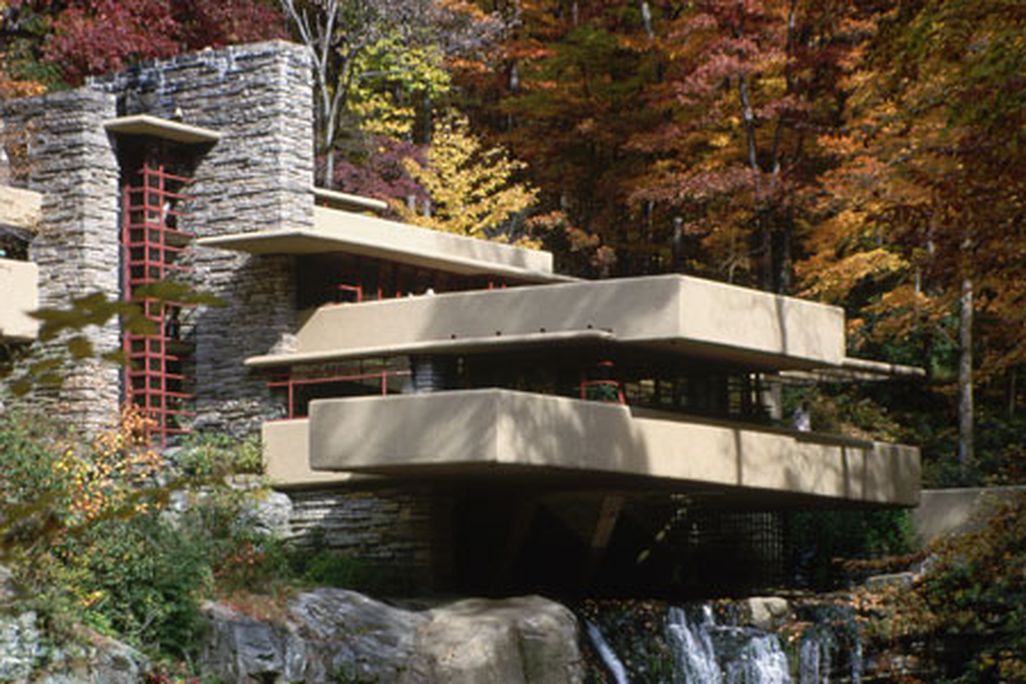
Fallingwater (Richard A. Cooke/Corbis )

Photo Gallery (1/4)

"Fallingwater."

Explore more photos from the story

More from Smithsonian.com

  • The Smithsonian Life List: 43 Places to See Before You Die

If the skyscraper is America's most iconic building, a small personal residence in southwest Pennsylvania might be its most ingenious. Frank Lloyd Wright completed Fallingwater in 1937, and months later Time magazine put the house on its cover, proclaiming it the architect's "most beautiful job." Ayn Rand based much of her 1943 classic, The Fountainhead, on Wright and the house he had wrought.

Wright designed it in 1935, at his professional nadir, as a mountain retreat for Pittsburgh retail mogul Edgar J. Kaufmann, who wanted a home near the waterfalls of Bear Run. Wright took that notion to its extreme. "I want you to live with the waterfall," he is said to have told Kaufmann, "not just to look at it." Cantilevered concrete terraces hover some 30 feet above the falls. The incessant sound of rushing water permeates the home, yet never overwhelms. A boulder juts through the living room and doubles as a hearth. Low ceilings direct attention outside. During a visit to the house a couple of years ago, I was struck by Wright's vanishing windows, which open outward from wall corners, leaving no panes to obstruct the wilderness view.

Together these elements create a building that's timeless, organic and quintessentially American, says Franklin Toker, author of Fallingwater Rising: Frank Lloyd Wright, E.J. Kaufmann, and America's Most Extraordinary House. "You've never seen a building that fits with nature so tightly," Toker says. "It's not merely nature, it's animated. You've seen Vegas and Times Square, but you've never seen a building that's in constant motion."


If the skyscraper is America's most iconic building, a small personal residence in southwest Pennsylvania might be its most ingenious. Frank Lloyd Wright completed Fallingwater in 1937, and months later Time magazine put the house on its cover, proclaiming it the architect's "most beautiful job." Ayn Rand based much of her 1943 classic, The Fountainhead, on Wright and the house he had wrought.

Wright designed it in 1935, at his professional nadir, as a mountain retreat for Pittsburgh retail mogul Edgar J. Kaufmann, who wanted a home near the waterfalls of Bear Run. Wright took that notion to its extreme. "I want you to live with the waterfall," he is said to have told Kaufmann, "not just to look at it." Cantilevered concrete terraces hover some 30 feet above the falls. The incessant sound of rushing water permeates the home, yet never overwhelms. A boulder juts through the living room and doubles as a hearth. Low ceilings direct attention outside. During a visit to the house a couple of years ago, I was struck by Wright's vanishing windows, which open outward from wall corners, leaving no panes to obstruct the wilderness view.

Together these elements create a building that's timeless, organic and quintessentially American, says Franklin Toker, author of Fallingwater Rising: Frank Lloyd Wright, E.J. Kaufmann, and America's Most Extraordinary House. "You've never seen a building that fits with nature so tightly," Toker says. "It's not merely nature, it's animated. You've seen Vegas and Times Square, but you've never seen a building that's in constant motion."

    Subscribe now for more of Smithsonian's coverage on history, science and nature.

← Previous
The Resilient Uffizi Gallery
Smithsonian Life List:
43 Places to
See Before You Die
Next →
The Ancient Architecture of Fatehpur Sikri

Related topics: Architecture Frank Lloyd Wright Pennsylvania


| | | Reddit | Digg | Stumble | Email |
 

Add New Comment


Name: (required)

Email: (required)

Comment:

Comments are moderated, and will not appear until Smithsonian.com has approved them. Smithsonian reserves the right not to post any comments that are unlawful, threatening, offensive, defamatory, invasive of a person's privacy, inappropriate, confidential or proprietary, political messages, product endorsements, or other content that might otherwise violate any laws or policies.

Comments (16)

+ View All Comments

i love this house its so pretty and it has an amazing story to it i went to the house and its the nicest house that i have ever seen if yo have never been there i think you should go it will blow your mind

Posted by Tessa on April 24,2013 | 02:12 PM

good thing it got fixed and its still around

Posted by angie huhn on April 24,2013 | 02:09 PM

cool

Posted by sara brown on April 17,2013 | 02:24 PM

I went to Falling Water last summer (2010); I had wanted to visit for a few years. It is out-of-the-way but the drive is pleasant and the destination is well worth the effort. The guided tour groups are limited in size and that makes the whole visit very intimate and very personal. The guides love their job of showing visitors around.

The setting is spectacular and the house is a marvel.

Posted by Jack Hanna on August 4,2011 | 02:20 PM

If you are driving by, do indeed stop.

Posted by David Sucher on September 12,2010 | 01:05 AM

My mother, husband and I are planning our first trip to Fallingwater. We're tempted to forgo the longer 2 hour tour for the regular tour and the lecture on Frank Lloyd Wright. I've read several posts on how the longer tour is amazing, is it more technical and geared towards architects? The longer tour takes you to secondary areas of the house -- does anyone know which sort of places are solely available through the longer tour?

Thanks!

Posted by gaby on May 6,2010 | 12:48 AM

In the late ninties I, along with my daughter, Bitsy Spencer and her two small children, visited Falling Waters. I amfrom Ky and we have some great views here, but this was one of the greatest adventures I have had the priviledges of my life time. One must see it to appreciate the work of Mr. Wright

Posted by Gloria S Thomas on February 20,2010 | 05:49 PM

Fallingwater ripples through many inspirational dimensions. My friend, Suzanne Martinson, collaborated with Jane Citron and Robert Sendall to write a wonderful cookbook entitled The Fallingwater Cookbook: Elsie Henderson’s Recipes & Memories (University of Pittsburgh Press, 2008). Elsie Henderson was the cook at Fallingwater for the Kaufmann family for fifteen years. If you love Fallingwater, you’ll love Elsie Henderson and this unique insight into this “most architecturally significant private residence in the United States.”

Posted by Garland Long on February 19,2010 | 07:17 PM

Rand was an immature moron with her notions that the rest of us are 'second-handers' simply because we aren't creative geniuses like her story book characters. A bunch of bologna. Wright was merely an above average architect compared to his contemporaries back then and architects of today. He had the good fortune to become the 'darling of the media'. The cold humid mist emanating from the running water will be sufficient enough to give the healthiest human a serious case of arthritis and rheumatism. It would make the building expensive to heat, not to mention the corrosive effects on the steel encased concrete structure supporting the cantilevered terraces. Finished repairs? Humbug I say. This building would be more suited to a western semi-arid climate where it might look 'above average'. I can only visualize the green mold, mildew and slime coating the underneath side of the lower terrace. Give me a break!

Posted by Ray Murray on November 5,2009 | 07:14 PM

So you say this: "Ayn Rand based much of her 1943 classic, The Fountainhead, on Wright and the house he had wrought." But I've also read this: "A common, unfounded, speculation is that Roark was inspired by American architect Frank Lloyd Wright; a claim both Rand and Wright denied. Rand did, however, once commission Wright to design a summer cottage for her; it was never built. The most that may be suggested is that some of the descriptions of Roark's buildings resemble those of Wright: a notable example being the "Heller House" - the first of Roark's designs to be built - cantilevered over the edge of a cliff in a descriptive image reminiscent of Wright's famous Fallingwater in Pennsylvania." If you had taken a few hours to sit and read the book before spouting off about its content (or at the least an educated article) you'd realize it goes way beyond architecture. Rand used it as an analogy to the "Objectivist" philosophy she developed in both "The Fountainhead" and "Atlas Shrugged". -PM

Posted by Paul Whitfield on December 4,2008 | 04:58 AM

On a recent trip west we were able to arrange a visit to Fallingwater on our way back home. It was wonderful. The house is incredible, a true work of art to be enjoyed by all who go there. The knowledgable tour guide provided extra details. We noticed cars from all over the country. Well worth the trip to the house located in such a beautiful area.

Posted by Kathleen S Ely on October 23,2008 | 10:10 AM

I thought the house fallingwater was built near sandy lake pa. in the 1930 . Then moved to mill run . A i wrong.

Posted by leo on July 27,2008 | 04:56 PM

When is the next trip to Fallingwater from DC? Thank you.

Posted by toni on March 14,2008 | 01:21 AM

I visited Fallingwater some years ago, when the repairs had just begun. Even with the construction work and scaffolding, the place was breathtaking. How good to know it has been fully restored and will remain an iconic Pennsylvania landmark!

Posted by Joyce on March 11,2008 | 03:20 PM

+ View All Comments


Advertisement


Travel with Smithsonian


Most Popular

  • Viewed
  • Emailed
  • Commented
  1. The 20 Best Small Towns in America of 2012
  2. Myths of the American Revolution
  3. The 20 Best Small Towns to Visit in 2013
  4. For 40 Years, This Russian Family Was Cut Off From All Human Contact, Unaware of WWII
  5. Seven Famous People Who Missed the Titanic
  6. The Scariest Monsters of the Deep Sea
  7. 16 Photographs That Capture the Best and Worst of 1970s America
  8. Why Are Finland's Schools Successful?
  9. A Brief History of the Salem Witch Trials
  10. Women Spies of the Civil War
  1. For 40 Years, This Russian Family Was Cut Off From All Human Contact, Unaware of WWII
  2. The Story Behind Banksy
  3. Mona Eltahawy on Egypt’s Next Revolution
  4. Why Procrastination is Good for You
  5. The Surprising Satisfactions of a Home Funeral
  6. Why Are Finland's Schools Successful?
  7. A Walking Tour of Tallinn
  1. Life on Mars?
  2. The Mystery of Easter Island
  3. Women Spies of the Civil War
  4. What the Discovery of Hundreds of New Planets Means for Astronomy—and Philosophy
  5. Taking the Great American Roadtrip
  6. On the Case
  7. A Call to Save the Whooping Crane
  8. Colombia Dispatch 5: The Kogi Way of Life
  9. The Ten Most Disturbing Scientific Discoveries
  10. How Do Smithsonian Curators Decide What to Collect?

View All Most Popular »

Advertisement

Follow Us

Smithsonian Magazine
@SmithsonianMag
Follow Smithsonian Magazine on Twitter

Sign up for regular email updates from Smithsonian.com, including daily newsletters and special offers.

In The Magazine

May 2013

  • Patriot Games
  • The Next Revolution
  • Blowing Up The Art World
  • The Body Eclectic
  • Microbe Hunters

View Table of Contents »


First Name
Last Name
Address 1
Address 2
City
State   Zip
Email


Smithsonian Store

A Guide to Smithsonian Architecture

Item No. 10335


View full archiveRecent Issues


  • May 2013


  • Apr 2013


  • Mar 2013

Newsletter

Sign up for regular email updates from Smithsonian magazine, including free newsletters, special offers and current news updates.

Subscribe Now

About Us

Smithsonian.com expands on Smithsonian magazine's in-depth coverage of history, science, nature, the arts, travel, world culture and technology. Join us regularly as we take a dynamic and interactive approach to exploring modern and historic perspectives on the arts, sciences, nature, world culture and travel, including videos, blogs and a reader forum.

Explore our Brands

  • goSmithsonian.com
  • Smithsonian Air & Space Museum
  • Smithsonian Student Travel
  • Smithsonian Catalogue
  • Smithsonian Journeys
  • Smithsonian Channel
  • About Smithsonian
  • Contact Us
  • Advertising
  • Subscribe
  • RSS
  • Topics
  • Member Services
  • Copyright
  • Site Map
  • Privacy Policy
  • Ad Choices

Smithsonian Institution