• Smithsonian
    Institution
  • Smithsonian
    Journeys
  • Smithsonian
    Store
  • Smithsonian
    Channel
  • goSmithsonian
    Visitors Guide
  • Air & Space
    magazine

Smithsonian.com

  • Subscribe
  • Home
  • History & Archaeology
  • People & Places
  • Science & Nature
  • Arts & Culture
  • Travel
  • Photos
  • Videos
  • Games & Puzzles
  • Blogs
  • Heritage

Frybread Recipe

A recipe from Foods of the Americas: Native Recipes and Traditions
  • Smithsonian magazine, July 2008, Subscribe
 
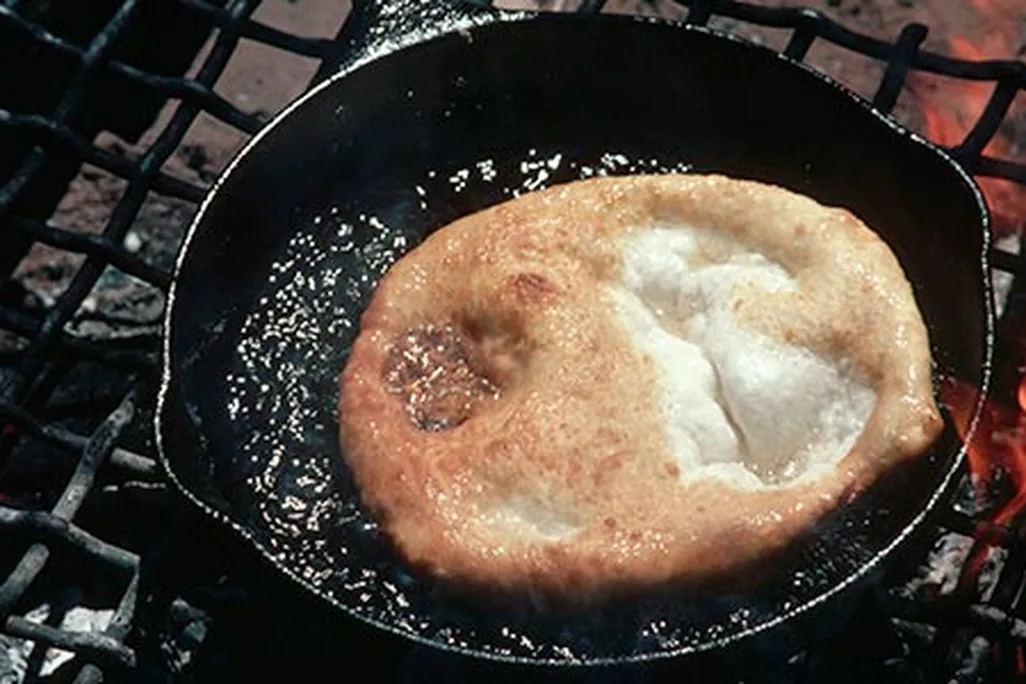
Frybread Navajo frybread cooks in an iron frying pan.

Buddy Mays / Corbis

 
Tweet

Article Tools

 
  • Comments (58)
  • Font
  • Email
  • RSS
  • Print
  • Related Topics

    Native Americans

    Recipes

    More from Smithsonian.com
    • Frybread

    Ingredients:

    3 cups all-purpose flour
    1 tablespoon baking powder
    1 teaspoon salt
    1 1/4 cups warm water
    Extra flour for processing
    (Yield: 8 to 12 small portions or 6 to 8 larger portions)

    Directions:

    To make the dough thoroughly blend the flour with the baking powder and salt in a mixing bowl or on a suitable, clean working surface. Make a well in the center of the flour mixture and pour the warm water in the center of the well. Work the flour mixture into the water with a wooden spoon, or use your hands. Gently knead the dough into a ball and form it into a roll about 3 inches in diameter. Cover the dough with a clean kitchen towel to prevent drying and let the dough relax for a minimum of 10 minutes. This dough is best used within a few hours, although it may be used the next day if covered tightly with plastic wrap, refrigerated, then allowed to warm to room temperature.

    To form the bread, place the dough on a cutting board. Cut the dough with a dough cutter or knife into desired thickness. This process of cutting helps keep your portion sizes consistent. Naturally, you will want to cut small pieces for appetizers (or, alternatively, if you are making sandwiches, cut them bigger). Once you have determined the size, begin cutting in the center of the roll and continue the halving process until all of the portions have been sliced. Cover the pieces of dough with a dry, clean towel while you process each piece to prevent drying. Place some flour in a shallow pan to work with when rolling out the dough. Lightly dust each piece of dough and then place the dough on a lightly floured work surface. With a rolling pin, roll each piece to about 1/4-inch thickness. Place each finished piece in the flour, turn and lightly coat each piece, gently shaking to remove the excess flour. Stack the rolled pieces on a plate as you complete the process. Cover with a dry towel until ready to cook.

    To cook fry bread, place any suitable frying oil in a deep, heavy pan. The oil should be a minimum of 1 inch deep. Place pieces of bread in the oil. Do not overcrowd the pan. Cook 2 to 3 minutes per side. This bread generally does not brown and should be dry on the exterior and moist in the center. Try cooking one piece first, let it cool, and taste for doneness. This will give you a better gauge of how to proceed with the balance of the bread, ensuring good results. Place the finished breads on a paper towel to absorb excess oil. Serve this bread immediately after cooking.

    To make grill bread, place the bread on a clean medium hot grill. When bubbles form and the dough has risen slightly, turn the bread over to finish cooking. The bread is done when the surface appears smooth and is dry to the touch. Cooking time will vary but plan on approximately 2 to 3 minutes per side. This bread cooks quickly and is best when moist in the center, with a pliant crust. Some browning occurs, but generally speaking, this is a blond bread.

    From Foods of the Americas: Native Recipes and Traditions, by Fernando and Marlene Divina and the Smithsonian's National Museum of the American Indian. © 2004 Smithsonian Institution and Fernando and Marlene Divina.


    Ingredients:

    3 cups all-purpose flour
    1 tablespoon baking powder
    1 teaspoon salt
    1 1/4 cups warm water
    Extra flour for processing
    (Yield: 8 to 12 small portions or 6 to 8 larger portions)

    Directions:

    To make the dough thoroughly blend the flour with the baking powder and salt in a mixing bowl or on a suitable, clean working surface. Make a well in the center of the flour mixture and pour the warm water in the center of the well. Work the flour mixture into the water with a wooden spoon, or use your hands. Gently knead the dough into a ball and form it into a roll about 3 inches in diameter. Cover the dough with a clean kitchen towel to prevent drying and let the dough relax for a minimum of 10 minutes. This dough is best used within a few hours, although it may be used the next day if covered tightly with plastic wrap, refrigerated, then allowed to warm to room temperature.

    To form the bread, place the dough on a cutting board. Cut the dough with a dough cutter or knife into desired thickness. This process of cutting helps keep your portion sizes consistent. Naturally, you will want to cut small pieces for appetizers (or, alternatively, if you are making sandwiches, cut them bigger). Once you have determined the size, begin cutting in the center of the roll and continue the halving process until all of the portions have been sliced. Cover the pieces of dough with a dry, clean towel while you process each piece to prevent drying. Place some flour in a shallow pan to work with when rolling out the dough. Lightly dust each piece of dough and then place the dough on a lightly floured work surface. With a rolling pin, roll each piece to about 1/4-inch thickness. Place each finished piece in the flour, turn and lightly coat each piece, gently shaking to remove the excess flour. Stack the rolled pieces on a plate as you complete the process. Cover with a dry towel until ready to cook.

    To cook fry bread, place any suitable frying oil in a deep, heavy pan. The oil should be a minimum of 1 inch deep. Place pieces of bread in the oil. Do not overcrowd the pan. Cook 2 to 3 minutes per side. This bread generally does not brown and should be dry on the exterior and moist in the center. Try cooking one piece first, let it cool, and taste for doneness. This will give you a better gauge of how to proceed with the balance of the bread, ensuring good results. Place the finished breads on a paper towel to absorb excess oil. Serve this bread immediately after cooking.

    To make grill bread, place the bread on a clean medium hot grill. When bubbles form and the dough has risen slightly, turn the bread over to finish cooking. The bread is done when the surface appears smooth and is dry to the touch. Cooking time will vary but plan on approximately 2 to 3 minutes per side. This bread cooks quickly and is best when moist in the center, with a pliant crust. Some browning occurs, but generally speaking, this is a blond bread.

    From Foods of the Americas: Native Recipes and Traditions, by Fernando and Marlene Divina and the Smithsonian's National Museum of the American Indian. © 2004 Smithsonian Institution and Fernando and Marlene Divina.

        Subscribe now for more of Smithsonian's coverage on history, science and nature.


    Related topics: Native Americans Recipes


    Tweet Digg
     
    Comments (58)

    + View All Comments

    Since this is the Smithsonian magazine, I would expect that the history to be provided by the magazine as to the origin of fry bread. If anyone is paying attention to the recipe you will realize it is the exact same thing you find in biscuits, Irish Soda Bread and scones. The missing ingredient is lard of some sort. Though I have found other versions of this recipe that include it.

    The Navajo developed it based upon the rancid food supplies given to them after they reached the reservation. It would not surprise me to find out that the wife of an Irish solider couldn't stand to watch them starve anymore and provided them with a recipe that they then altered to fry because ovens were not an option.

    We are having this tonight with a traditional Aztec meal called, Posole or Pozole depending on which spelling you prefer. I am opting for the Pork over the meat the Aztecs used to make this dish sacred. :) If you don't know what that is, don't ask.

    My great great grandmother was born on the trail of tears. I make this bread and other Native dishes as often as I can, usually at least once a month, as a way of honoring her spirit and all she and her daughter, my great grandmother, sacrificed so I and my children could be here today.

    Posted by Becca on January 26,2012 | 04:50 PM

    I am of mixed race as is with MOST WHITE people (English, Irish, Native American, Spanish, German and so on). How ever, the only time I found out about Fry Bread was when I lived on the reservation and going to the pow wows. Most white people do not know about fry bread at all. Not all bad food is made by the WHITE MAN...???

    Posted by LeeZeno on January 18,2012 | 03:51 PM

    The pioneers going west in the 19th century made "scones" out of bread dough, fried, as there weren't ovens available along the trail....many people have fried dough and made it a part of their culture. Like doughnuts, it's a treat...enjoy!

    Posted by Lita Hansen on January 9,2012 | 12:07 PM

    I think we are all missing the point. This is part of Native American heritage because they had to use it in their diet. I have never tried fry bread but intend to make it to experience it. I believe someone said do over think it.

    Posted by Margie on October 21,2011 | 08:03 PM

    I just made some Cherokee Fry Bread for the first time! I got the first recipe from my mother but this is the first time I made it. My mother passed away four years ago. I work at Texas School for the Blind. I made it for my students here and they were jumping with joy for more! I am teaching them about the different tribes and food history ect. My mother was part Cherokee and she was from Oklahoma and so am I. I miss Oklahoma allthough I did not get to live there long. I had a lot of happy times there. I wish my mother was here to see and taste the bread I made but I know she is here in my heart. My dad is still alive but he never was the same since my mom's been gone. I hope to make the bread again soon and try to make the bread into fried pies. A lot of my students don't even know what bread is hardly or they have never heard of the Indian Fry Bread. They are use to eating at the fast food places. Liz Brooks Barnstead

    Posted by Liz Brooks on September 28,2011 | 10:29 PM

    Geez people! It's supposed to be a treat! Yes I know our people didn't come up with this and it was a necessity borne out of reservation life. It has BECOME "tradition" because of pow wows, "Indian Centers" and such. In fact, I'm in the mood for "something bad" and will make some right now at 10:41 in the evening. I'll just run on the treadmill a little longer and that'll be that.

    Wado (Thanks)!

    Posted by Carlos on August 19,2011 | 10:42 PM

    I was born in san antonio,texas, our family made buneulos,which are the skinnier in shape eaten with cinnamon sugar and fried crispy, then as a teenager thru adulthood we were transplanted to gallup,nm everybody had little stands at the flea market on sat. yes in every nation there is some sort of fry bread the hispanics from new mexico in the espanola-santafe albu. had sopapillas- small squares or triangles served with your dinner as a form of bread to eat or as a dessert served with honey they are all good no matter where you eat them..., amen to that

    Posted by marlene on October 10,2010 | 09:39 PM

    Fry bread should only be an EXTREMELY rare treat - white flour deep fried in lard is not traditional food for native people. It was made so we wouldn't starve when put on reservations and given flour rations. With the diabetes rates of native people going higher and higher, I will not make, or eat this food anymore.

    Posted by MM on July 9,2010 | 01:26 PM

    Great recipe and even better to hear all of the great stories in this comment thread. I wish there was a place to get fry bread tacos where I live! It looks like someone is trying to open up a shop now, but they haven't opened it yet.

    http://www.kickstarter.com/projects/ericevans/aunties-fry-bread-tacos-sharing-native-american-cu

    It's amazing how few places there are to get Native American foods.

    Posted by daniel jeffries on June 7,2010 | 11:23 PM

    thanks this has really helped me for my school project for history food fair thank you so so so much

    i dont know what i cando to think you oh my red skinny jeans your a life saver :)<3

    Posted by danielle diamonds on May 11,2010 | 10:04 AM

    The BEST fry bread I ever had was on the San Carlos Apache Reservation in Arizona. An Apache lady named Mrs. Goseyun made some for our lunch. They were about 10 inches in diameter and had refried beans on it but I devoured 1 1/2 pieces with some taco sauce over it. I've loved it ever since and hope I have it again. We've been making fry bread and it's pretty good with soup beans or honey.

    Posted by peter wright on April 4,2010 | 10:36 PM

    I have been sitting with the Elders here on Vancouver Island for close to 10yrs now and at just about every gathering from Naming Ceremonies to Funerals there is Frybread. I have had it with everything from garlic salt to cinnamon sugar, rice and beans to jellies and jams. I don't care what people put on it, it is fantastic. I would encourage everyone to get to know our First Nations/Native American brothers and sisters better. You can only experience it first hand and I guarantee that you will be welcomed with open arms. I cannot imagine my life never having gone through this experience. Go to a PowWow ... particiapte in a "Wannabe" dance and eat lots of Frybread. It is an experience not soon forgotten.

    Posted by Bro. John (aka The Flying Monk) on March 17,2010 | 01:52 PM

    Frybread is not a native tradition!! I am a full blooded Ho-Chunk Native American!! No where in my culture was there a historic meal made with frybread!

    This introduction was made when Native Americans were forced onto reservations! which is why you find it in all tribes! This unhealthy way of making bread is a European influence!! Much like all the unhealthy introductions made to Native Americans!!

    A form of Frybread is made in almost every corner of the planet!! Spanish explorers introduced this to many cultures so if I read my history correctly frybread was originated from white culture and thats why people of all colors make it all over the world!!

    It was the Wild West Show Culture of the late 1800's that introduced it as a Native American staple because it sold well and was easy to get the ingrediants for it!!!

    Just the same way this show had an infulence on how pow wow's are done today!! To get the most exposure to the viewers of the show!

    Posted by Gayle on January 13,2010 | 07:49 PM

    People..Please, Stop thinking!
    Mary Helen(4/7/09) almost nailed it, but it's Frybread & "Indian Tacos" Not Navajo. (A Kiowa Should Know That!)
    The rest of you need to stop comparing other cultures, stop looking for origins, stop overthinking it until you try it yourself.
    Good Frybread needs no condiments nor explanation, but experiment w yr favorites, it only gets better! From Calgary to Santa Fe... NYC to Schurz,NV...You can find a long line of great FryBread recipes (many of them guarded more closely than national secrets!)Buy, borrow, or trade for a recipe. Better yet, spend some time with the Artisans themselves. The time won't be wasted, and yer Tummy will thank you!

    Posted by Jess on October 13,2009 | 02:45 PM

    + View All Comments

    Post a Comment


    Name: (required)

    Email: (required)

    Comment:

    Comments are moderated, and will not appear until Smithsonian.com has approved them. Smithsonian reserves the right not to post any comments that are unlawful, threatening, offensive, defamatory, invasive of a person's privacy, inappropriate, confidential or proprietary, political messages, product endorsements, or other content that might otherwise violate any laws or policies.


    Advertisement


    Popular Videos

    • Newest
    • Most Viewed

    Behind the Scenes of the Smithsonian App

    (01:28)

    Behind the Scenes at the World Orchid Convention

    (3:15)

    Playing the Unplayable Records

    (3:39)

    Introducing Ask Smithsonian

    (1:15)

    View All Newest Videos »

    Behind the Scenes at the World Orchid Convention

    (3:15)

    Playing the Unplayable Records

    (3:39)

    A Brief History of Chocolate

    A Brief History of Chocolate

    (01:22)

    Mammoth vs. Mastodon

    View All Videos »

    Most Popular

    • Viewed
    • Emailed
    • Commented
    • Topics
    1. What You See When You Turn a Fish Inside Out
    2. Women Spies of the Civil War
    3. Revisiting The Rise and Fall of the Third Reich
    4. A Brief History of the Salem Witch Trials
    5. Annie Leibovitz's American Pilgrimage
    6. 28 Places to See Before You Die—the Taj Mahal, Grand Canyon and More
    7. Who Was Cleopatra?
    8. Why Are Finland's Schools Successful?
    9. Tattoos
    10. When Did Girls Start Wearing Pink?
    1. Revisiting The Rise and Fall of the Third Reich
    2. Why Are Finland's Schools Successful?
    3. When Did Girls Start Wearing Pink?
    4. How Our Brains Make Memories
    5. Madame Curie's Passion
    6. The Oldest Modernist Paintings
    7. The Fall of Zahi Hawass
    8. The Mystique of Route 66
    9. Our Imperiled Oceans: Seeing Is Believing
    10. The Science of Sarcasm? Yeah, Right
    1. Women Spies of the Civil War
    2. North Dakota - Landmarks and Points of Interest
    3. Who Was Cleopatra?
    4. The Vikings: A Memorable Visit to America
    5. The Devastating Costs of the Amazon Gold Rush
    6. Henrietta Lacks’ ‘Immortal’ Cells
    7. Photo of the Day: Walk around Boston Commons
    8. The Tail of the Whale
    9. Dinosaur Shocker
    10. Tattoos
    1. American Civil War

    View All Most Popular »

    Advertisement

    Follow Us

    Smithsonian Magazine
    @SmithsonianMag
    Follow Smithsonian Magazine on Twitter

    Sign up for regular email updates from Smithsonian.com, including daily newsletters and special offers.


    In The Magazine

    February 2012

    • Gold Fever
    • Mystique of the Mother Road
    • The Orchid Olympics
    • Mad for Dickens
    • Dickens' Secret Affair

    View Table of Contents »


    First Name
    Last Name
    Address 1
    Address 2
    City
    State   Zip
    Email

    Smithsonian Store

    Jefferson Bible
    Smithsonian Edition

    Get your own copy of this recently conserved treasure.

    Smithsonian Journeys

    Private Jet Tours

    Explore some of the most treasured and legendary places on Earth, aboard our private aircrafts.


    View full archiveRecent Issues


    • Feb 2012


    • Jan 2012


    • Dec 2011

    Newsletter

    Sign up for regular email updates from Smithsonian magazine, including free newsletters, special offers and current news updates.

    Subscribe Now

    About Us

    Smithsonian.com expands on Smithsonian magazine's in-depth coverage of history, science, nature, the arts, travel, world culture and technology. Join us regularly as we take a dynamic and interactive approach to exploring modern and historic perspectives on the arts, sciences, nature, world culture and travel, including videos, blogs and a reader forum.

    Explore our Brands

    • goSmithsonian.com
    • Smithsonian Air & Space Museum
    • Smithsonian Student Travel
    • Smithsonian Catalogue
    • Smithsonian Journeys
    • Smithsonian Channel
    • Site Map
    • Privacy Policy
    • Copyright
    • Member Services
    • About Smithsonian
    • Contact Us
    • Advertising
    • Subscribe
    • RSS
    • Topics

    Smithsonian Institution

    Produced by Clickability