
The Amazing Albatrosses
They fly 50 miles per hour. Go years without touching land. Predict the weather. And they’re among the world’s most endangered birds
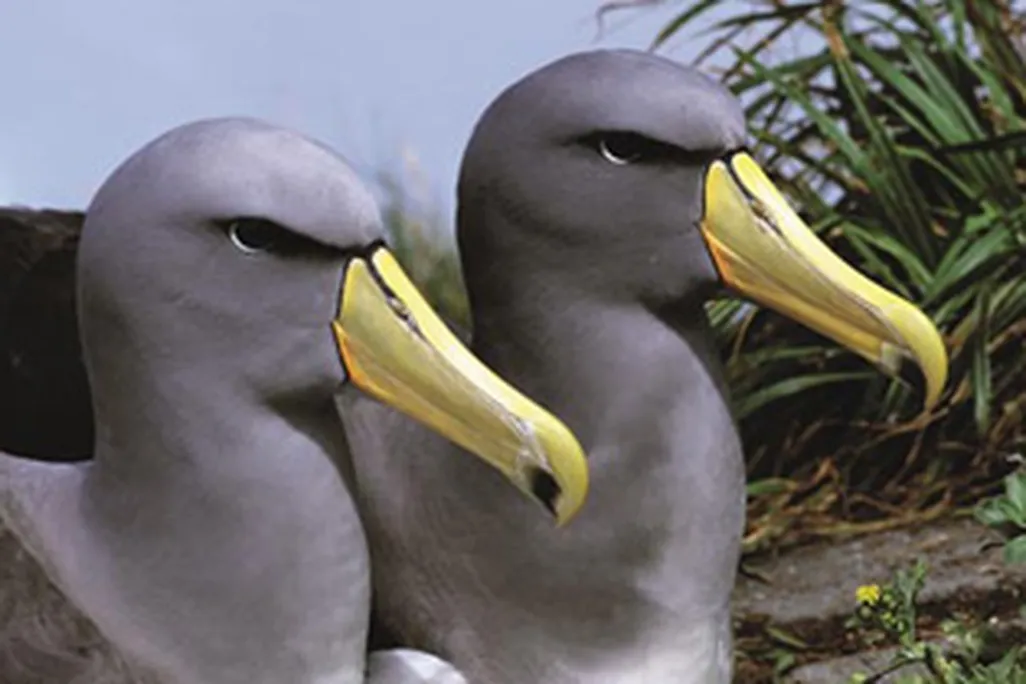
Through the fog steamed our yacht, Mahalia, sliding down gray ocean swells. The gale that had kept us in port for three days in the Chatham Islands, east of New Zealand, had blown itself out, and banks of sea mist lolled in its wake. A fogbow formed on the horizon, and through its bright arch albatrosses rose and fell in an endless roller-coaster glide. Ahead, the mist thinned to reveal a fang of rock rearing 570 feet out of the sea: the Pyramid, the sole breeding site of the Chatham albatross. Around its shrouded summit the regal birds wheeled by the hundreds, their plangent wails and strange kazoo-like cackles echoing off the black volcanic slopes.
The Mahalia's skipper lowered an inflatable dinghy and ran me ashore. Fur seals roused themselves to watch our approach, then, taking fright, tobogganed into the sea. The skipper positioned the craft against a barnacled rock face—no mean feat in the six-foot swells—and I jumped, gripping rubbery stalks of bull kelp and pulling myself up to a jumble of boulders. Sidestepping the fetid pools where seals had been lying, I scrambled up to the only level part of the island, an area about the size of a tennis court, where Paul Scofield, an ornithologist and expert on the Chatham albatross, and his assistant Filipe Moniz had pitched tents, anchoring them with three-inch-long fishhooks wedged into crevices in the rock.
A few feet away a partly fledged Chatham albatross chick stood up on its pedestal nest, yawned and shook its shaggy wings. Then it flumped down with the stoical look one might expect from a creature that had sat on a nest for three months and had another month or two to go.
Around the Pyramid colony adult albatrosses were landing with a whoosh, bringing meals of slurrified seafood to their perpetually hungry offspring. When one alighted near the tents, Scofield and Moniz each picked up a shepherd's crook and crept toward it. The bird tried to take off, its wings stretching some six feet as it ran from Moniz. A swipe with the crook, a bleat of protest, and the albatross was apprehended, snagged by the neck.
Moniz cradled the bird, keeping a tight grip on its devilishly hooked bill, while Scofield taped a popsicle-size GPS logger—a tracking device—between its shoulders, spray-painted its snowy chest with a slash of blue for ease of recognition, and released it. "One down, 11 to go," Scofield said. He and Moniz were planning to stay three weeks on the Pyramid, and they hoped to deploy the devices on a dozen breeding adults to track their movements at sea.
Scofield, of New Zealand's Canterbury Museum and co-author of Albatrosses, Petrels and Shearwaters of the World, has been studying albatrosses for more than 20 years. To research these birds is to commit oneself to months at a time on the isolated, storm-lashed but utterly spectacular specks of land on which they breed: from the Crozet Islands in the Indian Ocean, to South Georgia in the South Atlantic, to Campbell Island and the Snares Islands in New Zealand. Scofield has visited most of them.
Studying albatrosses is also not without risks. In 1985, the yacht taking Scofield to Marion Island in the South Indian Ocean was rolled twice and dismasted, 700 miles south of South Africa. Jury-rigged, the yacht limped to its destination. Scofield and the crew stayed on Marion with other albatross researchers for five months (they had planned on only two days) while waiting for a ship to pick them up. Another time, during a ferocious storm in the Chathams, Scofield and his colleagues had to wear safety harnesses bolted to the rock as they slept in their tents, in case a wave washed over their campsite. Albatross eggs and even adult birds were bowled off their nests by the wind, and Scofield observed more than one parent try to push an egg back onto the nest with its bill—a challenge analogous to rolling a football up a flight of steps with your nose.
Scofield and other albatross researchers return year after year to their field studies knowing that albatrosses are one of the most threatened families of birds on earth. All but 2 of the 21 albatross species recognized by the International Union for the Conservation of Nature are described as vulnerable, endangered or, in the case of the Amsterdam and Chatham albatrosses, critically endangered. The scientists hope that the data they gather may save some species from extinction.
Albatrosses are among the largest seabirds. The "great albatrosses," the wandering and royal albatrosses, have the widest wingspans—ten feet or more—of any living bird. These are the birds of legend: the souls of drowned sailors, the harbinger of fair breezes and the metaphor for penance in Samuel Taylor Coleridge's Rime of the Ancient Mariner: "Ah! well a-day! what evil looks / Had I from old and young! / Instead of the cross, the Albatross / About my neck was hung."
A wandering albatross is a "regal, feathery thing of unspotted whiteness," wrote Herman Melville. They look white in flight, but even the wanderers have a few darker feathers on their wings, and many of the smaller species have varying combinations of black, white, brown and gray plumage.
Albatrosses are masters of soaring flight, able to glide over vast tracts of ocean without flapping their wings. So fully have they adapted to their oceanic existence that they spend the first six or more years of their long lives (which last upwards of 50 years) without ever touching land. Most live in the Southern Hemisphere, the exceptions being the black-footed albatross of the Hawaiian archipelago and a few nearby islands; the short-tailed albatross, which breeds near Japan; the waved albatross of equatorial Galápagos; and the Laysan albatross of the North Pacific.
Everything about albatrosses underscores the difficulty of eking out an existence in their environment. Unlike penguins, which can hunt for extended periods underwater and dive to great depths, albatrosses can plunge into only the top few feet of the ocean, for squid and fish. The lengthy albatross "chickhood" is an adaptation to a patchy food supply: a slow-maturing chick needs food less often than a fast-maturing one. (Similarly, the prolonged adolescence—around 12 years in wandering albatrosses—is an extended education during which birds prospect the oceans, learning where and when to find food.) The chick's nutritional needs cannot be met by a single parent. Mate selection, therefore, is a critical decision, and is all about choosing a partner that can bring home the squid.
Jean-Claude Stahl of the Museum of New Zealand has studied courtship and pairing in southern Buller's albatrosses, which breed on the Snares Islands—a naturalist's El Dorado where penguins patter along forest paths, sea lions sleep in shady glades and myriad shearwaters blacken the evening sky. In Buller's albatrosses the search for a partner takes several years. It begins when adolescent birds are in their second year ashore, at about age 8. They spend time with potential mates in groups known as gams, the albatross equivalent of singles bars. In their third year ashore, males stake a claim to a nest site and females shop around, inspecting the various territory-holding males. "Females do the choosing, and their main criterion seems to be the number of days a male can spend ashore—presumably a sign of foraging ability," says Stahl.
Pairs finally form in the fourth year ashore. Albatross fidelity is legendary; in southern Buller's albatrosses, only 4 percent will choose new partners. In the fifth year, a pair may make its first breeding attempt. Breeding is a two-stage affair. "Females have to reach a sufficiently fat state to trigger the breeding feeling and return to the colony," says Paul Sagar of New Zealand's National Institute of Water and Atmospheric Research. "When they are back, the local food supply determines whether or not an egg is produced."
The breeding pair returns to the same nest year after year, adding a fresh layer of peat and vegetation until the pedestal becomes as tall as a top hat.
Because it takes so long for the birds to produce a chick, albatross populations are keenly vulnerable to threats on their breeding islands. Introduced predators such as rodents and feral cats—the islands have no native land mammals—pose a danger, especially to defenseless chicks, which are left alone for long periods while their parents shuttle back and forth from distant feeding grounds. In one of the most extreme examples of seabird predation, mice on Gough Island, in the South Atlantic, are decimating the populations of petrels and albatrosses that breed there, killing an estimated 1,000 Tristan albatross chicks a year.
Natural disasters also cause heavy losses. In 1985, storm surges washed over two royal albatross breeding islands in the Chathams, killing chicks and, even more problematic, removing much of the islands' scant soil and vegetation. With the albatrosses lacking nesting material in subsequent years, the breeding success rate dropped from 50 percent to 3 percent: the birds laid their eggs on bare rock, and most eggs were broken during incubation.
Yet the most pernicious threats to albatrosses today are not to chicks but to adult birds. Along with other seabirds, they are locked in a competitive battle with humankind for the food resources of the sea—and the birds are losing. This is not just because of the efficiency of modern fishing practices but because fishing equipment—hooks, nets and trawl wires—inflict a heavy toll of injury and death.
John Croxall, a seabird scientist with the British Antarctic Survey, has described the decrease in numbers in some albatross species as "catastrophic." Given the role of fisheries in their decline, he says, knowledge of the birds' distribution at sea and their foraging patterns is "critical to their conservation."
/https://tf-cmsv2-smithsonianmag-media.s3.amazonaws.com/filer/alba2.jpg)
/https://tf-cmsv2-smithsonianmag-media.s3.amazonaws.com/filer/alba_main_pop.jpg)
/https://tf-cmsv2-smithsonianmag-media.s3.amazonaws.com/filer/alba3.jpg)
/https://tf-cmsv2-smithsonianmag-media.s3.amazonaws.com/filer/alba4.jpg)
/https://tf-cmsv2-smithsonianmag-media.s3.amazonaws.com/filer/alba5.jpg)
/https://tf-cmsv2-smithsonianmag-media.s3.amazonaws.com/filer/alba6.jpg)
Over the past two decades, high-tech tracking devices such as the GPS loggers used by Scofield on the Pyramid have begun to fill in gaps in our knowledge about where albatrosses roam and where they are coming into lethal contact with fishing operations. Previously, when an albatross flew away from its breeding island, it virtually disappeared, its activities and whereabouts unknown. But now the lives of these birds are being revealed in all their unimagined complexity, stunning accomplishment and tragic vulnerability.
GPS loggers can give a bird's position to within a few yards. Some loggers also have temperature sensors. By attaching them to the legs of their study birds, scientists can tell when the birds are flying and when they are resting or feeding on the sea, because the water is generally cooler than the air.
As nifty as GPS loggers are, there is a snag: you have to get them back—an outcome by no means guaranteed. Among the larger albatrosses, chick-feeding forays can last ten days or more and encompass thousands of square miles of ocean. Lots of things can go wrong on these outings, particularly in and around commercial fishing grounds, where birds die by the thousands, done in by hooks, nets and the lines that haul them. And because albatrosses have to struggle to take flight in the absence of a breeze, birds may be becalmed on the sea.
On the Pyramid, Scofield was reasonably confident of retrieving his GPS devices. The Chatham albatrosses' feeding forays tend to be relatively short—only a few days—and there was little chance of his birds becoming becalmed in the windy latitudes they inhabit, meridians known to mariners as the Roaring Forties, Furious Fifties and Screaming Sixties. More worrisome to Scofield was the knowledge that the area adjacent to the Chatham Islands—known as the Chatham Rise—is one of New Zealand's richest commercial fishing grounds, replete with orange roughy and several other deep water species. Albatrosses, too, know where fish are found, and the birds sample the most productive fishing areas much as human shoppers make the rounds of favorite stores.
And what expeditions these birds make! From mollymawks, as the smaller species are known, to the great albatrosses, these super-soarers cover tens of thousands of miles in their oceanic forays. Individuals of some species circumnavigate the globe, covering 500 miles a day at sustained speeds of 50 miles per hour.
And then they somehow find their way home—even when home is an outpost in the ocean like the Pyramid, not much bigger than an aircraft carrier. At the start of their breeding season, albatrosses have been tracked making almost ruler-straight trips from distant foraging areas to their nests. Because the birds maintain their course day and night, in cloudy weather and clear, scientists believe they use some kind of magnetic reckoning to fix their position relative to the earth's magnetic field.
The birds also seem able to predict the weather. Southern Buller's albatrosses were found to fly northwest if a low-pressure system, which produces westerly winds, was imminent, and northeast if an easterly wind-producing high-pressure system prevailed. The birds typically chose their direction 24 hours prior to the arrival of the system, suggesting they can respond to barometric cues.
In his autopsy room in Wellington, ornithologist Christopher Robertson slit open a plastic bag containing a white-capped albatross. The swan-sized carcass had been thawing for several days. Along with dozens of other seabirds in Robertson's freezers, this one had been collected at sea for the government's fisheries science program.
Robertson carefully unfolded the bird's wings—wings that would have carried it halfway around the world, between its breeding grounds in New Zealand's Auckland Islands and its feeding grounds in South African seas.
The albatross bore a raw wound at the elbow. Its feathers and skin had been rasped down to bare bone, presumably by the thick steel wires—called warps—that pull a trawl net. Of the 4,000 albatrosses and other seabirds Robertson's group has autopsied over nine years, nearly half have been killed by trawl fisheries, which use giant sock-shaped nets towed at depths of a quarter mile to capture 40 tons of fish in a single haul. (Albatrosses and other large, soaring birds tend to die as a result of collisions with the warps, while smaller, more agile fliers such as petrels and shearwaters are more likely to get ensnared in nets—to be crushed or drowned—while feeding.) The finding has surprised the fishing industry and conservation groups, which have considered longline fishing—in which thousands of baited hooks are fed out behind the fishing vessel—a greater threat to seabirds.
There are no reliable figures for the number of birds killed per year through contact with commercial fishing operations, but estimates for the Southern Ocean are in the tens of thousands. Vessels in well-regulated fisheries are required to minimize their impact on seabirds and report any accidental deaths, but there is a large shadow fleet of illegal, unregulated and unreported (IUU) vessels operating outside the regulations, answering to no one.
Many New Zealand fishers have adopted ingenious methods to reduce injuring and killing seabirds—or attracting them to boats in the first place (see sidebar, opposite). However, there is some evidence to suggest that fisheries may benefit albatross populations: a ready supply of discarded fish reduces competition for food between and within albatross species and provides an alternative food source to predatory birds such as skua, which often attack albatross chicks. Sagar and Stahl's research in the Snares Islands suggests that the free lunch boosts the number of chicks that fledge in a given year. They found that 70 percent of feedings brought by adult birds to their chicks contained discards from nearby fisheries.
Does this mean that fishing is a net benefit to seabird populations? Should the industry be given "a conservation award for the thousands of seabirds it supports," as one fisheries consultant gamely suggested to me?
Not at all, says Stahl. In albatrosses—long-lived, slow-maturing species that produce a single chick every one to two years—the long-term negative impact of adult death far outweighs the short-term benefit of chick survival. It may take three, four or even five successful chick rearings to compensate for the death of just one parent, says Stahl. He calculates that "even small increases in adult mortality can wipe out the benefit of tons of discards fed to chicks."
Although Scofield's tracking of Chatham albatrosses shows that they, too, frequent the same fishing grounds as deep-sea trawlers, not enough work has been done to compare the benefits of chick survival with the costs of adult deaths from fishing vessels. "We don't know the degree to which we're propping them up," says Scofield.
One albatross population that has unashamedly been propped up is the colony of endangered northern royal albatrosses at Taiaroa Head, near the city of Dunedin, on New Zealand's South Island. Taiaroa Head is one of the only places in the world where a visitor can get close to great albatrosses. The colony is tiny, with only 140 individuals, and the breeding effort is managed assiduously—"lovingly" would not be too strong a word.
Royal albatross chicks are nest-bound for nine months. Providing meals for these chicks is so demanding that the parents take a year off before breeding again. Lyndon Perriman, the senior ranger, described to me some of the ingenious techniques used to maximize reproductive success.
"If a bird has been sitting on an egg for 10 days and has not been relieved by its partner, we put the egg in an incubator and give the bird a fiberglass replica to sit on," he said. "If the partner hasn't returned by day 15, we start to supplementary-feed the sitting bird, giving it salmon smolts. But we prefer not to interfere. It could simply be that the partner has hit a patch of calm weather somewhere and is struggling to get back. But at day 20 it's pretty clear the partner isn't coming back, and a chick with only one parent won't survive, so we take the fiberglass egg away, and the bird figures out that breeding for that year is over."
"We also take the egg away from first-time breeders, because they tend to be clumsy with their big webbed feet and are likely to break the egg," Perriman said. "We'll either give the real egg to a pair that's sitting on a dud—broken or infertile or whatever—or keep it in the incubator until it hatches." Breeding success is 72 percent, compared with an estimated 33 percent had humans not assisted.
Adult birds at Taiaroa have died of heat exhaustion, so rangers turn on sprinklers during hot, still days. There was no danger of the birds overheating when I visited, with raindrops spattering the tinted windows of the observatory. I picked up a toy albatross, a life-size replica of a fully grown chick. It was surprisingly heavy, weighted to match the real thing: 20 pounds. Fledglings of most albatross species weigh 50 percent more than adults. They need the extra fat to tide them over when they are learning to feed themselves.
A tour group crowded against the observatory's viewing window. A few yards away an albatross was hunkered down on its nest, protecting its chick from a gale then whipping the hillside. A voice exclaimed: "Look! There she goes!" A chorus of admiring gasps and sighs followed as the bird spread its "vast archangel wings"—Melville's majestic description in Moby-Dick—and soared past the lighthouse on its way out to sea.
Coleridge never saw an albatross, but his Rime introduced a legend. Redemption for the poem's woebegone mariner comes when he embraces all life, no matter how lowly. The moral of the tale, says the mariner to his listener, is this: "He prayeth well, who loveth well / Both man, and bird, and beast." It is a message still worth heeding.
Kennedy Warne, a writer and photographer from Auckland, New Zealand, wrote about Carl Linnaeus in the May 2007 issue.