
Asteroid Hunters
Astronomers are determined to protect human beings from inanimate outer space invaders
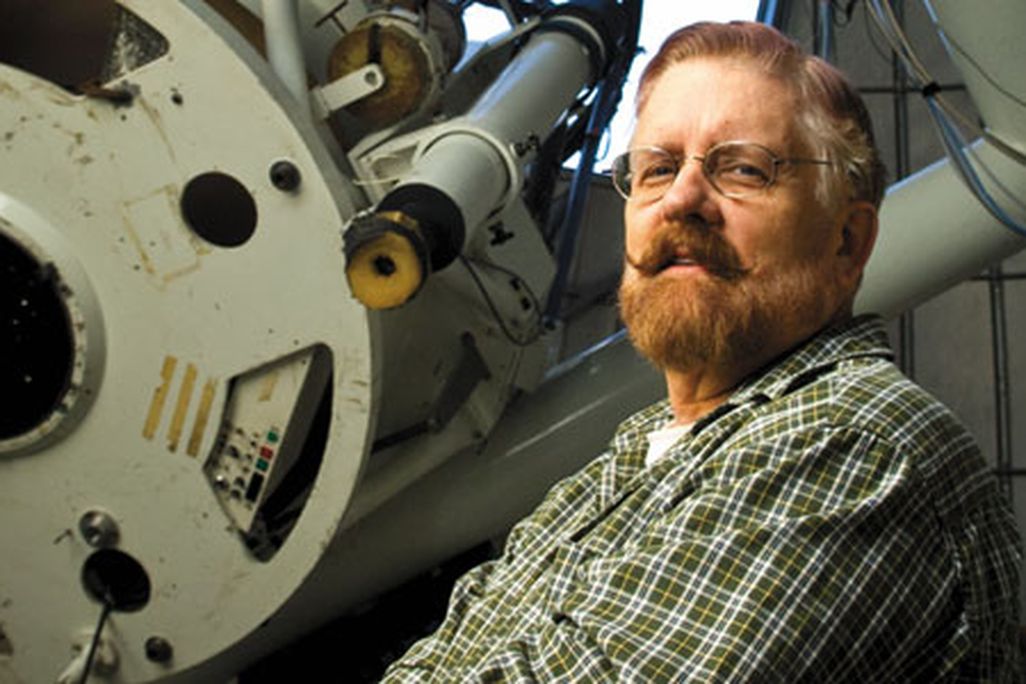
Most of us do what we can for the environment, but Rik Hill’s actual job is to protect the planet. “Whoa, look at that!” he says, pointing at a moving blip of light on a computer screen. “It’s an unknown object. We just discovered one.”
We’re in an observatory on the summit of Mount Lemmon, a 9,000-foot peak north of Tucson, Arizona.
Hill’s boss, Ed Beshore, leans in and nods. “That’s an N-E-O,” he says, referring to a near Earth object. “It’s a nice one. It’s bright, and it’s moving fast.”
Hill, an astronomer, sends an e-mail to the Smithsonian Astrophysical Observatory in Cambridge, Massachusetts, where the Minor Planet Center monitors hundreds of thousands of small bodies in our solar system. The message gives the object’s coordinates at the time of its discovery so other astronomers can track it. And they’ll want to: an NEO is any asteroid or comet that will come within about 30 million miles of Earth’s orbit.
We’ll find out in the morning whether this NEO poses a threat. For now, Hill leans back, a cup of strong coffee in hand, and grins. “It’s not even midnight, and it’s a good night already,” he says. By dawn, he will spot two more.
I went to Mount Lemmon to see the top NEO hunters in action. Beshore and Hill are part of the Catalina Sky Survey, which has found about 2,500 NEOs in the past decade—including 577 in 2009, some 70 percent of the total discovered that year. The rocks range from the size of tables to mountains. Most will bypass Earth. But NEOs have plowed into our planet countless times before, and will do so again.
In October 2008, the survey’s Rich Kowalski observed a small NEO from this telescope. Within two hours, the Minor Planet Center used sightings by others to chart its trajectory. The asteroid would hit Earth in less than a day. Observers worldwide locked onto it, capturing 570 telescope images. NASA scientists calculated it would strike the Nubian Desert of northern Sudan. It was only the size of a small pickup truck, and most of it would burn up in the atmosphere. Even so, news of the imminent impact went all the way to the White House.
About 19 hours after Kowalski discovered it, asteroid 2008 TC3 lit up the sky above Sudan with the energy of more than 1,000 tons of TNT. Black fragments as large as apples landed in the desert. Two months later, NASA-led researchers collected hundreds of the extraterrestrial rocks.
In one sense, spotting the incoming asteroid was a triumph, because it demonstrated that astronomers can detect even a small projectile heading our way. But the feat was also sobering, because they saw it too late to do anything about it. Hill and his fellow NEO hunters hope to detect large asteroids sooner, preferably years or decades in advance.
“It’s the only natural disaster we can stave off,” says Don Yeomans, manager of NASA’s NEO command center at the Jet Propulsion Laboratory (JPL) in Pasadena, California.
Oddballs of the solar system, asteroids are battered chunks of rock and metal that have tumbled around the heavens since the Sun’s eight major planets (plus demoted Pluto) formed about 4.6 billion years ago. Astronomers have cataloged about a half-million asteroids, most in the gap between the orbits of Mars and Jupiter. About 7,000 known NEOs loop wildly among the inner planets, following paths that shift in response to gravity and the Sun’s heat. “Their orbits are all over the place,” says Paul Chodas of JPL. “They’re rebels.”
In the desert 175 miles north of Tucson, Meteor Crater is the scar where a boxcar-size hunk of iron slammed into Earth 50,000 years ago. The crater is nearly a mile wide and 550 feet deep, edged with layers of warped and shattered rock. The asteroid blew up with the energy of the largest hydrogen bombs ever detonated on Earth, vaporizing the desert and unleashing deadly supersonic winds for many miles. I visited the crater as night fell, and I felt keenly aware that fragments of the solar system can invade our cozy realm of Earth and Moon.
If a 100-foot-wide asteroid hit Earth, the shock wave from its explosion in the atmosphere could flatten trees and kill every large animal for hundreds of square miles. That’s just what happened in 1908 at Tunguska, Siberia. The odds are roughly one in ten that such a blast will occur in the next 40 years. An asteroid 500 feet across could destroy a metropolitan area or spawn massive tsunamis. Those impacts occur every 30,000 years, on average.
Hundreds of known NEOs are more than a mile wide. If an asteroid that big struck Earth, firestorms could produce worldwide clouds of soot that would block sunlight and plunge the planet into an “asteroid winter.” That happens every few million years, scientists estimate. Once every 100 million years or so, an even larger asteroid may cause a mass extinction; most scientists believe a six-mile-wide asteroid doomed the dinosaurs 65 million years ago.
Astronomers with the Catalina survey find new NEOs almost every night. They start by taking four pictures of the same patch of sky, with ten minutes between each exposure, and compare them on a computer screen. While background stars shine in the same place in each image, NEOs appear as four distinct dots along a straight line. The astronomers are skilled at ruling out man-made satellites, electronic sparks from cosmic rays and other streaking objects that could be mistaken for an NEO. “They look at everything with the human eye,” NASA’s Yeomans says. “They’ve been doing it for so long, and they’re so dedicated.”
Hill, who has used telescopes since he was a child during the Sputnik era, has been on the team since 1999. He has found more comets—22—than all but three other people in history. (Comets usually originate in the outer solar system and are less common in Earth’s neighborhood than asteroids.) During my visit to Mount Lemmon, he made a trumpeting noise just before he pointed out the first NEO to us. “I love what I do,” he says. “I would do this for free.”
The Catalina Sky Survey consists of nine astronomers using two modest telescopes in Arizona and one in Australia. The team refurbished a long-unused telescope at Mount Lemmon with a 60-inch mirror, small by modern standards. NASA provides $1 million per year—peanuts in astronomy circles. “We’re very careful and meticulous,” says Beshore, a former software engineer who directs the survey. “We get the numbers just right.”
As it happens, astronomers at the Catalina telescope in Australia and other sites around the world took pictures of the NEO after Hill discovered it the night of my visit, allowing the Minor Planet Center to calculate its orbit. By the next morning, the results had been posted online: the asteroid didn’t threaten Earth. I felt a bit let down; no worldwide scoop for me.
Before Beshore joined the survey in 2002, he was skeptical that he’d spot any hazardous asteroids. “Then I realized, my God, the sky is full of these things,” he says. “I have more perspective that yes, this could happen, we might get hit. It would be really satisfying to find an object and then do something about it.”
Don Yeomans often thinks about what that might be. Scale models of asteroids fill the windowsill of his office at JPL in Pasadena. He runs the lab’s NEO clearinghouse, which looks nothing like a Hollywood depiction of a planetary-defense headquarters. There are no wall-size display screens, no blinking panels or red telephones, just ordinary-looking offices. But the workers are well aware of their lofty mission. “We don’t let our guard down, even for a day,” Yeomans says. “It’s our job to monitor the inner solar system and make sure none of these objects gets close to the Earth.”
The tracking starts at the Minor Planet Center, which archives data from a global network of professional and amateur astronomers. “We inventory the solar system,” says center director Tim Spahr. “If the world wants to know about an asteroid, we have the catalog.”
The JPL team takes orbit data from the Minor Planet Center and refines it, asteroid by asteroid. A computer program called Sentry projects each NEO’s orbit for 100 years. Once an asteroid starts approaching Earth, it will do so again and again in an orbital waltz driven by gravity as both bodies travel around the Sun. Most NEOs will plunge into the Sun after a million years of this pas de deux.
“It’s a mathematical problem, and a fascinating one at that,” says JPL’s Chodas. “It’s just exhilarating.”
A 900-foot-wide asteroid called Apophis caused a stir in 2004 when JPL calculated there was a 3 percent chance it would slam into Earth in 2029. With the next set of images, JPL’s Steve Chesley forecast a more precise orbit, and he ruled out an impact. However, there’s still a tiny chance it will hit in 2036 or 2068—depending on the exact route the asteroid follows during its next pass near Earth.
If Apophis did drift onto a collision course and was headed for Russia, a Russian military official said last year, his country might prepare a mission to knock it off course. But that would be premature, Yeomans says. “You have to be careful about moving asteroids around in space,” he adds, lest a deflection inadvertently steer Apophis toward Earth. “They should only be moved if they are a real threat.”
Among the groups studying how best to prevent a collision is the B612 Foundation, named for the asteroid in Antoine de Saint-Exupéry’s The Little Prince. Led by Apollo 9 astronaut Rusty Schweickart, the foundation has proposed a mission to a nonthreatening asteroid to test whether gravity from a hovering spacecraft could shift the asteroid’s orbit. “You don’t want to blow them up,” says Schweickart. “All you need to do to protect Earth is to push them gently.”
Exploding an asteroid would require deploying nuclear weapons in space, scientists say. They caution that no one knows how asteroid material would respond to such a blast. Some NEOs are thought to be loosely packed piles of rubble. One recent study suggests that a deliberate explosion would barely disperse the pieces, and they would reassemble under their own gravity.
In Yeomans’ mind, scientists have already demonstrated the best technique: ramming. In 2005, a NASA science mission called Deep Impact crashed an 816-pound copper mass into a comet to learn more about its icy interior. If scientists were to detect a 600-foot-wide asteroid ten years in advance, Yeomans says, it could be deflected with a two-ton projectile traveling six miles per second. He says that’s enough to make it miss the Earth. Barely.
But given the limited number of astronomers and the small telescopes scanning the sky for asteroid threats, says Yeomans, we probably won’t see a small incoming object until it’s just a week or two away from hitting us. “In that case,” he says, “all you can do is evacuate.”
Robert Irion has written about comets, black holes, new planets and other astronomical phenomena for Smithsonian.
/https://tf-cmsv2-smithsonianmag-media.s3.amazonaws.com/filer/solar-system-near-earth-objects-4.jpg)
/https://tf-cmsv2-smithsonianmag-media.s3.amazonaws.com/filer/Master-Disaster-Mount-Lemmon-2.jpg)
/https://tf-cmsv2-smithsonianmag-media.s3.amazonaws.com/filer/Master-Disaster-Meteor-Crater-3.jpg)
/https://tf-cmsv2-smithsonianmag-media.s3.amazonaws.com/filer/Master-Disaster-Rik-Hill-1.jpg)