
Richard Branson on Space Travel
The billionaire entertainment mogul talks about the future of transportation and clean energy
/https://tf-cmsv2-smithsonianmag-media.s3.amazonaws.com/accounts/headshot/megan.png)
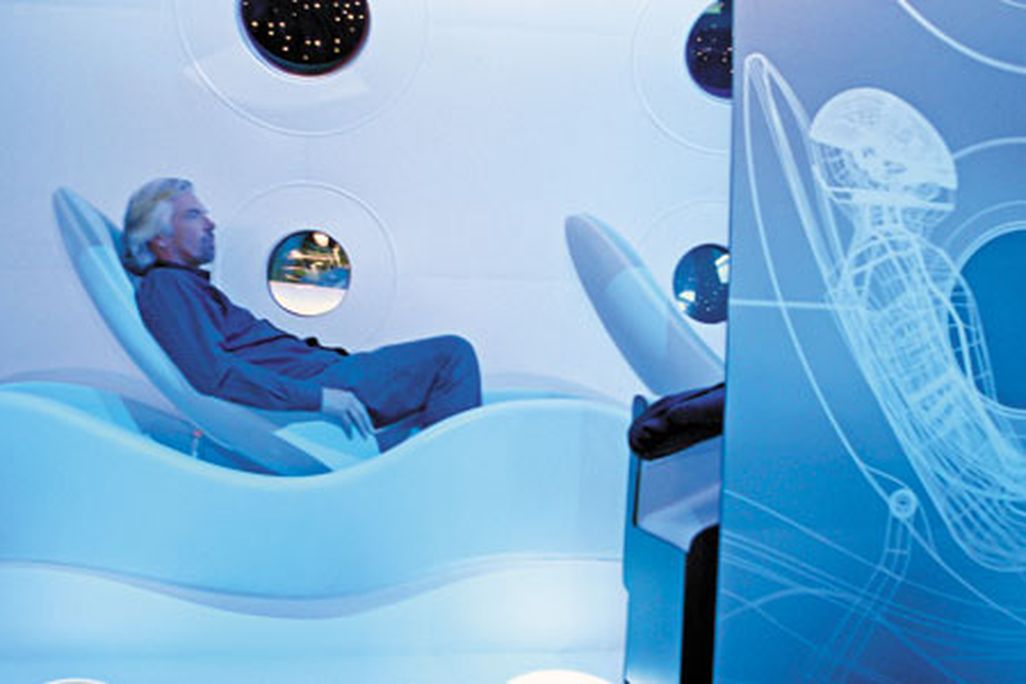
Richard Branson was born in Surrey, England, and founded Virgin Records in 1970 at age 20. The brand now includes more than 300 companies, including Virgin Atlantic Airways, Virgin Trains and Virgin Galactic, a venture that, by 2012, is expected to ferry six passengers 68 miles above the Earth at a cost of $200,000 each. Sir Richard, who conducts business from a private island in the British Virgin Islands, exchanged e-mails with the magazine’s Megan Gambino.
Why commercial space travel?
Industrial and scientific development in the void of space that surrounds our delicate planet will help us carry on living on Earth over the next century. Satellites already deliver information (through agricultural weather satellites and the GPS system) that provides the extra margin of food that keeps nearly a billion people a year from starving. Today’s generation has the technological ability to do more industrial work up there, providing communications, advanced science and even, potentially, solar power and [computer] server farms in space—thus taking CO2-intensive industry out of the atmosphere. The challenge is to get the technology up there in a safe, reliable and cheap way with minimal environmental impact. Nonreusable rockets launched from the ground based on designs from the 1940s are not the answer. It will come from the private sector working with—and independent of—agencies like NASA to bring new materials and technologies into space.
The future for trains?
Rising oil prices, road congestion and tougher tax policy on aviation will force consumers to radically reduce their dependency on car and, yes, domestic air travel. The likely result is that more consumers will turn to rail for domestic travel. It will continue to expand as major manufacturers develop a range of high-speed trains using technology based on non-fossil fuels.
What alternatives are attainable by 2050?
We face an oil peak well before 40 years is up, making it urgent to rid our dependence on imported oil. There is much debate about just how much oil is left in the world, but what is certain is we have seen the last of the cheap oil, and the price of extracting it is only going up as it gets harder to do. We must work faster to change consumer behavior and develop alternative sources of power. Lightweight carbon composite materials will mean it will take less time for us to travel great distances and require less-dirty fuels. Environmental issues are not a charitable adjunct to normal day-to-day business. Governments must issue clear targets to encourage the adoption of electric cars and incentives to invest in renewable fuels and technologies.
/https://tf-cmsv2-smithsonianmag-media.s3.amazonaws.com/accounts/headshot/megan.png)