Married, With Glitches
Will human-robot interactions be undone by technical difficulties?
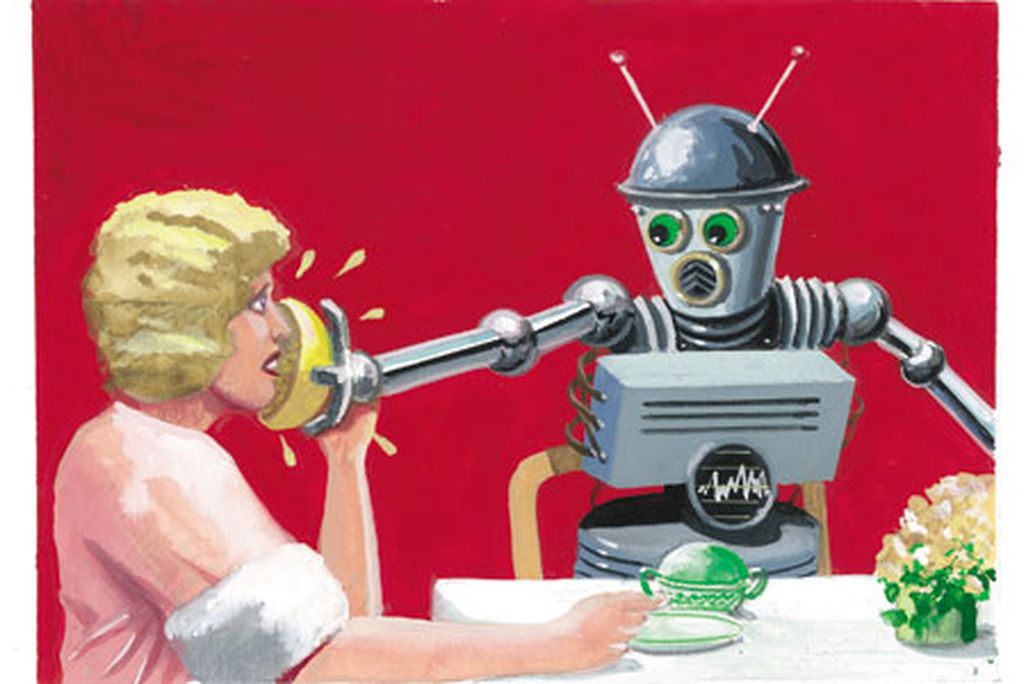
- By Bruce McCall
- Smithsonian magazine, July-August 2010, Subscribe
“My forecast is that around 2050, the state of Massachusetts will be the first jurisdiction to legalize marriages with robots.”
—Artificial intelligence researcher David Levy
Maastricht University
From The American Journal of Annulment and Divorce
June 2053
UNDERLYING CAUSES OF HUMAN-ROBOT MARITAL DISCORD
In the first major study undertaken since the passage of the Automaton Marriage Act of 2050, questionnaires distributed to 125 recently divorced couples have yielded the following findings:
PART I
Humans tire of their robot mates almost three times faster than robots tire of humans.
1. The key reasons cited by humans for dissatisfaction with robots are:
• “That infernal humming.”
• Stench of overheated or burning electrical wires, especially during lovemaking.
• Robots can’t go in the water, limiting family vacation options.
• Simple maintenance regimen among robots (software upgrades, frequent oil changes) spawns corrosive resentment in flesh-and-blood partners.
• Robots refuse to perform household chores, citing “degrading leftover stereotypes dating back to crude 2010-era robot clichés.”
2. Robots disenchanted with human spouses list three primary causes:
• Human minds comparatively slow and sluggish, with limited memory and frequent lapses; need to use pen/pencil even for simple E=mc2 calculations.
• The human need to eat and sleep creates “hopeless” scheduling incompatibilities.
• Snoring.
PART II
Our surveys reveal that extramarital infidelity is the “tipping point” for the deterioration of human-robot relationships.
1. As noted elsewhere in roboliterature (see “Russian Robot Wives Date Cyclotrons,” National Enquirer, March 2047), a notorious flaw of robots’ artificial intelligence technology is an underdeveloped moral sense. Over 75 percent of human-robot marital spats involve rampant robot promiscuity.
2. Survey Q #36: “Is ‘monogamy’ absent from the robot word-recognition program?”: Yes: 98.6 percent. Ought to Be: 1.32 percent. Don’t Know: .08 percent.
PART III
Post-divorce life for humans is generally more fraught than for their robot ex-partners, according to statistics compiled by Massachusetts’ Suddenly-Single Outreach Program:
1. Almost 95 percent of divorced robots patronized a downtown club, appliance store or singles bar within two hours of the final decree. (Figure for divorced humans: 4 percent.)
2. Survey Q #59: “Plan to keep in touch with human former in-laws?”: No responses.
PART IV
Can the robot-human divorce epidemic be curbed? It’s too soon to tell. But helpful clues have surfaced:
1. A panel of ex-NASA pastors concludes that a joint prenuptial reading of any up-to-date robot technical manual can nip many ill-advised person-machine romances in the bud.
2. Given the sobering fact that at least half of all human-robot marriages occur within 48 hours and 15 square miles of major electronics expos, it would appear that the glamorous swirl typical of such venues raises unreal expectations for both human and robot. Better for initial “hookups” to take place in more emotionally neutral settings; e.g., a lab or biomechanics conferences not held in Las Vegas.
Bruce McCall is a writer and artist in New York City.
Subscribe now for more of Smithsonian's coverage on history, science and nature.


Comments (8)
Mara, How do you know that is a male robot,and not a female robot?
Thomas, Are you saying that gay robot/human relationships are wrong?
Mara, Are you stereo typing the male robots as abusive?
Sounds to me like you two are very prejudiced, and are trying to project your damaging views on the rest of us.
Bruce, Well done!!!
Posted by Susan Worth on March 13,2011 | 12:15 PM
Female robot spouse:"Nag,nag,nag"........Male human partner: Click..."Good night dear".......YES
Posted by Joseph Smith on September 21,2010 | 11:47 PM
So do we all now need to experience Ayckbourn's play in order to understand what is funny and what is not? Perhaps that would help me understand why this article's graphic of the male robot shoving a grapefruit in the face of the human female ought to make me laugh? Sorry, but just because something is labelled as a humorous piece does not necessarily mean that it is actually funny... and we need to recognize that sometimes humorists rely on our own negative stereotypes and prejudices to make their jokes effective.
Posted by Mara Rosen on September 11,2010 | 08:26 PM
Lighten up, people!
Sir Alan Ayckbourn wrote a play about this very subject of human - robot relationships. Its called "Comic Potential" and it was a huge hit in London's West End. It also deals with humor and what makes things funny. Thomas, you should read it or see it done. I think you might need it.
Posted by Gretchen Roose on September 6,2010 | 12:56 PM
Even though I can already hear cries of “lighten up” and “get a sense of humor”, I will nevertheless risk derision to express a complaint about Bruce McCall’s last page article “Married, With Glitches” in Smithsonian, July-August 2010.
The major problem with this article is that it leads off a with a David Levy quotation that Massachusetts will be the first jurisdiction to legalize marriage with robots. Whatever the original context of Mr. Levy’s comment, this tongue-in-cheek “forecast” is obviously intended as a commentary on the ongoing legal controversy on gay marriage in the United States. However many times I re-read this to try to enjoy the joke, it unfortunately continues to leave a rather bitter aftertaste.
Gay marriage is evolving as our century’s “duh” social issue, which future generations will look at much as we today look at former prohibitions against woman’s property and voting rights and laws against interracial marriages. Sadly, there remain a large proportion of the public who regard gay people as sub-human or otherwise unworthy of marital rights. In the national debate on gay marriage, I have heard comments such as “what’s next, marriage to your dog?” Such comments seek to trivialize the marriage issue and to degrade gays by comparing to something not even human. Regrettably, Mr. McCall’s piece has the same effect.
I wonder whether the Smithsonian considers it appropriate to make jokes about Massachusett’s position at the forefront of human rights and at the expense of people who continue to struggle for equal treatment under law? Personally, I considered it a joke of considerably bad taste.
Posted by Thomas Whitehorn on August 8,2010 | 06:06 AM
"WOW" is the only word I could think of to describe the contents of the 40th Anniversary Smithsonian. I always look forward to receiving the magazine, but was hesitant about the content of the 40 things you need to know about the next 40 years. It was impossible to put the issue down, and I finished it in one sitting. The 3 articles that caught both my attention and imagination were; George Whisides' "Nanotechnology", Anthony Atala' "Organs Made to Order" and Bonnie Bassler' "Listening to Bacteria". I gravitated to these articles for the reasons that technology fascinates me and I have a personal interest in the outcome of these experiments of the future. Although the subject matter on the "Last Page" fits with this month' theme, the article left me wanting for the usual chuckle.
John Reichert, LaGrange Park, IL.
Posted by John Reichert on July 15,2010 | 03:38 PM
While I certainly wouldn't want the entire magazine to turn into this type of article, I thought it was fabulous. Poignant, yet hilarious - a great way to help us get perspective while being amused and really wonderful at pointing out the way dissatisfaction operates.
Posted by Miriam Pia on July 14,2010 | 03:18 PM
VERY INTERESTING READING. WOULD LIKE TO SEE MORE OF THESE.
Posted by hina bawa on July 10,2010 | 08:21 PM