• Smithsonian
    Institution
  • Travel
    With Us
  • Smithsonian
    Store
  • Smithsonian
    Channel
  • goSmithsonian
    Visitors Guide
  • Air & Space
    magazine

Smithsonian.com

  • Subscribe
  • History & Archaeology
  • Science
  • Ideas & Innovations
  • Arts & Culture
  • Travel & Food
  • At the Smithsonian
  • Photos
  • Videos
  • Games
  • Shop
  • 40th Anniversary

Five Game-Changing Crops That Could Help Feed the Hungry

Food security experts say these crops, if grown more widely, could help feed the hungry
| | | Reddit | Digg | Stumble | Email |
  • By Amanda Bensen
  • Smithsonian magazine, July-August 2010, Subscribe
 
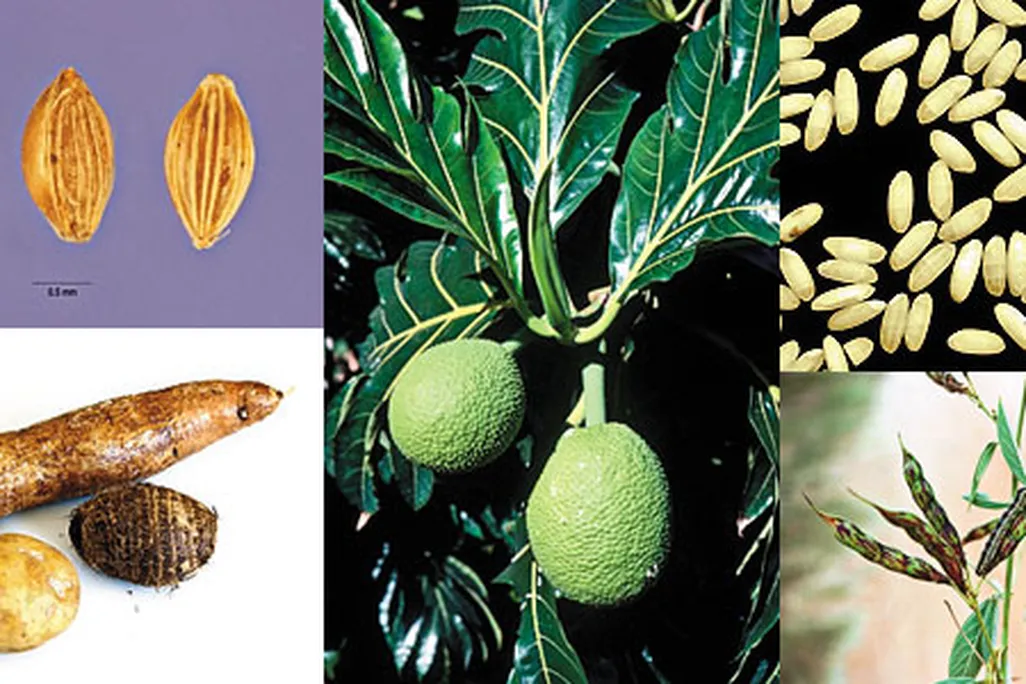
Crops to feed the hungry
Experts say these crops if grown widely, could help feed the hungry. (Clockwise from left: Jose Hernandez, Provided by ARS Systematic Botany and Mycology Laboratory; Frederick R. McConnaughey / Photo Researchers, Inc.; AJ / IRRI / Corbis; Pallava Bagla / Corbis; Scimat / Photo Researchers, Inc.)

Related Links

  • Crops for the Future
  • Golden Rice
  • BioCassava Plus

More from Smithsonian.com

  • Smithsonian magazine's 40th Anniversary
  • Rosamond Naylor on Feeding the World

Fonio (Digitaria exilis)
A type of millet prized in West Africa—the Dogon people of Mali say the universe sprang from a fonio seed—it thrives in poor soil, is rich in amino acid nutrients and provides a tasty base for bread, porridge, pasta and beer.
What’s Next? Develop a more efficient way to harvest the tiny seeds.

Fortified Cassava (Manihot esculenta)
These starchy roots, the source of tapioca, are the primary food for 250 million Africans. Scientists have endowed the traditional plant with new genes that pack the equivalent of
a daily multivitamin into each serving.
Next: Field trials in Nigeria, where the added nutrients could save up to 30,000 lives a year.

Breadfruit (Artocarpus altilis)
Known throughout the tropics, this relative of
the fig tree bears large fruit rich in carbohydrates, fiber and minerals. It requires less land, water and labor to cultivate than other high-starch crops like maize or rice.
Next: Distributing new fast-maturing cultivars to needy farmers.

Pigeon Pea (Cajanus cajan)
This protein-rich legume grows well in much of India, China, sub-Saharan Africa and South America. Its deep roots help it resist droughts while improving soil fertility and reducing erosion.
Next: Integrating hardier pigeon pea hybrids to diversify maize-based agricultural systems.

Golden rice
By inserting daffodil genes into a common rice, scientists created a strain enriched with beta carotene, a source of vitamin A. Health experts say millions of malnourished children worldwide could avoid blindness and death from vitamin A deficiency if they ate this genetically modified grain.
Next: Cross-breeding experimental golden strains with native rice varieties in needy regions of Southeast Asia.


Fonio (Digitaria exilis)
A type of millet prized in West Africa—the Dogon people of Mali say the universe sprang from a fonio seed—it thrives in poor soil, is rich in amino acid nutrients and provides a tasty base for bread, porridge, pasta and beer.
What’s Next? Develop a more efficient way to harvest the tiny seeds.

Fortified Cassava (Manihot esculenta)
These starchy roots, the source of tapioca, are the primary food for 250 million Africans. Scientists have endowed the traditional plant with new genes that pack the equivalent of
a daily multivitamin into each serving.
Next: Field trials in Nigeria, where the added nutrients could save up to 30,000 lives a year.

Breadfruit (Artocarpus altilis)
Known throughout the tropics, this relative of
the fig tree bears large fruit rich in carbohydrates, fiber and minerals. It requires less land, water and labor to cultivate than other high-starch crops like maize or rice.
Next: Distributing new fast-maturing cultivars to needy farmers.

Pigeon Pea (Cajanus cajan)
This protein-rich legume grows well in much of India, China, sub-Saharan Africa and South America. Its deep roots help it resist droughts while improving soil fertility and reducing erosion.
Next: Integrating hardier pigeon pea hybrids to diversify maize-based agricultural systems.

Golden rice
By inserting daffodil genes into a common rice, scientists created a strain enriched with beta carotene, a source of vitamin A. Health experts say millions of malnourished children worldwide could avoid blindness and death from vitamin A deficiency if they ate this genetically modified grain.
Next: Cross-breeding experimental golden strains with native rice varieties in needy regions of Southeast Asia.

    Subscribe now for more of Smithsonian's coverage on history, science and nature.


Related topics: Farming


Additional Sources

“Lost Crops of Africa, Vol. 1: Grains,” Board on Science and Technology for International Development, National Academy Press, 1996.


| | | Reddit | Digg | Stumble | Email |
 

Add New Comment


Name: (required)

Email: (required)

Comment:

Comments are moderated, and will not appear until Smithsonian.com has approved them. Smithsonian reserves the right not to post any comments that are unlawful, threatening, offensive, defamatory, invasive of a person's privacy, inappropriate, confidential or proprietary, political messages, product endorsements, or other content that might otherwise violate any laws or policies.

Comments (3)

Are the Fonia seeds available for planting in the South Africa? If so, would you please send me a link to further pursue this?

Posted by Richard Power on September 18,2011 | 04:01 AM

Thanks, Mrs. Naylor, for pointing out these "new" fields of agriculture. Let's hope people are paying attention and let's hope the new strain of cassava killing germ that's around Lake Victoria doesn't kill off that fortified cassava! One note: breadfruit is not a savory treat, but it could be a staple item like rice and bread are now. You're right - more people are going to go hungry and thirst - a LOT more - because the impetus to change isn't great enough.

Posted by Glenn on November 2,2010 | 07:37 AM

Are the Fonia seeds available for planting in the United States? If so, would you please send me a link to further pursue this?
Thank you,
Dennis Walter

Posted by Dennis Walter on August 17,2010 | 07:09 PM


Advertisement


Most Popular

  • Viewed
  • Emailed
  • Commented
  1. The 20 Best Small Towns in America of 2012
  2. Myths of the American Revolution
  3. The 20 Best Small Towns to Visit in 2013
  4. For 40 Years, This Russian Family Was Cut Off From All Human Contact, Unaware of WWII
  5. The Scariest Monsters of the Deep Sea
  6. 16 Photographs That Capture the Best and Worst of 1970s America
  7. Seven Famous People Who Missed the Titanic
  8. Why Are Finland's Schools Successful?
  9. Will the Real Great Gatsby Please Stand Up?
  10. Women Spies of the Civil War
  1. Why Procrastination is Good for You
  2. The Surprising Satisfactions of a Home Funeral
  3. Mona Eltahawy on Egypt’s Next Revolution
  4. When Continental Drift Was Considered Pseudoscience
  5. The Story Behind Banksy
  6. A Walking Tour of Tallinn
  7. Why Are Finland's Schools Successful?
  8. Microbes: The Trillions of Creatures Governing Your Health

  1. Life on Mars?
  2. A Brief History of the Salem Witch Trials
  3. Will the Real Great Gatsby Please Stand Up?
  4. Taking the Great American Roadtrip
  5. Uncovering Secrets of the Sphinx
  6. The Measure of Genius: Michelangelo’s Sistine Chapel at 500
  7. Life in the City Is Essentially One Giant Math Problem
  8. The Story Behind the Peacock Room's Princess
  9. Looking at the Battle of Gettysburg Through Robert E. Lee’s Eyes
  10. Cut Your Use of Plastic, Plastic, Plastic

View All Most Popular »

Advertisement

Follow Us

Smithsonian Magazine
@SmithsonianMag
Follow Smithsonian Magazine on Twitter

Sign up for regular email updates from Smithsonian.com, including daily newsletters and special offers.

In The Magazine

May 2013

  • Patriot Games
  • The Next Revolution
  • Blowing Up The Art World
  • The Body Eclectic
  • Microbe Hunters

View Table of Contents »


First Name
Last Name
Address 1
Address 2
City
State   Zip
Email


Travel with Smithsonian


Smithsonian Store

Stars and Stripes Throw

Our exclusive Stars and Stripes Throw is a three-layer adaption of the 1861 “Stars and Stripes” quilt... $65


View full archiveRecent Issues


  • May 2013


  • Apr 2013


  • Mar 2013

Newsletter

Sign up for regular email updates from Smithsonian magazine, including free newsletters, special offers and current news updates.

Subscribe Now

About Us

Smithsonian.com expands on Smithsonian magazine's in-depth coverage of history, science, nature, the arts, travel, world culture and technology. Join us regularly as we take a dynamic and interactive approach to exploring modern and historic perspectives on the arts, sciences, nature, world culture and travel, including videos, blogs and a reader forum.

Explore our Brands

  • goSmithsonian.com
  • Smithsonian Air & Space Museum
  • Smithsonian Student Travel
  • Smithsonian Catalogue
  • Smithsonian Journeys
  • Smithsonian Channel
  • About Smithsonian
  • Contact Us
  • Advertising
  • Subscribe
  • RSS
  • Topics
  • Member Services
  • Copyright
  • Site Map
  • Privacy Policy
  • Ad Choices

Smithsonian Institution