
Big Love
In a mating ritual, male humpback whales leap, splash and fight. But researchers ask: just what does a female whale want?
It's a perfect morning for sighting humpback whales. The water is calm under a slight breeze. Researchers Lou Herman and Adam Pack and three assistants scan the horizon with binoculars, looking for the characteristic misty plume blown into the air by a surfacing whale. Herman steers his motor launch, Kohola II, into the shallow waters of Auau Channel, separating Maui and Lanai islands.
"OK, off the starboard, we've got a competitive pod," shouts Pack, of the Dolphin Institute, a research center based in Honolulu. In a competitive pod, a female is accompanied by males vying to mate with her. The contests can be violent—the suitors often attack each other underwater—and the pod grows or shrinks as the melee attracts newcomers and drives others away.
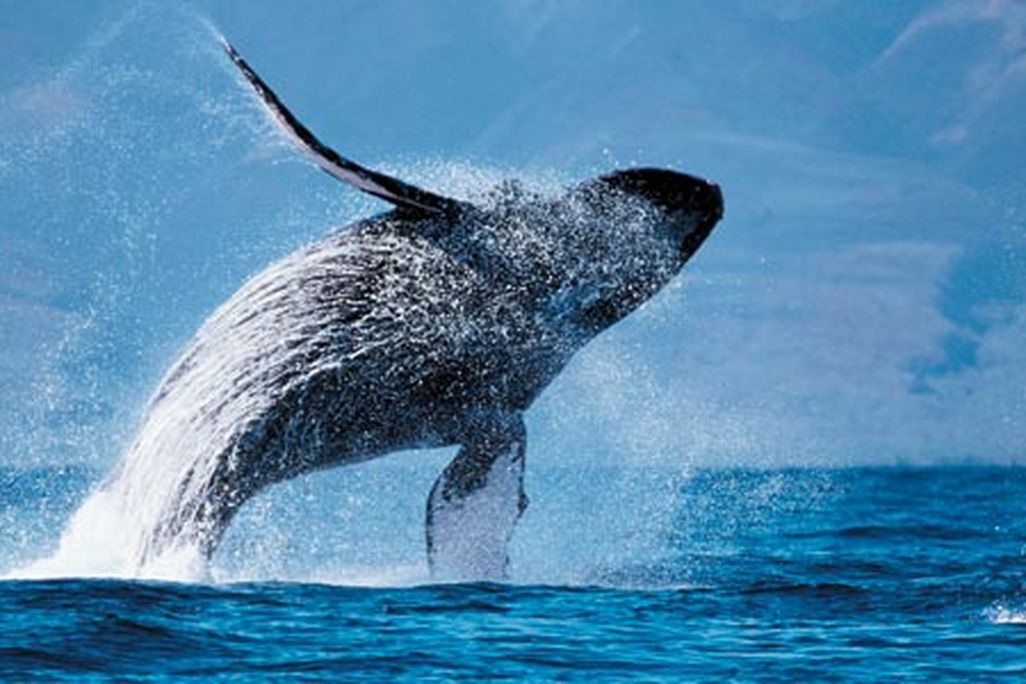
Ten males are now swarming around this female. We watch the whales surface and spout, their black backs arching above the waves almost in unison as they breathe and dive. They're packed tightly together, like a team of motorcycle toughs, and they churn the water white and foamy. Sometimes a male surges ahead, breaking high above the waves to reveal its long, winglike pectoral fins. Thus the animal's scientific name: Megaptera novaeangliae, the giant wing of New England, because the first humpbacks to be scientifically described came from northeastern U.S. waters.
Herman motors in close behind the white wake of the whales. "They're going flukes-up in a minute," Pack calls out, and the others ready their cameras to record the underside of each whale's flukes, or the two halves of its tail. Humpback whales have distinctive black-and-white patterns on their flukes, enabling researchers to identify individuals.
Herman has studied humpbacks here for 34 years, making this one of the longest-running whale research projects. A psychologist by training, Herman studies dolphin intelligence as well as humpback whale behavior; he's now president of the Dolphin Institute. He's published more than a hundred papers on such topics as the songs of humpbacks, their migration routes and interactions between mothers and calves. Pack joined the project in the 1990s, and the two scientists now oversee the life-history records of every whale the team photographs.
"OK, ready, we've got flukes coming up on the right," Pack calls out, as one of the males heads nose-down in a deep dive, the kind that will show off every inch of his tail as it flips up behind him. "Hey, we know him," Pack shouts. "I think we've got a re-sight of Number 48."
The three assistants fire away with their cameras, before the entire pod dives far below the surface.
"Pod's down," Pack announces. "Let's wait a few minutes, and then I want a full-boat watch."
Four minutes go by. "Behind you!" research assistant Aliza Milette shouts from the stern. "Pod up!"
Herman swings the boat around, positioning it again behind the whales, which battle on oblivious to our presence. Pack assigns names as they surface. "This male—maybe Number 48—on the left is Whitehook, the one behind him is Spade, that one with the tall dorsal fin, I'm calling Tall." A male with a slightly tilted dorsal fin is dubbed Slope, and two other males are christened Whitepoint and Flat. The female is referred to simply as N.A., or Nuclear Animal, since most of the action centers on her. N.A. seems not to notice; her dives are slow and smooth, her manner easy and unruffled.
"The female always sets the pace in these shows," Herman says. Yet around her peaceful bulk, all is mayhem. Whitehook heaves himself half out of the water to charge headfirst at another male. He again launches himself skyward, then falls backward, a maneuver Pack calls a "reversal," which makes a male look larger to his rivals. Whitehook then slaps his long jaw on the water, breaches again and makes yet another reversal.
"Wow! He must be the P.E., the principal escort," says Pack. "There's usually one guy in these pods who does most of the showing off."
"It's his way of showing her—and his competitors—his energy and strength," adds Herman. "He's likely to be the one swimming the closest to her, too, and guarding her, keeping the other males away."
"We think the females choose a particular male," says Herman, "but we don't know that for certain, and we don't know what male attributes the females prefer."
Herman and Pack hope to witness a mating, something never before seen in humpback whales. Their grand pursuit would settle some of the most basic questions about the natural history of the species. If females choose their mates, as Herman suspects, observing the whales' mating behavior could reveal which males are most attractive to females. Scientists suspect that the largest, most powerful—and therefore among the oldest—males in a competitive pod are most likely to succeed in mating. In the past, such large whales may have been prime targets for hunters, which may help explain why the humpback whale population dropped so precipitously in the past century.
I stood with a cluster of tourists on a cliff above the Auau Channel and watched humpbacks breach in the waters below. Improbably, given their mass and bulk, they seemed to hover above the sea before crashing backward. At each daring breach, we whale watchers gasped, laughed and applauded. The humpbacks appeared to be having fun, too, seemingly confirming Herman Melville's description of them in Moby-Dick as the "most gamesome and light-hearted of all the whales."
Humpbacks are among the world's largest creatures. Adults weigh as much as 50 tons and grow as long as 50 feet (impressive, but only half the length of blue whales). Like most "great whales," or those longer than 30 feet, they are members of the baleen family, which means they fuel their massive bodies by filtering shrimplike krill and small fish through plates called baleen, which hang from their upper jaws. They spend most of the year feeding in cold, prey-rich waters in the northern and southern oceans. (This year humpbacks were found north of Alaska in the Beaufort Sea for the first time, possibly because of climate change, says Phil Clapham, a whale expert at the National Oceanic and Atmospheric Administration, or NOAA.)
When it's time to breed, humpbacks make the longest migrations of any mammal—5,000 miles or more one way—traveling from the poles to the tropics in as little as six weeks. Some 5,000 humpbacks gather off Hawaii each breeding season, which lasts from December to May. Other breeding sites are in the warm coastal waters of Australia; Fiji, Tonga and other South Pacific islands; the east and west coasts of Africa; the West Indies; and the tropical parts of the Americas.
Photo records of humpback flukes—which are collected by other teams of humpback researchers around the world as well as Herman and Pack—have revealed a greater degree of flexibility in the whales' wanderings than previously imagined. Instead of heading north to Alaska from Hawaii, some whales cross the Pacific Ocean and end up in Japan. And researchers have been following some whales for so long they've seen young calves grow up and have calves of their own. Starting at about age 5, females give birth every two to three years. Pregnancy lasts nearly a year, and the calves nurse for about ten months. Mother and calf travel to their feeding grounds together, a journey that teaches the calf the annual migration route.
Even male humpbacks are more gregarious and social than their nomadic lifestyle might suggest. Males sometimes form temporary alliances while breeding and feeding, and at times both sexes work together to corral fish for feeding. "They're intelligent creatures," says Herman.
Herman has been keeping an eye on Hawaii's humpbacks since 1975. That was the year when "someone mentioned to me that they'd seen humpbacks here, offshore, which was a real surprise," he recalls onboard the Kohola II. (The boat's name is the Hawaiian word for humpback.) "So my wife and I chartered a helicopter. From the air, we spotted a few pods. No one knew there were any humpbacks in these waters until our report." The last mention of humpbacks in Hawaii had been decades earlier. So many of the animals had been slaughtered that they'd all but vanished from local waters.
Humpbacks were nearly hunted to extinction. Harvested in a limited way by coastal peoples for thousands of years, they became a prime target for commercial whalers in the 1800s. Whale oil was as highly prized then as petroleum is today. The northern right whale had been nearly exterminated (because northern right whales, Eubalaena glacialis, float after being killed, whalers said the species was the "right whale" to hunt). And new technological advances—steam-powered ships and explosive harpoons—made it possible for whalers to catch humpbacks efficiently. Demand grew during World War I, when European armies used glycerin from baleen whale oil to make explosives. Commercial whalers moved into feeding grounds near Antarctica where humpbacks, blue, Bryde's, fin and sei whales gathered each year in vast numbers. The whalers commenced a slaughter that continued until 1948, two years after the International Whaling Commission (IWC) was formed with 15 member states to regulate the whale harvest.
Based on whaling records, scientists estimate that whaling nations (primarily the United States, the United Kingdom, Norway and Australia) killed more than 250,000 humpback whales during the 20th century. Certain populations were so reduced that many scientists feared they would never recover. In 1966, the IWC enacted a worldwide moratorium on the commercial hunting of humpback whales, a ban the Soviet Union ignored for seven years. NOAA's Phil Clapham estimates that by 1973, the number of humpbacks remaining may have been "in the low thousands," down from half a million or more.
In 1986, with nearly every whale species hovering close to extinction, the IWC extended the moratorium to all commercial whaling. Only small communities that have traditionally depended on whale meat, such as the coastal Inuit peoples of Alaska and Greenland, are allowed to kill a limited number of the animals. Norway and Iceland have rejected the overall ban; they primarily hunt minke whales, a species that whalers ignored in the past because of its small size. In recent years, Japan has hunted minke, sperm, sei, fin and Bryde's whales under an IWC regulation that allows governments to take whales for scientific research.
Overall, the IWC's moratorium on whale hunting is regarded as one of the most successful conservation measures of the 20th century. At least some populations of gray, Bryde's, blue, bowhead, sei and fin whales are stable or increasing in number. The northern right whale still hasn't recovered, however, and the northwest Pacific population of gray whales numbers less than a hundred. Today, the worldwide population of humpback whales stands at around 70,000.
Citing the humpback population rebound, Japan's Fisheries Agency last November dispatched its whaling ships to the Antarctic's Southern Ocean Sanctuary to harpoon as many as 50 humpbacks annually. In December, after worldwide protests, it postponed the hunt (see sidebar on page 60).
Some humpback experts point out that it's not necessary to kill whales to study them. "We're trying to put a face on each humpback whale," says Pack. "We're building the individual life stories of each one we see—who they spend time with, when they have calves, where they travel."
Aboard the Kohola II, Pack straps on a snorkel and mask and climbs into the water. In one hand he totes a well-worn video camera; with the other hand he strokes out to the area where the pod disappeared. About five feet away from the spot, he gives us a thumbs up, then dives down to join the whales.
After a few minutes, Pack pops to the surface and signals to be picked up. "They're on their way up," he says, as Herman helps pull him aboard.
Dripping from his dive, Pack explains what he saw below: "The N.A. is about 80 feet down, and Whitehook is right below her, chasing off intruders. It's classic mate-guarding behavior. He's making big sweeps with his pectoral fins if any guy comes near her; and if a challenger approaches from the front, he leaves her and makes a head-on attack. He sculled backwards once to take a tail swipe at a secondary escort, and then he sidled up next to her and blew out a linear bubble trail. Right after that, she began surfacing, and everybody followed."
Most of the violent battles among the males take place underwater. Some fights are deadly, Pack says; one male's battered body was found near a competitive pod 12 years ago. The males lunge forward with open jaws to gouge or scrape a rival, use their heads as battering rams or bash each other with their pectoral fins and flukes.
When the pod resurfaces in the channel, two competitors are oozing blood from their bumpy jaws. Their injuries don't slow them down; they plunge back into the fray. Whitehook smashes a whale on his left with his lower jaw, whacks another with his pectoral fin, then rockets skyward while others crash and heave to get out of his way. Another sprays from its blowhole so close to the boat that a fine mist settles over us.
"Oh, great, whale snot on my camera lens," mutters one of the crew.
Whitehook continued his daredevil displays, but was his behavior a prelude to mating? "We wish we knew," says Herman. "We've traveled with many, many competitive pods, and we've both gone in the water and filmed them after a deep dive. But this behavior that you've seen today: does it mean that she'll choose Whitehook for her mate? Or does it mean that he's already mated with her? We don't know. We guess that he's the one she favors, since she lets him stay with her. Maybe one day, we'll be lucky."
Virginia Morell has written about the Zuni Indians, climate science and wildebeests for Smithsonian.