
Corn Plastic to the Rescue
Wal-Mart and others are going green with “biodegradable” packaging made from corn. But is this really the answer to America’s throwaway culture?
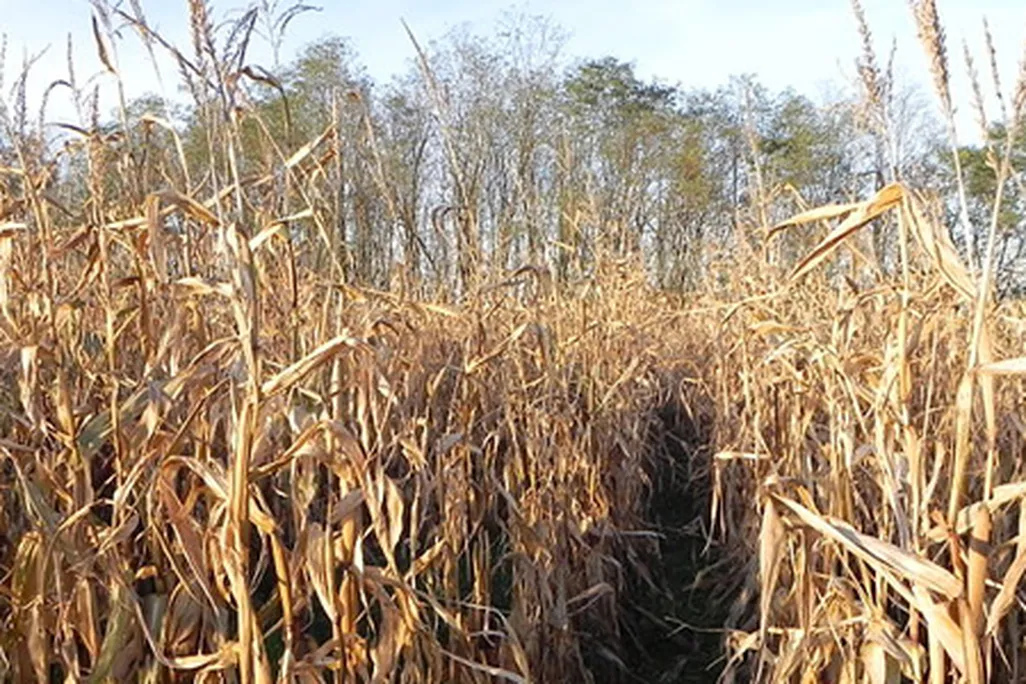
Thirty minutes north of Omaha, outside Blair, Nebraska, the aroma of steaming corn—damp and sweet—falls upon my car like a heavy curtain. The farmland rolls on, and the source of the smell remains a mystery until an enormous, steam-belching, gleaming-white architecture of tanks and pipes rises suddenly from the cornfields between Route 75 and the flood plain of the Missouri River. Behold NatureWorks: the largest lactic-acid plant in the world. Into one end of the complex goes corn; out the other come white pellets, an industrial resin poised to become—if you can believe all the hype—the future of plastic in a post-petroleum world.
The resin, known as polylactic acid (PLA), will be formed into containers and packaging for food and consumer goods. The trendy plastic has several things going for it. It’s made from a renewable resource, which means it has a big leg up—both politically and environmentally—on conventional plastic packaging, which uses an estimated 200,000 barrels of oil a day in the United States. Also, PLA is in principle compostable, meaning that it will break down under certain conditions into harmless natural compounds. That could take pressure off the nation’s mounting landfills, since plastics already take up 25 percent of dumps by volume. And corn-based plastics are starting to look cheap, now that oil prices are so high.
For a few years, natural foods purveyors such as Newman’s Own Organics and Wild Oats have been quietly using some PLA products, but the material got its biggest boost when Wal-Mart, the world’s largest retailer, announced this past October that it would sell some produce in PLA containers. The move is part of the company’s effort to counter criticisms that it has been environmentally irresponsible. “Moving toward zero waste is one of our three big corporate goals for the environment,” says Matt Kistler, vice president of private brands and product development for the retailer. Wal-Mart plans to use 114 million PLA containers a year, which company executives estimate will save 800,000 barrels of oil annually.
To make plastic packaging and containers from a renewable resource that can be returned to the earth as fertilizer sounds like an unmitigated good. Selling fruits and veggies in boxes that don’t leach chemicals into landfills sounds equally wonderful. But PLA has considerable drawbacks that haven’t been publicized, while some claims for its environmental virtues are downright misleading. It turns out there’s no free lunch after all, regardless of what its container is made of, as I learned when I tried to get to the bottom of this marvelous news out of corn country.
At the NatureWorks plant in Blair, I don a hard hat, earplugs, gloves and protective eyewear and swear that I will snap no photographs. What can be revealed by my hosts is revealed: corn kernels are delivered and milled, dextrose is extracted from starch. Huge fermenters convert the dextrose into lactic acid, a simple organic chemical that is a by-product of fermentation (or respiration, in the case of the lactic acid that builds up in muscle tissue after intense activity). Industrial lactic acid is derived from many starchy sources, including wheat, beets and potatoes, but NatureWorks is owned by Cargill, the world’s largest corn merchant, and so its lactic acid comes from corn. The compound is converted to lactide, and lactide molecules are linked into long chains or polymers: polylactic acid, PLA.
I did get a chance to see and touch the obscure object of my desire when some liquid PLA, with the color and shine of caramelized sugar, burst from a pipe and solidified in flossy strands on the steel-grated floor. The next time I saw the stuff, in a box in a warehouse, it had been crystallized into translucent white balls the size of peas: PLA resin. In the hands of fabricators, the pellets would be melted and reshaped into containers, films and fibers.
Though the polymer, because of its low melting point, doesn’t yet have as many applications as does the far more common plastic polyethylene terephthalate (PET), used to make soda bottles and some polyester fibers, the company has plans, as a large banner in the office proclaims, to “Beat PET!” In some ways, corn plastic is clearly easier on the environment. Producing PLA uses 65 percent less energy than producing conventional plastics, according to an independent analysis commissioned by NatureWorks. It also generates 68 percent fewer greenhouse gases, and contains no toxins. “It has a drastically different safety profile,” says NatureWorks operations manager Carey Buckles. “It’s not going to blow up the community.”
For retailers, PLA has a halo effect. Wild Oats was an early adopter of the stuff. “Our employees loved the environmental message of the containers, that they came from a renewable resource, and our customers had a strong reaction when we told them they were compostable,” says Sonja Tuitele, a Wild Oats spokesperson. The containers initially boosted the company’s deli sales by 17 percent, she says, and the chain now uses six million PLA containers a year. Newman’s Own Organics uses PLA packaging for its salad mixes. “We felt strongly that everywhere we can get out of petroleum products, we should,” says Newman’s Own CEO Peter Meehan. “No one has ever gone to war over corn.”
Wal-Mart, which has begun using PLA containers in some stores, has also switched packaging on high-end electronics from PET to a sandwich of cardboard and PLA. “It has a smaller packaging footprint, it’s completely biodegradable and it costs less,” says Kistler. What Wal-Mart says about PLA’s biodegradable nature is true, but there’s an important catch.
Corn plastic has been around for 20 years, but the polymer was too expensive for broad commercial applications until 1989, when Patrick Gruber, then a Cargill chemist looking for new ways to use corn, invented a way to make the polymer more efficiently. Working with his wife, also a chemist, he created his first prototype PLA products on his kitchen stove. In the beginning, it cost $200 to make a pound of PLA; now it’s less than $1.
The polymer has had to get over some cultural hurdles. In the mid-1980s, another bio-based plastic appeared on grocery store shelves: bags made from polyethylene and cornstarch that were said to be biodegradable. “People thought they would disappear quickly,” recalls Steven Mojo, executive director of the Biodegradable Products Institute. They didn’t. Will Brinton, president of Woods End, a compost research laboratory in Mt. Vernon, Maine, says the bags broke into small fragments of polyethylene, fragments that weren’t good for compost—or public relations. “It was a big step backward for the biodegradability movement,” he adds. “Whole communities abandoned the concept of biodegradable bags as a fraud.”
According to a biodegradability standard that Mojo helped develop, PLA is said to decompose into carbon dioxide and water in a “controlled composting environment” in fewer than 90 days. What’s a controlled composting environment? Not your backyard bin, pit or tumbling barrel. It’s a large facility where compost—essentially, plant scraps being digested by microbes into fertilizer—reaches 140 degrees for ten consecutive days. So, yes, as PLA advocates say, corn plastic is “biodegradable.” But in reality very few consumers have access to the sort of composting facilities that can make that happen. NatureWorks has identified 113 such facilities nationwide—some handle industrial food-processing waste or yard trimmings, others are college or prison operations—but only about a quarter of them accept residential foodscraps collected by municipalities.
Moreover, PLA by the truckload may potentially pose a problem for some large-scale composters. Chris Choate, a composting expert at Norcal Waste Systems, headquartered in San Francisco, says large amounts of PLA can interfere with conventional composting because the polymer reverts into lactic acid, making the compost wetter and more acidic. “Microbes will consume the lactic acid, but they demand a lot of oxygen, and we’re having trouble providing enough,” he says. “Right now, PLA isn’t a problem,” because there’s so little of it, Choate says. (NatureWorks disputes that idea, saying that PLA has no such effect on composting processes.) In any event, Norcal says a future PLA boom won’t be a problem because the company hopes to convert its composters to so-called anaerobic digesters, which break down organic material in the absence of oxygen and capture the resulting methane for fuel.
/https://tf-cmsv2-smithsonianmag-media.s3.amazonaws.com/filer/pla_choate_388.jpg)
/https://tf-cmsv2-smithsonianmag-media.s3.amazonaws.com/filer/pla_buckles.jpg)
/https://tf-cmsv2-smithsonianmag-media.s3.amazonaws.com/filer/pla_gruber.jpg)
/https://tf-cmsv2-smithsonianmag-media.s3.amazonaws.com/filer/pla_lombardi.jpg)
Wild Oats accepts used PLA containers in half of its 80 stores. “We mix the PLA with produce and scraps from our juice bars and deliver it to an industrial composting facility,” says the company’s Tuitele. But at the Wild Oats stores that don’t take back PLA, customers are on their own, and they can’t be blamed if they feel deceived by PLA containers stamped “compostable.” Brinton, who has done extensive testing of PLA, says such containers are “unchanged” after six months in a home composting operation. For that reason, he considers the Wild Oats stamp, and their in-store signage touting PLA’s compostability, to be false advertising.
Wal-Mart’s Kistler says the company isn’t about to take back used PLA for composting. “We’re not in the business of collecting garbage,” he says. “How do we get states and municipalities to set up composting systems? That is the million-dollar question. It’s not our role to tell government what to do. There is money to be made in the recycling business. As we develop packaging that can be recycled and composted, the industry will be developed.”
For their part, recycling facilities have problems with PLA too. They worry that consumers will simply dump PLA in with their PET. To plastic processors, PLA in tiny amounts is merely a nuisance. But in large amounts it can be an expensive hassle. In the recycling business, soda bottles, milk jugs and the like are collected and baled by materials recovery facilities, or MRFs (pronounced “murfs”). The MRFs sell the material to processors, which break down the plastic into pellets or flakes, which are, in turn, made into new products, such as carpeting, fiberfill, or containers for detergent or motor oil. Because PLA and PET mix about as well as oil and water, recyclers consider PLA a contaminant. They have to pay to sort it out and pay again to dispose of it.
NatureWorks has given this problem some thought. “If the MRF separates the PLA, we’ll buy it back from them when they’ve got enough to fill a truck,” says spokeswoman Bridget Charon. The company will then either take the PLA to an industrial composter or haul it back to Blair, where the polymer will be broken down and remade into fresh PLA.
Despite PLA’s potential as an environmentally friendly material, it seems clear that a great deal of corn packaging, probably the majority of it, will end up in landfills. And there’s no evidence it will break down there any faster or more thoroughly than PET or any other form of plastic. Glenn Johnston, manager of global regulatory affairs for NatureWorks, says that a PLA container dumped in a landfill will last “as long as a PET bottle.” No one knows for sure how long that is, but estimates range from 100 to 1,000 years.
Environmentalists have other objections to PLA. Lester Brown, president of the Earth Policy Institute, questions the morality of turning a foodstuff into packaging when so many people in the world are hungry. “Already we’re converting 12 percent of the U.S. grain harvest to ethanol,” he says. The USDA projects that figure will rise to 23 percent by 2014. “How much corn do we want to convert to nonfood products?” In addition, most of the corn that NatureWorks uses to make PLA resin is genetically modified to resist pests, and some environmentalists oppose the use of such crops, claiming they will contaminate conventional crops or disrupt local ecosystems. Other critics point to the steep environmental toll of industrially grown corn. The cultivation of corn uses more nitrogen fertilizer, more herbicides and more insecticides than any other U.S. crop; those practices contribute to soil erosion and water pollution when nitrogen runs off fields into streams and rivers.
NatureWorks, acknowledging some of those criticisms, points out that the corn it uses is low-grade animal feed not intended for human use. And it processes a small amount of non-genetically engineered corn for customers who request it. NatureWorks is also investigating better ways to segregate PLA in traditional recycling facilities, and it’s even buying renewable energy certificates (investments in wind power) to offset its use of fossil fuels. But there’s not much the company can do about the most fundamental question about corn plastic containers: Are they really necessary?
A few miles south of Blair, in Fort Calhoun, Wilkinson Industries occupies a sprawling, low brick building in a residential neighborhood. Wilkinson converts NatureWorks resin into packaging. In a warehouse-size room, the pellets are melted, pressed into a thin film and stretched into sheets that a thermoformer stamps into rigid containers—square, tall, rectangular or round. (PLA can also take the shape of labels, electronics casings, wrap for flowers, gift cards, clothing fiber and pillow stuffing.) “We’re shipping trays to Google’s cafeteria and to [filmmaker] George Lucas’ studio in San Francisco,” says Joe Selzer, a Wilkinson vice president. “We do trays for Del Monte’s and Meijer stores’ fresh cut fruit. And, oh yeah, we do Wal-Mart.”
PLA amounts to about 20 percent of the plastic products made by Wilkinson. The rest is polystyrene and PET. “We’d like to see PLA be the resin of the future, but we know it never will be,” says Selzer. “It’s cost stable, but it can’t go above 114 degrees. I’ve had people call me and say, ‘Oh my god, I had my takeout box in my car in the sun and it melted into a pancake!’” Bridget Charon, sitting next to me, raises an eyebrow. Selzer continues. “Our number-one concern is PLA’s competitive price, and then its applications. After that comes the feel-good.”
Selzer leads us up a staircase to an interior room the size of a large pantry. It’s crammed with samples of the 450 different containers fabricated by Wilkinson, which also stamps out aluminum trays. “Here’s Kentucky Fried Chicken’s potpie,” Selzer says, pointing to a small round tin. “This plastic tray is for a wedding cake. This one’s for crudités. This is for cut pineapple.” (Wilkinson manufactured the original TV dinner tray, a sample of which resides in the Smithsonian Institution.) As I look around, I can’t help thinking that almost all these products will be dumped, after just an hour or two of use, straight into a big hole in the ground.
Martin Bourque, executive director of the Berkeley Ecology Center, a nonprofit recycling organization, holds a dim view of PLA convenience packaging. “Yes, corn-based packaging is better than petroleum-based packaging for absolutely necessary plastics that aren’t already successfully recycled, and for packaging that cannot be made of paper,” he says. “But it’s not as good as asking, ‘Why are we using so many containers?’ My worry is that PLA legitimizes single-serving, over-packaged products.”
Many ecologists argue that companies should produce consumer goods that don’t pollute the earth in their manufacture or disposal. In Cradle to Cradle: Remaking the Way We Make Things, the architect William McDonough writes about a future in which durable goods, like TVs and cars, are made from substances that cycle back into the manufacturing process, while packaging for short-lived products, like shampoo, will decompose back into the earth. NatureWorks says it wants to be part of that future. As the company’s former CEO, Kathleen Bader, told Forbes magazine, “We’re offering companies a chance to preempt embarrassing demands for responsible packaging. Brands that wait for legislative fiat will be left behind and exposed.”
Eric Lombardi, president of the Grassroots Recycling Network and a leader in the international Zero Waste movement, takes a nuanced view of PLA’s progress. He says it’s “visionary” even to think about biologically based plastic instead of a petroleum-based one. True, he says, there are problems with PLA, “but let’s not kill the good in pursuit of the perfect.” He suggests that the difficulty disposing of PLA reflects a larger deficiency in how we handle trash. He’s calling for a composting revolution. “We need a convenient, creative collection system with three bins: one for biodegradables, which we’ll compost, one for recycling, and one for whatever’s left.”
Until such a system is in place, it’s going to be hard to have cheap convenience packaging and feel good about its environmental effect—to have our takeout cake and eat it too. But the manufacture of PLA does save oil and generates far less air pollution. And we have to start somewhere.
Elizabeth Royte, a resident of Brooklyn, is the author of Garbage Land: On the Secret Trail of Trash. Photographer Brian Smale is based in Seattle.