Content ID:
Field:


  • About Smithsonian
  • Email Updates
  • Member Services
  • Shop
  • Archive
Smithsonian.com
  • Smithsonian Institution
  • Smithsonian Channel
  • goSmithsonian
  • Air & Space magazine
  • Home
  • History & Archaeology
  • People & Places
  • Science & Nature
  • Arts & Culture
  • Travel
  • Photos & Videos
  • Games & Puzzles
  • Subscribe
  • Anthropology & Behavior
  • Dinosaurs
  • Environment
  • Technology & Space
  • Wildlife
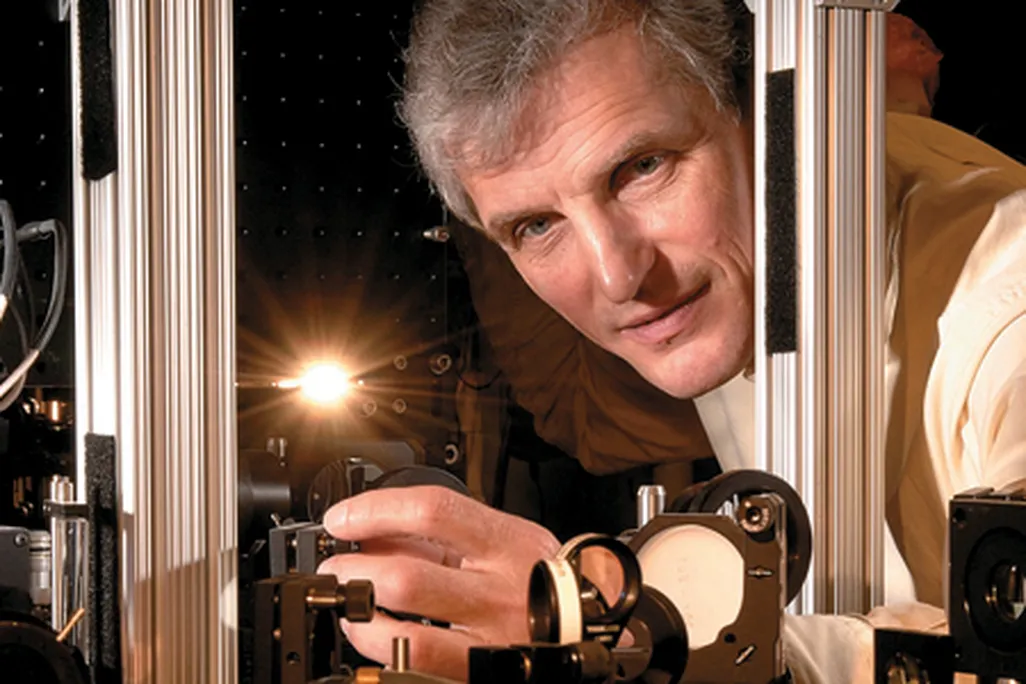
Bright idea: Wolfgang Ketterle (in his M.I.T lab) hopes to discover new forms of matter by studying ultracold atoms. Bright idea: Wolfgang Ketterle (in his M.I.T lab) hopes to discover new forms of matter by studying ultracold atoms.

Richard Howard

  • Science & Nature

The Coldest Place in the Universe

Physicists in Massachusetts come to grips with the lowest possible temperature: absolute zero
  • By Tom Shachtman
  • Smithsonian magazine, January 2008

Article Tools

  • Font
  • Share/Save/Bookmark Share
  • Email
  • Print
  • Digg Digg
  • Comments
  • StumbleUpon StumbleUpon
  • RSS
  • Reddit Reddit

    Related Topics

    Physics

    Related Links

    Wolfgang Ketterle’s MIT Website
    Lene Vestergaard Hau’s Harvard University Website

    Related Books

    Absolute Zero and the Conquest of Cold

    by Tom Shachtman
    Mariner Books, 1999

    (Page 2 of 2)

    More from Smithsonian.com
    • Absolute Zero
    • Tracking the Bighorns

    She is able to manipulate light this way because the density and the temperature of the BEC slows pulses of light down. (She recently took the experiments a step further, stopping a pulse in one BEC, converting it into electrical energy, transferring it to another BEC, then releasing it and sending it on its way again.) Hau uses BECs to discover more about the nature of light and how to use "slow light"—that is, light trapped in BECs—to improve the processing speed of computers and provide new ways to store information.

    Not all ultracold research is performed using BECs. In Finland, for instance, physicist Juha Tuoriniemi magnetically manipulates the cores of rhodium atoms to reach temperatures of 180 trillionths of a degree F above absolute zero. (The Guinness record notwithstanding, many experts credit Tuoriniemi with achieving even lower temperatures than Ketterle, but that depends on whether you're measuring a group of atoms, such as a BEC, or only parts of atoms, such as the nuclei.)

    It might seem that absolute zero is worth trying to attain, but Ketterle says he knows better. "We're not trying," he says. "Where we are is cold enough for our experiments." It's simply not worth the trouble—not to mention, according to physicists' understanding of heat and the laws of thermodynamics, impossible. "To suck out all the energy, every last bit of it, and achieve zero energy and absolute zero—that would take the age of the universe to accomplish."

    Tom Shachtman is the author of Absolute Zero and the Conquest of Cold, the basis for a future PBS "Nova" documentary.

    Where's the coldest spot in the universe? Not on the moon, where the temperature plunges to a mere minus 378 Fahrenheit. Not even in deepest outer space, which has an estimated background temperature of about minus 455°F. As far as scientists can tell, the lowest temperatures ever attained were recently observed right here on earth.

    The record-breaking lows were among the latest feats of ultracold physics, the laboratory study of matter at temperatures so mind-bogglingly frigid that atoms and even light itself behave in highly unusual ways. Electrical resistance in some elements disappears below about minus 440°F, a phenomenon called superconductivity. At even lower temperatures, some liquefied gases become "superfluids" capable of oozing through walls solid enough to hold any other sort of liquid; they even seem to defy gravity as they creep up, over and out of their containers.

    Physicists acknowledge they can never reach the coldest conceivable temperature, known as absolute zero and long ago calculated to be minus 459.67°F. To physicists, temperature is a measure of how fast atoms are moving, a reflection of their energy—and absolute zero is the point at which there is absolutely no heat energy remaining to be extracted from a substance.

    But a few physicists are intent on getting as close as possible to that theoretical limit, and it was to get a better view of that most rarefied of competitions that I visited Wolfgang Ketterle's lab at the Massachusetts Institute of Technology in Cambridge. It currently holds the record—at least according to Guinness World Records 2008—for lowest temperature: 810 trillionths of a degree F above absolute zero. Ketterle and his colleagues accomplished that feat in 2003 while working with a cloud—about a thousandth of an inch across—of sodium molecules trapped in place by magnets.

    I ask Ketterle to show me the spot where they'd set the record. We put on goggles to protect ourselves from being blinded by infrared light from the laser beams that are used to slow down and thereby cool fast-moving atomic particles. We cross the hall from his sunny office into a dark room with an interconnected jumble of wires, small mirrors, vacuum tubes, laser sources and high-powered computer equipment. "Right here," he says, his voice rising with excitement as he points to a black box that has an aluminum-foil-wrapped tube leading into it. "This is where we made the coldest temperature."

    Ketterle's achievement came out of his pursuit of an entirely new form of matter called a Bose-Einstein condensate (BEC). The condensates are not standard gases, liquids or even solids. They form when a cloud of atoms—sometimes millions or more—all enter the same quantum state and behave as one. Albert Einstein and the Indian physicist Satyendra Bose predicted in 1925 that scientists could generate such matter by subjecting atoms to temperatures approaching absolute zero. Seventy years later, Ketterle, working at M.I.T., and almost simultaneously, Carl Wieman, working at the University of Colorado at Boulder, and Eric Cornell of the National Institute of Standards and Technology in Boulder created the first Bose-Einstein condensates. The three promptly won a Nobel Prize. Ketterle's team is using BECs to study basic properties of matter, such as compressibility, and better understand weird low-temperature phenomena such as superfluidity. Ultimately, Ketterle, like many physicists, hopes to discover new forms of matter that could act as superconductors at room temperature, which would revolutionize how humans use energy. For most Nobel Prize winners, the honor caps a long career. But for Ketterle, who was 44 years old when he was awarded his, the creation of BECs opened a new field that he and his colleagues will be exploring for decades.

    Another contender for the coldest spot is across Cambridge, in Lene Vestergaard Hau's lab at Harvard. Her personal best is a few millionths of a degree F above absolute zero, close to Ketterle's, which she, too, reached while creating BECs. "We make BECs every day now," she says as we go down a stairwell to a lab packed with equipment. A billiards-table-size platform at the center of the room looks like a maze constructed of tiny oval mirrors and pencil-lead-thin laser beams. Harnessing BECs, Hau and her co-workers have done something that might seem impossible: they have slowed light to a virtual standstill.

    The speed of light, as we've all heard, is a constant: 186,171 miles per second in a vacuum. But it is different in the real world, outside a vacuum; for instance, light not only bends but also slows ever so slightly when it passes through glass or water. Still, that's nothing compared with what happens when Hau shines a laser beam of light into a BEC: it's like hurling a baseball into a pillow. "First, we got the speed down to that of a bicycle," Hau says. "Now it's at a crawl, and we can actually stop it—keep light bottled up entirely inside the BEC, look at it, play with it and then release it when we're ready."

    She is able to manipulate light this way because the density and the temperature of the BEC slows pulses of light down. (She recently took the experiments a step further, stopping a pulse in one BEC, converting it into electrical energy, transferring it to another BEC, then releasing it and sending it on its way again.) Hau uses BECs to discover more about the nature of light and how to use "slow light"—that is, light trapped in BECs—to improve the processing speed of computers and provide new ways to store information.

    Not all ultracold research is performed using BECs. In Finland, for instance, physicist Juha Tuoriniemi magnetically manipulates the cores of rhodium atoms to reach temperatures of 180 trillionths of a degree F above absolute zero. (The Guinness record notwithstanding, many experts credit Tuoriniemi with achieving even lower temperatures than Ketterle, but that depends on whether you're measuring a group of atoms, such as a BEC, or only parts of atoms, such as the nuclei.)

    It might seem that absolute zero is worth trying to attain, but Ketterle says he knows better. "We're not trying," he says. "Where we are is cold enough for our experiments." It's simply not worth the trouble—not to mention, according to physicists' understanding of heat and the laws of thermodynamics, impossible. "To suck out all the energy, every last bit of it, and achieve zero energy and absolute zero—that would take the age of the universe to accomplish."

    Tom Shachtman is the author of Absolute Zero and the Conquest of Cold, the basis for a future PBS "Nova" documentary.


    1 2


    Related topics: Physics

     
    Comments

    you should not have left out the graphic from page 21 of the print issue

    Posted by frank on December 22,2007 | 10:42AM

    I loved the article on the Coldest Place in the Universe (in the January 2008 issue)and want to use it in my classes, where we are about to begin thermodynamics. The trouble is, you used Fahrenheit degrees instead of Celsius, and never mentioned the Kelvin scale. My students are confused enough without having to translate your -459.67oF to -273.15oC. I wish Smithsonian would go to metric. Trying to be suitable for all, you make it tough for those of us who are teaching science. Thanks to Tom Shchtman for a really good piece. Regards. Paul Barra

    Posted by Paul A. Barra on December 25,2007 | 06:15AM

    Thoroughly enjoyed the article however one question came to mind. There was a chart explaining that the coldest temperature in deep space was -455°F. If light slows down to nearly stopping at absolute 0 (459.67°F) then how does the coldest temperature in space affect travel time from source to viewer? Astronomers have measured the distance to stars by knowing the speed of light but are these distances correct if the speed of light has slowed due to extremely cold temperatures? Just curious.

    Posted by Ed on December 26,2007 | 06:56AM

    If, "To physicists, temperature is a measure of how fast atoms are moving, ……", is it possible to talk about any temperature, let alone absolute zero, in a vacuum? Perhaps we need to define more rigorously "vacuum" - for us laymen. My on-line dictionary states, "vacuum - a space entirely devoid of matter." Trained as an electricaI engineer, I had assumed that "vacuum" meant a region in three-dimensional space wherein there is no matter of any kind whatsoever. Also, are we rigorously correct if we talk about "temperature" in "outer space"? Unless I am badly mistaken, are there not supposed to be only about 1 or 2 atoms per cubic yard in "outer space"? (or is it 1 or 2 molecules?) If so, what types of atoms (or molecules) do we assume those are? Maybe, also, we need to define more rigorously "outer space." For example, where is it? - how far between planets - or between galaxies? Or, frankly, is it merely a loose term in common parlance for discussing extra-earthly regions?

    Posted by George A. Barnard on December 30,2007 | 09:48AM

    Thank you for a great article. It is wonderfully up to date, and very interesting. I agree completely with Paul Barra re: Smithsonian updating to metric. As a Chemistry/Physics high school teacher, I struggle constantly to convince my students that working in Celsius, or in this case Kelvin, is the way to go. We don't even teach converting to/from Farenheit anymore. So, when I use this article with my students, we will have to spend some time "doing the conversions". Linda Martin

    Posted by Linda Martin on December 31,2007 | 04:59PM

    Prior to reading Ed's post, I had also got to thinking of how distances in our universe are measured in light years which presume the speed of light to be constant and began to wonder what effect there would be if it were to turn out that the universe actually contains cold regions where the speed of light might be slowed to a near-standstill or crawl. Assuming scientists have correctly calculated the age of light reaching us, it could turn out that distant galaxies might be a lot closer than we think. Imagine if, say, a million light years of cold empty space were equivalent in distance to a single light year of warmer, dust-filled space. On the other hand, if the distances believed to separate the stars and galaxies are indeed correct we could be looking back trillions and quadrillions of years in our telescopes as opposed to mere millions and billions and the universe could be exponentially older than the big bang theorists would have us believe... Just speculating...

    Posted by Terry Phelan on December 31,2007 | 11:19PM

    Ed makes a very good point. I'm wondering if anyone has thought to use the science of perspective to double-check and see if the apparent size of galaxies observed is appropriate for the distances they are alleged to be from us in terms of light years. It's a shame author Tom Shachtman didn't delve into astronomical implications in an otherwise excellent article as Wolfgang Ketterle's discoveries could provide simple explanations for phenomena that heretofore required elaborate theories. Black holes, for instance, could simply be pockets of space where the temperature is so cold the photons are immobilized. Likewise, our so-called "expanding universe" might be a simple illusion resulting from fluctuations in the speed of light due to subtle variations in the temperature of space. I'm curious to learn whether Dr. Ketterle has considered the astronomical implications of his research, for by creating the equivalent of a black hole in an earthly laboratory and thereby helping all of us to better understand the cosmos, Ketterle may deserve more than a simple Guiness Book record. In my humble opinion, a Nobel prize may be in order.

    Posted by Terry Phelan on January 3,2008 | 10:39AM

    I found your artical very informative and entertaining. A question does come to my mind. If the moon is -253 degrees when it faces the sun and -378 degrees at night, the sun must contribute very little to keeping its planets warm. To me this means that most of the warmth on earth is derived from its molten core and not from the sun. Thank you.

    Posted by paul skillman on January 4,2008 | 08:05AM

    If Ketterle's experiments are replicable, those who may still wish to view the speed of light as a constant will have to give him credit for demonstrating that temperature can infinitely stretch time. Think about it. If a patch of space the temperature that Ketterle has been able to produce in his lab were to intervene between ourselves and a star we were observing, the photons coming from the star would be stopped dead in their tracks like a frozen traffic jam but it would appear to an earthly observer that the star had somehow been sucked into some sort of black hole. Of course it wouldn't have been, any more than our sun gets gravitationally sucked into every passing cloud on a balmy day. What would our universe look like if light really did travel everywhere, all the time at the unimpeded "speed of light?" My guess is we'd have no night at all. Like the denizens of Asimov's "Nightfall", like the words to the Springsteen song, we'd be blinded by the light.

    Posted by Terry Phelan on January 4,2008 | 01:25PM

    I read some good comments on the article, but no one hit on the possibilty of harnessing light at absolute zero and using it indefinitely! Is it possible?

    Posted by Steve A. Williams on January 5,2008 | 07:13PM

    Good article, but the chart on page 21 show the Moon's surface temperature in sunlight to be -253. No mattrer which scale is used (C, F, K, R) the Moon's sunside is + degrees, not negative. Check with NASA the next time. If I am remiss, then blame my science education and attention to correct representations. The subsurface temperatures now are another issue. I hope this is helpful, andcauses a change. Thank You.

    Posted by Terry Wilson on January 5,2008 | 07:47PM

    While reading and thinking about the ideas described in "The Coldest Place in the Universe," an article in the January 2008 Simithsonian about Bose-Einstein condensates, this question popped into my head: are "time" and "temperature" some how related? might they be equivalent in the same manner as energy and matter? And if so, can the time variable in physics equations be replaced with a temperature variable? IF temperature simply measures the motion of atoms, and if we measure time by an interval between their vibrations, why not? When I finished my morning throne obligations, I went immediately to google and searched the string "equivalence of time and temperature" and found 29 articles: http://www.google.com/search?q=%22equivalence+of+time+and+temperature%22 and sure enough, there are a few people who have started to use the idea, mostly in materials and engineering as a principle for extrapolation from short-term test data to describe longer-term behaviors of materials under stress . . . My question to physicists among us is whether the Time-temperature superposition principle may have broader and deeper application beyond materials research?

    Posted by David Addleton on January 12,2008 | 06:31AM

    A very interesting article, I never imagined there was a temperature so cold.

    Posted by Nicholas on January 12,2008 | 11:59PM

    I'm only twelve and I fully understood each meaning! The topic made me want to keep reading. I'm going to present this article to my class and explain it to my peers. I can't wait to see the looks on their faces!

    Posted by Karbelly on January 15,2008 | 06:57PM

    Cool article, but exactly what device is capable of measuring temperature that cold?

    Posted by Jody Wyse on January 17,2008 | 02:25PM

    This is absolutly amazing! I was quite impressed at how easily I understood this article and I found the given information fascinating! I knew some about studies and experiments being preformed on and about the extreme cold, but this has taken my knowledge and interest to a higher level.

    Posted by Margaret Pruitt on January 19,2008 | 05:19PM

    Jody, it's been a while since I've looked at instrumentation for uses like this, but if memory serves, a device called a Straty-Adams gauge is capable of measuring temperatures down to a few thousands of 1 degree Kelvin. The temperatures cited in this article are still lower, though, so I don't know if a Straty-Adams gauge will suffice or whether another technique is required.

    Posted by Rich Kulawiec on January 21,2008 | 06:16PM

    Just a few points here in response to people's qeustions: Ed, The cosmic background radiation (CMB) has been measured as being around -455 degrees. This is the radiation left over from the big bang at the beginning of the universe. Light only slows down when it enters a tightly packed BEC composed of thousands or millions of particles. As these do not exist in the vacuum of space the speed of light would remain (relatively) constant. Paul, The heat from the sun contributes a great deal to the temperature of a planet. Consider how cold it can get at night and then how hot it can be during the day. However, this is due to the atmosphere of the earth being heated and trapping the heat energy in. The moon has no atmosphere to speak of and as such doesn't retain as much heat. Terry is right though, the temperature gets up to 253 degrees during the day. thats positive not negative. Steve, You could theoretically trap light indefinitely using these methods yes, but you could not use it for anything. As soon as you start using the light you would be using up its energy and it would eventually run out depending on how much was there to start with. Hope this info helps.

    Posted by Ed Smith on January 21,2008 | 06:38PM

    I never would have thought the coldest temp would be right here on Earth. I thought perhaps Pluto or some far off planet would be the place.

    Posted by Stock Forums on January 21,2008 | 07:02PM

    Ed, Terry, Paul, You misunderstand the reason for the slowing of the light, within an BEC. It is not explictly due to the cold, but rather the raw density of these states that enable them to slow light in such as fashion. The cold is merely the facilitator. Regions of deep space are 'cold' because of the lack of radiant energy, and the lack of matter, as far as I understand. Neither of these would impact the speed of light, in any serious way. The constant, C, is only the speed of light in a vaccum, but space is 'close enough'.

    Posted by Vanna on January 21,2008 | 07:33PM

    I am very curious as to the "slowing of light" inside a BEC, from an observer outside the BEC does the light appear at all or would i become an area void of light? I'd assume if no light is reaching your eyes it would appear dark. Also does anyone have any speculation as to why the sodium "defies" gravity and climbs up the walls of anything containing it?

    Posted by Stuart on January 22,2008 | 03:47AM

    If light slows down that much in almost absolute zero, wouldn't that mean that the light from stars and galaxies is slower and therefor the stars and galaxies much closer than we now think?

    Posted by Christian in San Diego on January 22,2008 | 10:29AM

    1 question: How can light be slowed down in a BEC, but as soon as it is released from it, it speeds back up to it's original velocity? I thought matter (and light is considered matter, specifically called a photon) could only speed up when some type of forced provided propulsion to it. How then does it seem to speed up with nothing pushing on it? And about using light for energy and other purposes: I've always been told that light has infinite energy, which is why nothing can go as fast as it. Therefore, there would be no way it could "run out." How can you run out of something if it never runs out?

    Posted by Richard on January 22,2008 | 12:25PM

    Enjoyed reading this one as it answered why on some nights every month the head lamps on my car are rubbish ,as most gas guzzler drivers will tell you you get dark nights and light nights where the light just will not travel as far as it normally does this seems to have a pattern repeated most months ,so maybe the scientists instead of searching deep space or making up gasses in a lab should drive around at night and find what gasses if any are causing this problem ,I think it would answer a lot more questions .

    Posted by james smith on January 22,2008 | 01:47PM

    So, if it is the resulting density (and not the temperature) that can slow the speed of light, and bring it to a stop, then do all the same light speed laws apply? That is, that nothing can exceed the speed of light. If the speed of light is reduced to zero, then I should think very odd things may be occurring. Is the speed of light utterly tied to density and nothing else? Can we go the other way? Is there anything less dense than a vacuum (even hypothetically?) - and therefore will we see an bump up in this constant?

    Posted by Gregg on January 22,2008 | 03:27PM

    If all the atoms slow down to 0, arn't they still travling as a group with the rotation of the speed of theerath on its axis and then the velocity of the earth around the sun, and the velocity of the sun in teh spiral galxy etc, their not standing still even when their not moving in relation to each other they move as a group in relation to the earth, so are they really at absolute zero?

    Posted by Ian RoeBuck on January 22,2008 | 09:41PM

    As for individuals complaining of the U.S. Standard Units vs. The International System of Units (SI or Metric System), the argument is truly unnecessary. U.S. Standard Units provide a superior system in regards to everyday usage. With Metric Units, you have to measure in Millimeters or Meters for close distances. However, in Standard Units you can measure in Inches, and Feet. Inches are far more manageable for everyday usage than miniscule Millimeters, while a Foot is far more precise than a Meter. Standard Units even include Yards which happen to be close enough to a Meter that they negate its necessity. As far as Fahrenheit is concerned, it has no disadvantage to Celsius (or the Centigrade Scale). Not to mention that Fahrenheit represents nearly equal temperature differences for Earth's Climatic Measurements (-129 to +134) and even the Mean Lunar Surface Temperatures (-242 to +224). Having 180 Degrees present, Fahrenheit may also be easily represented symmetrically through a circular scale.

    Posted by JAK on January 22,2008 | 09:42PM

    like the article and i think the gravity from ,the sun holds the solar system together ,gravity increas's with the tempiture of the star? ,ase i looked into are new location's that sciencetist change the position ase to whear we are in the galaxy? and most galaxy's have a few stars in the center rotating around a black hole ,some how gravity increase with the size of the star ?could a black hole be absolute zero ? opposite attract ?

    Posted by mlton vincent on January 23,2008 | 12:12AM

    I have thought for years that the "impossibility" of reaching absolute zero temperature is related to the "impossibility to exceed the speed of light in normal space. I believe this is because mass and energy must exist in an equilibrium. There can be no mass without energy and no energy without mass. From this assumption it follows that at absolute zero you would have mass without energy, but since they must exist in a equilibium some of the mass would be converted to energy. Conversely if one were in a state where the speed of light was exceeded then there would be massless energy. Instead some of the energy condenses into mass. The simple expression of E = Mc** algebraically at least implies that if either E or M is 0 then the other would be zero also.

    Posted by Steve on January 23,2008 | 12:44AM

    Suppose that we are traveling in a space vehicle and we are somewhere between our solar system and a distant star or our galaxy and a distant galaxy. From initial thrusts we have accelorated to a speed of 26100 miles per hour. When we pass through the voids in space where the tempurature is near enough to absolute zero to slow the speed of light to say 100 miles per hour--does that mean that we are traveling 26000 miles per hour faster than the speed of light? Or maybe I am just too wierd

    Posted by don taufer on January 26,2008 | 11:39AM

    i really enjoyed this articale i am learing about absolute zero in my 8th grade science class this year. I am using this articale as part of my research for a project i am doing on absolute zero. corey willette michigan

    Posted by corey willette on January 28,2008 | 12:14PM

    The reason why light slows down passing through BEC is because the particles are superimposed, remember that a BEC occurs when a number of atoms/particles are at the same quantum state, i.e. indistinguishable from one another (sort of) even in the extreme cold of the inter galactic space (-455 F) matter is so low in density that light does not slow down measurably and even if the space had a temp of absolute zero, without a BEC mass light would just pass through unhindered. Even the thickest dust clouds that allow passage to photons do not even begin to compare with BEC in its ability to "hinder" photons. So, do not be worried, universe is neither trillions of years old nor stars are much closer. Also when light stops all you'd see is a black void. If photons cannot reach (since they are not moving)our measurement tools we cannot see the light trapped. So it is impossible to stop light and use it indefinitely. Light needs to move, fast, to be of any use as light :)

    Posted by pangaean on January 29,2008 | 01:38AM

    We should correct a common fallacy that seems to be is a lot of these posts. The speed of light is not affected by the temperature but by the material its passing through. The BEC slows and stops light because of the state of matter it is. Light traveling through glass or water moves at a different speed than light through air or vacuum. That is why we are able to see rainbows through prisms and sprays of water. The speed of each wavelength through the medium is modified differently. In the vacuum of space, where the amount of matter is so diffuse, the speed of the light traveling is relatively unmodified.

    Posted by J on January 29,2008 | 08:05AM

    "Inches are far more manageable for everyday usage than miniscule Millimeters, while a Foot is far more precise than a Meter. " Uh, JAK, ever heard of centimeters? What on earth does 'a foot is far more precise than a meter' even mean? The metric system is far more intuitive and self-consistent than the imperial system ever was or could be.

    Posted by Alex on February 1,2008 | 06:04PM

    Thank you! This realy helped me! I had a Science paper to write! ~Jake

    Posted by Jake on February 5,2008 | 12:23PM

    I had always assumed that absolute zero will never be possible on Earth. As your article had discussed, the particles (being that of atoms) slow down so that gravity had (reasonably) no effect, but wouldn't gravity hinder the possibility of absolute zero? I'm thinking energy is still in play in respects to gravity, I have no proof of this but all I'm saying is wouldn't it be easier to achieve absolute zero in an zero 'G' environment such as space?

    Posted by Anthony Wuhlar on February 8,2008 | 11:38AM

    This was a great article and it taught me a lot, even though I'm only 14 I really enjoyed the piece and it was put very simply. That being said, thank you for NOT switching to the metric system. Please don't make the change, seeing as there are plenty of Americans out here that read Smithsonian regularly and would appreciate not having to convert to metric. Thanks!

    Posted by N. Vlasek on February 11,2008 | 06:40PM

    Regarding the metric system mini-debate going on here: while I believe that the statement that the US standard units are superior for everyday use is absurd, I do believe that a compromise would be best. Include both: use the SI units, with US standard units following in parentheses. One exception, temperatures in many cases are more appropriately given as Celsius instead of kelvin (again Fahrenheit would be in parentheses); however, for something like this article kelvin is probably more appropriate.

    Posted by S. Bowling on February 22,2008 | 08:00AM

    very good and informative article. it really provided me great information which i can include in my science essay. thank u.

    Posted by rabi on February 26,2008 | 08:22PM

    I sent this article to my grand daughter and quietly reminded this prodigy child age 12 that she IS our future... Thank you for your time. Kay

    Posted by Kay Bishop on March 2,2008 | 02:32PM

    I sent this article to my grand daughter and quietly reminded this prodigy child age 12 that she IS our future... Thank you for your time. Kay

    Posted by Kay Bishop on March 2,2008 | 02:32PM

    love it! love it ! LI ! so now that we can stop light I was wondering if these "new" observations or matter can be classified along with Dark Matter as being on and the same?? and it shadowy properties will this help of pinpoint the lost 80%matter or the known universe? and if freezing light has real world applications for astronomy!!! NEW tools for astronomy and particles (BEC) fascinating!!!

    Posted by Brian D on March 4,2008 | 11:02PM

    Cool! (No pun intended.) This article is a great example of why I have been reading Smithsonian since graduate school - when I saw a copy in a doctor's waiting room. Beyond being interesting, this and many other Smithsonian articles launch streams of thought in my mind and create a joy for learning. Sometimes learning information that is useful to ME, but more often just learning for the sake of advancing knowledge itself. Thank you, and keep up the great work!

    Posted by Joe Reed on March 11,2008 | 12:50PM

    I'm more interested in seeing a clip from it or something. It was an interesting read.

    Posted by Sipifi on March 23,2008 | 05:51AM

    One question should be (or could be) "How much light can we store up in a BEC and how quickly can we then release it (and focus/control it)?"

    Posted by Kris on May 27,2008 | 07:50AM

    http://www.frostcloud.com/forum/showthread.php?p=390965#poststop Head on collisions of training and coaching is a kind of derailment. Photons absorbed in Bose Einstein Condensates the entertainment. Protons at near light speed hitting are splitting in opposite direction. Dead reckonings like busted was Buster in Mythbusters head on iron. Horse what hoarse over screaming and yelling after a primal scream And, everybody deafened by the sound of the unseen beam its seam. Like a western movie with train robbers barring the way of the train Wanting the load of gold hidden in the caboose wick goes out in rain. Wheels of industry, commerce running on fossil fuels balanced books. Machinery of inventions as mans kings and priests turned into crooks. Sleepers under railway tracks like tacks under foot in clickerty clack. Racking the matter of the splatter of bloody mindedness in the flack. Inspirations from Thoreau and Emerson philosopher are Americana’s. Beastlike enterprises consumptions heads like many headed hydras. Bears like Yogi shooting through gates twenty four times a second. Movie theatres export culture military industrial complex wreckoned.

    Posted by TruthInArt on June 12,2008 | 03:12PM

    Assuming that any motion at all implies energy, as far as we are constantly moving, on Earth, through the Solar System, through the Milky Way Galaxy, to some unknown incomprehensible region of space as a result of the Big Bang universal expansion, won't absolute zero forever be impossible to achieve? However, that doesn't mean we shouldn't try. Already, BEC's are affecting and contributing to our understanding of matter and energy. My thought is based on my initial assumption, which may or may not be correct. Ex veritus

    Posted by Max on June 16,2008 | 04:40PM

    I recently re-read this article and I too had questions about how this would affect cosmic distances. This is relevant especially in that the "vacuum" of deep space seems to have at least 25 times the matter (dark matter being the culprit) than has been assumed. It is true, is it not, that in cosmic math time equals distance, or rather that the rate of flow of light is used to describe distance. So if a more dense cold "vacuum" exist might not it affect the rate of the flow of light. So after reading the comments above and seeking enlightenment therefrom, I find the blind leading the blind with verbalized canards and old "truths". So such an interesting article and yet no real follow up on some really basic questions. How very faculty like.

    Posted by drlobojo on June 23,2008 | 12:20PM

    This article is really interesting. I'd like to read and learn more about the coldest place!

    Posted by Charlotte on November 1,2008 | 05:42PM

    Interesting article and knowledge. Thank you for it. Several comments to offer. Metric is international and equally accurate to US Standard. Measure is measure regardless of the unit used. Metric is easy, based on 10, and simply add a prefix. The USA hasn't fully changed because grandma's racepies use teaspoons, cups, ounces, degrees F, and since most elementary teachers are women they are not the least bit interested in teaching the S.I. Not intended to berate, just purely observing and stating the facts. Next, temperature has no effect on light, matter does. Empty space (vacuum) is void of matter and the only energy it may contain is that of photons passing through it, thus affecting the temperature for that moment and when the photons have passed the energy level of the space returnes to zero, 0 Klevin. Black holes via gravity affect photons, bending light or prohibiting it from escaping. The BEC experiments listed are full of matter so close together that light enters and becomes impeded in its quest to continue in a straight line. It depends on how much light is fed into the BEC material. Remember there is space between the nucleus and the electron(s) of an atom, so even with near zero energy (temperature) and grouped closely together in a 3D control zone there are voids for photon travel; thus light being absorbed and raising the temperature, or reflected until they enter a new tiny space and continue traveling until all the light energy has been absorbed, changing the overall temperature too. Eventually some may find passages for escape if their energy is not absorbed first. I know I left out a lot, please read between the lines.

    Posted by Randall Williams on November 2,2008 | 12:42PM

    It would seem to be that these experiments would have a direct relationship to medical science; i.e., the effects of variables (magnetism, instrumnets/chemicals, including temp.) upon the nature of matter, and, its characteristics prior to eventual conversion and release or distribution. Can we not affect the speed (or lack of it) in the process of disseminating characterists of growth, disease, cure, etc ?

    Posted by David on November 6,2008 | 06:31AM

    The reason why light slows down passing through BEC is because the particles are superimposed, remember that a BEC occurs when a number of atoms/particles are at the same quantum state, i.e. indistinguishable from one another (sort of) even in the extreme cold of the inter galactic space (-455 F) matter is so low in density that light does not slow down measurably and even if the space had a temp of absolute zero, without a BEC mass light would just pass through unhindered. Even the thickest dust clouds that allow passage to photons do not even begin to compare with BEC in its ability to "hinder" photons. So, do not be worried, universe is neither trillions of years old nor stars are much closer. Also when light stops all you'd see is a black void. If photons cannot reach (since they are not moving)our measurement tools we cannot see the light trapped. So it is impossible to stop light and use it indefinitely. Light needs to move, fast, to be of any use as light :)

    Posted by daniel on November 10,2008 | 05:29PM

    Freezing an object to 0 degrees Kelvin would cease all physical activity it takes to keep the object in existence. It would disappear creating a perfect vaccum in which all universal material would seek to fill the void, a truly dynamic occurance on the order of a black hole.

    Posted by William Goodrum on November 10,2008 | 05:43PM

    Hey wow im not a scientist but just a mere kid this is interesting i thought that absolute zero cannot be reached by man and it was almost reached but how did they manage such extreme temperatures???(i just scimmed the page) Can we possilby travel with light one day???

    Posted by Michael on November 10,2008 | 05:43PM

    Hmmmm...I think I might see a transporter in our future!

    Posted by Tim Marquis on November 10,2008 | 05:43PM

    I dont think they've actually created the coldest temperature in the universe because technology will gro and grow and we'll keep getting a point where everything is possible. This is just a step through that process.

    Posted by Cindy on November 10,2008 | 05:44PM

    that was realy cool and I learned a ton from it. I didn't even know that we could slow down light

    Posted by elijah on November 10,2008 | 05:47PM

    cool...

    Posted by Hassan Basri on November 10,2008 | 05:47PM

    JEEZ absolute zero is no big deal, just head to Minnesota and stand outside in January. The wind chill on most days is enough to freeze your socks to yer undies.

    Posted by grim reaper on November 10,2008 | 05:51PM

    Wow!!!!!!!!!!!!!!!!!!! The more I read,(and I love ALL these subjects)the more I feel ignorant about it. Like Plato said: All I know is that I know nothing. Excellent work.....Thank God we have people like you guys on Earth. Max

    Posted by Max on November 10,2008 | 05:53PM

    Regarding Ed's post. He wonders what the temperature of -455 out in space does to the speed of light, if these scientist can slow light to a crawl at -459. First, the difference between -455 and -459 is huge when you are talking about slowing down light. More importantly, These scientists slow light to a crawl by sending it through ultra-cold very dense matter (Bose-Einstein Condensates). In space there is very little matter, so the light is moving through a vacuum (or a very close to a vaccuum). It is the cold matter (BEC) that slows down light, not just the cold. (there has to be some matter to measure temperature, in deepest space, halfway between two galaxies, there are tiny amounts of extremely diffuse matter, moving and vibrating very slowly).

    Posted by Mike Lee on November 10,2008 | 05:54PM

    Wonder what's on the other side of 0 Kelvin? Another universal dimension perhaps??? Maybe it's where gravity is manufactured. Hmmm, I wonder...

    Posted by Mark Granger on November 10,2008 | 05:55PM

    I am curious about how these people that are "stopping light" actually KNOW that they are. If the light was completely stopped, wouldn't it be impossible to see it? I always thought that before it was possible to "see" something, the light that was reflecting off of it had to reach our eyes. But if the stopped light wasn't moving, how would the scientists be able to see it?

    Posted by Miles on November 10,2008 | 05:56PM

    The article is wrong. The Coldest Place in the Universe is located on the grounds of the Naval Observatory in Washington.

    Posted by D Sakarya on November 10,2008 | 05:57PM

    thats is crazy this should be in the top wonders of the world

    Posted by Tyler Aaron Massie on November 10,2008 | 06:04PM

    I gotta go get me some HOT cocoa !

    Posted by Crabshaw on November 10,2008 | 06:06PM

    And reaching absolute zero, what are we going to do about it? The butter will be harder than a rock in a refrigerator of abosulte zero. What's the point?

    Posted by Mr. Anonymous on November 10,2008 | 06:08PM

    Why is the international system of units such a difficult thing comprehend? It leads to errors that can be catastrophic (loss of a space probe because one set of engineers used feet and another used meters) to comical (American-made appliances being rejected because their electrical cords were too short, one yard vs. one meter) or just irritating. The speed of light in a vacuum is defined as being EXACTLY 299792458 meters per second. Translating that gives a different value (186282.397) for the speed of light in miles per second. Please consider at least mentioning the values in the system of units used by the majority of people on this planet.

    Posted by Nevyn on November 10,2008 | 06:22PM

    I am confused. What was the wind chill, maybe it is still colder in space. Outside in Alaska, it very cold with wind chill Sarah

    Posted by hello on November 10,2008 | 06:23PM

    Wow... This provoked me to think about a variety of things, especially the astronomical applications this research.

    Posted by Larry on November 10,2008 | 06:24PM

    i don't understand why people are suprised that they understood this article... i learned all of this in 9th grade science(last year) and understood it perfectly fine. standards these days are sadly low...

    Posted by johnny R on November 10,2008 | 06:28PM

    For an opinion on the origin of absolute zero temperature: www.dark-energyuniverse.com

    Posted by mickey lawson on November 10,2008 | 06:28PM

    Im quite surprised at myself. Im 15 years old and Im pretty sure I understood this article. This is intense, honestly, and extremely interesting. Yet I have a question. Lets say that from a certain star to earth an area managed to reach this temperature. Then light would be kept in this area, but when is it released? Is the light release when the temperature rises or does it simply release at a random time period? The idea of slowing down the speed of light, well if it was slowed down wouldnt it last longer? So if we wanted to use a certain light source for a very long period of time could we make the "light" last longer by having it reach these temperatures?

    Posted by Alina on November 10,2008 | 06:30PM

    i really love the article. it proves that you dont need to go to outerspace to find out where is the coldest spot in the universe, but a lot of brilliant minds proved to us that theres more than that thanmeets the eye.

    Posted by ella on November 10,2008 | 06:30PM

    How would this experiment play out in the vast regions of dark matter which make up the bulk of space? If the Higgs-Boson(believed to be responsible for all matter) is absent than there is no light or energy and thus time to measure. We are still looking for answers pertaining to the third dimension. I anxiously await experiments for the fourth and beyond.

    Posted by Augustin Garnier on November 10,2008 | 06:35PM

    I loved the article on the Coldest Place in the Universe (in the January 2008 issue. But, how? and why? lay claim that the coldest spot is here on earth under experimental conditions set forth. When in fact we know very little of the true known temperatures within the deep universe space-time continuum, light-years away which has yet to be explored and recorded. Fahrenheit temperatures are referenced in the above articles, but none given in Kelvin temperatures.I honor and respect the accomplishments of national and international science in the field of ultracold physics in the laboratory. But such should remain as refernece to laboratory controlled conditions, which is only one part of acquiring universal knowledge. For now such can temporally rest on the laurals of laboratory feats. However, a contingency might well be to error on the side of caution than to lay claim to earth bound absolutes.

    Posted by CV Lite on November 10,2008 | 06:35PM

    I found this extremely interesting and immediately told my parents. Liquid that seeps through solid, wow! Liquids that behave against gravity is plain awesome.

    Posted by cullan on November 10,2008 | 06:36PM

    would we be able to use these super cold temps to maybe move through space quicker?? i mean if the gasses can go solid and move through solid objects maybe we might be able to kind of fold space over enough to travel...???anyone who wants to chat bout this email me @ bobaatari@yahoo.com

    Posted by bob atari on November 10,2008 | 06:45PM

    In reality, absolute Zero is the minimal point at which, what we call matter, can exist. The notion that a material can be brought to absolute Zero and not wink out of existence is absurd.

    Posted by Adrian F. Cerny on November 10,2008 | 06:45PM

    I liked the article overall and sparked my general interest in science and physics. I do have a few questions though. Ive heard if you slow down an atom to absolute zero, there is a theory that it will then disappear. If anyone has any educated speculation on that or backing, be my guest...im all ears. And my last question is: why do the experiments that Ketterle and others get SO close to achieving absolute zero to the trillionth, and not get there or beyond it? I mean, what would be the hindrance to that 1/trillionth of a degree to achieve absolute zero?? I remember reading that Ketterly said it would be very difficult...but did he mean impossible? All interesting to me...if anyone could further discuss this, that would be great. Thank you!

    Posted by Troy on November 10,2008 | 06:51PM

    Ina mo...The speed of light, as we've all heard, is a constant: 186,171 miles per second in a vacuum. But it is different in the real world, outside a vacuum; for instance, light not only bends but also slows ever so slightly when it passes through glass or water. Still, that's nothing compared with what happens when Hau shines a laser beam of light into a BEC: it's like hurling a baseball into a pillow. "First, we got the speed down to that of a bicycle," Hau says. "Now it's at a crawl, and we can actually stop it—keep light bottled up entirely inside the BEC, look at it, play with it and then release it when we're ready."

    Posted by anthony on November 10,2008 | 06:55PM

    Per Ed's comment; They were only able to slow down the light in the real world(earth). Space is a vacuum so the same physics don't apply. He mentions that in the article

    Posted by Tony on November 10,2008 | 07:00PM

    And all along I thought it was Winnipeg, Manitoba in Feburary

    Posted by Stu on November 10,2008 | 07:04PM

    if you can stop light and kind let's say bottle it up and then release it.. well, perhaps they can work on trapping energy of some form and release it when needed. maybe as a form of propulsion. kinda like on that spiderman movie. hmmmm.

    Posted by j e III on November 10,2008 | 07:06PM

    one more word, Gravatons..........

    Posted by j e III on November 10,2008 | 07:07PM

    NIST CODATA says that the speed of light in a vacuum is EXACTLY (i.e. NO fractional part) 299792458 meters per second.

    http://physics.nist.gov/cgi-bin/cuu/Value?c|search_for=c

    Meters converts to miles according to a precisely defined ratio that makes the speed of light in a vacuum approximately equal to 186282.4 miles per second (within about 2 5/8 *fathoms* for the English measurement fanatics ;), figure that one out!) (quick, how many fathoms in a furlong? how many cables in a league? how many tablespoons in a peck?)

    So, it seems that I am not the only one who has *never* heard that "The speed of light, as we've all heard, is a constant: 186,171 miles per second in a vacuum."

    FYI: The ability to have the speed of light in meters be an exact value with no fraction comes from the way meters and second are *defined*. How long is a second? It is exactly as long as it needs to be to allow light to move exactly *that* far in a vacuum. Therefor, light moves exactly *that* far in a second. Who would'a thunk it?

    Posted by donq on November 10,2008 | 07:08PM

    The coldest spot in the universe is the upper Peninsula here in Michigan. You are all wrong.

    Posted by Rodney on November 10,2008 | 07:09PM

    This thing is awesome! I've always sorta had a thing for science, its always been my best class, even now despite how much I hate it biology is my best subject. Anyways, to me this is the sort of thing that will one day bring about fusion reactors, despite the obvious differences in science and scientific field.

    Posted by the nameless one on November 10,2008 | 07:11PM

    David, people have already tried freezing tissues, slowing them down, and the big problem is that we haven't really developed safe unfreezing methods-- a brain could turn to mush while it thaws out. While it is true that making things cold can slow down cell death and give the body more time to recover so to speak, there is a certain tipping point I think where it simply kills an organism-- bacteria/cancer/etc AND host. I'm pretty certain near 0 degree temperature would fall under instant death.

    Posted by K. on November 10,2008 | 07:13PM

    It goes to show us how much we don't know. God does have a sense of humor.

    Posted by garnucci on November 10,2008 | 07:18PM

    If the power of controling light is at hand, then can the technology be used to make a light saber of some sort like in "Star Wars"?

    Posted by Zack on November 10,2008 | 07:19PM

    I'm wondering how thorough the sweep of other "cold spots" in the universe was. When I read the part in the article about the light beam stopping, it made me wonder if there are areas in space like this that stop us from seeing light that would be otherwise obvious. Almost like a cloaking technique. Then again, maybe other equipment would sense where this phenomenon lacked...or perhaps not. This article was very interesting! With the apparent affect on mater these temperatures have, I wonder if some scientists are almost timid in regards to going further. If scientists are able to facilitate some of these super-conductive responses in a more tolerable environment, I'd like to pre-order a lamp with inversed (de-)lighting options.

    Posted by Angela Renee on November 10,2008 | 07:23PM

    One comment, The speed of light in a vacuum is always the same (as far as experiments have said so far). The reduction in speed that they are talking about is known only to happen in matter. It's actually not even a "slowing of the speed of light", in the sense that the photons don't slow down. They are massless particles (Physicist think -- down to a pretty small error at least) and thus can only travel at the traditional speed of light of about 3.0x10^8m/s. The effect that they're talking about here is the delay in absorption and emission of photons while traveling through matter. When light travels through matter, usually the photons of the light are continuously absorbed and emitted by the atoms in the matter. It's a complex process with a lot of exciting Physics involved. This emission process usually has a delay associated with it between the time the atom absorbs the photon and enters a higher quantum state and when it emits and returns to the previous lower quantum state. In matter that is very cold, for reasons still not completely understood, this process is slowed down signficantly, even to the point where the atoms can be made to absorb and then trapped in the higher quantum state, effectively "trapping" the light in the matter. If anyone is interested in a more technical treatment of this subject, they can do a Google search on the subject. I've seen quite a few interesting articles before on the subject in the American Physical Society magazine. These articles are typically written for the non-expert in the field and are accessible to anyone with a basic Physics and Mathematics (basic Calculus) background. They've helped me to understand a lot of these subjects much more deeply. Nice article about a very interesting subject.

    Posted by Joshua on November 10,2008 | 07:25PM

    This article further convinces me of my strong intuitive sense that the speed of light is not always constant but can vary for a variety of reasons, although in general it is a useful "constant", it is not actually a "constant", and I believe the speed of light may very well vary with time, that the speed of light decays over long periods of time....also, this article further reminds me of my long held intuitive sense that the speed of light is not the cosmic speed limit but that something undiscovered can go faster than the speed of light, also by using a wormhole one could in practical terms go faster than the speed of light by traveling very quickly to a remote part of the universe.

    Posted by Nathan on November 10,2008 | 07:29PM

    The coldest spot in the Universe? Who said? The scientists who conducted the experiment? Frankly, I doubt it's even the coldest spot in our own galaxy, the Milky Way. The most they can be reasonably granted is that their laboratory briefly produced the coldest spot in our small solar system.

    Posted by Len Robertson on November 10,2008 | 07:35PM

    i really do not understand why Americans have to use farenheit or feet, or mile.. when it so much easier to use the metric system. easier to convert. Just wondering

    Posted by joe on November 10,2008 | 07:40PM

    If we are to find a cold place on the planet without a lab should we not have considered the areas that are low in temperature with no light to boot.Like the Arctic in the months of Nov-Jan. We have the cold(Vacuum)Cold temp (No Energy). Reminded me of the old days the speed of sound and light which one is faster.I long ago branched from science but thought the article interesting.Makes you think.Gravitational forces and the objects light passes through.Tough calculations, whether using Celcius which i grew up with or fahreneight which i'm still learning.

    Posted by Lebohang Mothapo on November 10,2008 | 07:41PM

    Weird, Earth's gravity defying substance called Helium II is colder than deep outer space.

    Posted by Marc Alejandro on November 10,2008 | 07:44PM

    I am very fascinated by this and wonder what was the reaction when the coldest temperature was achieved, and what determination was arrived at.

    Posted by Rene on November 10,2008 | 07:46PM

    Can this stuff be made in "Weapons Grade" quantities? Sort of a Anti-Weapon weapon?

    Posted by HAWK on November 10,2008 | 07:47PM

    A truly fascinaiting and marvelouse topic that I came across I am hoping that I may come across such intriguing mind blowing topics again.

    Posted by Fenix Slivka on November 10,2008 | 07:48PM

    Since light is affected by gravity, light will, of course, have a different "speed" when entering a BEC. Light's speed - outside of entering a BEC - must be a constant.

    Posted by William Wheeler on November 10,2008 | 07:49PM

    well, if the coldest temperature ever was recorded here on Earth, Why is the article about Coldest place on Earth. Scientists used stuff to make the cold happen. Odd if you tell me.

    Posted by Austin on November 10,2008 | 07:53PM

    I guess that you could say; "Cool, REALLY COOL!" The question that I have is of how many ways this can be applied to our everyday use? I know this has been used in electrical transmissions, but have not kept abreast of other discoveries.

    Posted by George Chaney on November 10,2008 | 07:57PM

    Well you know slowing something down would help you observe it better and thats what cold does to the absence of energy in matter. My mom always said life is like a box of bec's you never know what youre going to get... No seriously if you consider the paradoxical nature of calculus where the existence of infinity somehow disappears like the xeno paradox with the simultaneous coexistence of quanta photons in light experimentation you might conclude that particles teetering on the edge of existence and non existence implies that objects dont really move... but existence changes position. How that happens exactly though might be a bit of mystery if at all true...

    Posted by Allen Brothers on November 10,2008 | 08:01PM

    Interesting article with sometimes not so interesting comments. What is up with the comments that light is impossible to slow down when the article is about that very thing happening in a lab already? I do see some interesting applications when it comes to cold fusion though. I am looking forward to seeing how this ties into the theory of an electrical universe rather then the presently accepted untenable theory of a gravity based universe

    Posted by Kevin on November 10,2008 | 08:02PM

    Awesome! I was at the edge of my seat reading in complete amazement and awe. I look forward to having the opportunity to further explore this new field. Thank you for this article.

    Posted by Jason Tadman on November 10,2008 | 08:06PM

    It seems like maybe someone should try an experiment combining this study and dark matter research. Perhaps a BEC made up of dark matter rather than our regular matter? Maybe that could prove or disprove the hypothetical that the universe may be much older and much smaller? Isn't science fun?

    Posted by David Wisinger on November 10,2008 | 08:07PM

    Amazing. I never would have guessed that temps that cold are acheivable. I studied astronomy for 2 years, and didn't think it was possible to acheive temps so close to absolute zero here on Earth, nor to stop the movement of light. I have been thoroughly interested in science since I was about 10, and I'm 20 now. I feel the Smithsonian should stick to American measurements. They are, after all, located here in America, and our system is just as accurate as the metric system. We don't have to do what the rest of the world is doing.

    Posted by Britt on November 10,2008 | 08:12PM

    Regarding the passage of photons through a BEC: Since the BEC is very close to absolute zero and therefore the matter has almost no energy. The electrons therefore would have collapsed into a very low orbit, perhaps even skimming the surface of the nucleus. It is easy to see how light photons would get trapped in such a complex.

    Posted by Matt N on November 10,2008 | 08:19PM

    Its an amazing feat in the name of science without question. I'm just a student attending university of arkansas and i find it absolutely fascinating to see what we can do with technology. My question is actually probably not practical, but Im sure on the minds of the general population reading this. On the matter of superfluidity if you can achieve that temp within a human for just spilt seconds can they become transparent and move through solid barriers? I mean i know it borders on the realm of super natural but if you can get water to do it and light to STOP completely surely it has to be in a thought process somewhere that we can actually break the norms on thoughts of what we can do. Anyways, enough ranting, keep up the great work.

    Posted by Jeremey Dawson on November 10,2008 | 08:23PM

    Ed, about your speed about outer space and speed of light slowing down in ultra-cold environments. I understand your question, but keep in mind when they say "light slows down near absolute zero", they mean it does so when going through matter (such as glass). At ultra-low temperatures achieved by millions of atoms acting as one, the effective density of that lump is surprisingly high. Just as a thrown ball slows down if encountering cold syrup due to friction, the same thing happens with light in the molasses-like environment it finds amoung bose-einstein condensates. talking about outer space being effectively just as cold is misleading. There is hardly any matter there. The few atoms scattered over swaths of space are in fact similar to BECs presumeably and are just as cold. But there's sooo few of them that for the most part light travels through empty space-time where "temperature" doesn't apply, and nothing acts to slow it down from the textbook speed of precisely c.

    Posted by Iggz on November 10,2008 | 08:25PM

    if you reach absolute 0 measured in kelvin's then the electrons would fall into the nucleus and mater as you know it would break down and cease to exist... and the amount of energy it would take to make it absolute 0 for even a split of a second, is overwhelming, it hasn't been done yet, and personally it would be stupid to try it here on earth..... so... the coldest natural place in our solar system would most defiantly be in outer space.....

    Posted by ted on November 10,2008 | 08:29PM

    A very interesting and enjoyable article, but it brings up many questions with nothing on the other end of the equal sign. It has been mentioned that time and temperature may be related, but if this was to be true it must mean that time itself can fluctuate as temperature does. Is there any way to even measure it if it does? No instrument I've ever heard of has that capability. As for obtaining absolute zero, is it really too impossible to comprehend? Where does gravity have no effect on an object? Space. It would seem that we could already be halfway there. In space there is nothing to hinder light which is why scientists have used this method as a measurement of distance for some time now. Although it is now known that light can drastically be altered due to low temperatures and the production of these BEC's who's to say some day, hundreds of years from now, these experiments can't be re-created, or perfected, in space. We could be that much closer to understanding absolute zero which, consequently, would answer many previously unanswered questions.

    Posted by Nick Newton on November 10,2008 | 08:31PM

    I understand the concept of research and technology. I also see alot of vernaculars used that are mind boggling to say the least. Honest question..does any of this research benefit mankind right now at this point? I mean in reality I think it's all speculation. No one really knows because no one has been that far out in space nor in between the distances of any of the planets. I think it's left up to a individuals speculation on how they want to digest all of these theorys being put forth. I say as I have said in the pass quit making reason and logic and go with your gut and do it! I mean if your manurfacturing coldness in a lab can you really compare it to natural coldness?

    Posted by leroy on November 10,2008 | 08:36PM

    I believe this is a fantastic article. It created some new thought processes in my head. What if we could figure out a way to immediately drop to nearly absolute zero and back again. Could we somehow learn to control time? Would we be able to have the elements that make up our bodies transposed and reformed as bits of light, therefore causing us to be able to send ourselves from one place to another as would information be sent over the internet. If we could find a way to get our bodies to adapt to temperatures like these (although the human body is very vulnerable to extreme heat and lack thereof) could we slow the aging process and cause our lives to be longer? Personally I think scientists like those mentioned in the articles should be sign up first so that they can continue with their incredible discoveries. I thoroughly enjoyed this now I will need to end so that I may finish my atomic timeline project that is due in Chemistry tomorrow. Thanks again.

    Posted by Jeremy R. Gross on November 10,2008 | 08:36PM

    I found the article very interesting. Never came to my mind that the coldest place is here with us. Any more interesting findings ?

    Posted by Jemesa Pillay on November 10,2008 | 08:43PM

    If you were able to get in a ship go into deep space where absolute 0,accured -460, and you flew into a cluster of (bec) condensates the first thang you see be the only thing you see. look at your hand and five minutes later still only see your hand? if light stops does it still hold the same information?

    Posted by rick on November 10,2008 | 08:45PM

    Randall Williams, empty space? I do not fully understand dark matter even to the extent which modern science does, but is there really such a thing as empty space if dark matter truly exists? Couldn't BEC be formed by dark matter and affect the speed of light from other galaxies? I admit my ignorance. I'm just asking.

    Posted by Dennis on November 10,2008 | 08:47PM

    What happens to spacetime when, and were we slow light down to a stoping point?

    Posted by jeff,triolo on November 10,2008 | 08:52PM

    yes, yes, yes, but, this has not answered the factor of time. According to this guesswork light and time are dependent on atomically how insular space is. Clearly, this is a place where the defusion of, so called emperical speculation and practical science create a subjective black hole. this is an arguement about the viscosity of an area beyond our ability to draw conclusions. we are still an immature species.

    Posted by moondog on November 10,2008 | 08:54PM

    I was very glad to see that someone finally answered the question about light slowing down in the supercold temperatures of deep space. It says in the article that, despite what they are finding out about changing the speed of light in certain circumstances, the speed of light is still, and always will be, constant in a vacuum (such as outer space). This means that even if space were absolute zero, light would still move at its normal speed. Now, to address another rather dense comment I read in the posts. Paul Skillman posted, way back in January: "A question does come to my mind. If the moon is -253 degrees when it faces the sun and -378 degrees at night, the sun must contribute very little to keeping its planets warm. To me this means that most of the warmth on earth is derived from its molten core and not from the sun. Thank you." Paul, you are forgetting one very key fact here, I'm sure because you are merely taking it for granted. The earth is equipped with an atmosphere, which is the main difference between this planet and every other planet in the solar system. The atmosphere traps heat from the sun and warms the surface of the planet, making it possible for our liquid water, our life-compatible temperatures, and life in general. The core of the earth has hardly any role at all in the surface temperatures. Sorry if I'm sounding like a science geek, I just thought I would answer your question.

    Posted by Michael on November 10,2008 | 08:56PM

    How about we stop being selfish and use both measuring systems when we give Fahrenheit or Celsius for temperatures. Like a lot of you are with the Fahrenheit system is the way I would be with the Celsius system. Like one of the articles further up these comments about students getting confused for calculating the difference between the two of them. As for the article. Great! I just wish there could be a documentary on tv to show the world how light reacts to cold temperatures. Something that facinating is hard to believe unless many people see it. I would love to see light slow down to bicycle speed and watch it be TAMPERED with. And, how do they measure to the millionth or trillionth degree? That is crazy.

    Posted by chuck on November 10,2008 | 08:59PM

    I agree, but if you look on page 11 and really read it then I think it will make sence(to some of us:)

    Posted by john stud on November 10,2008 | 09:00PM

    This is very exciting to hear about. I'm sure that this type of science will help in new future applications.

    Posted by Jackie on November 10,2008 | 09:03PM

    Many U.S. teachers think the answer is "Liberia and Burma" (make that Myanmar). Let's give Liberia and Myanmar a break! All countries have adopted the metric system, including the U.S., and most countries (but not the U.S.) have taken steps to eliminate most uses of traditional measurements. However, in nearly all countries people still use traditional units sometimes, at least in colloquial expressions. Becoming metric is not a one-time event that has either happened or not. It is a process that happens over time. Every country is somewhere in this process of going metric, some much further along than others. -----I thought that I would copy and paste this article for Randall Williams (few articles above) the people who think every country except for US is metric. Maybe people should read up on things before voicing their apinions on things they don't know about.

    Posted by on November 10,2008 | 09:08PM

    This article is really amazing and it made me think....hard. I was reading some of the other comments and i also am wondering how they get measure the temperature of the actual molecules. Do they make special tools just to measure absolute zero and amazingly low temperatures?? And if they do, what does it look like? Just wondering. Im only 13 and I think this stuff is awesome, but I'm a little confused. In the section of the article with Hau, how is she able to "play with" the BEC with the light trapped in it?? And when she says that she can just "realese it", does that mean she's letting the light just go off in whatever direction it wants? Yeah, i know, there are probably reasonable answers to these questions, but im only in 8th grade so I'm probably not suppose to get it anyways.

    Posted by Cameron on November 10,2008 | 09:08PM

    Humm, I wonder why the light stops as it passes through a BEC? Actually why does it slow down when it passes through transparent materials? Is this related to why it slows down in a BEC? Does matter behave as a kind of mini black hole, and warp the space through which the photons are traveling, Or does it have something to do with the EM field, considering most matter is made up of charged particles? What's going on here? Can anyone explain this? I was watching something on NOVA, and they showed this double slit experiment, and pointed out how light behaves as a wave, but is a particle too, so to me it's as if the photons are already there as the medium and it's just the disturbance in this photon field that manifest probabilistically as photons within that wave front. Given that and the fact that most particles have a charge, perhaps this BEC creates a kind of singularity within the photon field, a kind of dense goo of photons, thereby slowing or even stopping the wavefront. Upon warming the BEC, the wavefront can continue on it way, through the field of photons. I guess I'll look it up in Wiki :(

    Posted by Chris on November 10,2008 | 09:11PM

    She recently took the experiments a step further, stopping a pulse in one BEC, converting it into electrical energy, transferring it to another BEC, then releasing it and sending it on its way again.) I could not understand this part of the article. I am a commerce graduate.

    Posted by g.ramachandran on November 10,2008 | 09:18PM

    Without weighing in on the unit debate, I'd just like to point out that the speed of light is 186,282 miles per second, not 186,171. I suspect that is a typographical error rather than one of converting units, though.

    Posted by Hunter Appler on November 10,2008 | 09:23PM

    If the experiments are correct in that extremely cold temperatures can slow or even stop light altogether are the "measured" distances between stars and other celestial bodies taking into a account the coldness of space? Also, if temperature can do weird things to matter is that what a black hole is? A collapsed star that has turned so cold that it's slowing/stopping light from moving or escaping? If so, can temperature be a property of gravity (or viceversa)?

    Posted by Fabio on November 10,2008 | 09:24PM

    A very nice article. Just loved it

    Posted by Aditya on November 10,2008 | 09:27PM

    Metric units are not superior to the common standard measurement system. Using Celsius instead of farenheit would like posting the article in French rather than English.

    Posted by George on November 10,2008 | 09:30PM

    Our earth is rotating about 1,000 miles per hour, circling the sun at an enormous speed. And our solar system is traveling around our galaxy, and our galaxy traveling through space. When you combine all these speeds plus unknown relative speeds how do we know we are not traveling at , just under, or faster than light already? Perhaps we are just under and when you cool light maybe you only slowed it down a little to the speed we are traveling , that is why it seems to stop ( like passing someone on the freeway if you go the same speed they don’t move from your sight)

    Posted by Daryl on November 10,2008 | 09:35PM

    I sent this to a friend, who is offically now going crazy with glee. Me too. Great article.

    Posted by Feddy 2004 on November 10,2008 | 09:42PM

    Interesting article! Slowing the light down is a great achievement. Such a BEC can make existence of invisibility cloak real which was only in fantasy fiction stories.

    Posted by aditya koneru on November 10,2008 | 10:43PM

    Metric units are simpler; even for Americans like me.

    Posted by Average Joe on November 11,2008 | 02:37AM

    There was recieved much pleasure as I read your article concerning the coldest temperatures however I would like to point out that the absolute zero temperature that is never quite reach is done at 14.7 pounds per square inch if you were to do this same experiment at 7 miles down in the deep ocean you would find a new absolute that would burst the barriers and therein you would find the key to speeds faster than light and in effect space would be folded

    Posted by Thomas Virgil Phelan on November 11,2008 | 08:23AM

    Thank you for a very interesting article as well as arguments.
    Some are wondering if a black hole can be near or are at absolute zero temperature, here is a great research done by the physicist Stephen Hawking who specialized in Black Holes. Hawking radiation (also known as Bekenstein-Hawking radiation) is a thermal radiation with a black body spectrum predicted to be emitted by black holes due to quantum effects. In this the thermal radiation means that the Black holes are definitely hot in nature. Also if you look at how our solar system planets have form such as earth through accretion and collisions of planetesimal masses you can see that the combine kinetic force created heat that is why our planet core his melted. By the same mean with the super absorption of material into the black hole the temperature must be really hot. This is how Hawking radiation works. It is a thermal heat wave radiating from the black hole as it looses its heat. According to the Hawking radiation the smaller the black hole is the more the radiation it creates. There we have it black hole seems to be warm rather than cold.

    Posted by Gilles Meira on November 13,2008 | 11:13PM

    Thomas that is an interesting argument, where did you find your info? I was wondering according to the laws of physics regarding increasing the momentum of a physical body it takes four times the amount of energy for twice the speed. Here, what is important is the amount of energy it takes to achieve a certain state; this law applies as well to thermodynamics. In quantum physics to obtain a certain state you need an equal amount of energy to equilibrate the formula. The problem we have is that in order to achieve absolute zero you will need an infinite amount of energy as it will take you four times as much to lower the temperature by only twice as low. Also here you will start to enter fractional numbers that have no limits. For example to lower from 1 degree to ½ a degree it would take you four times the amount of energy to go from 1 to ¼ it would take you 16 times that amount of energy. The problem is that when you go so low it becomes an exponential factor for the energy. It is similar in idea as Einstein’s special theory of relatively were in order to go faster than light you will need an infinite energy source. That is also one of the reason in the article professor Kettlerle mention that the physicists predict it is not possible. So clearly we cannot not reach it, we can come closer and closer to it but not reach it.

    Posted by Gilles Meira on November 13,2008 | 11:49PM

    im not to versed on this but from what i understand lights slows down the colder it gets and the temp in space can get to 455 below wouldnt that mess up the lightyear mesurement and make it inconsistent so could the universe be bigger or smaller than we now think?

    Posted by john vanorden on November 14,2008 | 05:46AM

    John to answer your question light does not slow down at a mere -455C it actually takes temperature colder than that. The absolute zero is −459.67 °F. In the experiment where they slow the light and even stop it they were only 810 trillionths of a degree F above absolute zero. In other term they were only 0.00000000000000081 or 81x1016 away from the absolute zero. If you prefer light will respond to temperature very close to lower than -459F. Also a very important factor is the BEC or cloud particle they use that enable them to manipulate light because of it quantum state. A photon of light goes under the Bosons forces elements which are 4 all together: gluon, photon, Z element, and W element. At temperature near absolute zero those forces react as one element or have the same quanta or in the same quantum state. If you prefer if you have a Frenchman, an Englishman, Chinese man, and a Russian man who come and get citizen ship in the US they all become American act as American but are from different country as heritage. I hope this helped. So light is exclusively made of photon when traveling in the BEC become part of it and can be manipulated as the BEC can. The substance of the BEC is the same as Plasma State. If you have a plasma lamp may be you can understand better how they can manipulate it, and play with it. By the way if you need more explanation regarding the Bosons Forces just reply in a comment. In case it might interest some of you, I believe they use Helium 4 to create their BEC. Thanks to all and to Smithsonian.com for an interesting subject.

    Posted by Gilles Meira on November 15,2008 | 08:06AM

    I noticed that at near absolute zero, light cannot pass through certain objects, and also , light cannot pass through the immense gravity of a black hole, which is so dense, might be very hot, but because of it's extreme gravitational pull, heat readings would not be obtainable. Does anyone else see a similarity here??

    Posted by Dave on November 15,2008 | 09:09AM

    Thanks for a nice article. In a way I have a complaint similar to that of another science teacher. One of my students read your article and asked me in my chemistry class if I was not wrong when I told the class that the lowest possible temperature is about -273 degrees Celsius. I don't teach the conversion from F to C or C to F. We simply work in Celsius with some conversions to Kelvins. However, it did test my confidence in my knowledge of the subject and it was absolutely wonderful to know that there are teenagers who are actually reading your articles on their own and have the courage to question their teachers. I advocate the use of Celsius and the metric system and in my classes I don't waste time having the students learn conversion equations for temperatures used in only two countries on this planet. We simply do everything in the metric system and Celsius so that they can be caught up with the rest of the WORLD!!!!! A agree with the other science teacher that people connected to the Smithsonian should stick with metric/Celsius. Thanks again for a great article and for inspiring my student to question the supposed contradiction in facts. Bill Brenton Chemistry Teacher Gridley High School Gridley, California U.S.A.

    Posted by William L. Brenton on November 15,2008 | 11:37AM

    You are right Dave. We cannot get a temperature reading coming out of the black hole. However, you can get a radiation reading at the event horizon as some particle fall into the black hole which are lost while other escape the event horizon. This is known as Hawking radiation.

    Posted by Gilles Meira on November 16,2008 | 01:49AM

    Ed has a very valid point.I was just wondering that if in near-zero temperature matter behave differently that what is predicted by physical laws, how do physicists bring all of that deviation to be explained on a common platform of theoritical physics.Also intergalactic distance measured this far, I guess would be needing complex correction. How could that be achieved or rationalised. also it just cropped up in my mind that what would be the state of movement of light in a Black Hole (where its trapped by immense gravity.Is there a speed-temperature co-relation work-out for that matrix?...

    Posted by George Stephen on November 20,2008 | 12:13AM

    The way that super-cooled temperatures seem to have a productive effect on electrical applications (circuits and so forth), there must be a correlation as well with the human brain and more productive brain activity in cooler environments. Not to say that the locals among the Court of Neptune are on the short side of the intellectual staff, or anything. However, it would make an interesting study to determine intellectual, academic, political, emotional, and/or other factors that may be common among people within common climatic regions. It may also affect how one would even determine the results of experiments such as the absolute 0, depending on their ability of perception of those results.

    Posted by Angela Renee on November 27,2008 | 02:53AM

    Great article. I couldn't even begin to explain the thought process this has sent my mind, the conspiracies and possibilities of this science. And regarding the metric vs US measurements. If I pick up an american magazine, please place all the foreign stuff in parenthisis. As the previous poster said, would you want to pick up a french magazine just to find out it was all in spanish?

    Posted by Kurt on January 6,2009 | 05:22PM

    Hawking radiation occurs because of the interaction of the black hole with the nonzero energy of physical vacuum when examined at very short time-scales. The vacuum is really a sea of various so-called 'virtual' particles and antiparticles being created and annihilated continuously. Some of the antiparticles are trapped by the black hole's gravity and disappear over the event horizon before they can recombine. When one antiparticle is attracted over the event horizon and its matching particle escapes, radiation seems to be emitted. The antiparticle that crosses the event horizon combines with the black hole to cause a loss of matter (matter interacting with antimatter is annihilated and turns into pure energy). So actually the black hole would look hotter after this occurs, but the energy would have to be carried away by photons that cannot ever cross the event horizon going outward. So there is no way to observe this energy.

    The thing that fascinates me is the asymmetry of this process. If it occurred equally easily each way, so that virtual particles and antiparticles of the vacuum crossed the event horizon in equal numbers, there would be no net loss of mass. However, I believe that the asymmetry must be due to the way these particles interact with the strong gravitational field near the event horizon. But someone who knows more about this might be able to correct me.

    By the way, not all 'black holes' or 'singularities' that have been proposed would undergo the weirdnesses of this process and give off heat while losing mass. There are 'naked singularities' postulated that have no event horizons due to the conditions under which they exist, say in extremely dense particle clouds.

    Posted by John Trombley on March 5,2009 | 03:47PM

    I thought the coldest place on earth was Vostok, Antarctica.

    Posted by on May 21,2009 | 11:46AM

    From what I understand about temperature, it is the measurement of the movement of molecules and atoms that bang up against the measureing device or the vibration that they make. So then wouldn't the absence of molecules and atoms in space be absolute 0. But the measureing device would give off heat. So then it couldn't actually ever be measured.

    Posted by Jeffrey Lentz on June 12,2009 | 10:32PM

    What's this fareniheit thing? Is it a new scientific measurement?

    Posted by Benjamin Lewis on September 18,2009 | 10:55PM

    very interesting. how about making a cloud at absolute zero, at this size? 7,926 miles
    x 3?
    ____________
    Its said before movies that the sun is going to have a solar blast capable of destroying the earth. why not cover the earth 3 times (outterside of atmosphere), using sattelites as magnets, clouds reaching 0 Kalvin. easy solution. I mean all of it would be free for our governments... makes you think though. satellites must contain a strong magnetic field in order to stay within the orbit (around the earth). Can we not magnify the gravity pull make it a negative force and push this solar flare away from earth?

    Posted by Jonathan on November 18,2009 | 07:19PM

    Post a Comment


    Name: (required)

    Email: (required)

    Comment:


    Advertisement


    Most Popular Video

    • Newest
    • Most Viewed
    Coral Reef Spawn

    How Coral Reefs Spawn

    Watch coral reefs reproduce in a flurry of carefully-timed action

    Flipping Out Over Pinball

    David Silverman has collected more than 800 pinball machines to preserve their history

    Sing Along to the Messiah

    Sing Along to the Messiah

    The story within Handel's famous piece is what drives its enduring popularity

    A Rare Look at Tucker Cars

    Collector David Cammack owns three of the 43 remaining cars in existence designed by Preston Tucker

    The Residents of Arlington Cemetery

    While President Kennedy may be one of the best known gravesites in Arlington, there are many other notable Americans buried there

    The Ju/'Hoansi Tribe in Action

    Over the course of 50 years, John Marshall filmed the African tribe, tracking how their nomadic culture slowly died out

    Watch the Gecko's Tail Flip

    Leopard geckos can shed their tail to distract predators, and the tails can leap up to 3 cm in one jump

    A Final Takeoff

    Watch one of Amelia Earhart's final takeoffs

    Most Popular

    • Viewed
    • Emailed
    • Commented
    1. Ten Notable Apocalypses That (Obviously) Didn’t Happen
    2. Tattoos
    3. A Brief History of the Salem Witch Trials
    4. Top Ten Places Where Life Shouldn't Exist... But Does
    5. Wolves and the Balance of Nature in the Rockies
    6. 28 Places to See Before You Die—the Taj Mahal, Grand Canyon and More
    7. John Brown's Day of Reckoning
    8. Ethiopia's Exotic Monkeys
    9. How Arlington National Cemetery Came to Be
    10. Evolution in the Deepest River in the World
    1. Ten Notable Apocalypses That (Obviously) Didn’t Happen
    2. Crawling Around with Baltimore Street Rats
    3. How Arlington National Cemetery Came to Be
    4. Invasion of the Longhorn Beetles
    5. 28 Places to See Before You Die—the Taj Mahal, Grand Canyon and More
    6. Ethiopia's Exotic Monkeys
    7. The Surprising Satisfactions of a Home Funeral
    8. Boise, Idaho: Big Skies and Colorful Characters
    9. Memoirs of a World War II Buffalo Soldier
    10. Decoding Jackson Pollock
    1. Ten Notable Apocalypses That (Obviously) Didn’t Happen
    2. How Arlington National Cemetery Came to Be
    3. Evolution in the Deepest River in the World
    4. A Brief History of the Salem Witch Trials
    5. Artist William Wegman
    6. The Rescue of Henry Clay
    7. Man Ray’s Signature Work
    8. Memoirs of a World War II Buffalo Soldier
    9. From Brooklyn to Worthington, Minnesota
    10. What would you add to the Smithsonian Life List?

    - - - Advertisements - - -


    Join Us

    Facebook

    Facebook

    Become a fan of Smithsonian magazine's official Facebook page!

    Twitter

    Follow Smithsonian magazine on Twitter

    In The Magazine

    December 2009 Issue Cover

    December 2009

    • Wildlife Trafficking
    • Hallelujah
    • The Pyramid Man
    • Glee Mail
    • Savoring Puebla

    View Table of Contents »

    Smithsonian magazine presents

    6th Annual Smithsonian Photo Contest Winners

    Out of more than 17,000 entries contributed from around the world, Smithsonian and its readers select the year's best

    • Smithsonian Store
    • Smithsonian Journeys

    Kokeshi Dolls

    Item No. 85070

    Antarctica: Aboard National Geographic Explorer

    Journey to Antarctica to experience this otherworldly and unparalleled wilderness up close. (Jan 7 - 21, 2010)


    View full archiveRecent Issues

    • December 2009 Issue Cover
      Dec 2009

    • November 2009 Issue
      Nov 2009

    • October 2009 Issue Cover
      Oct 2009

    Newsletter

    Sign up for regular email updates from Smithsonian magazine, including free newsletters, special offers and current news updates.

    Subscribe Now

    About Us

    Smithsonian.com expands on Smithsonian magazine's in-depth coverage of history, science, nature, the arts, travel, world culture and technology. Join us regularly as we take a dynamic and interactive approach to exploring modern and historic perspectives on the arts, sciences, nature, world culture and travel, including videos, blogs and a reader forum.

    Explore our Brands

    • goSmithsonian.com
    • Smithsonian Air & Space Museum
    • Smithsonian Institution
    • Smithsonian Catalogue
    • Smithsonian Journeys
    • Smithsonian Channel
    • Site Map
    • Privacy Policy
    • Copyright
    • About Smithsonian
    • Contact Us
    • Advertising
    • Reader Panel
    • Subscribe
    • RSS
    • Topics

    Smithsonian Institution

    Produced by Clickability