
Rethinking Neanderthals
Research suggests they fashioned tools, buried their dead, maybe cared for the sick and even conversed. But why, if they were so smart, did they disappear?
/https://tf-cmsv2-smithsonianmag-media.s3.amazonaws.com/filer/neanderthal_burial.jpg)
Bruno Maureille unlocks the gate in a chain-link fence, and we walk into the fossil bed past a pile of limestone rubble, the detritus of an earlier dig. We’re 280 miles southwest of Paris, in rolling farm country dotted with long-haired cattle and etched by meandering streams. Maureille, an anthropologist at the University of Bordeaux, oversees the excavation of this storied site called Les Pradelles, where for three decades researchers have been uncovering, fleck by fleck, the remains of humanity’s most notorious relatives, the Neanderthals.
We clamber 15 feet down a steep embankment into a swimming pool-size pit. Two hollows in the surrounding limestone indicate where shelters once stood. I’m just marveling at the idea that Neanderthals lived here about 50,000 years ago when Maureille, inspecting a long ledge that a student has been painstakingly chipping away, interrupts my reverie and calls me over. He points to a whitish object resembling a snapped pencil that’s embedded in the ledge. “Butchered reindeer bone,” he says. “And here’s a tool, probably used to cut meat from one of these bones.” The tool, or lithic, is shaped like a hand-size D.
All around the pit, I now see, are other lithics and fossilized bones. The place, Maureille says, was probably a butchery where Neanderthals in small numbers processed the results of what appear to have been very successful hunts. That finding alone is significant, because for a long time paleoanthropologists have viewed Neanderthals as too dull and too clumsy to use efficient tools, never mind organize a hunt and divvy up the game. Fact is, this site, along with others across Europe and in Asia, is helping overturn the familiar conception of Neanderthals as dumb brutes. Recent studies suggest they were imaginative enough to carve artful objects and perhaps clever enough to invent a language.
Neanderthals, traditionally designated Homo sapiens neanderthalensis, were not only “human” but also, it turns out, more “modern” than scientists previously allowed. “In the minds of the European anthropologists who first studied them, Neanderthals were the embodiment of primitive humans, subhumans if you will,” says Fred H. Smith, a physical anthropologist at LoyolaUniversity in Chicago who has been studying Neanderthal DNA. “They were believed to be scavengers who made primitive tools and were incapable of language or symbolic thought.”Now, he says, researchers believe that Neanderthals “were highly intelligent, able to adapt to a wide variety of ecologicalzones, and capable of developing highly functional tools to help them do so. They were quite accomplished.”
Contrary to the view that Neanderthals were evolutionary failures—they died out about 28,000 years ago—they actually had quite a run. “If you take success to mean the ability to survive in hostile, changing environments, then Neanderthals were a great success,” says archaeologist John Shea of the State University of New York at Stony Brook. “They lived 250,000 years or more in the harshest climates experienced by primates, not just humans.” In contrast, we modern humans have only been around for 100,000 years or so and moved into colder, temperate regions only in the past 40,000 years.
Though the fossil evidence is not definitive, Neanderthals appear to have descended from an earlier human species, Homo erectus, between 500,000 to 300,000 years ago. Neanderthals shared many features with their ancestors—a prominent brow, weak chin, sloping skull and large nose—but were as big-brained as the anatomically modern humans that later colonized Europe, Homo sapiens. At the same time, Neanderthals were stocky, a build that would have conserved heat efficiently. From musculature marks on Neanderthal fossils and the heft of arm and leg bones, researchers conclude they were also incredibly strong. Yet their hands were remarkably like those of modern humans; a study published this past March in Nature shows that Neanderthals, contrary to previous thinking, could touch index finger and thumb, which would have given them considerable dexterity.
Neanderthal fossils suggest that they must have endured a lot of pain. “When you look at adult Neanderthal fossils, particularly the bones of the arms and skull, you see [evidence of] fractures,” says Erik Trinkaus, an anthropologist at WashingtonUniversity in St. Louis. “I’ve yet to see an adult Neanderthal skeleton that doesn’t have at least one fracture, and in adults in their 30s, it’s common to see multiple healed fractures.” (That they suffered so many broken bones suggests they hunted large animals up close, probably stabbing prey with heavy spears—a risky tactic.) In addition, fossil evidence indicates that Neanderthals suffered from a wide range of ailments, including pneumonia and malnourishment. Still, they persevered, in some cases living to the ripe old age of 45 or so.
Perhaps surprisingly, Neanderthals must also have been caring: to survive disabling injury or illness requires the help of fellow clan members, paleoanthropologists say. A telling example came from an Iraqi cave known as Shanidar, 250 miles north of Baghdad, near the border with Turkey and Iran. There, archaeologist Ralph Solecki discovered nine nearly complete Neanderthal skeletons in the late 1950s. One belonged to a 40- to 45-year-old male with several major fractures. Ablow to the left side of his head had crushed an eye socket and almost certainly blinded him. The bones of his right shoulder and upper arm appeared shriveled, most likely the result of a trauma that led to the amputation of his right forearm. His right foot and lower right leg had also been broken while he was alive. Abnormal wear in his right knee, ankle and foot shows that he suffered from injury-induced arthritis that would have made walking painful, if not impossible. Researchers don’t know how he was injured but believe that he could not have survived long without a hand from his fellow man.
“This was really the first demonstration that Neanderthals behaved in what we think of as a fundamentally human way,” says Trinkaus, who in the 1970s helped reconstruct and catalog the Shanidar fossil collection in Baghdad. (One of the skeletons is held by the Smithsonian Institution’s National Museum of Natural History.) “The result was that those of us studying Neanderthals started thinking about these people in terms of their behavior and not just their anatomy.”
Neanderthals inhabited a vast area roughly from present-day England east to Uzbekistan and south nearly to the Red Sea. Their time spanned periods in which glaciers advanced and retreated again and again. But the Neanderthals adjusted. When the glaciers moved in and edible plants became scarcer, they relied more heavily on large, hoofed animals for food, hunting the reindeer and wild horses that grazed the steppes and tundra.
Paleoanthropologists have no idea how many Neanderthals existed (crude estimates are in the many thousands), but archaeologists have found more fossils from Neanderthals than from any extinct human species. The first Neanderthal fossil was uncovered in Belgium in 1830, though nobody accurately identified it for more than a century. In 1848, the Forbes Quarry in Gibraltar yielded one of the most complete Neanderthal skulls ever found, but it, too, went unidentified, for 15 years. The name Neanderthal arose after quarrymen in Germany’s NeanderValley found a cranium and several long bones in 1856; they gave the specimens to a local naturalist, Johann Karl Fuhlrott, who soon recognized them as the legacy of a previously unknown type of human. Over the years, France, the Iberian Peninsula, southern Italy and the Levant have yielded abundances of Neanderthal remains, and those finds are being supplemented by newly opened excavations in Ukraine and Georgia. “It seems that everywhere we look, we’re finding Neanderthal remains,” says Loyola’s Smith. “It’s an exciting time to be studying Neanderthals.”
Clues to some Neanderthal ways of life come from chemical analyses of fossilized bones, which confirm that Neanderthals were meat eaters. Microscopic studies hint at cannibalism; fossilized deer and Neanderthal bones found at the same site bear identical scrape marks, as though the same tool removed the muscle from both animals.
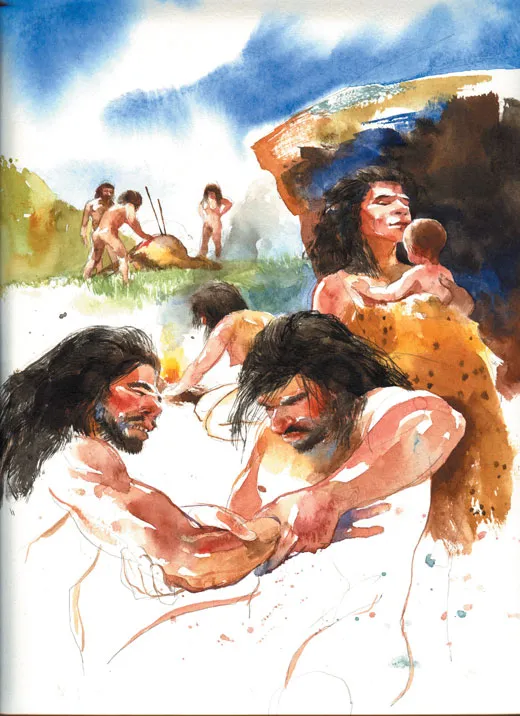
The arrangement of fossilized Neanderthal skeletons in the ground demonstrates to many archaeologists that Neanderthals buried their dead. “They might not have done so with elaborate ritual, since there has never been solid evidence that they included symbolic objects in graves, but it is clear that they did not just dump their dead with the rest of the trash to be picked over by hyenas and other scavengers,” says archaeologist Francesco d’Errico of the University of Bordeaux.
Paleoanthropologists generally agree that Neanderthals lived in groups of 10 to 15, counting children. That assessment is based on a few lines of evidence, including the limited remains at burial sites and the modest size of rock shelters. Also, Neanderthals were top predators, and some top predators, such as lions and wolves, live in small groups.
Steven Kuhn, an archaeologist at the University of Arizona, says experts “can infer quite a bit about who Neanderthal was by studying tools in conjunction with the other artifacts they left behind.” For instance, recovered stone tools are typically fashioned from nearby sources of flint or quartz, indicating to some researchers that a Neanderthal group did not necessarily range far.
The typical Neanderthal tool kit contained a variety of implements, including large spear points and knives that would have been hafted, or set in wooden handles. Other tools were suitable for cutting meat, cracking open bones (to get at fatrich marrow) or scraping hides (useful for clothing, blankets or shelter). Yet other stone tools were used for woodworking; among the very few wooden artifacts associated with Neanderthal sites are objects that resemble spears, plates and pegs.
I get a feel for Neanderthal handiwork in Maureille’s office, where plastic milk crates are stacked three high in front of his desk. They’re stuffed with plastic bags full of olive and tan flints from Les Pradelles. With his encouragement, I take a palm-size, D-shaped flint out of a bag. Its surface is scarred as though by chipping, and the flat side has a thin edge. I readily imagine I could scrape a hide with it or whittle a stick. The piece, Maureille says, is about 60,000 years old. “As you can see from the number of lithics we’ve found,” he adds, referring to the crates piling up in his office, “Neanderthals were prolific and accomplished toolmakers.”
Among the new approaches to Neanderthal study is what might be called paleo-mimicry, in which researchers themselves fashion tools to test their ideas. “What we do is make our own tools out of flint, use them as a Neanderthal might have, and then look at the fine detail of the cutting edges with a high-powered microscope,” explains Michael Bisson, chairman of anthropology at McGill University in Montreal. “Atool used to work wood will have one kind of wear pattern that differs from that seen when a tool is used to cut meat from a bone, and we can see those different patterns on the implements recovered from Neanderthal sites.” Similarly, tools used to scrape hide show few microscopic scars, their edges having been smoothed by repeated rubbing against skin, just as stropping a straight razor will hone its edge. As Kuhn, who has also tried to duplicate Neanderthal handicraft, says: “There is no evidence of really fine, precise work, but they were skilled in what they did.”
Based on the consistent form and quality of the tools found at sites across Europe and western Asia, it appears likely that Neanderthal was able to pass along his toolmaking techniques to others. “Each Neanderthal or Neanderthal group did not have to reinvent the wheel when it came to their technologies,” says Bisson.
The kinds of tools that Neanderthals began making about 200,000 years ago are known as Mousterian, after the site in France where thousands of artifacts were first found. Neanderthals struck off pieces from a rock “core” to make an implement, but the “flaking” process was not random; they evidently examined a core much as a diamond cutter analyzes a rough gemstone today, trying to strike just the spot that would yield “flakes,” for knives or spear points, requiring little sharpening or shaping.
Around 40,000 years ago, Neanderthals innovated again. In what passes for the blink of an eye in paleoanthropology, some Neanderthals were suddenly making long, thin stone blades and hafting more tools. Excavations in southwest France and northern Spain have uncovered Neanderthal tools betraying a more refined technique involving, Kuhn speculates, the use of soft hammers made of antler or bone.
What happened? According to the conventional wisdom, there was a culture clash. In the early 20th century, when researchers first discovered those “improved” lithics—called Châtelperronian and Uluzzian, depending on where they were found—they saw the relics as evidence that modern humans, Homo sapiens or Cro-Magnon, had arrived in Neanderthal territory. That’s because the tools resembled those unequivocally associated with anatomically modern humans, who began colonizing western Europe 38,000 years ago. And early efforts to assign a date to those Neanderthal lithics yielded time frames consistent with the arrival of modern humans.
But more recent discoveries and studies, including tests that showed the lithics to be older than previously believed, have prompted d’Errico and others to argue that Neanderthals advanced on their own. “They could respond to some change in their environment that required them to improve their technology,” he says. “They could behave like modern humans.”
Meanwhile, these “late” Neanderthals also discovered ornamentation, says d’Errico and his archaeologist colleague João Zilhão of the University of Lisbon. Their evidence includes items made of bone, ivory and animal teeth marked with grooves and perforations. The researchers and others have also found dozens of pieces of sharpened manganese dioxide—black crayons, essentially—that Neanderthals probably used to color animal skins or even their own. In his office at the University of Bordeaux, d’Errico hands me a chunk of manganese dioxide. It feels silky, like soapstone. “Toward the end of their time on earth,” he says, “Neanderthals were using technology as advanced as that of contemporary anatomically modern humans and were using symbolism in much the same way.”
Generally, anthropologists and archaeologists today proffer two scenarios for how Neanderthals became increasingly resourceful in the days before they vanished. On the one hand, it may be that Neanderthals picked up a few new technologies from invading humans in an effort to copy their cousins. On the other, Neanderthals learned to innovate in parallel with anatomically modern human beings, our ancestors.
Most researchers agree that Neanderthals were skilled hunters and craftsmen who made tools, used fire, buried their dead (at least on occasion), cared for their sick and injured and even had a few symbolic notions. Likewise, most researchers believe that Neanderthals probably had some facility for language, at least as we usually think of it. It’s not far-fetched to think that language skills developed when Neanderthal groups mingled and exchanged mates; such interactions may have been necessary for survival, some researchers speculate, because Neanderthal groups were too small to sustain the species. “You need to have a breeding population of at least 250 adults, so some kind of exchange had to take place,” says archaeologist Ofer Bar-Yosef of Harvard University. “We see this type of behavior in all hunter-gatherer cultures, which is essentially what Neanderthals had.”
But if Neanderthals were so smart, why did they go extinct? “That’s a question we’ll never really have an answer to,” says Clive Finlayson, who runs the Gibraltar Museum, “though it doesn’t stop any of us from putting forth some pretty elaborate scenarios.” Many researchers are loath even to speculate on the cause of Neanderthals’ demise, but Finlayson suggests that a combination of climate change and the cumulative effect of repeated population busts eventually did them in. “I think it’s the culmination of 100,000 years of climate hitting Neanderthals hard, their population diving during the cold years, rebounding some during warm years, then diving further when it got cold again,” Finlayson says.
As Neanderthals retreated into present-day southern Spain and parts of Croatia toward the end of their time, modern human beings were right on their heels. Some researchers, like Smith, believe that Neanderthals and Cro-Magnon humans probably mated, if only in limited numbers. The question of whether Neanderthals and modern humans bred might be resolved within a decade by scientists studying DNA samples from Neanderthal and Cro-Magnon fossils.
But others argue that any encounter was likely to be hostile. “Brotherly love is not the way I’d describe any interaction between different groups of humans,” Shea says. In fact, he speculates that modern humans were superior warriors and wiped out the Neanderthals. “Modern humans are very competitive and really good at using projectile weapons to kill from a distance,” he says, adding they also probably worked together better in large groups, providing a battlefield edge.
In the end, Neanderthals, though handy, big-brained, brawny and persistent, went the way of every human species but one. “There have been a great many experiments at being human preceding us and none of them made it, so we should not think poorly of Neanderthal just because they went extinct,” says Rick Potts, head of the Smithsonian’s Human Origins Program. “Given that Neanderthal possessed the very traits that we think guarantee our success should make us pause about our place here on earth.”