Of all the many prejudices that afflict an average Englishman, the one to which I most happily subscribe is the notion that we produce, and long have produced, the finest maps in all the world.
Britain’s British Isles of such accuracy, precision and beauty as to dazzle the beholder. There is an axiom, universally held in the Kingdom, that whatever an Ordnance map may indicate, one can be absolutely sure it is, in description and location, exactly and canonically right.
Which is why, some 15 years ago, while I was leafing through a few maps in London, I was puzzled to see inscribed on Survey Sheet 55, which covers that small area of western Scotland titled "Lochgilphead & Loch Awe," a single, curiously unexpected word.
It had been written in blue, in the middle of a strait that separates two Inner Hebridean islands—one small and little known called Scarba, and another, larger, called Jura. At the northern side of this strait, two-thirds of the way toward its Atlantic exit, the map said, with neither comment nor explanation, "Whirlpool." The body of water in which it was sited was known as the Gulf of Corryvreckan: whatever it was that lurked two-thirds of the way along it was therefore known as the Corryvreckan Whirlpool.
But hold on! Whirlpools, I thought, were mythical entities, not the kind of thing to put on a modern-day map. Having the word there somehow diminished the chart—made it look like an ancient portolan illustrated with sea serpents, or one of those fanciful boreal symbols denoting an area notorious for gales. A whirlpool surely wasn’t a real thing—it was more of a symbol, a personification of the worries of ancient mariners, like a kraken or a Minotaur or a mermaid. A myth, in short, like Ulysses’ Charybdis.
A chimera? The stuff of legend?
So, I assumed—wasn’t the Corryvreckan Whirlpool likely to be just the same, just a myth, an exaggerated memory, the stuff of Celtic legend, in the way that Charybdis was part of the mythic sagas of Greece? Surely in reality it wasn’t any more than I had assumed all whirlpools to be—a temporary thing, like the vortex in the bathtub, a momentary eddy in a river, a rush of current in an estuary?
Yet because it was written on the map, perhaps it did have to be something extraordinary. Perhaps in fact there was a whirlpool in Corryvreckan that was so huge and infernal and unexpected that it was not a chimera at all, but fixed into the ocean so firmly that it could be called permanent. No one I spoke to in London seemed to know for sure. Only a visit could settle the matter.
Of all the many prejudices that afflict an average Englishman, the one to which I most happily subscribe is the notion that we produce, and long have produced, the finest maps in all the world.
Britain’s British Isles of such accuracy, precision and beauty as to dazzle the beholder. There is an axiom, universally held in the Kingdom, that whatever an Ordnance map may indicate, one can be absolutely sure it is, in description and location, exactly and canonically right.
Which is why, some 15 years ago, while I was leafing through a few maps in London, I was puzzled to see inscribed on Survey Sheet 55, which covers that small area of western Scotland titled "Lochgilphead & Loch Awe," a single, curiously unexpected word.
It had been written in blue, in the middle of a strait that separates two Inner Hebridean islands—one small and little known called Scarba, and another, larger, called Jura. At the northern side of this strait, two-thirds of the way toward its Atlantic exit, the map said, with neither comment nor explanation, "Whirlpool." The body of water in which it was sited was known as the Gulf of Corryvreckan: whatever it was that lurked two-thirds of the way along it was therefore known as the Corryvreckan Whirlpool.
But hold on! Whirlpools, I thought, were mythical entities, not the kind of thing to put on a modern-day map. Having the word there somehow diminished the chart—made it look like an ancient portolan illustrated with sea serpents, or one of those fanciful boreal symbols denoting an area notorious for gales. A whirlpool surely wasn’t a real thing—it was more of a symbol, a personification of the worries of ancient mariners, like a kraken or a Minotaur or a mermaid. A myth, in short, like Ulysses’ Charybdis.
A chimera? The stuff of legend?
So, I assumed—wasn’t the Corryvreckan Whirlpool likely to be just the same, just a myth, an exaggerated memory, the stuff of Celtic legend, in the way that Charybdis was part of the mythic sagas of Greece? Surely in reality it wasn’t any more than I had assumed all whirlpools to be—a temporary thing, like the vortex in the bathtub, a momentary eddy in a river, a rush of current in an estuary?
Yet because it was written on the map, perhaps it did have to be something extraordinary. Perhaps in fact there was a whirlpool in Corryvreckan that was so huge and infernal and unexpected that it was not a chimera at all, but fixed into the ocean so firmly that it could be called permanent. No one I spoke to in London seemed to know for sure. Only a visit could settle the matter.
The nearest railway station appeared to be Oban, a good ten hours by sleeper from London. Long enough a journey to read something useful about the coastline I was due to visit. With three recommended items—a large-scale chart of the Gulf of Corryvreckan and Approaches, a battered copy of the 1958 Royal Navy’s West Coast of Scotland Pilot, and a more up-to-date Yachtsman’s Pilot—I studied as the train roared northward through the night. The mariners’ chart noted the site with only one spare and simple phrase: "Dangerous tidal streams." The Admiralty Pilot was a little more expansive, devoting two full pages to the phenomenon, with phrases such as "heavy overfalls extend as much as 3 miles seaward...very violent and dangerous turbulence...no vessel should then attempt this passage without local knowledge." Only the more modern work mentioned the magic word, though being circumspect, the author having placed it between inverted commas. "The ‘whirlpool’ of Corryvreckan," it said, is in "one of the most notorious stretches of water anywhere around the British Isles."
It was raining at Oban, with a stiff westerly wind. The map in the station hall suggested a complicated journey: the closest inhabited site was an island called Luing, which could be reached by car from another island called Seil, which was itself joined to the mainland by an 18th-century bridge. I drove there, crossed the ancient and alarmingly humpbacked structure, and stopped at an inn on the far side. Aye, said an old man at the bar, he knew well of the Corryvreckan. The "old hag," they called it locally. The Cailleach. Corryvreckan, or Coirebhreacain in Gaelic, means in one translation "the cauldron of the speckled seas." In another, the cauldron that centuries back had drowned one Prince Brecan, who was the son of Lochlin, then the king of Norway.
A journey to see the beast
It was a terrible, magnificent thing. Many had died in it, the old man said. His own brother was one such, who had drowned in the whirlpool 30 years back, coming home from a fishing trip.
One hour and one soaking ferry crossing later and I was with a boatman who agreed that he was foolish enough to make the journey to look upon the beast. A small sum in folding money had changed hands, and I, by now swathed in a borrowed set of orange oilskins and a black sou’wester, clambered down into his little fishing boat, a sturdy and well-worn thing of many years. As I steadied myself between the piles of lobster creels and coils of old blue rope, we swept out of the calm of Cullipool’s harbor on Luing and into the gray chop of the sound.
The rain had stopped, but the wind was decidedly westerly, and freshening. The tide was just now slack and about to turn on the flood. "The right time," said the boatman, "the perfect time to see the old hag do her worst."
We motored steadily south, with Luing on our left, the grassy mass of Lunga to our right. The boatman talked ceaselessly, pointing out the islands that we passed. Behind Lunga rose the peaks of the Garvellachs, where Saint Columba is said to have stayed back in the sixth century. There was a lighthouse, Fladda, and the old slate quarries of Belnahua, flooded and abandoned after a mighty storm back in Victorian times.
The waves became stronger as we chugged onward. At the south end of Lunga was a narrow strait into which seawater seemed to be pouring and churning, like a furious river. The Bealach a’ Choin Ghlais, the boatman pointed out on the chart—the Grey Dogs. A shortcut over to the Garvellachs, he said, if you had the stomach for it. Locals say it was used as a backdrop to simulate the Corryvreckan in I Know Where I’m Going, a film in which the climax was played out in the whirlpool. "But they wouldnae film in the Cailleach herself," he said. "Far too risky, what with all their precious cameras. Mind you, on a braw day, the Grey Dog can be a fierce thing herself."
And of a sudden, a steady growling roar
And then we rounded Scarba and turned due west at last, and into the mouth of the notorious gulf. Jura was now on our left, and the hills began to close in. Directly ahead, far away, lay open water—the Atlantic Ocean, uninterrupted until the coast of Newfoundland. But between our little boat and the ocean swells, at a point where, a half-mile ahead, the black walls of Scarba pushed toward Jura until the gulf was no more than 1,100 yards across, there was, all of a sudden, a ragged line of white. Breakers. Spray. And, faint at first but growing above the throb of the diesel engine, a steady growling roar.
"That’ll be her," said the boatman, with a look of mischief. He turned his pipe bowl uppermost, and pulled his sea bonnet down over his face. His hands gripped the wheel more tightly, his knuckles whitening. "We could be in for a little wetting," he said. "It’s the perfect tide for it. A flood tide and a westerly gale. Ideal, if you know what you’re about."
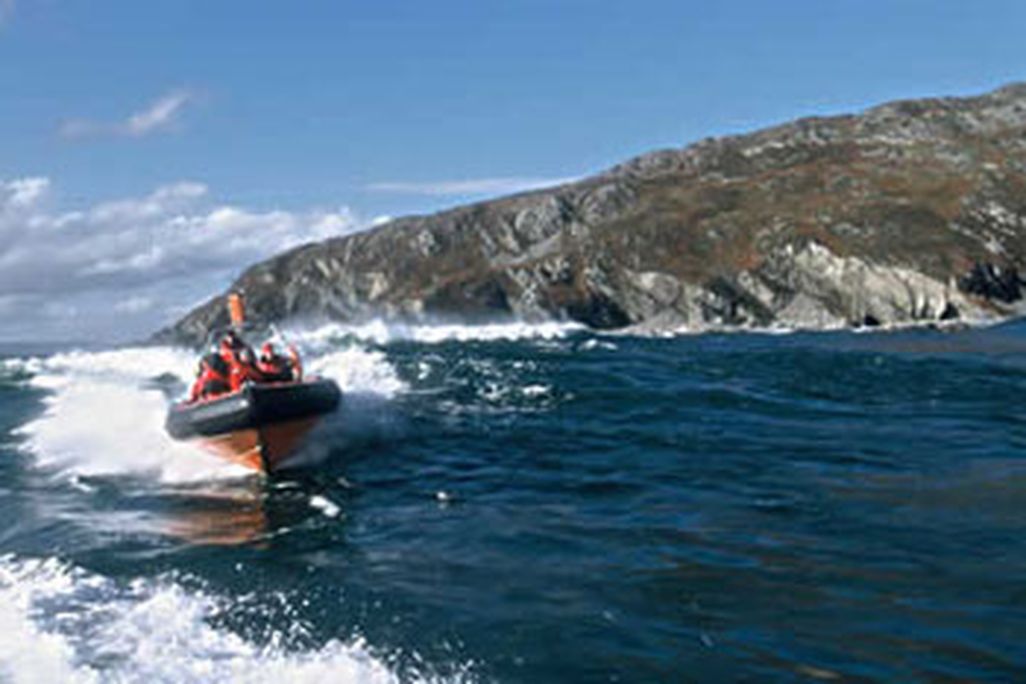
And as he said this, so the little fishing boat began to rear and pitch in the strangest way—her bow first turning this way, then another, seemingly quite beyond the control of the wheel. Currents began to tear her off her course, and the rocks—less than a hundred yards off the Scarba shore—began to race by, now on the starboard side, now ahead, now to port, now astern, as we wheeled round, caught by forces unseen, deep, hugely strong.
"Watch the sea!" he shouted, and pointed to the right, to where the surface of the water seemed suddenly oily, as though there were a puddle of grease on top of it, a hundred feet across. I gazed at the flatness until, without warning, a plume of contorted and confused water belched upward, then fell back upon itself and began in a matter of seconds to swirl into a vortex—a real, perfectly formed whirlpool, 30 feet across, with us perched delicately on its edge.
And the waters boiled and bubbled
"Hold on!" cried the boatman, and he accelerated, at first gently, then more fiercely, to make sure the craft didn’t get caught and spun down into the center. We edged out away from the lip, only to find, quite unexpectedly, that another flat circle of oily-looking water had appeared ahead of us on the left. Its flatness then promptly vanished, too, into an eruption of swirling green water, and its new currents licked at us, prompting another change of course, another burst of engine—after which there was another, and another and another.
It was for fully an hour that we reared and plunged in this manner, and the waters boiled and bubbled around us, and the Scarba cliffs, black and jagged and streaming with water, came worryingly close too many times for comfort. And then, just as suddenly as it had begun, it was over. We had gunned our engine one final time, had set a course due west, had climbed through what seemed a wall of green, a standing wave that always lay between the whirlpool and the open sea—and everything was immediately and thankfully quiet, a perfect calm. The sun had come out and glinted on the ironbound cliffs. Seagulls and cormorants wheeled on the falling winds. Dolphins played beneath our bow. Seals slipped sleekly off the rocks. Peace settled upon the sea, and but for a low and gentle roaring from astern, the Whirlpool of Corryvreckan might have been a chimera after all.
"And that," said the boatman—his pipe now right side up, a newly lit plug of black shag glowing in the bowl—"is the first of five."
The Corryvreckan, he went on to explain, is the worst permanent whirlpool to be found in Britain. But sailors who make a study of heavy-weather sailing know there are in fact more. This, he said, isn’t the worst in the world. There is one in Norway so terrible that its name has become part of the English language—though for the life of him he couldn’t remember its name, and we chugged home to Cullipool in silence, with my teeth in any case chattering too much with cold for any sensible conversation.
He remembered later, as we dried out in his living room. "The Maelstrom," he announced. "The very grandest of them all."
Five that are wild enough
There are indeed a number of whirlpools in the world that have enough permanence about them to be fully deserving of the name. Definition is important, though. Small, temporary, harmless eddies that resemble whirlpools are commonplace. Every river with any power seems to generate them at some point in its course, as the water plays with the irregularities of the banks, divides, washes back upon itself, rejoins the stream a little later. Traveler and writer Jonathan Raban describes the ferocity of the "boils" in the Mississippi in his classic 1981 book Old Glory: An American Voyage. The swirling waters to be seen off Hock Cliff along England’s River Severn are well known. More trivially, every bath generates a whirlpool as it empties.
The ocean, too, has momentary whirlpools aplenty: for instance the wild, whirling tidal races, called Swelkie, of the Pentland Firth, between the Orkney Islands and the Scottish mainland, where the currents of the North Sea and the Atlantic flow back and forth; or the Strait of Messina, where the Ionian and Tyrrhenian seas meet, the site of Homer’s Charybdis; and of still more to be seen in the waters between Greece and the island of Evvoia, where Aristotle is said to have drowned.
But there seem to be just five that are wild enough and big enough and famous enough to be thought of as permanent, repeatable features of the sea. The Corryvreckan is one. The small but fierce Naruto Whirlpool off the eastern end of the island of Shikoku in central Japan is another. The Old Sow, which lies off the southern tip of Deer Island, New Brunswick, is a third.
But in Norway there lies the most famous of them all—and the only one that has so far received anything approaching close academic study. This is—or, put more accurately, these are—the Maelstrom.
For there are two maelstroms in Arctic Norway, and it took me a day’s wandering and inquiring to find out which one was which. Murphy’s Law ensured, of course, that the easier of the two to reach, and which is called the Saltstraumen, was not the one for which I was looking.
Not that the Saltstraumen is unspectacular. It, like all whirlpools, is a tidal affair, seen and heard best when the tide is racing in either the flood or the ebb. It is close to the small town of Bodø, at a point where the tidal waters of one of the deep ocean fjords rush into a narrow channel between two great granite islands called Straumøya and Knapplundøya.
Four times a day, as regularly as the moon and sun dictate—and a timetable is published every year, for visitors, with the spring tides (which make for a greater spectacle) marked in bold—the tides rush in and out. As they do so, crucially, their waters pass over a narrow ledge of rock that suddenly spikes upward from the seabed. The deep currents smash against the rock, the water is forced upward to where it meets surface water going even faster—the result being the creation of trails of long, ragged whirlpools, lines of which can be seen roaring along the currents, into or out of the sea.
Its fierce waves and stupendous powers are seen from on high
The Saltstraumen is both dangerous and yet at the same time curiously benign. The boatman who took me out, in a small aluminum skiff that looked dismayingly puny, had lost his brother as a child, swept in while he was fishing for mackerel. And at close quarters the waves are fierce, the power stupendous—although, unlike the Corryvreckan’s maverick behavior, they are wholly predictable. But what gives the Saltstraumen the appearance of vincibility is that a road bridge stretches high above the torrent—and the whole episode can be viewed from the comfort of a concrete sidewalk, 120 feet above the water.
What goes on below the surface has been studied in detail at the one whirlpool that, as my Scottish guide mentioned, has added a word to the English lexicon: the Maelstrom. This region of sea where tide and current, wind and seabed have all conspired to create the most brutal of marine phenomena is properly known as the Moskstraumen: it is also to be found in Arctic Norway, at the southern end of the chain of islands known as Lofoten that lies about 50 miles off the mainland coast.
The chain is a place renowned for its winter fisheries: from January to April the best cod on earth comes from the Lofoten waters. The seas off the archipelago are exceedingly complex, with black deeps and sudden shallows, weird currents and dense fogs. The seamen who occupy their business here are skilled, wary, courageous. And they know full well the dangers of the whirlpool that rages between Lofoten Point and the tiny off-island called Værøy. Not for nothing, they say, is the long-abandoned village that overlooks the swirling torrents called Hell.
We set off—from a fishing village that was called simply Å—in a powerful rubber boat. The skipper was Stig Einarsen: he had hands the size of dinner plates and the stance of an ox. There was a lumpy following sea, and we bumped uncomfortably southward, the cliffs rising ever higher on our right, flocks of seabirds swooping down to see who was bent on such madness.
Poe had it just about right
Einarsen stopped for a moment off the lighthouse at the point and asked if we felt content and confident. Getting the answer he wanted he then floored his engine, rounded the ledge of cliffs—and the gray waters hit us like a sudden succession of hammer blows. Edgar Allan Poe, I later read, had it just about right when in 1841 he wrote:
"Even while I gazed, this current acquired a monstrous velocity. Each moment added to its speed—to its headlong impetuosity. In five minutes the whole sea ...was lashed into ungovernable fury....Here the vast bed of the waters, seamed and scarred into a thousand conflicting channels, burst suddenly into phrensied convulsion—heaving, boiling, hissing...."
It was indeed a tremendous display of the power and might of fast-running, uncontrollable water. We bucked and twisted, rose near vertical, plummeted deep into troughs, spun round and round, took heavy waves from every side. Occasionally Einarsen, who knew these seas like the pattern of his grandfather’s oiled-wool sweater, would duck the boat into a peaceful inlet. From there we would watch the chaos rage for a few drenched moments, before venturing out into the roaring and the cold once more. And just as the Scottish boatman had done years before, he kept us there for a full hour until, with a grin, he finally relented, set the lighthouse on our port beam, and zoomed north past the point and out into the calms where the fishing boats lay, before chugging us steadily home, out of the rain.
On the way, he told us a little of the stories that have surrounded this mighty force—of how Poe had written an entire story about it, of how Jules Verne had used the Maelstrom as the place in which to destroy the Nautilus, and of how 1,000-year-old Nordic legends related that two giant millstones had sunk off Scotland, and had rolled across to these islands, grinding away still, making the sea as salty as it is today. The whirlpool appears on a map in the great Description of the Northern Peoples, published in 1555, and I’ve seen it on 17th-century charts of the Hanseatic League. As we came into port that evening, we could see a flag fluttering above the town hall: it was blue and, lest anyone forget, had a white whirlpool at its center.
But what are these things? Why do such whirlpools form? Why are they so fixed, so dangerous, so legendary?
They have their similarities and differences. The Corryvreckan is perhaps a quarter of a mile across, with its great belches of water appearing randomly, whirling dervishlike for a few moments before being replaced by others just as wild. The Old Sow is a thing of lumpy waves and one large sinkhole of water that seems to suck into itself for many minutes at each flood tide. Japan’s Naruto Whirlpool, which also can be viewed from a highway bridge, is much like the Norwegian Saltstraumen—small chains of whirling water racing down the currents, neat and tidy in its sudden spasms of violence. The Maelstrom somehow combines all of these into one huge area of mightily confused sea, gray and ponderous in the way that it grinds up all ships who pass through incautiously, turning them into matchwood and oblivion.
Boiling down those ferocious boils
Bjørn Gjevik, working at the University of Oslo, wrote a study of the Maelstrom in 1997—one of the few extensive mathematical studies that I’ve been able to find of the aqueous complexities that whirlpools seem to be. What he found seems, at first blush, to be common among the great whirlpools.
By making careful measurement of the speeds of waters at different levels and at different places and times of night and day and month and season—a monstrously difficult and dangerous task, one has to assume—he seemed to think that it was "eccentricities on the bottom of the sea" that were the key.
These submarine phenomena—rocks, shelves, ridges, peaks—conspire with the furious winds and with the great concatenations of tides and currents. They produce what Gjevik calls in his paper an "exceptional strong topographic enhancement" of what might otherwise merely be a very strong oceanic tidal flow. They interrupt the smooth passage of water and make its submarine motions become infinitely more complex—and while whatever happens deep under the sea still remains a mystery, what happens up above, on the surface, is in these places self-evident, dramatic and spectacular.
n other words, whirlpools—the Maelstrom especially, the others most probably—are fluid marine phenomena that have solid submarine causes. There is the pinnacle that rises underneath the Saltstraumen. There is a shelf of rock that rears up in the Corryvreckan. There are shallows that the charts of Norway show south of Lofoten Point. There are ridges of rock under Japan’s Naruto Strait such as to allow a bridge to be built across it. And a number of near-islands loom perilously beneath the keels of such boats as pass beside the international boundary in the tidal estuary that divides the state of Maine from the Canadian province of New Brunswick.
Shallowing, in short, is what it is all about. A narrow passage, a fast-speeding current, howling winds, large tides—and beneath all of these things a sudden, dangerous, confusion-causing shallowing. When these conditions all combine—then the waters begin to eddy and swirl, vortices are formed, immense sounds begin to thunder, spray fills the air, and all around the region notices are posted to warn sailors that to pass through this or that at flood or the ebb is at your direst peril.
Blame it all on a rock
Which does little for the sense of legend, of course. The Nordic saga writers and the Gaelic poets and those who still today give out survival certificates in Maine for those who brave the Old Sow in full spate might not prefer a rational explanation. Tales of long-dead Norwegian princes do much to add luster to a legend: to have science bring explanation steals the pleasures of romance.
But it is an ill wind. Some people will be more than happy at what Bjørn Gjevik of the University of Oslo seems to have found. Britain’s Ordnance Survey, for example, will be pleased at the news that whatever occurs in the Gulf of Corryvreckan, at the very least, probably owes its existence to the presence of rock below the surface of the sea. And that is because a rock, whether it is seen or unseen, is a thing of undeniable permanence—which means by extension that any disturbance it creates, far from being a myth, truly is permanent as well.
And if the Corryvreckan really is a permanent phenomenon, then surely, the Survey will say, there unarguably does deserve to be written in indelible blue printing on the best and most accurate maps that are made the single word "whirlpool." Accuracy in the Ordnance Surveys is all; and if the Corryvreckan Whirlpool is proved to be a thing of permanence, then this map, like all the rest, is happily and precisely right.


Comments
Sir, re the comment that Belnahua was flooded by a great storm.
Today, Aug 25, 2009, I talked with Angus Shaw, aged 102 years, whose uncle , James Shaw quarried slate on Belnahua uuntil at least World War 1 and possibly beyond.
Apparently the quarry always flooded naturally and only constant pumping kept it at bay. When work and pumpinmg stopped - the island flooded.
Posted by Alan Hunter, Scotland on August 25,2009 | 12:23PM