
Diamonds Unearthed
Smithsonian diamond expert Jeffrey Post discusses conflict diamonds, colored diamonds and synthetic gems grown in the lab
The UN-backed Kimberley Process, which went into effect in 2003, requires participating states to certify that exported diamonds are conflict-free. The World Diamond Council says that 99 percent of the world’s supply of diamonds today is from conflict free areas. Do you agree with this estimate?
The Kimberley Process has made a big difference in the way diamonds are tracked. The fact that you have to certify diamonds from their sources and then track them has provided a lot of peace of mind. It’s given some clout to try to force certain countries to follow through on procedures that protect the integrity of diamonds and their sources. In some ways, it’s been surprising that so many different groups have come together and made this thing work. Obviously there is a strong motivation on the part of the industry. That said, I don’t think anybody knows for sure that 99 percent of the diamonds are really coming through that procedure. I know that diamonds are still being found in alluvial deposits in some places. People take those diamonds to Antwerp and they sell them, and they don’t have certificates. Certainly it happens, but it is a small number of diamonds. So I don’t know whether it’s 99 percent or 90 percent, but any figure like that is a pretty good one; it’s a pretty successful story.
What gives a diamond color?
Typically people think about diamonds, of course, as being colorless. Part of the reason for that is because we get trained by the marketing machine of the diamond industry to go out and buy diamonds. So the price of a diamond most people buy is typically pegged to the color of it. The more colorless it is, the more valuable it tends to be. The only exception to that is if the diamonds have an intense enough color that they’re called a fancy color diamond, which can add tremendously to the price. Pure diamond, pure carbon is going to be a colorless material.
The colors are always due to some impurity or defect in the diamond’s structure.
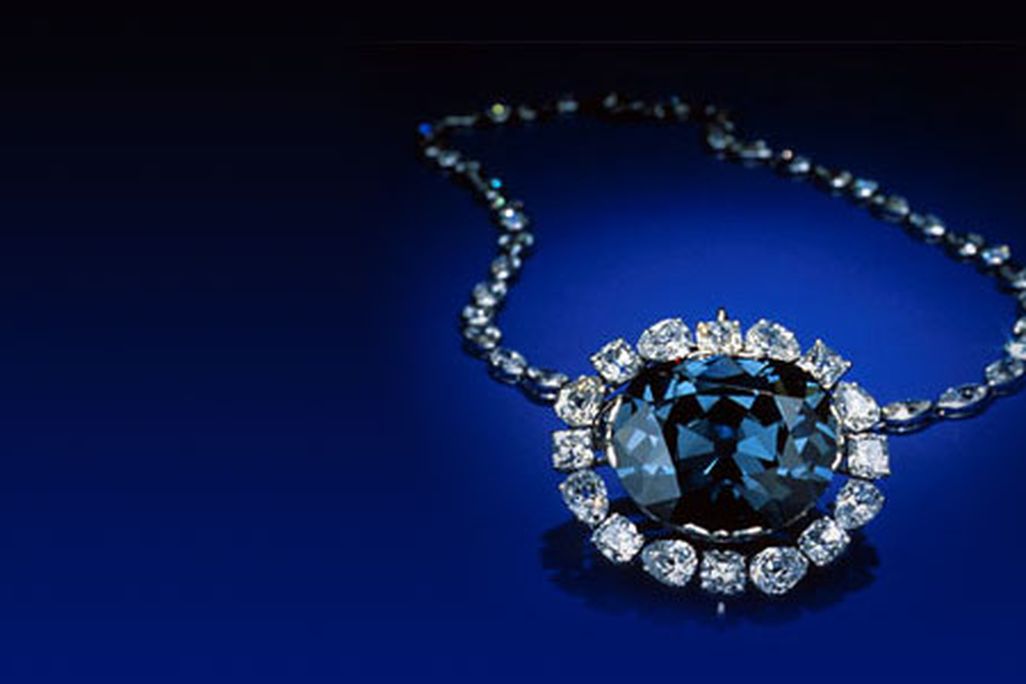
It’s the impurities that give rise to colors not only in most diamonds, but most gem materials. In the case of the blue diamonds, it’s a little bit of boron that happened to get trapped in the crystal structure as it was forming that gives you blue color. Blue is an extremely rare color. Maybe, at most, one out of 200,000 diamonds found in the world has any hint of a blue color to it, and typically it’s a very pale blue.
If some of the nitrogen is replacing some of the carbon atoms in the structure, that little bit of nitrogen can color the diamond a yellowish color. It’s thought that most yellowish to maybe brownish-yellow diamonds probably get their color because of some kind of defect structure related to nitrogen impurities.
Green diamonds are thought to form mostly because of natural radiation in the rocks where the diamonds are found. The radiation produces defects, mistakes in the crystal structure of the diamond, and these defects can trap electrons that will interact with light to produce the green color. Interestingly, most green diamonds do not have a green body color. They have sort of a green outer coating because the green color originates from the radiation that is in the rocks surrounding the diamonds after they’ve been brought to the surface. Because it’s coming from the rock surrounding it, it tends to be most intense at the surface and only in some cases will it completely penetrate the whole diamond. So green is a very unusual color.
Then you get pinkish to reddish diamonds, although I’ve never actually seen what I would call a true red diamond. I’ve seen a very dark pink, but mostly they’re pinkish, sometimes pinkish to brown. Those are thought to be colored by some kind of mechanical defect or stresses in the diamond that may have been induced during the travel to the surface or by tectonic forces working on the rocks after they’re brought to the surface. These defects are thought to trap electrons in such a way that they interact with the light to produce pink and red colors. You also get all sorts of shades of browns to yellows to oranges, which are combinations of these various basic causes of color.
Because there are only handfuls of any size that are cut each year, there’s a standing demand. Prices can go very high. These intensely colored diamonds may sell for the highest price per carat of any gem material.
How are diamonds produced synthetically?
The diamond crystals being produced right now are typically produced in large presses, high pressure and high temperature devices. There are companies now that have set up dozens of these presses so they can feed in some sort of carbon material along with the necessary catalysts. They close up these presses then apply pressures and temperatures that are somewhat comparable to how diamonds form in the mantle of the Earth. Depending upon the presses, the temperatures and what kind of diamonds they are trying to grow, it may be a matter of days to weeks. They then open the presses and pull out the diamond crystals.
They can routinely grow crystals that are several carats in size. Right now they’re producing cut gemstones in the range of one to two carats. They’re trying to step it up so they can more routinely grow cut stones that are two to three carats in size. But each time they open a press, there’s still some surprise awaiting them. It turns out that growing crystals is an extremely sensitive process. Crystals are so sensitive to slight variations in the conditions under which they grow that the diamonds often look different. So part of the goal in synthetic diamond production is to standardize the process so well that companies can reliably produce diamonds of a certain size and quality.
Another way of producing diamonds in the lab is out of a gas. Basically it’s a reduction process. You start with methane gas. It’s mixed with hydrogen gas, which reduces the methane. Under the right conditions, a partial vacuum, you can form diamonds. There are a number of different detailed processes, industrial secrets, but that’s the basic technique.
Under the right conditions, with the right mixtures of gases, you can literally form diamonds in thick sheets. These sheets are the kinds of things that could be used potentially for heat sinks or other industrial applications where you need to cut shapes or cut large windows or plates out of diamond. So there’s a lot of speculation that if these producers of sheets of chemical vapor deposition (CVD) diamond can produce enough high-quality diamonds that are thick enough and uniform enough, there will be a huge industrial advancement in the use of diamonds.
When were synthetic diamonds first produced?
In the 1950s, GE developed the reproducible, industrial scale process for synthesizing diamonds. Since then, the industry has really grown and improved.
Are colored diamonds being produced synthetically?
It’s possible to synthesize a colored diamond. Colored diamonds will probably be the most important way in which synthetic diamonds affect the market because of the high prices of natural colored diamonds, They’re really focusing on the yellows right now, but they can do blues and pinks as well. You can synthesize yellow diamonds and sell a one-carat, yellow diamond for 10 or 20 percent of the price of what a natural colored diamond would be. For people who are more interested in having a large colored diamond than they are in having a natural, large yellow colored diamond, they can buy it for a small fraction of the price. This is a place, a niche, which the synthetic diamond producers are really trying to exploit. They can produce the colored diamonds at a price that is so much less than the natural-colored stones, and they can produce a steady supply of them, so the market can build around them. They’re banking on the fact that there will be enough people out there that will be happy to buy a synthetic colored diamond and pay a lot less money for it.
In part one of this three-part series, diamond expert Jeffrey Post, curator of the National Gem and Mineral collection, explains how the rare crystals form. In the final installment, discover the fascinating stories behind the Smithsonian's collection.