
The Mystery of Easter Island
New findings rekindle old debates about when the first people arrived and why their civilization collapsed
/https://tf-cmsv2-smithsonianmag-media.s3.amazonaws.com/accounts/headshot/BrianWolly.png)
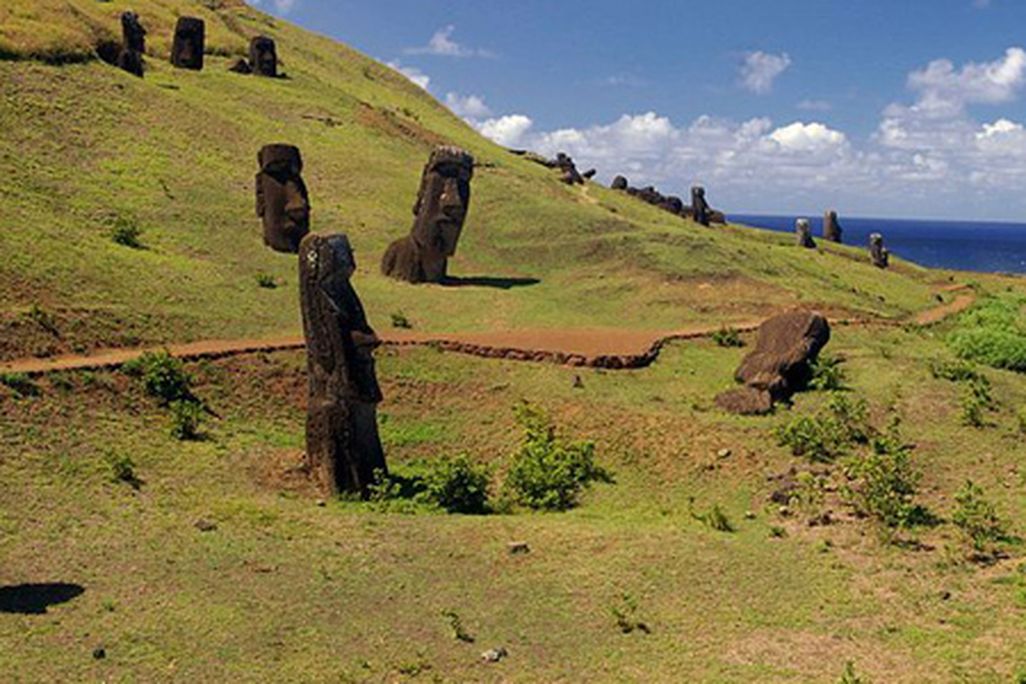
Hundreds of years ago, a small group of Polynesians rowed their wooden outrigger canoes across vast stretches of open sea, navigating by the evening stars and the day's ocean swells. When and why these people left their native land remains a mystery. But what is clear is that they made a small, uninhabited island with rolling hills and a lush carpet of palm trees their new home, eventually naming their 63 square miles of paradise Rapa Nui—now popularly known as Easter Island.
On this outpost nearly 2,300 miles west of South America and 1,100 miles from the nearest island, the newcomers chiseled away at volcanic stone, carving moai, monolithic statues built to honor their ancestors. They moved the mammoth blocks of stone—on average 13 feet tall and 14 tons—to different ceremonial structures around the island, a feat that required several days and many men.
Eventually the giant palms that the Rapanui depended on dwindled. Many trees had been cut down to make room for agriculture; others had been burned for fire and used to transport statues across the island. The treeless terrain eroded nutrient-rich soil, and, with little wood to use for daily activities, the people turned to grass. "You have to be pretty desperate to take to burning grass," says John Flenley, who with Paul Bahn co-authored The Enigmas of Easter Island. By the time Dutch explorers—the first Europeans to reach the remote island—arrived on Easter day in 1722, the land was nearly barren.
Although these events are generally accepted by scientists, the date of the Polynesians' arrival on the island and why their civilization ultimately collapsed is still being debated. Many experts maintain that the settlers landed around 800 A.D. They believe the culture thrived for hundreds of years, breaking up into settlements and living off the fruitful land. According to this theory, the population grew to several thousand, freeing some of the labor force to work on the moai. But as the trees disappeared and people began to starve, warfare broke out among the tribes.
In his book Collapse, Jared Diamond refers to the Rapanui's environmental degradation as "ecocide" and points to the civilization's demise as a model of what can happen if human appetites go unchecked.
But new findings by archaeologist Terry Hunt of the University of Hawai'i may indicate a different version of events. In 2000, Hunt, archaeologist Carl Lipo of California State University, Long Beach, and their students began excavations at Anakena, a white sandy beach on the island's northern shore. The researchers believed Anakena would have been an attractive area for the Rapanui to land, and therefore may be one of the earliest settlement sites. In the top several layers of their excavation pit, the researchers found clear evidence of human presence: charcoal, tools—even bones, some of which had come from rats. Underneath they found soil that seemed absent of human contact. This point of first human interaction, they figured, would tell them when the first Rapanui had arrived on the island.
Hunt sent the samples from the dig to a lab for radiocarbon dating, expecting to receive a date around 800 A.D., in keeping with what other archaeologists had found. Instead, the samples dated to 1200 A.D. This would mean the Rapanui arrived four centuries later than expected. The deforestation would have happened much faster than originally assumed, and the human impact on the environment was fast and immediate.
Hunt suspected that humans alone could not destroy the forests this quickly. In the sand's layers, he found a potential culprit—a plethora of rat bones. Scientists have long known that when humans colonized the island, so too did the Polynesian rat, having hitched a ride either as stowaways or sources of food. However they got to Easter Island, the rodents found an unlimited food supply in the lush palm trees, believes Hunt, who bases this assertion on an abundance of rat-gnawed palm seeds.
/https://tf-cmsv2-smithsonianmag-media.s3.amazonaws.com/filer/easter-2statuesapr07.jpg)
/https://tf-cmsv2-smithsonianmag-media.s3.amazonaws.com/filer/easter-overview.jpg)
/https://tf-cmsv2-smithsonianmag-media.s3.amazonaws.com/filer/easter-statuerow.jpg)
/https://tf-cmsv2-smithsonianmag-media.s3.amazonaws.com/filer/easter-dig.jpg)
/https://tf-cmsv2-smithsonianmag-media.s3.amazonaws.com/filer/easter-stone.jpg)
/https://tf-cmsv2-smithsonianmag-media.s3.amazonaws.com/filer/easter-statue.jpg)
/https://tf-cmsv2-smithsonianmag-media.s3.amazonaws.com/filer/easter-ledge.jpg)
/https://tf-cmsv2-smithsonianmag-media.s3.amazonaws.com/filer/easter-kite.jpg)
Under these conditions, he says, "Rats would reach a population of a few million within a couple of years." From there, time would take its toll. "Rats would have an initial impact, eating all of the seeds. With no new regeneration, as the trees die, deforestation can proceed slowly," he says, adding that people cutting down trees and burning them would have only added to the process. Eventually, the degeneration of trees, according to his theory, led to the downfall of the rats and eventually of the humans. The demise of the island, says Hunt, "was a synergy of impacts. But I think it is more rat than we think."
Hunt's findings caused a stir among Easter Island scientists. John Flenley, a pollen analyst at New Zealand's University of Massey, accepts that the numerous rats would have some impact on the island. "Whether they could have deforested the place," he says, "I'm not sure."
Flenley has taken core samples from several lakebeds formed in the island's volcanic craters. In these cores, he has found evidence of charcoal. "Certainly there was burning going on. Sometimes there was a lot of charcoal," he says. "I'm inclined to think that the people burning the vegetation was more destructive [than the rats]."
Adding to the civilization's demise, European explorers brought with them Western diseases like syphilis and smallpox. "I think that the collapse happened shortly before European discovery of the island," Flenley says. "But it could be that the collapse was more of a general affair than we think, and the Europeans had an effect on finishing it off."
Flenley, who initially surveyed Easter Island in 1977, was one of the first scientists to analyze the island's pollen—a key indicator of foresting. The island's volcanic craters, which once housed small lakes, were ideal sites for his research. "The sediment was undisturbed. Each layer was put down on top of the layer before," says Flenley, referring to core samples from one crater's lakebeds. "It's like a history book. You just have to learn to read the pages." The samples showed an abundance of pollen, indicating that the island had once been heavily forested. The pollen rate then dropped off dramatically. "When I dated the deforestation at that site, it came starting at about 800 A.D. and finishing at this particular site as early as 1000 A.D.," a finding in line with other radiocarbon dates on the island. Since this was one of the first settlement sites, Flenley says, it makes sense that deforestation would have occurred even earlier than it did on other parts of the island.
This crater, Flenley believes, would have been one of the only sources of freshwater on the island, and therefore one of the first places the Polynesians would have settled. "It wasn't only a site of freshwater, it was also a very sheltered crater," he says. "It would have been possible to grow tropical crops." Anakena, the beach where Hunt did his research, would have been a good place to keep their canoes and to go fishing, but not a good place to live. Hunt, Flenley says, "has definitely shown a minimum age for people being there, but the actual arrival of people could have been somewhat earlier."
Other scientists who work on the island also remain skeptical of Hunt's later colonization date of 1200 A.D. Jo Anne Van Tilburg, founder of the Easter Island Statue Project and a scientist at the University of California, Los Angeles, is one of the island's leading archaeologists and has studied the moai for nearly 30 years. "It's not logical that they were constructing megalithic sites within a few years of arrival on the island," she says. Van Tilburg and her colleagues have surveyed all 887 of the island's statues. "By 1200 A.D., they were certainly building platforms," she says referring to the stone walls on which the islanders perched the moai, "and others have described crop intensification at about the same time. It's hard for me to be convinced that his series of excavations can overturn all of this information."
Despite these questions, Hunt remains confident in his findings. Many scientists, he says, "get a date, tell a story, invest a lot in it, and then don't want to give it up. They had a very good environmental message."
Hunt, Lipo, and their students continue to do excavation work on the island. They have recently moved on from Anakena to do work on the northwest coast. They also plan to date the earliest rat-gnawed seeds. "We keep getting a little more evidence," says Hunt, who has published his findings in Science. "Everything looks very consistent."
Scientists may never find a conclusive answer to when the Polynesians colonized the island and why the civilization collapsed so quickly. Whether an invasive species of rodent or humans devastated the environment, Easter Island remains a cautionary tale for the world.
Whitney Dangerfield, a freelance writer in Washington, D.C. whose work has appeared in National Geographic and the Washington Post, is a regular contributor to Smithsonian.com.
/https://tf-cmsv2-smithsonianmag-media.s3.amazonaws.com/accounts/headshot/BrianWolly.png)
Planning Your Next Trip?
Explore great travel deals
A Note to our Readers Smithsonian magazine participates in affiliate link advertising programs. If you purchase an item through these links, we receive a commission.