
Columbus’ Confusion About the New World
The European discovery of America opened possibilities for those with eyes to see. But Columbus was not one of them
In the year 1513, a group of men led by Vasco Núñez de Balboa marched across the Isthmus of Panama and discovered the Pacific Ocean. They had been looking for it—they knew it existed—and, familiar as they were with oceans, they had no difficulty in recognizing it when they saw it. On their way, however, they saw a good many things they had not been looking for and were not familiar with. When they returned to Spain to tell what they had seen, it was not a simple matter to find words for everything.
For example, they had killed a large and ferocious wild animal. They called it a tiger, although there were no tigers in Spain and none of the men had ever seen one before. Listening to their story was Peter Martyr, member of the King's Council of the Indies and possessor of an insatiable curiosity about the new land that Spain was uncovering in the west. How, the learned man asked them, did they know that the ferocious animal was a tiger? They answered "that they knewe it by the spottes, fiercenesse, agilitie, and such other markes and tokens whereby auncient writers have described the Tyger." It was a good answer. Men, confronted with things they do not recognize, turn to the writings of those who have had a wider experience. And in 1513 it was still assumed that the ancient writers had had a wider experience than those who came after them.
Columbus himself had made that assumption. His discoveries posed for him, as for others, a problem of identification. It seemed to be a question not so much of giving names to new lands as of finding the proper old names, and the same was true of the things that the new lands contained. Cruising through the Caribbean, enchanted by the beauty and variety of what he saw, Columbus assumed that the strange plants and trees were strange only because he was insufficiently versed in the writings of men who did know them. "I am the saddest man in the world," he wrote, "because I do not recognize them."
We need not deride Columbus' reluctance to give up the world that he knew from books. Only idiots escape entirely from the world that the past bequeaths. The discovery of America opened a new world, full of new things and new possibilities for those with eyes to see them. But the New World did not erase the Old. Rather, the Old World determined what men saw in the New and what they did with it. What America became after 1492 depended both on what men found there and on what they expected to find, both on what America actually was and on what old writers and old experience led men to think it was, or ought to be or could be made to be.
During the decade before 1492, as Columbus nursed a growing urge to sail west to the Indies—as the lands of China, Japan and India were then known in Europe—he was studying the old writers to find out what the world and its people were like. He read the Ymago Mundi of Pierre d'Ailly, a French cardinal who wrote in the early 15th century, the travels of Marco Polo and of Sir John Mandeville, Pliny's Natural History and the Historia Rerum Ubique Gestarum of Aeneas Sylvius Piccolomini (Pope Pius II). Columbus was not a scholarly man. Yet he studied these books, made hundreds of marginal notations in them and came out with ideas about the world that were characteristically simple and strong and sometimes wrong, the kind of ideas that the self-educated person gains from independent reading and clings to in defiance of what anyone else tries to tell him.
The strongest one was a wrong one—namely, that the distance between Europe and the eastern shore of Asia was short, indeed, that Spain was closer to China westward than eastward. Columbus never abandoned this conviction. And before he set out to prove it by sailing west from Spain, he studied his books to find out all he could about the lands that he would be visiting. From Marco Polo he learned that the Indies were rich in gold, silver, pearls, jewels and spices. The Great Khan, whose empire stretched from the Arctic to the Indian Ocean, had displayed to Polo a wealth and majesty that dwarfed the splendors of the courts of Europe.
Polo also had things to say about the ordinary people of the Far East. Those in the province of Mangi, where they grew ginger, were averse to war and so had fallen an easy prey to the khan. On Nangama, an island off the coast, described as having "great plentie of spices," the people were far from averse to war: they were anthropophagi—man-eaters—who devoured their captives. There were, in fact, man-eating people in several of the offshore islands, and in many islands both men and women dressed themselves with only a small scrap of cloth over their genitals. On the island of Discorsia, in spite of the fact that they made fine cotton cloth, the people went entirely naked. In one place there were two islands where men and women were segregated, the women on one island, the men on the other.
Marco Polo occasionally slipped into fables like this last one, but most of what he had to say about the Indies was the result of actual observation. Sir John Mandeville's travels, on the other hand, were a hoax—there was no such man—and the places he claimed to have visited in the 1300s were fantastically filled with one-eyed men and one-footed men, dog-faced men and men with two faces or no faces. But the author of the hoax did draw on the reports of enough genuine travelers to make some of his stories plausible, and he also drew on a legend as old as human dreams, the legend of a golden age when men were good. He told of an island where the people lived without malice or guile, without covetousness or lechery or gluttony, wishing for none of the riches of this world. They were not Christians, but they lived by the golden rule. A man who planned to see the Indies for himself could hardly fail to be stirred by the thought of finding such a people.
Columbus surely expected to bring back some of the gold that was supposed to be so plentiful. The spice trade was one of the most lucrative in Europe, and he expected to bring back spices. But what did he propose to do about the people in possession of these treasures?
When he set out, he carried with him a commission from the king and queen of Spain, empowering him "to discover and acquire certain islands and mainland in the ocean sea" and to be "Admiral and Viceroy and Governor therein." If the king and Columbus expected to assume dominion over any of the Indies or other lands en route, they must have had some ideas, not only about the Indies but also about themselves, to warrant the expectation. What had they to offer that would make their dominion welcome? Or if they proposed to impose their rule by force, how could they justify such a step, let alone carry it out? The answer is that they had two things: they had Christianity and they had civilization.
Christianity has meant many things to many men, and its role in the European conquest and occupation of America was varied. But in 1492 to Columbus there was probably nothing very complicated about it. He would have reduced it to a matter of corrupt human beings, destined for eternal damnation, redeemed by a merciful savior. Christ saved those who believed in him, and it was the duty of Christians to spread his gospel and thus rescue the heathens from the fate that would otherwise await them.
Although Christianity was in itself a sufficient justification for dominion, Columbus would also carry civilization to the Indies; and this, too, was a gift that he and his contemporaries considered adequate recompense for anything they might take. When people talked about civilization—or civility, as they usually called it—they seldom specified precisely what they meant. Civility was closely associated with Christianity, but the two were not identical. Whereas Christianity was always accompanied by civility, the Greeks and Romans had had civility without Christianity. One way to define civility was by its opposite, barbarism. Originally the word "barbarian" had simply meant "foreigner"—to a Greek someone who was not Greek, to a Roman someone who was not Roman. By the 15th or 16th century, it meant someone not only foreign but with manners and customs of which civil persons disapproved. North Africa became known as Barbary, a 16th-century geographer explained, "because the people be barbarous, not onely in language, but in manners and customs." Parts of the Indies, from Marco Polo's description, had to be civil, but other parts were obviously barbarous: for example, the lands where people went naked. Whatever civility meant, it meant clothes.
But there was a little more to it than that, and there still is. Civil people distinguished themselves by the pains they took to order their lives. They organized their society to produce the elaborate food, clothing, buildings and other equipment characteristic of their manner of living. They had strong governments to protect property, to protect good persons from evil ones, to protect the manners and customs that differentiated civil people from barbarians. The superior clothing, housing, food and protection that attached to civilization made it seem to the European a gift worth giving to the ill-clothed, ill-housed and ungoverned barbarians of the world.
Slavery was an ancient instrument of civilization, and in the 15th century it had been revived as a way to deal with barbarians who refused to accept Christianity and the rule of civilized government. Through slavery they could be made to abandon their bad habits, put on clothes and reward their instructors with a lifetime of work. Throughout the 15th century, as the Portuguese explored the coast of Africa, large numbers of well-clothed sea captains brought civilization to naked savages by carrying them off to the slave markets of Seville and Lisbon.
Since Columbus had lived in Lisbon and sailed in Portuguese vessels to the Gold Coast of Africa, he was not unfamiliar with barbarians. He had seen for himself that the Torrid Zone could support human life, and he had observed how pleased barbarians were with trinkets on which civilized Europeans set small value, such as the little bells that falconers placed on hawks. Before setting off on his voyage, he laid in a store of hawk's bells. If the barbarous people he expected to find in the Indies should think civilization and Christianity an insufficient reward for submission to Spain, perhaps hawk's bells would help.
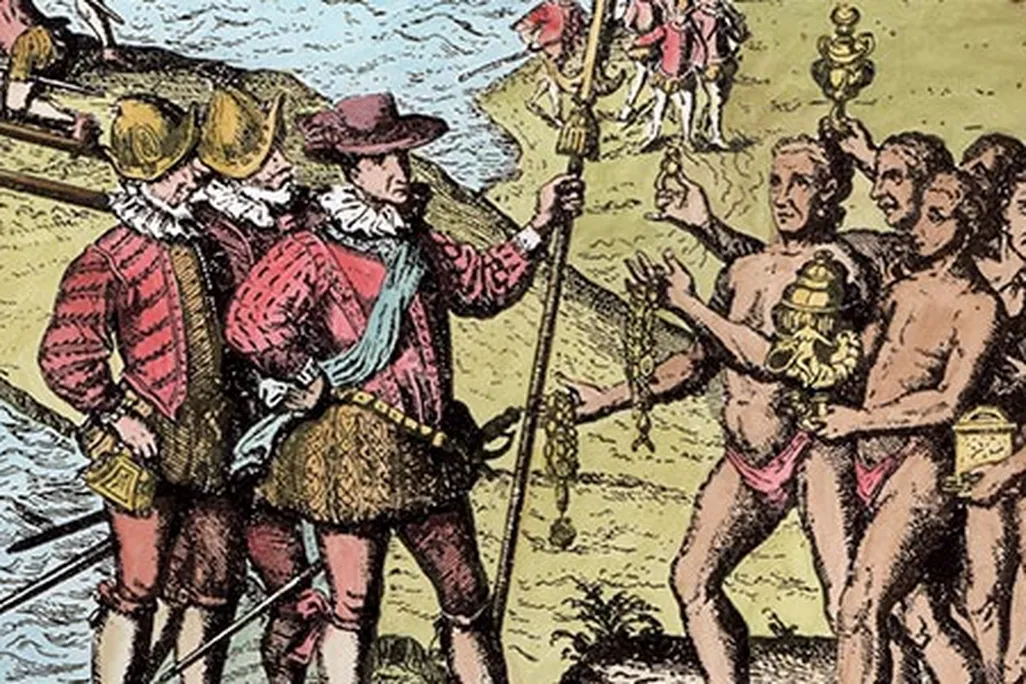
Columbus sailed from Palos de la Frontera on Friday, August 3, 1492, reached the Canary Islands six days later and stayed there for a month to finish outfitting his ships. He left on September 6, and five weeks later, in about the place he expected, he found the Indies. What else could it be but the Indies? There on the shore were the naked people. With hawk's bells and beads he made their acquaintance and found some of them wearing gold nose plugs. It all added up. He had found the Indies. And not only that. He had found a land over which he would have no difficulty in establishing Spanish dominion, for the people showed him an immediate veneration. He had been there only two days, coasting along the shores of the islands, when he was able to hear the natives crying in loud voices, "Come and see the men who have come from heaven; bring them food and drink." If Columbus thought he was able to translate the language in two days' time, it is not surprising that what he heard in it was what he wanted to hear or that what he saw was what he wanted to see—namely, the Indies, filled with people eager to submit to their new admiral and viceroy.
Columbus made four voyages to America, during which he explored an astonishingly large area of the Caribbean and a part of the northern coast of South America. At every island the first thing he inquired about was gold, taking heart from every trace of it he found. And at Haiti he found enough to convince him that this was Ophir, the country to which Solomon and Jehosophat had sent for gold and silver. Since its lush vegetation reminded him of Castile, he renamed it Española, the Spanish island, which was later Latinized as Hispaniola.
Española appealed to Columbus from his first glimpse of it. From aboard ship it was possible to make out rich fields waving with grass. There were good harbors, lovely sand beaches and fruit-laden trees. The people were shy and fled whenever the caravels approached the shore, but Columbus gave orders "that they should take some, treat them well and make them lose their fear, that some gain might be made, since, considering the beauty of the land, it could not be but that there was gain to be got." And indeed there was. Although the amount of gold worn by the natives was even less than the amount of clothing, it gradually became apparent that there was gold to be had. One man possessed some that had been pounded into gold leaf. Another appeared with a gold belt. Some produced nuggets for the admiral. Española accordingly became the first European colony in America. Although Columbus had formally taken possession of every island he found, the act was mere ritual until he reached Española. Here he began the European occupation of the New World, and here his European ideas and attitudes began their transformation of land and people.
The Arawak Indians of Española were the handsomest people that Columbus had encountered in the New World and so attractive in character that he found it hard to praise them enough. "They are the best people in the world," he said, "and beyond all the mildest." They cultivated a bit of cassava for bread and made a bit of cottonlike cloth from the fibers of the gossampine tree. But they spent most of the day like children idling away their time from morning to night, seemingly without a care in the world. Once they saw that Columbus meant them no harm, they outdid one another in bringing him anything he wanted. It was impossible to believe, he reported, "that anyone has seen a people with such kind hearts and so ready to give the Christians all that they possess, and when the Christians arrive, they run at once to bring them everything."
To Columbus the Arawaks seemed like relics of the golden age. On the basis of what he told Peter Martyr, who recorded his voyages, Martyr wrote, "they seeme to live in that golden worlde of the which olde writers speake so much, wherein menne lived simply and innocently without enforcement of lawes, without quarreling, judges and libelles, content onely to satisfie nature, without further vexation for knowledge of things to come."
As the idyllic Arawaks conformed to one ancient picture, their enemies the Caribs conformed to another that Columbus had read of, the anthropophagi. According to the Arawaks, the Caribs, or Cannibals, were man-eaters, and as such their name eventually entered the English language. (This was at best a misrepresentation, which Columbus would soon exploit.) The Caribs lived on islands of their own and met every European approach with poisoned arrows, which men and women together fired in showers. They were not only fierce but, by comparison with the Arawaks, also seemed more energetic, more industrious and, it might even be said, sadly enough, more civil. After Columbus succeeded in entering one of their settlements on his second voyage, a member of the expedition reported, "This people seemed to us to be more civil than those who were in the other islands we have visited, although they all have dwellings of straw, but these have them better made and better provided with supplies, and in them were more signs of industry."
Columbus had no doubts about how to proceed, either with the lovable but lazy Arawaks or with the hateful but industrious Caribs. He had come to take possession and to establish dominion. In almost the same breath, he described the Arawaks' gentleness and innocence and then went on to assure the king and queen of Spain, "They have no arms and are all naked and without any knowledge of war, and very cowardly, so that a thousand of them would not face three. And they are also fitted to be ruled and to be set to work, to cultivate the land and to do all else that may be necessary, and you may build towns and teach them to go clothed and adopt our customs."
So much for the golden age. Columbus had not yet prescribed the method by which the Arawaks would be set to work, but he had a pretty clear idea of how to handle the Caribs. On his second voyage, after capturing a few of them, he sent them in slavery to Spain, as samples of what he hoped would be a regular trade. They were obviously intelligent, and in Spain they might "be led to abandon that inhuman custom which they have of eating men, and there in Castile, learning the language, they will much more readily receive baptism and secure the welfare of their souls." The way to handle the slave trade, Columbus suggested, was to send ships from Spain loaded with cattle (there were no native domestic animals on Española), and he would return the ships loaded with supposed Cannibals. This plan was never put into operation, partly because the Spanish sovereigns did not approve it and partly because the Cannibals did not approve it. They defended themselves so well with their poisoned arrows that the Spaniards decided to withhold the blessings of civilization from them and to concentrate their efforts on the seemingly more amenable Arawaks.
The process of civilizing the Arawaks got underway in earnest after the Santa Maria ran aground on Christmas Day, 1492, off Caracol Bay. The local leader in that part of Española, Guacanagari, rushed to the scene and with his people helped the Spaniards to salvage everything aboard. Once again Columbus was overjoyed with the remarkable natives. They are, he wrote, "so full of love and without greed, and suitable for every purpose, that I assure your Highnesses that I believe there is no better land in the world, and they are always smiling." While the salvage operations were going on, canoes full of Arawaks from other parts of the island came in bearing gold. Guacanagari "was greatly delighted to see the admiral joyful and understood that he desired much gold." Thereafter it arrived in amounts calculated to console the admiral for the loss of the Santa Maria, which had to be scuttled. He decided to make his permanent headquarters on the spot and accordingly ordered a fortress to be built, with a tower and a large moat.
What followed is a long, complicated and unpleasant story. Columbus returned to Spain to bring the news of his discoveries. The Spanish monarchs were less impressed than he with what he had found, but he was able to round up a large expedition of Spanish colonists to return with him and help exploit the riches of the Indies. At Española the new settlers built forts and towns and began helping themselves to all the gold they could find among the natives. These creatures of the golden age remained generous. But precisely because they did not value possessions, they had little to turn over. When gold was not forthcoming, the Europeans began killing. Some of the natives struck back and hid out in the hills. But in 1495 a punitive expedition rounded up 1,500 of them, and 500 were shipped off to the slave markets of Seville.
The natives, seeing what was in store for them, dug up their own crops of cassava and destroyed their supplies in hopes that the resulting famine would drive the Spaniards out. But it did not work. The Spaniards were sure there was more gold in the island than the natives had yet found, and were determined to make them dig it out. Columbus built more forts throughout the island and decreed that every Arawak of 14 years or over was to furnish a hawk's bell full of gold dust every three months. The various local leaders were made responsible for seeing that the tribute was paid. In regions where gold was not to be had, 25 pounds of woven or spun cotton could be substituted for the hawk's bell of gold dust.
Unfortunately Española was not Ophir, and it did not have anything like the amount of gold that Columbus thought it did. The pieces that the natives had at first presented him were the accumulation of many years. To fill their quotas by washing in the riverbeds was all but impossible, even with continual daily labor. But the demand was unrelenting, and those who sought to escape it by fleeing to the mountains were hunted down with dogs taught to kill. A few years later Peter Martyr was able to report that the natives "beare this yoke of servitude with an evill will, but yet they beare it."
The tribute system, for all its injustice and cruelty, preserved something of the Arawaks' old social arrangements: they retained their old leaders under control of the king's viceroy, and royal directions to the viceroy might ultimately have worked some mitigation of their hardships. But the Spanish settlers of Española did not care for this centralized method of exploitation. They wanted a share of the land and its people, and when their demands were not met they revolted against the government of Columbus. In 1499 they forced him to abandon the system of obtaining tribute through the Arawak chieftains for a new one in which both land and people were turned over to individual Spaniards for exploitation as they saw fit. This was the beginning of the system of repartimientos or encomiendas later extended to other areas of Spanish occupation. With its inauguration, Columbus' economic control of Española effectively ceased, and even his political authority was revoked later in the same year when the king appointed a new governor.
For the Arawaks the new system of forced labor meant that they did more work, wore more clothes and said more prayers. Peter Martyr could rejoice that "so many thousands of men are received to bee the sheepe of Christes flocke." But these were sheep prepared for slaughter. If we may believe Bartolomé de Las Casas, a Dominican priest who spent many years among them, they were tortured, burned and fed to the dogs by their masters. They died from overwork and from new European diseases. They killed themselves. And they took pains to avoid having children. Life was not fit to live, and they stopped living. From a population of 100,000 at the lowest estimate in 1492, there remained in 1514 about 32,000 Arawaks in Española. By 1542, according to Las Casas, only 200 were left. In their place had appeared slaves imported from Africa. The people of the golden age had been virtually exterminated.
Why? What is the meaning of this tale of horror? Why is the first chapter of American history an atrocity story? Bartolomé de Las Casas had a simple answer, greed: "The cause why the Spanishe have destroyed such an infinitie of soules, hath been onely, that they have helde it for their last scope and marke to gette golde." The answer is true enough. But we shall have to go further than Spanish greed to understand why American history began this way. The Spanish had no monopoly on greed.
The Indians' austere way of life could not fail to win the admiration of the invaders, for self-denial was an ancient virtue in Western culture. The Greeks and Romans had constructed philosophies and the Christians a religion around it. The Indians, and especially the Arawaks, gave no sign of thinking much about God, but otherwise they seemed to have attained the monastic virtues. Plato had emphasized again and again that freedom was to be reached by restraining one's needs, and the Arawaks had attained impressive freedom.
But even as the Europeans admired the Indians' simplicity, they were troubled by it, troubled and offended. Innocence never fails to offend, never fails to invite attack, and the Indians seemed the most innocent people anyone had ever seen. Without the help of Christianity or of civilization, they had attained virtues that Europeans liked to think of as the proper outcome of Christianity and civilization. The fury with which the Spaniards assaulted the Arawaks even after they had enslaved them must surely have been in part a blind impulse to crush an innocence that seemed to deny the Europeans' cherished assumption of their own civilized, Christian superiority over naked, heathen barbarians.
That the Indians were destroyed by Spanish greed is true. But greed is simply one of the uglier names we give to the driving force of modern civilization. We usually prefer less pejorative names for it. Call it the profit motive, or free enterprise, or the work ethic, or the American way, or, as the Spanish did, civility. Before we become too outraged at the behavior of Columbus and his followers, before we identify ourselves too easily with the lovable Arawaks, we have to ask whether we could really get along without greed and everything that goes with it. Yes, a few of us, a few eccentrics, might manage to live for a time like the Arawaks. But the modern world could not have put up with the Arawaks any more than the Spanish could. The story moves us, offends us, but perhaps the more so because we have to recognize ourselves not in the Arawaks but in Columbus and his followers.
The Spanish reaction to the Arawaks was Western civilization's reaction to the barbarian: the Arawaks answered the Europeans' description of men, just as Balboa's tiger answered the description of a tiger, and being men they had to be made to live as men were supposed to live. But the Arawaks' view of man was something different. They died not merely from cruelty, torture, murder and disease, but also, in the last analysis, because they could not be persuaded to fit the European conception of what they ought to be.
Edmund S. Morgan is a Sterling Professor emeritus at Yale University.
/https://tf-cmsv2-smithsonianmag-media.s3.amazonaws.com/filer/Bartolome-de-Las-Casas-2.jpg)
/https://tf-cmsv2-smithsonianmag-media.s3.amazonaws.com/filer/Christopher-Columbus-520.jpg)
Planning Your Next Trip?
Explore great travel deals
A Note to our Readers Smithsonian magazine participates in affiliate link advertising programs. If you purchase an item through these links, we receive a commission.