
The History of Cricket in the United States
The game is both very British and, to Americans, very confusing. But it was once our national pastime, and its gaining fans on these shores
"Good shot, Mouse!" comes a voice from a small crowd of spectators under an awning at the edge of a softball field in suburban Atlanta. It's a semifinal playoff between the Tropical Sports Club and North Atlanta on a hot afternoon in early October, and a Tropical player has just lofted a ball over the fence. But this is a match, not a game; the player is a batsman, not a batter, and a ball whacked over a fence is a "six," not a home run. This may be a softball diamond, but the action on the field—sorry, the pitch—is cricket.
At one end of the awning, a large West Indian woman is barbecuing jerk chicken in an oil drum. There's spicy fish soup and Red Stripe beer. Reggae booms out of the back of a van. Between "balls"—pitches, in baseball—the men talk politics and reminisce about life back on the island of Jamaica.
"Yes, Mouse!" the crowd roars again, as the same batsman sends another ball skyward. For a moment, the ball hangs motionless against the blue sky, before landing with a thump on the awning above the barbecue, just missing the jerk chicken lady. "Stop trying to put out the fire, man!" she bellows to the players as the crowd erupts in laughter.
Cricket—now played by millions of people in 92 countries ranging from the Caribbean to Europe to Africa to South Asia—was once the national game of, yes, these United States. And one of the first outdoor sports to be played on these shores. An 1844 cricket match between teams from the United States and Canada was the first international sporting event in the modern world, predating the revival of the Olympic Games by more than 50 years.
In a diary he kept between 1709 and 1712, William Byrd, owner of the Virginia plantation Westover, noted, "I rose at 6 o'clock and read a chapter in Hebrew. About 10 o'clock Dr. Blair, and Major and Captain Harrison came to see us. After I had given them a glass of sack we played cricket. I ate boiled beef for my dinner. Then we played at shooting with arrows...and went to cricket again till dark."
The first public report of a cricket match in North America was in 1751, when the New York Gazette and the Weekly Post Boy carried an account of a match between a London "eleven" (as cricket teams, or "sides," are called) and one from New York City. The latter side won, though it is almost certain that both teams comprised residents of New York.
The rules of the game on this side of the Atlantic were formalized in 1754, when Benjamin Franklin brought back from England a copy of the 1744 Laws, cricket’s official rule book. There is anecdotal evidence that George Washington's troops played what they called "wickets" at Valley Forge in the summer of 1778. After the Revolution, a 1786 advertisement for cricket equipment appeared in the New York Independent Journal, and newspaper reports of that time frequently mention "young gentlemen" and "men of fashion" taking up the sport. Indeed, the game came up in the debate over what to call the new nation's head of state: John Adams noted disapprovingly—and futilely—that "there are presidents of fire companies and cricket clubs."
As the country's growing population spread west and south, so too did cricket. Abe Lincoln reportedly turned out to watch Chicago play Milwaukee in 1849. By then, an estimated 10,000 Americans were playing the game, and many more were watching. But the seeds of cricket's destruction in the United States had already been sown.
Today, many Americans dismiss cricket as an elitist game played by girlie-men. That may be because the game is superficially slow. Or because the players still tend to dress in traditional whites and, during four-day international matches, break for tea. Or maybe it's because, in a sporting world that seems to have turned increasingly nasty, the game's code of sportsmanship remains rectitudinously strict. (The recent unpleasantness during Pakistan's tour of England—an umpire ruled that Pakistan had doctored the ball; Pakistan staged an after-tea protest; the umpires declared the game a forfeit—set off a crisis that made baseball's steroids scandal seem subdued.)
But in most of the former Commonwealth, cricket is a game of the masses. This is especially true in cricket-mad South Asia, where last year's match between India and Pakistan was hailed as a sign of warming in the chilly relationship between the two countries (until, that is, India suggested it would side against Pakistan in the ball-scuffing affair). And most cricketers would argue that the game is far more dynamic, and dangerous, than baseball. For starters, a cricket ball is heavier—by half an ounce—than the ball used in the American game. With a core of cork, sheathed in layers of twine and cork shavings, and wrapped in a bright red leather casing (it is sometimes called a "cherry"), a cricket ball is a fearsome projectile when launched at a batsman. Unlike in baseball, the bowler (the equivalent of the pitcher) is in full flight after sprinting for up to 30 paces before launching the ball. Nor is it usually bowled through the air; that is a "full toss" and considered easy to hit. Far more often, the ball is bounced off the ground, whose grass has usually been trimmed and rolled to a concrete-like hardness, and it may rise toward the batsman's head as a "bouncer" or "bumper." Balls have been clocked at 95 miles per hour or more (as fast as a major-league fastball); before the introduction of safety helmets, in the 1970s, it was not uncommon for batsmen to be felled, or seriously injured, by bouncers.
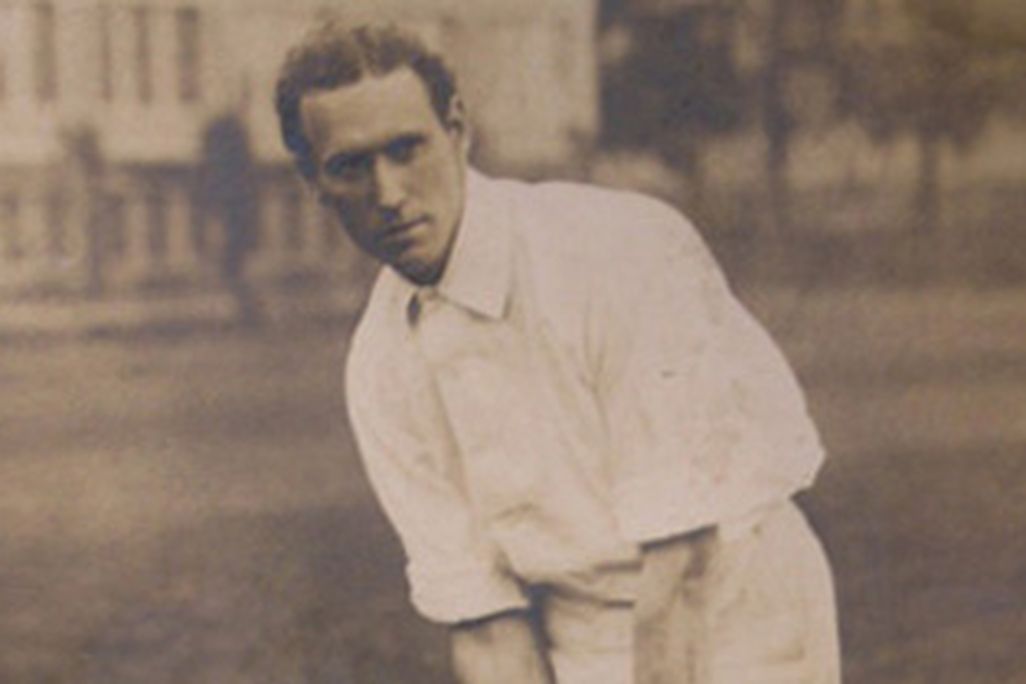
The greatest American cricketer, a witty but tough Philadelphian named J. Barton King, was one of the fastest bowlers of his generation, and on a 1908 tour of England he set bowling records that stood for more than 40 years. One of the first athletes to take his physical condition seriously, King developed special exercises to strengthen his wrist and fingers (legend has it that he could send a cricket ball up to a second-story window with the snap of his fingers), and he analyzed his technique with scientific acumen. In his memoir, The Angler and How I Bowled It, King writes, "Pitchers were beginning to learn to throw what is called the 'hook,' that is, a ball that travels with very little curve until the last ten or twelve feet.... I began to experiment in order to develop the same kind of ball in cricket."
By the time King put away his bat, after the first decade of the 20th century, cricket had all but perished in the United States. While baseball's exact origins remain clouded in a romantic haze, and are still hotly debated, it seems fairly certain that it evolved from rounders, a game played by British schoolgirls. A year before the Civil War broke out, Beadle's Dime Base-Ball Player, published in New York City, sold 50,000 copies in the United States. Soldiers from both sides of the conflict carried it, and both North and South embraced the new game. It was faster than cricket, easier to learn and required little in the way of equipment: just a bat (simpler to make than a cricket bat, which requires sophisticated joinery), a ball and four gunnysacks thrown on a patch of ground, and you're ready to play.
Within a few years, baseball had swept all before it. By the early 1870s, there were 2,000 baseball clubs, 100,000 players, 250,000 spectators and, perhaps most important, a sound commercial structure.
Yet cricket went down swinging: in 1878, some 15,000 people in Philadelphia watched a local eleven hold the Australians, already emerging as a cricketing powerhouse, to a draw. Fifteen years later, Philadelphia—then, as now, the crucible of North American cricket—beat the Aussies. "In its heyday, Philadelphia had more than 100 cricket clubs," says John Douglas, acting director of athletics at Pennsylvania's Haverford College, the only U.S. college or university that still has a varsity cricket team. "Every neighborhood in Philadelphia had a cricket team, and all the teams supplied players for the famous Gentlemen of Philadelphia who toured England in the 19th century."
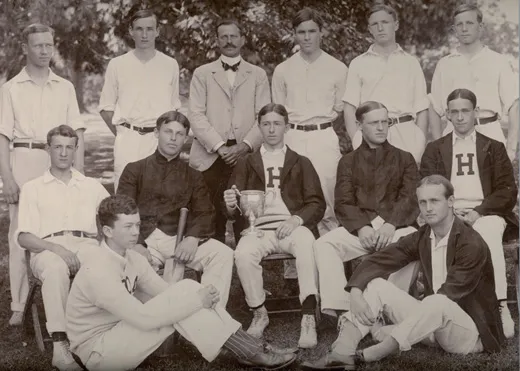
Built in 1904, the Haverford pavilion—cricket for locker room—smells of old wood and sweat. Sepia-tinted photographs of American players in white trousers hang on the walls. With names such as Ashbridge, Comfort and Congdon, Wood, Starr and Scattergood, the young men sport handlebar mustaches, blazers and striped caps. Douglas nods toward a picture of the 1873 team. "J. M. Fox was the captain of the cricket team, and he's also credited with bringing golf to America," he says.
Sitting at a long wooden table in Haverford's C. C. Morris Cricket Library, the largest collection of cricket literature and memorabilia in the Western Hemisphere, Alfred Reeves, 81, is dressed in an immaculate blue blazer. Reeves immigrated to the United States from his native Yorkshire in 1978 and eventually settled in Philadelphia. "I went for a walk one evening near the Merion Cricket Club [near Philadelphia], and I was sure I heard a cricket ball and bat," he recalls. "So I put my whites on and climbed over the wall of this famous cricket club, dropped on the other side and said, 'I just arrived from England. Do you mind if I join in?'"
No one minded. Reeves, who had loved the game since childhood—"more than 60 years of weekend cricket" is how he describes his marriage—was soon playing for Merion, one of America's oldest and best-known clubs. But by the time Reeves joined, cricket's golden age had long since given way to baseball, tennis and golf. The British themselves may have provided the coup de grâce for cricket in the United States when, in 1909, the Imperial Cricket Conference was founded to govern the game and ruled that no country outside the British Empire could belong.
Now, improbably, North American cricket is bouncing back, thanks in no small part to the huge influx of immigrants from countries such as India, Pakistan and those of the Caribbean. An estimated 30,000 people play or watch cricket in the United States each year. In 2005, New York City mayor Michael Bloomberg announced plans to build a $1.5 million cricket pitch at St. Albans Park, Queens. In Philadelphia, Alfred Reeves has helped revive the famous British Officers' Cricket Club, which now competes against about 20 clubs in and around the city, including one—the Philadelphia Cricket Club—whose roster includes a two-thirds majority of U.S.-born players.
"I had always been interested in the game," says Chris Spaeth, 36, a Philadelphia Cricket Club regular who was exposed to it at Colorado State University, where there was a large contingent of Indian students. "When I moved back to Philly, I played soccer. But there wasn't the camaraderie I was looking for, the sporting element. So I found my way to cricket."
So did Doug Genna, a jovial, 22-year-old Haverford graduate. Genna was a wrestler and a lacrosse goalie in high school. When he took up cricket at Haverford, he naturally gravitated toward wicket keeper, the position closest to goalie and roughly analogous to a catcher in baseball. For Genna, the most difficult adjustment was the length of time each cricket match takes. As with baseball, there is no time limit and no clock. "Wrestling takes six minutes," he says. "Now I have to play in a match that can last for six hours. It's a big challenge to keep myself mentally focused."
In recent years, cricket has moved beyond New York and Philadelphia to Dallas, Wichita, Los Angeles and Atlanta, the home of Desmond Lewis, 60, a soft-spoken Jamaican who used to play at the pinnacle of the game. (In 1971 he played for the West Indies team and batted alongside Sir Garfield Sobers, a player of Babe Ruthian stature.) "When I came here, you couldn't find 11 people to make a team," Lewis says. "Now we have 23 teams in the Atlanta region, with about 400 players actively involved." As we talk, his team, Tropical Sports Club, is on its way to defeating North Atlanta, which includes Faizan Sayeed, 19. Sayeed, who immigrated to Atlanta from Pakistan in 1990, helped the U.S. Under-19 team to a surprise victory over Canada in a world championship qualifying match in Toronto last September. When I ask if he feels more American or Pakistani, he says: "When it comes to cricket, I definitely feel [more] American."
A new organization, Major League Cricket, recently unveiled a ten-year development plan intended to rebuild the sport from the ground up by working with schools and other local authorities to develop young talent. But can cricket find a place in a culture dominated by football, baseball, basketball and NASCAR? In a sporting age too often defined by inflated egos and commercialism, it would be nice to think so. "Liberty must be developed from within," wrote John Lester, who was born in Britain but played his cricket in Philadelphia. "And there is only one form of government that can breed it—personal self-government.... If cricket is alien to our ideal of democracy, so much the worse for our democracy."
Or, as Alfred Reeves puts it, "Cricket is the only sport in the world that has gentlemanly conduct written into the laws. Part of my gospel is: It's the game first; then it's the team; then it's the player. You're last. And don't ever forget it." Those sentiments may sound somewhat treacly nowadays, but there was a time when they made perfect sense.