
Thailand’s Fight Club
Inside the little-known, action-packed world of Muay Thai boxing
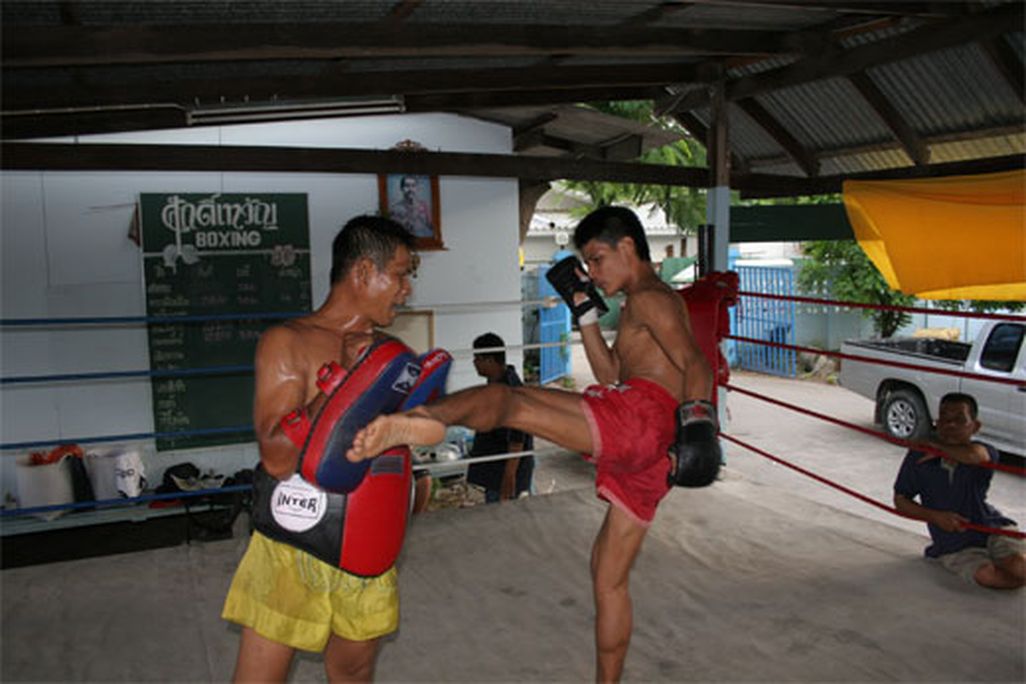
Saktaywan Boxing Gym resides on a narrow and quiet road in northern Bangkok. It is neighbored on one side by a small apartment complex and on the other side by a sewage canal. The gym is outdoors, and a rank odor lingered in the air when I first walked through its gates on a muggy afternoon in July.
Three skinny, shirtless Thai boys punched and kicked invisible opponents inside a dusty boxing ring. A shaded area beside the ring housed gloves, shin guards, head protectors, four punching bags and free weights. Next to the equipment two more boys jumped rope, their bare feet bouncing in rhythm on the cracked concrete.
As I watched them, Ajarn Sit, Saktaywan's 48-year-old head trainer, grabbed me by the arm and sat me down on a stone bench. (Ajarn means "teacher.") Sit's nose was flat and slanted to the right—it had been broken several times in his younger days as a professional Muay Thai fighter. He stood a mere 5-feet-5-inches tall, had spiky hair, wore a perpetual scowl and spoke barely intelligible English in declarative, enthusiastic bursts:
"You lazy, you no good Muay Thai," he said to me right away.
I was perplexed by what seemed an obvious insult, until he kept talking and I realized he was saying: If you're lazy, your Muay Thai won't improve.
I had come to Saktaywan to train in Thailand's national sport, Muay Thai, also known as Thai Boxing—a martial art known for its ferocity and direct style. For many centuries, Muay Thai has been a profoundly important part of Thai culture and history. Now word has spread west. The emergence of Mixed Martial Arts organizations in the 1990s, such as Ultimate Fighter Championship and Pride, made Muay Thai a trendy choice for martial artists in the United States and the rest of the world. The 2005 Muay Thai action film Tom Yum Goong grossed more than $12 million in the United States, boosted in part by the endorsement of Quentin Tarantino. In November, television producer Mark Burnett, best known for his hit series Survivor, announced plans to air a Muay Thai reality show in Bangkok with a cast of international boxers.
Training camps like Saktaywan, which number in the thousands throughout Thailand, have become destinations for foreign martial artists who want to dive deeply into the sport and temporarily experience the austere and disciplined lifestyle of a Thai boxer. I was introduced to this possibility by Nestor Marte, the 40-year-old owner of Ultimate Gym Muay Thai in New York City, where I had been his student for two years. In his twenties Marte had spent seven years training at Saktaywan. Following the death of Saktaywan's previous owner in 2004, Marte started managing and financing the camp. He agreed to let me train at Saktaywan alongside its Thai boxers for several months.
That first day, it took Ajarn Sit almost 20 minutes to tell me his personal history. He had fought more than 200 times during his 17-year professional career, which started at age 12. At one point he was ranked number three in his weight class at Bangkok's Rajadamnern Stadium, which along with Lumpini Stadium is one of the two most prestigious boxing venues in Thailand. And he has been training boxers at Saktaywan since he retired as a fighter 19 years ago. His linguistic trademark is "super," which he pronounces "soop-uh."
When he finished, he looked down at my stomach, smiled and cheerfully pinched my belly. "You soop-uh full man, no good. You soop-uh seet-up," he said. You're too fat. You should do sit-ups.
Muay Thai is known as the "Science of Eight Limbs" because it includes the use of elbows and knees as weapons, in addition to punches and kicks. The sport's history is shrouded in myth. It's even possible that it wasn't developed in Thailand—Laos, Cambodia and Myanmar (formerly Burma) each sometimes claims responsibility for its origins. What is certain is that the history of Muay Thai is closely and uniquely intertwined with the history of Thailand.
According to Muay Thai: A Living Legacy, an English-language book about the sport by Kat Prayukvong and Lesley Junlakan, Thais first began training in Muay Thai in the Sukhothai period (1238-1377)—a skill they would later use in multiple wars against the neighboring country of Burma. In temples, Buddhist monks taught young boys Muay Thai as part of their daily education. At that time, the training included punching loincloths hanging on tree branches and kicking banana trees, says the Web site for the Muay Thai Institute in Bangkok.
Muay Thai training camps began to flourish after the capital moved from Sukhothai to the city of Ayutthaya. Perhaps the most famous Muay Thai story from this time is that of King Sri Sanpetch VIII, better known as the Tiger King, who in 1702 disguised himself as a common villager so that he could fight in a country fair, where muay contests were commonly held. He defeated the town's best fighters before disappearing back to his palace.
In 1767 the Burmese captured Ayutthaya and destroyed the written records about Muay Thai. A statue now stands in Ayutthaya that tells the legend of Nai Khanom Tom, a Thai boxer taken prisoner during the Burmese invasion. In 1774, the Burmese king ordered a boxing exhibition to determine whether Burmese boxing was superior to Thai boxing. Nai Khanom Tom defeated ten consecutive Burmese opponents on a single day, March 17, which is now "Muay Thai Day" in Thailand.
During his reign from 1868 to 1925, King Chulalongkorn oversaw Muay Thai's evolution from a military practice to royal entertainment. The king invited boxers from throughout the country to fight in his presence at the Grand Palace in Bangkok. Prayukvong and Junlakan describe how the king awarded the winners honorary titles that matched their boxing styles, such as Pra Chai Choke Shok Channa (Lord Lucky Fight and Win) and Muen Cha-ngad Choeng Shok (Knight of the Clear Fighting Tactic).
/https://tf-cmsv2-smithsonianmag-media.s3.amazonaws.com/filer/thai_waikru1.jpg)
/https://tf-cmsv2-smithsonianmag-media.s3.amazonaws.com/filer/thai_bobkicksit.jpg)
/https://tf-cmsv2-smithsonianmag-media.s3.amazonaws.com/filer/thai_bobknees.jpg)
/https://tf-cmsv2-smithsonianmag-media.s3.amazonaws.com/filer/thai_crowd1.jpg)
/https://tf-cmsv2-smithsonianmag-media.s3.amazonaws.com/filer/thai_dowroundbag.jpg)
/https://tf-cmsv2-smithsonianmag-media.s3.amazonaws.com/filer/thai_MTInstitute.jpg)
/https://tf-cmsv2-smithsonianmag-media.s3.amazonaws.com/filer/thai_MTInstitute9.jpg)
/https://tf-cmsv2-smithsonianmag-media.s3.amazonaws.com/filer/thai_nestor.jpg)
By the middle of the 20th century Muay Thai had become a wildly popular commercial sport in Bangkok. Every day there are fights in Lumpini Stadium or Rajadamnern Stadium, as well as smaller stadiums in cities and villages across Thailand. Five days a week, the bouts are televised. If baseball is America's national pastime, Muay Thai could be Thailand's equivalent.
The five boxers at Saktaywan Boxing Gym were initially amused by my presence, grinning and cracking jokes about the white farang, or foreigner, whenever I couldn't keep up—which was all the time.
It became clear to me after only a few days of training at Saktaywan that Muay Thai consumed most of their lives. Thai boxers don't just train in their camp—they live there. At Saktaywan they cook meals together, share one bathroom and sleep side-by-side on the floor of a cramped shack.
The fighters train seven days a week, their schedule beginning at 6 a.m. and ending around 7 p.m. The morning starts with a 45-minute run along a Bangkok highway, weaving through crowds of schoolchildren in yellow uniforms, feeling the breeze of cars that whiz by within a foot. The five-mile run is made more difficult by having to breathe the densely polluted and humid Bangkok air.
The boxers then eat a light breakfast, sometimes not more than water and a little rice, before starting the first of two daily training sessions. They warm up by jumping rope and shadowboxing (sparring without a partner to practice technique and stretch the muscles). Then they punch, kick, knee and elbow the punching bags filled with sand packed so tightly that it feels like hitting a metal pole. Much of this contact is designed to build resistance in the shins, which are used for both kicking an opponent and blocking kicks. (Mine had dents in them the first two weeks of training, until they began to callus.) All the training takes place outdoors in 90-degree heat.
Meanwhile, Ajarn Sit calls boxers into the ring one by one, holding pads that he orders them to strike in various combinations. He is an effective motivator. I had the bad habit of dropping my hands when I got tired, leaving my face exposed. Ajarn Sit noticed. "Hands up!" he would yell, just before smacking me in the face with the pads. It worked.
My first round with Ajaarn Sit lasted about ten minutes, but the pace he demanded made it feel like ten hours. We stopped at one point to take a break—except it wasn't a break. "You push-ups now!" he yelled. The intensity of the training combined with the heat made me dizzy, and when the drill resumed I stumbled onto the mat. Ajarn Sit told me to drink some water as the boxers surrounding the ring laughed. I wanted to throw up.
When not in the ring with Ajaarn Sit, the boxers often spar with each other, either at a brisk pace with protective shin guards and headgear, where the aim is to improve timing and coordination, or at a slower tempo without the protection, working instead on technique. They practice "clinching," a kind of stand-up wrestling allowed in Muay Thai. The goal of clinching is to position your arms inside of your opponent's and grab control of the back of his head, providing leverage to knee him in the chest or, in some cases, the face.
Even during training sessions, the boxers' faces never betrayed any emotion or exhaustion. Years of these repetitive exercises had not only perfected their technique but seemingly also hardened each boxer's visage. There was no hesitation or wasted movements—only mechanical, lightning-fast blows and blocks.
After the morning session the boxers eat a big lunch and relax until the later afternoon, when they take a two-mile jog and start again. I only rarely did both sessions in a day, but even in my "limited" training of three to six hours a day, I shed 15 pounds in the first two months.
Most Thai boxers come from poor families. Saktaywan's best boxer, Gaew (pronounced Gee-oh), was born in Bangkok. Struggling with the cost of raising him, Gaew's parents dropped him off at Saktaywan to start training when he was eight-years-old. Muay Thai camps have straightforward arrangements with their boxers: the camp provides them training, a place to live and eat and health insurance. In return, a boxer splits half his prize money with the camp.
In his prime Gaew was ranked third in his weight class at Rajadamnern Stadium, earning more than 40,000 baht (about 1,000 U.S. dollars) per fight before splitting it with the camp. He gave some of the money to his family and saved the rest. In November, the 23-year-old Gaew announced his retirement after almost 80 career fights.
Saktaywan's other boxers—nicknamed Dow, Chay, Koong and Bahb—have similar stories; for each of them, Muay Thai represented a way to make money for their families at a young age. At the very least, it guaranteed food and shelter.
To start making money on their investments, Mauy Thai camps typically start boxers fighting professionally at an early age. Gaew and Ajarn Sit, for example, both had their first fights at age 12. Saktaywan's other boxers, all younger than Gaew, started training in Muay Thai before their tenth birthdays and were fighting professionally by age 15. The rigors of training daily and fighting monthly wear down a fighter's body; by their twenties, most boxers are considering retirement.
The intensity of the training makes it difficult for Thai boxers to advance in school. Gaew dropped out in high school, as did two of the other four Saktaywan boxers. Only one of the five, Chay, is on pace to graduate from a local university. Perhaps as a result, Chay happens to be Saktaywan's weakest boxer.
It's difficult to say what awaits these boxers when they retire. The better ones, such as Ajarn Sit, can get jobs training other Thai boxers. Gaew doesn't yet know what he's going to do, but he has saved enough money from his fights to live comfortably for a while. It was clear from speaking with him that after 15 years he had grown weary of Muay Thai. When I asked him why he had retired, he started pointing to different parts of his body that had been injured. "I no want Muay Thai," he said dismissively. Then he shook his head, which I understood to mean he was tired of being hurt all the time.
Thailand has embraced Muay Thai's growing international base. Concerned that the sport's popularity abroad would lead to its perversion by inauthentic teaching, the Thai government created the World Muay Thai Council in September 1995 to establish a single set of international fight rules. The council later founded the Muay Thai Institute inside the sprawling Rangsit Stadium compound in northern Bangkok. The institute invites foreigners to live in the compound for weeks or months at a time, training in Muay Thai and learning its rituals. After enough time, the students get certified as Muay Thai instructors, referees or judges.


When I stopped by the institute one afternoon in November, about ten adult foreign students—including two Canadians, an Englishman and a Syrian—were training in one of Rangsit Stadium's three boxing rings. "Our goal is to make Muay Thai an international sport, just like soccer," Amnuay Kesbumrung, who is the institute's owner and a well-known local fight promoter, told me.
By chance, a few days later a tall and skinny westerner came through Saktaywan's camp wearing a pair of Muay Thai shorts. Surprised to see another white face in the neighborhood, I stopped him and asked who he was.
Yoann Govaida is a 25-year-old Frenchman training at another boxing gym in the area. He came to Bangkok six years ago to escape his job in a Paris bakery. Now he has 29 professional fights under his belt and wants to start fighting in Mixed Martial Arts, which combines Muay Thai with ground fighting. I asked what motivated him to pursue a career—indeed, a lifestyle—in Muay Thai.
"Well, you can't do it only for the money," he said in a thick French accent. "The training here is full-time, everyday, really intense. You have to love Muay Thai to do it this way."
One evening, Dow, one of Saktaywan's boxers, was scheduled for a fight at Rajadamern Stadium. I jumped into the bed of a large pick-up truck with Ajarn Sit and Saktaywan's other fighters, along with my teacher from New York, Nestor Marte, who was visiting his camp. We were also joined by Saktaywan's groupies—four middle-aged men, friends of Ajarn Sit, who always came along on fight nights to bet on Saktaywan's boxers.
The upper decks of Rajadamnern Stadium are reminiscent of a Wall Street trading floor from the 1980s. On the ground floor are the ringside VIPs, mostly tourists and wealthy Thais who coughed up 2,000 baht (about $50). But the real excitement takes place in the second and third tiers, where the gamblers and bookies pack together, constantly updating their bets, yelling hysterically at the fighters in between rounds and performing strange hand signals.
"They bet on everything at these fights," Marte said: which boxer will win, how he will win (knockout or decision), how long the fight will last, even which boxer will win an individual round.
With stakes so high, boxers are sometimes approached by gamblers seeking to influence the outcome of fights either through intimidation or bribery. "We once caught one of our guys [at Saktaywan] taking a payoff and had to throw him out," Marte said. "This is a big deal to a boxer. He lost everything—his place to live, his way to make a living, his reputation."
I asked Marte how a boxing gym can guard against its boxers falling prey to this kind of influence. "There's only one way," he said. "You have to build a sense of community at the gym. When one of our guys wins, it's good for the whole camp. We make more money and I can invest in making the camp better. So if one of our guys loses his fight because he was bribed, he knows he'll be disappointing the other boxers."
Dow's fight, in the 116-pound weight division, was third on the night's card. I sat down in a plastic chair near the ring to watch the first two fights, both in the 103-pound weight class. (On some nights the heaviest weight class at Rajadamnern is 145 pounds.) The boxers looked no older than 14-years-old. They had rail-thin upper bodies and disproportionately solid legs.
A Muay Thai fight is five rounds of three minutes each, with breaks of two minutes in between. In Thailand and most professional fights internationally, the only protective equipment worn by the fighters is a groin cup, a mouthpiece and either six-, eight- or ten-ounce gloves, depending on their weight class.
Unlike some martial arts that emphasize self-defense, Muay Thai fighting is a furious and unrelenting attack. Fighters are required, not merely encouraged, to always be advancing towards their opponents. A typical Western boxing strategy of "stick-and-move," where a fighter lands a blow and then retreats before being counter-punched, can be penalized in Muay Thai. When a fighter retreats for too long, the referee loudly instructs him to re-engage. If Muay Thai is for self-defense, then it's the pre-emptive kind.
Every blow in Muay Thai is meant to stop the opponent or knock him out. The base of power comes from rotating the hips and letting the limbs follow. Always on his toes, a boxer throws a right kick, for example, by rotating his entire body to the left, violently thrusting his right arm in the opposite direction, like pulling on a lever, as his right leg straightens completely just before the shin strikes its target—"like a swinging a baseball bat," Marte said.
The punching style resembles traditional boxing, and the knee and elbow strikes each have several variations. Otherwise, there are two basic kinds of kicks: a roundhouse and a straight "teep," or a "push" kick. This simplicity is also the root of Muay Thai's effectiveness. All strikes have a high probability of actually landing, with the emphasis on attacking the body (an obviously bigger target than the head).
When it was Dow's turn to fight, he entered the ring wearing a collection of traditional amulets and bodily adornments. On his head was the monkon, described by Muay Thai authors Prayukvong and Junlakan as a "circlet worn on the head as a charm to bring prosperity and to protect the wearer from danger." Dow took off his robe and got down on his knees in the middle of the ring.
He and his opponent then began the wai kru ram muay, a prayerful dance performed before every fight that pays homage to the boxer's teacher and training camp. The dance is performed to music, played by four musicians in the stadium's rear corner, which sounds like a snake-charming song with a heavy drumbeat. The same rhythmic music is also played during the fight, the beat increasing in intensity during each round.
The first round was uneventful; boxers generally use this round to size up an opponent. But starting in the second round, Dow repeatedly forced his opponent to clinch with him and kneed him in the chest. His opponent never found any way to defend against this. By the fifth round both fighters were exhausted, and Dow was so far ahead on points that the last round didn't really matter; he won by decision.
When Nestor Marte came to Bangkok in December 1989, he brought with him a letter written in Thai by the fluent relative of a friend that said, simply, "Hello, my name is Nestor Marte. I would like to learn Muay Thai." He hired a tuk-tuk, a three-wheeled open-air taxi, to drive him around Bangkok in search of Thai boxing camps.
"Everybody I met in Thailand thought I was crazy," he said. "At the time it was unheard of for foreigners to come to Thailand and train in Muay Thai."
On that first day, Marte met Ajarn Taywan, the founder of Saktaywan. Marte struggled at first. He spoke no Thai and was ignored by the other boxers. He would awaken covered in mosquito bites because he had discarded the hot blanket he was meant to sleep on to keep the bugs from coming up through the floor. Ajarn Taywan assigned a ten-year-old boxer to stay behind with Marte during the early morning runs to make sure he could find his way home after falling far behind the group.
But over time Ajarn Taywan took a liking to Marte, often inviting him over for dinner. Slowly, Marte learned Thai, and his boxing skills improved quickly as his body adjusted to the intense training. A 6-foot-4-inch Dominican weighing 190 pounds, Marte was too large to fight in Rajadamnern or Lumpini, so instead he fought in four special holiday festivals against opponents his size. He won all of them. Eventually Marte saw Ajarn Taywan as an adopted parent. He moved back to New York in 1996 and opened Ultimate Gym, returning to Bangkok several times a year to sharpen his skills.
When Ajarn Taywan died in 2004, Saktaywan closed temporarily. Its stable of professional boxers, whose prize money gave the camp its livelihood, disbanded to fight for other camps. Unwilling to watch Ajarn Taywan's legacy disappear, Marte pledged to restore Saktaywan to its former glory. "I was pretty much starting from scratch," he said. He began financing the camp, investing several thousand dollars to renovate the facility, hire a head trainer and purchase four new boxers from other camps, who in their prime can cost 100,000 baht, or roughly $3,000 apiece.
When Saktaywan officially reopened in January 2006, a group of Buddhist monks in orange robes blessed the grounds. But despite his efforts, Marte learned in December that Ajarn Taywan's daughter had sold the campgrounds to a family who wants to build an apartment complex on top of the gym. Saktaywan will likely close for good this month, so Marte has gathered all the camp's equipment to take back to New York for use at Ultimate Gym. And he's trying to secure a visa for Ajarn Sit, who may find himself unemployed, to teach Muay Thai alongside him in New York.
Several days after we discovered the camp had been sold, I sat with Ajarn Sit on the same bench where he had first introduced himself. Shadowboxing in front of us was his pudgy three-year-old son Sanooka, wearing tiny Muay Thai shorts and a pair of red boxing gloves that looked bigger than his head. He punched awkwardly and repeatedly tripped over himself trying to kick the air.
I asked Ajarn Sit if he thought that someday Sanooka would become a Muay Thai champion. He chuckled: "Oh yeah, man. Sanooka soop-uh fight. Soop-uh good, man."
Freelance writer Cardiff de Alejo Garcia reported this story from Bangkok, where he spent four months training in Muay Thai at Saktaywan Boxing Gym.