• About Smithsonian
  • Email Updates
  • Member Services
  • Shop
  • Archive

Smithsonian.com

  • Smithsonian Institution
  • Smithsonian Channel
  • goSmithsonian
  • Air & Space magazine
  • Home
  • History & Archaeology
  • People & Places
  • Science & Nature
  • Arts & Culture
  • Travel
  • Photos & Videos
  • Subscribe
  • Anthropology & Behavior
  • Environment
  • Technology & Space
  • Wildlife
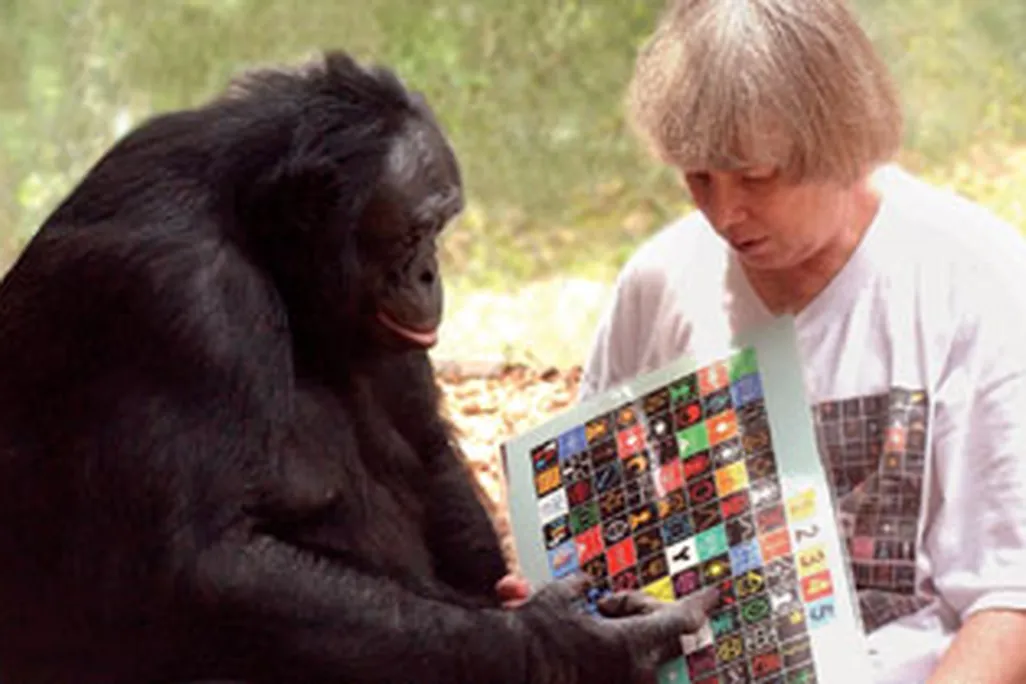
Sue Savage-Rumbaugh (with Kanzi in 2003) says her bonobos can communicate with her and each other using more than 348 symbols.

Great Ape Trust of Iowa

  • Science & Nature

Speaking Bonobo

Bonobos have an impressive vocabulary, especially when it comes to snacks
  • By Paul Raffaele
  • Smithsonian magazine, November 2006

Article Tools

 
  • Font
  • Email
  •  
  • Print
  • Comments
  •  
  • RSS
  •  

    Most Popular

    • Viewed
    • Emailed
    1. Diamonds on Demand
    2. Forget Jaws, Now it's . . . Brains!
    3. Corn Plastic to the Rescue
    4. Homing in on Black Holes
    5. The Coldest Place in the Universe
    6. Dinosaur Shocker
    7. On the Origin of a Theory
    8. Reading Between the Lines
    9. Wallace Broecker Geochemist, Palisades, New York
    10. Debating Manned Moon Missions
    1. Diamonds on Demand
    2. Rare Breed
    3. Forget Jaws, Now it's . . . Brains!
    4. Corn Plastic to the Rescue
    5. Dinosaur Shocker
    6. Reading Between the Lines
    7. Homing in on Black Holes
    8. Big Love
    9. Walk This Way
    10. Song and Dance Man

    To better understand bonobo intelligence, I traveled to Des Moines, Iowa, to meet Kanzi, a 26-year-old male bonobo reputedly able to converse with humans. When Kanzi was an infant, American psychologist Sue Savage-Rumbaugh tried to teach his mother, Matata, to communicate using a keyboard labeled with geometric symbols. Matata never really got the hang of it, but Kanzi—who usually played in the background, seemingly oblivious, during his mother’s teaching sessions—picked up the language.

    Savage-Rumbaugh and her colleagues kept adding symbols to Kanzi’s keyboard and laminated sheets of paper. First Kanzi used 6 symbols, then 18, finally 348. The symbols refer to familiar objects (yogurt, key, tummy, bowl), favored activities (chase, tickle), and even some concepts considered fairly abstract (now, bad).

    Kanzi learned to combine these symbols in regular ways, or in what linguists call"proto-grammar."Once, Savage-Rumbaugh says, on an outing in a forest by the Georgia State University laboratory where he was raised, Kanzi touched the symbols for"marshmallow"and"fire."Given matches and marshmallows, Kanzi snapped twigs for a fire, lit them with the matches and toasted the marshmallows on a stick.

    Savage-Rumbaugh claims that in addition to the symbols Kanzi uses, he knows the meaning of up to 3,000 spoken English words. She tests his comprehension in part by having someone in another room pronounce words that Kanzi hears through a set of headphones. Kanzi then points to the appropriate symbol on his keyboard. But Savage-Rumbaugh says Kanzi also understands words that aren’t a part of his keyboard vocabulary; she says he can respond appropriately to commands such as"put the soap in the water"or"carry the TV outdoors."

    About a year ago, Kanzi and his sister, mother, nephew and four other bonobos moved into a $10 million, 18-room house and laboratory complex at the Great Ape Trust, North America’s largest great ape sanctuary, five miles from downtown Des Moines. The bonobo compound boasts a 13,000-square-foot lab, drinking fountains, outdoor playgrounds, rooms linked by hydraulic doors that the animals operate themselves by pushing buttons, and a kitchen where they can use a microwave oven and get snacks from a vending machine (pressing the symbols for desired foods).

    Kanzi and the other bonobos spend evenings sprawled on the floor, snacking on M & M’s, blueberries, onions and celery, as they watch DVDs they select by pressing buttons on a computer screen. Their favorites star apes and other creatures friendly with humans such as Quest for Fire, Every Which Way But Loose, Greystoke: The Legend of Tarzan and Babe.

    Through a glass panel, Savage-Rumbaugh asks Kanzi if it’s OK for me to enter his enclosure."The bonobos control who comes into their quarters,"she explains. Kanzi, still the alpha male of this group in his middle age, has the mien of an aging patriarch—he’s balding and paunchy with serious, deep-set eyes. Squealing apparent agreement, he pushes a button, and I walk inside. A wire barrier still separates us."Kanzi can cause you serious damage if he wants,"Savage-Rumbaugh adds.

    Kanzi shows me his electronic lexigram touch pad, which is connected to a computer that displays—while a male voice speaks—the words he selects. But Kanzi’s finger slips off the keys."We're trying to solve this problem,"says Savage-Rumbaugh.

    She and her colleagues have been testing the bonobos’ ability to express their thoughts vocally, rather than by pushing buttons. In one experiment she described to me, she placed Kanzi and Panbanisha, his sister, in separate rooms where they could hear but not see each other. Through lexigrams, Savage-Rumbaugh explained to Kanzi that he would be given yogurt. He was then asked to communicate this information to Panbanisha."Kanzi vocalized, then Panbanisha vocalized in return and selected ‘yogurt’ on the keyboard in front of her,"Savage-Rumbaugh tells me.

    With these and other ape-language experiments, says Savage-Rumbaugh,"the mythology of human uniqueness is coming under challenge. If apes can learn language, which we once thought unique to humans, then it suggests that ability is not innate in just us."

    But many linguists argue that these bonobos are simply very skilled at getting what they want, and that their abilities do not constitute language."I do not believe that there has ever been an example anywhere of a nonhuman expressing an opinion, or asking a question. Not ever,"says Geoffrey Pullum, a linguist at the University of California at Santa Cruz."It would be wonderful if animals could say things about the world, as opposed to just signaling a direct emotional state or need. But they just don’t.”

    Whatever the dimension of Kanzi’s abilities, he and I did manage to communicate. I’d told Savage-Rumbaugh about some of my adventures, and she invited me to perform a Maori war dance. I beat my chest, slapped my thighs and hollered. The bonobos sat quiet and motionless for a few seconds, then all but Kanzi snapped into a frenzy, the noise deafening as they screamed, bared their teeth and pounded on the walls and floor of their enclosure. Still calm, Kanzi waved an arm at Savage-Rumbaugh, as if asking her to come closer, then let loose with a stream of squeaks and squeals."Kanzi says he knows you're not threatening them," Savage-Rumbaugh said to me," and he'd like you to do it again just for him, in a room out back, so the others won't get upset.”

    I’m skeptical, but I follow the researcher through the complex, out of Kanzi's sight. I find him, all alone, standing behind protective bars. Seeing me, he slapped his chest and thighs, mimicking my war dance, as if inviting me to perform an encore. I obliged, of course, and Kanzi joined in with gusto.

    To better understand bonobo intelligence, I traveled to Des Moines, Iowa, to meet Kanzi, a 26-year-old male bonobo reputedly able to converse with humans. When Kanzi was an infant, American psychologist Sue Savage-Rumbaugh tried to teach his mother, Matata, to communicate using a keyboard labeled with geometric symbols. Matata never really got the hang of it, but Kanzi—who usually played in the background, seemingly oblivious, during his mother’s teaching sessions—picked up the language.

    Savage-Rumbaugh and her colleagues kept adding symbols to Kanzi’s keyboard and laminated sheets of paper. First Kanzi used 6 symbols, then 18, finally 348. The symbols refer to familiar objects (yogurt, key, tummy, bowl), favored activities (chase, tickle), and even some concepts considered fairly abstract (now, bad).

    Kanzi learned to combine these symbols in regular ways, or in what linguists call"proto-grammar."Once, Savage-Rumbaugh says, on an outing in a forest by the Georgia State University laboratory where he was raised, Kanzi touched the symbols for"marshmallow"and"fire."Given matches and marshmallows, Kanzi snapped twigs for a fire, lit them with the matches and toasted the marshmallows on a stick.

    Savage-Rumbaugh claims that in addition to the symbols Kanzi uses, he knows the meaning of up to 3,000 spoken English words. She tests his comprehension in part by having someone in another room pronounce words that Kanzi hears through a set of headphones. Kanzi then points to the appropriate symbol on his keyboard. But Savage-Rumbaugh says Kanzi also understands words that aren’t a part of his keyboard vocabulary; she says he can respond appropriately to commands such as"put the soap in the water"or"carry the TV outdoors."

    About a year ago, Kanzi and his sister, mother, nephew and four other bonobos moved into a $10 million, 18-room house and laboratory complex at the Great Ape Trust, North America’s largest great ape sanctuary, five miles from downtown Des Moines. The bonobo compound boasts a 13,000-square-foot lab, drinking fountains, outdoor playgrounds, rooms linked by hydraulic doors that the animals operate themselves by pushing buttons, and a kitchen where they can use a microwave oven and get snacks from a vending machine (pressing the symbols for desired foods).

    Kanzi and the other bonobos spend evenings sprawled on the floor, snacking on M & M’s, blueberries, onions and celery, as they watch DVDs they select by pressing buttons on a computer screen. Their favorites star apes and other creatures friendly with humans such as Quest for Fire, Every Which Way But Loose, Greystoke: The Legend of Tarzan and Babe.

    Through a glass panel, Savage-Rumbaugh asks Kanzi if it’s OK for me to enter his enclosure."The bonobos control who comes into their quarters,"she explains. Kanzi, still the alpha male of this group in his middle age, has the mien of an aging patriarch—he’s balding and paunchy with serious, deep-set eyes. Squealing apparent agreement, he pushes a button, and I walk inside. A wire barrier still separates us."Kanzi can cause you serious damage if he wants,"Savage-Rumbaugh adds.

    Kanzi shows me his electronic lexigram touch pad, which is connected to a computer that displays—while a male voice speaks—the words he selects. But Kanzi’s finger slips off the keys."We're trying to solve this problem,"says Savage-Rumbaugh.

    She and her colleagues have been testing the bonobos’ ability to express their thoughts vocally, rather than by pushing buttons. In one experiment she described to me, she placed Kanzi and Panbanisha, his sister, in separate rooms where they could hear but not see each other. Through lexigrams, Savage-Rumbaugh explained to Kanzi that he would be given yogurt. He was then asked to communicate this information to Panbanisha."Kanzi vocalized, then Panbanisha vocalized in return and selected ‘yogurt’ on the keyboard in front of her,"Savage-Rumbaugh tells me.

    With these and other ape-language experiments, says Savage-Rumbaugh,"the mythology of human uniqueness is coming under challenge. If apes can learn language, which we once thought unique to humans, then it suggests that ability is not innate in just us."

    But many linguists argue that these bonobos are simply very skilled at getting what they want, and that their abilities do not constitute language."I do not believe that there has ever been an example anywhere of a nonhuman expressing an opinion, or asking a question. Not ever,"says Geoffrey Pullum, a linguist at the University of California at Santa Cruz."It would be wonderful if animals could say things about the world, as opposed to just signaling a direct emotional state or need. But they just don’t.”

    Whatever the dimension of Kanzi’s abilities, he and I did manage to communicate. I’d told Savage-Rumbaugh about some of my adventures, and she invited me to perform a Maori war dance. I beat my chest, slapped my thighs and hollered. The bonobos sat quiet and motionless for a few seconds, then all but Kanzi snapped into a frenzy, the noise deafening as they screamed, bared their teeth and pounded on the walls and floor of their enclosure. Still calm, Kanzi waved an arm at Savage-Rumbaugh, as if asking her to come closer, then let loose with a stream of squeaks and squeals."Kanzi says he knows you're not threatening them," Savage-Rumbaugh said to me," and he'd like you to do it again just for him, in a room out back, so the others won't get upset.”

    I’m skeptical, but I follow the researcher through the complex, out of Kanzi's sight. I find him, all alone, standing behind protective bars. Seeing me, he slapped his chest and thighs, mimicking my war dance, as if inviting me to perform an encore. I obliged, of course, and Kanzi joined in with gusto.


    Comments

    Thanks for this fascinating article. The people who criticize this research because the apes are not talking about world events are way off base. Do they think humans started out any differently than vocalizing emotional states and immediate needs?

    Posted by Judy Kamilhor on November 27,2007 | 04:31PM

    Did anyone read an article in the NYT that had one of the bonomos actually saying a few words (they can do many by synthesized speech. But actual speech let me know thanks

    Posted by mike on January 10,2008 | 01:31PM

    This is cool

    Posted by Bob on January 16,2008 | 08:56AM

    this is incredible

    Posted by magda Lech on January 26,2008 | 06:28PM

    This article I first read in a standardized test in my high school. We had to read it for the Reading portion of the test. After reading it, I was so intrigued that I did a little research. While I myself am not a supporter of Darwinism, i do believe that apes and humans share a common base for language. Apes are just as intelligent as any human who has not had any human contact from birth. Kanzi is an individual who has lived among humans and has learned that humans are just as smart as apes, from his point of view. All in all, the baboons you see behind bars are no different from your next door neighbor. Thank you for this article.

    Posted by Shannon on March 4,2008 | 07:14PM

    that is really fantastic, very cool

    Posted by borja on April 29,2008 | 05:10AM

    Absolutely amazing!! this is the greatest article

    Posted by De Anna on June 23,2008 | 03:09PM

    Post a Comment


    Name: (required)

    Email: (required)

    Comment:


    Advertisement

    Smithsonian Videos

    John Muir's Yosemite

    Carleton Watkins' 19th-Century Photographs of Yosemite Valley


    Sea Stallion from Glendalough

    Watch a video about the Viking ship replica’s construction and first voyage


    Taking the Plunge

    Learn about the often misunderstood great white shark


    Behind the Photos

    Gregory Crewdson discusses his virtual reality


    Down Under in Georgia

    Take a virtual tour of the Kangaroo Conservation Center


    Advertisement

    Marketplace

    • Labrador, Canada: Enter to win great prizes online, only in Labrador, Canada


    • Newfoundland, Canada: Click here to find out more about hiking the center of the earth at the Tablelands, Gros Morne National Park


    • Nova Scotia, Canada: The past is present every day in Nova Scotia


    • Montana: For a free vacation planner, log on to www.visitmt.com


    • Mexico: A whole new experience is expecting you in Mexico. Beyond your expectations.


    Promotions

    Subscribe Today & Win a FREE Trip to Paris!

    In The Magazine

    July 2008

    • Raiders or Traders?
    • Precarious Lebanon
    • Welcome to Your World
    • John Muir's Yosemite
    • The Great Human Migration
    • True Colors
    • Silken Treasure

    View Table of Contents

    Smithsonian magazine presents

    Smithsonian's 5th Annual Photo Contest Winners

    7,500 photographs, 82 countries, 50 finalists. And the seven winners are...

    ECOCENTER

    Greener Living

    Celebrate Earth Day with Smithsonian.com


    View full archiveRecent Issues


    • Jul 2008


    • Jun 2008


    • May 2008

    Newsletter

    Sign up for regular email updates from Smithsonian magazine, including free newsletters, special offers and current news updates.

    Subscribe Now

    About Us

    Smithsonian.com expands on Smithsonian magazine's in-depth coverage of history, science, nature, the arts, travel, world culture and technology. Join us regularly as we take a dynamic and interactive approach to exploring modern and historic perspectives on the arts, sciences, nature, world culture and travel, including videos, blogs and a reader forum.

    Explore our Brands

    • goSmithsonian.com
    • Smithsonian Air & Space Museum
    • Smithsonian Institution
    • Smithsonian Catalogue
    • Smithsonian Journeys
    • Smithsonian Channel
    • Site Map
    • Privacy Policy
    • Copyright
    • About Smithsonian
    • Contact Us
    • Advertising
    • Reader Panel
    • Subscribe
    • RSS

    Smithsonian Institution

    Produced by Clickability