
How the Louisiana Purchase Changed the World
When Thomas Jefferson purchased the Louisiana Territory from France, he altered the shape of a nation and the course of history
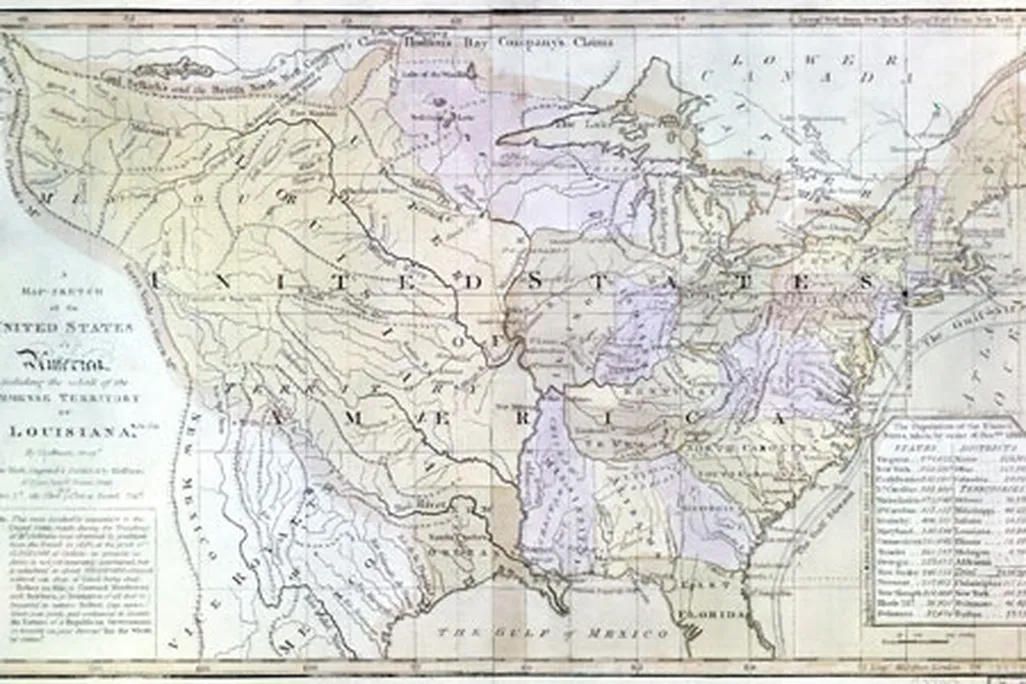
UNDERSTANDABLY, Pierre Clément de Laussat was saddened by this unexpected turn of events. Having arrived in New Orleans from Paris with his wife and three daughters just nine months earlier, in March 1803, the cultivated, worldly French functionary had expected to reign for six or eight years as colonial prefect over the vast territory of Louisiana, which was to be France’s North American empire. The prospect had been all the more pleasing because the territory’s capital, New Orleans, he had noted with approval, was a city with “a great deal of social life, elegance and goodbreeding.” He also had liked the fact that the city had “all sorts of masters—dancing, music, art, and fencing,” and that even though there were “no book shops or libraries,” books could be ordered from France.
But almost before Laussat had learned to appreciate a good gumbo and the relaxed Creole pace of life, Napoléon Bonaparte had abruptly decided to sell the territory to the United States. This left Laussat with little to do but officiate when, on a sunny December 20, 1803, the French tricolor was slowly lowered in New Orleans’ main square, the Placed’Armes, and the American flag was raised. After William C.C. Claiborne and Gen. James Wilkinson, the new commissioners of the territory, officially took possession of it in the name of the United States, assuring all residents that their property, rights and religion would be respected, celebratory salvos boomed from the forts around the city. Americans cried “Huzzah!” and waved their hats, while French and Spanish residents sulked in glum silence. Laussat, standing on the balcony of the town hall, burst into tears.
The Louisiana Purchase, made 200 years ago this month, nearly doubled the size of the United States. By any measure, it was one of the most colossal land transactions in history, involving an area larger than today’s France, Spain, Portugal, Italy, Germany, Holland, Switzerland and the British Isles combined. All or parts of 15 Western states would eventually be carved from its nearly 830,000 square miles, which stretched from the Gulf of Mexico to Canada, and from the Mississippi River to the Rocky Mountains. And the price, $15 million, or about four cents an acre, was a breathtaking bargain. “Let the Land rejoice,” Gen. Horatio Gates, a prominent New York state legislator, told President Thomas Jefferson when details of the deal reached Washington, D.C. “For you have bought Louisiana for a song.”
Rich in gold, silver and other ores, as well as huge forests and endless lands for grazing and farming, the new acquisition would make America immensely wealthy. Or, as Jefferson put it in his usual understated way, “The fertility of thecountry, its climate and extent, promise in due season importantaids to our treasury, an ample provision for our posterity, and a wide-spread field for the blessings of freedom.”
American historians today are more outspoken in their enthusiasm for the acquisition. “With the Declaration of Independence and the Constitution, this is one of the threethings that created the modern United States,” says Douglas Brinkley, director of the Eisenhower Center for American Studies in New Orleans and coauthor with the late Stephen E. Ambrose of The Mississippi and the Making of a Nation. Charles A. Cerami, author of Jefferson’s Great Gamble, agrees. “If we had not made this purchase, it would have pinched off the possibility of our becoming a continental power,” he says. “That, in turn, would have meant our ideas on freedom and democracy would have carried less weight with the rest of the world. This was the key to our international influence.”
The bicentennial is being celebrated with yearlong activities in many of the states fashioned from the territory. But the focal point of the celebrations is Louisiana itself. The most ambitious event opens this month at the New Orleans Museum of Art. “Jefferson’s America & Napoléon’s France” (April 12-August 31), an unprecedented exhibition of paintings, sculptures, decorative arts, memorabilia and rare documents, presents a dazzling look at the arts and leading figures of the two countries at this pivotal time in history. “What we wanted to do was enrich people’s understanding of the significance of this moment,” says Gail Feigenbaum, lead curator of the show. “It’s about more than just a humdinger of a real estate deal. What kind of world were Jefferson and Napoléon living and working in? We also show that our political and cultural relationship with France was extraordinarily rich at the time, a spirited interchange that altered the shape of the modern world.”
The “Louisiana territory” was born on April 9, 1682, when the French explorer Robert Cavelier, Sieur (Lord) de La Salle, erected a cross and column near the mouth of the Mississippi and solemnly read a declaration to a group of bemused Indians. He took possession of the whole Mississippi River basin, he avowed, in the name of “the most high, mighty, invincible and victorious Prince, Louis the Great, by Grace of God king of France and Navarre, 14th of that name.” And it was in honor of Louis XIV that he named the land Louisiana.
In 1718, French explorer Jean-Baptiste le Moyne, Sieur de Bienville, founded a settlement near the site of La Salle’s proclamation, and named it la Nouvelle Orléans for Philippe, Duke of Orléans and Regent of France. By the time of the Louisiana Purchase, its population of whites, slaves of African origin and “free persons of color” was about 8,000. A picturesque assemblage of French and Spanish colonial architecture and Creole cottages, New Orleans boasted a thriving economy based largely on agricultural exports.
For more than a century after La Salle took possession of it, the Louisiana Territory, with its scattered French, Spanish, Acadian and German settlements, along with those of Native Americans and American-born frontiersmen, was traded among European royalty at their whim. The French were fascinated by America—which they often symbolized in paintings and drawings as a befeathered Noble Savage standing beside an alligator—but they could not decide whether it was a new Eden or, as the naturalist Georges-Louis Leclerc de Buffon declared, a primitive place fit only for degenerate life-forms. But the official view was summed up by Antoine de La Mothe Cadillac, whom Louis XIV named governor of the territory in 1710: “The people are aheap of the dregs of Canada,” he sniffed in a 42-page report to the king written soon after he arrived. The soldiers there were untrained and undisciplined, he lamented, and the whole colony was “not worth a straw at the present time.” Concluding that the area was valueless, Louis XV gave the territory to his Bourbon cousin Charles III of Spain in 1763. But in 1800, the region again changed hands, when Napoléon negotiated the clandestine Treaty of San Ildefonso with Spain’s Charles IV. The treaty called for the return of the vast territory to France in exchange for the small kingdom of Etruria in northern Italy, which Charles wanted for his daughter Louisetta.
When Jefferson heard rumors of Napoléon’s secret deal, he immediately saw the threat to America’s Western settlements and its vital outlet to the Gulf of Mexico. If the deal was allowed to stand, he declared, “it would be impossible that France and the United States can continue long as friends.” Relations had been relaxed with Spain while it held New Orleans, but Jefferson suspected that Napoléon wanted to close the Mississippi to American use. This must have been a wrenching moment for Jefferson, who had long been a Francophile. Twelve years before, he had returned from a five-year stint as American minister to Paris, shipping home 86 cases of furnishings and books he had picked up there.
The crunch came for Jefferson in October 1802. Spain’s King Charles IV finally got around to signing the royal decree officially transferring the territory to France, and on October 16, the Spanish administrator in New Orleans, Juan Ventura Morales, who had agreed to administer the colony until his French replacement, Laussat, could arrive, arbitrarily ended the American right to deposit cargo in the city duty-free. He argued that the three-year term of the 1795 treaty that had granted America this right and free passage through Spanish territory on the Mississippi had expired. Morales’ proclamation meant that American merchandise could no longer be stored in New Orleans warehouses. As a result, trappers’ pelts, agricultural produce and finished goods risked exposure and theft on open wharfs while awaiting shipment to the East Coast and beyond. The entire economy of America’s Western territories was in jeopardy. “The difficulties and risks . . . are incalculable,” warned the U.S. vice-consul in New Orleans, Williams E. Hulings, in a dispatch to Secretary of State James Madison.
As Jefferson had written in April 1802 to the U.S. minister in Paris, Robert R. Livingston, it was crucial that the port of New Orleans remain open and free for American commerce, particularly the goods coming down the Mississippi River. “There is on the globe one single spot,” Jefferson wrote, “the possessor of which is our natural and habitual enemy. It is New Orleans, through which the produce of three-eighths of our territory must pass to market.” Jefferson’s concern was more than commercial. “He had a vision of America as an empire of liberty,” says Douglas Brinkley. “And he saw the Mississippi River not as the western edge of the country, but as the great spine that would hold the continent together.”
As it was, frontiersmen, infuriated by the abrogation of the right of deposit of their goods, threatened to seize New Orleans by force. The idea was taken up by lawmakers such as Senator James Ross of Pennsylvania, who drafted a resolution calling on Jefferson to form a 50,000-man army to take the city. The press joined the fray. The United States had the right, thundered the New York Evening Post, “to regulate the future destiny of North America,” while the Charleston Courier advocated “taking possession of the port . . . by force of arms.” As Secretary of State James Madison explained, “The Mississippi is to them everything. It is the Hudson, the Delaware, the Potomac, and all the navigable rivers of the Atlantic States, formed into one stream.”
With Congress and a vociferous press calling for action, Jefferson faced the nation’s most serious crisis since the American Revolution. “Peace is our passion,” he declared, and expressed the concern that hotheaded members of the opposition Federalist Party might “force us into war.” He had already instructed Livingston in early 1802 to approach Napoléon’s foreign minister, Charles Maurice de Talleyrand, to try to prevent the cession of the territory to France, if this had not already occurred, or, if the deal was done, to try to purchase New Orleans. In his initial meeting with Napoléon after taking up his Paris post in 1801, Livingston had been warned about Old World ways. “You have come to a very corrupt world,” Napoléon told him frankly, adding roguishly that Talleyrand was the right man to explain what he meant by corruption.
A wily political survivor who held high offices under the French Revolution, and later under Napoléon’s empire and the restored Bourbon monarchy, Talleyrand had spent the years 1792 to 1794 in exile in America after being denounced by the revolutionary National Convention, and had conceived a virulent contempt for Americans. “Refinement,” he declared, “does not exist” in the United States. As Napoléon’s foreign minister, Talleyrand customarily demanded outrageous bribes for diplomatic results. Despite a clubfoot and what contemporaries called his “dead eyes,” he could be charming and witty when he wanted—which helped camouflage his basic negotiating tactic of delay. “The lack of instructions and the necessity of consulting one’s government are always legitimate excuses in order to obtain delays in political affairs,” he once wrote. When Livingston tried to discuss the territory, Talleyrand simply denied that there was any treaty between France and Spain. “There never was a government in which less could be done by negotiation than here,” a frustrated Livingston wrote to Madison on September 1, 1802. “There is no people, no legislature, no counselors. One man is everything.”
But Livingston, although an inexperienced diplomat, tried to keep himself informed about the country to which he was ambassador. In March 1802, he warned Madison that France intended to “have a leading interest in the politics of our western country” and was preparing to send 5,000 to 7,000 troops from its Caribbean colony of Saint Domingue (now Haiti) to occupy New Orleans. But Napoléon’s troops in Saint Domingue were being decimated by a revolution and an outbreak of yellow fever. In June, Napoléon ordered Gen. Claude Victor to set out for New Orleans from the French controlled Netherlands. But by the time Victor assembled enough men and ships in January 1803, ice blocked the Dutchport, making it impossible for him to set sail.
That same month Jefferson asked James Monroe, a former member of Congress and former governor of Virginia, to join Livingston in Paris as minister extraordinary with discretionary powers to spend $9,375,000 to secure New Orleans and parts of the Floridas (to consolidate the U.S. position in the southeastern part of the continent). In financial straits at the time, Monroe sold his china and furniture to raise travel funds, asked a neighbor to manage his properties, and sailed for France on March 8, 1803, with Jefferson’s parting admonition ringing in his ears: “The future destinies of this republic” depended on his success.
By the time Monroe arrived in Paris on April 12, the situation had, unknown to him, radically altered: Napoléon had suddenly decided to sell the entire Louisiana Territory to the United States. He had always seen Saint Domingue, with a population of more than 500,000, producing enough sugar, coffee, indigo, cotton and cocoa to fill some 700 ships a year, as France’s most important holding in the Western Hemisphere. The Louisiana Territory, in Napoléon’s view, was useful mainly as a granary for Saint Domingue. With the colony in danger of being lost, the territory was less useful. Then, too, Napoléon was gearing up for another campaign against Britain and needed funds for that.
Napoléon’s brothers Joseph and Lucien had gone to see him at the Tuileries Palace on April 7, determined to convince him not to sell the territory. For one thing, they considered it foolish to voluntarily give up an important French holding on the American continent. For another, Britain had unofficially offered Joseph a bribe of £100,000 to persuade Napoléon not to let the Americans have Louisiana. But Napoléon’s mind was already made up. The First Consul happened to be sitting in his bath when his brothers arrived. “Gentlemen,” he announced, “think what you please about it. I have decided to sell Louisiana to the Americans.” To make his point to his astonished brothers, Napoléon abruptly stood up, then dropped back into the tub, drenching Joseph. A manservant slumped to the floor in a faint.
French historians point out that Napoléon had several reasons for this decision. “He probably concluded that, following American independence, France couldn’t hope to maintain a colony on the American continent,” says Jean Tulard, one of France’s foremost Napoléon scholars. “French policy makers had felt for some time that France’s possessions in the Antilles would inevitably be ‘contaminated’ by America’s idea of freedom and would eventually take their own independence. By the sale, Napoléon hoped to create a huge country in the Western Hemisphere to serve as a counterweight to Britain and maybe make trouble for it.”
On April 11, when Livingston called on Talleyrand for what he thought was yet another futile attempt to deal, the foreign minister, after the de rigueur small talk, suddenly asked whether the United States would perchance wish to buy the whole of the Louisiana Territory. In fact, Talleyrand was intruding on a deal that Napoléon had assigned to the French finance minister, François de Barbé-Marbois. The latter knew America well, having spent some years in Philadelphia in the late 1700s as French ambassador to the United States, where he got to know Washington, Jefferson, Livingston and Monroe. Barbé-Marbois received his orders on April 11, 1803, when Napoléon summoned him. “I renounce Louisiana,” Napoléon told him. “It is not only New Orleans that I will cede, it is the whole colony without reservation. I renounce it with the greatest regret. . . . I require a great deal of money for this war [with Britain].”
Thierry Lentz, a Napoléon historian and director of the Fondation Napoléon in Paris, contends that, for Napoléon, “It was basically just a big real estate deal. He was in a hurry to get some money for the depleted French treasury, although the relatively modest price shows that he was had in that deal. But he did manage to sell something that he didn’t really have any control over—there were few French settlers and no French administration over the territory—except on paper.” As for Jefferson, notes historian Cerami, “he actually wasn’t out to make this big a purchase. The whole thing came as a total surprise to him and his negotiating team in Paris, because it was, after all, Napoléon’s idea, not his.”
Showing up unexpectedly at the dinner party Livingston gave on April 12 for Monroe’s arrival, Barbé-Marbois discreetly asked Livingston to meet him later that night at the treasury office. There he confirmed Napoléon’s desire to sell the territory for $22,500,000. Livingston replied that he“would be ready to purchase provided the sum was reduced to reasonable limits.” Then he rushed home and worked until 3 a.m. writing a memorandum to Secretary of State Madison, concluding: “We shall do all we can to cheapen the purchase; but my present sentiment is that we shall buy.”
On April 15, Monroe and Livingston proposed $8 million.
At this, Barbé-Marbois pretended Napoléon had lost interest. But by April 27, he was saying that $15 million was as low as Napoléon would go. Though the Americans then countered with $12.7 million, the deal was struck for $15 million on April 29. The treaty was signed by Barbé-Marbois, Livingston and Monroe on May 2 and backdated to April 30. Although the purchase was undeniably a bargain, the price was still more than the young U.S. treasury could afford. But the resourceful Barbé-Marbois had an answer for that too. He had contacts at Britain’s Baring & Co. Bank, which agreed, along with several other banks, to make the actual purchase and pay Napoléon cash. The bank then turned over ownership of the Louisiana Territory to the United States in return for bonds, which were repaid over 15 years at 6 percent interest, making the final purchase price around $27 million. Neither Livingston nor Monroe had been authorized to buy all of the territory, or to spend $15 million—transatlantic mail took weeks, sometimes months, each way, so they had no time to request and receive approval of the deal from Washington. But an elated Livingston was aware that nearly doubling the size of America would make it a major player on the world scene one day, and he permitted himself some verbal euphoria: “We have lived long, but this is the noblest work of our whole lives,” he said. “From this day the United States take their place among the powers of the first rank.”
It wasn’t until July 3 that news of the purchase reached U.S. shores, just in time for Americans to celebrate it on Independence Day. A Washington newspaper, the National Intelligencer, reflecting how most citizens felt, referred to the “widespread joy of millions at an event which history will record among the most splendid in our annals.” Though we have no historical evidence of how Jefferson felt about the purchase, notes Cerami, reports from those in his circle like Monroe refer to the president’s “great pleasure,” despite his fear that the deal had gone beyond his constitutional powers. Not all Americans agreed, however. The Boston Columbian Centinel editorialized, “We are to give money of which we have too little for land of which we already have too much.” And Congressman Joseph Quincy of Massachusetts so opposed the deal that he favored secession by the Northeastern states, “amicably if they can; violently if they must.”
The favorable majority, however, easily prevailed and New England remained in the Union. As for the ever-succinct Thomas Jefferson, he wasted little time on rhetoric. “The enlightened government of France saw, with just discernment,” he told Congress, with typical tact, on October 17, 1803, “the importance to both nations of such liberal arrangements as might best and permanently promote the peace, friendship, and interests of both.” But, excited by the commercial opportunities in the West, Jefferson, even before official notice of the treaty reached him, had already dispatched Meriwether Lewis to lead an expedition to explore the territory and the lands beyond. All the way to the Pacific.
JEFFERSON’S AMERICA, NAPOLEON’S FRANCE
“We have tried to capture the suspense and fascination of a story whose outcome is known, yet was not foreordained,” says Gail Feigenbaum, curator of the Jefferson-Napoléon show on view in New Orleans April 12 to August 31, “and to tell it through a rich variety of objects.” The variety includes three important documents: a copy of the treaty, which bears Jefferson’s signature; a document covering payment of claims by American citizens against France, signed by Napoléon; and the official report of transfer of the Louisiana Territory signed by a bereaved prefect, Pierre de Laussat. The exhibition points up how intertwined the two nations were at the time. A seascape portrays the Marquis de Lafayette’s ship La Victoire setting sail to carry him across the Atlantic in 1777 to fight in the American Revolution. (There is also a portrait of the marquis himself and a 1784 painting by French artist Jean Suau, Allegory of France Liberating America.) A mahogany and gilded bronze swan bed that belonged to the famous French beauty Juliette Récamier is also on display. Fashion-conscious American ladies reportedly imitated Récamier’s attire, but not her custom of receiving visitors in her bedroom. And John Trumbull’s huge painting The Signing of the Declaration of Independence documents the historic American event that so greatly impressed and influenced French revolutionary thinkers. It hangs not far from a color engraving of the French Declaration of the Rights of Man, which was composed in 1789 by Lafayette with the advice of his American friend Thomas Jefferson.