
The Vikings: A Memorable Visit to America
The Icelandic house of what is likely the first European-American baby has scholars rethinking the Norse sagas
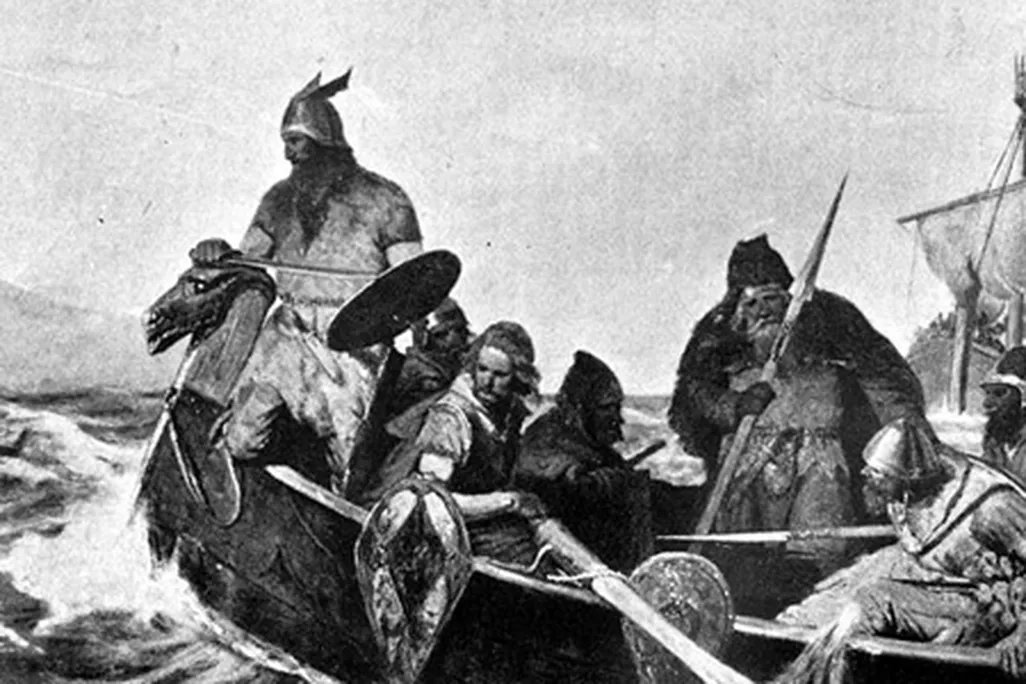
Roughly 1,000 years ago, the story goes, a Viking trader and adventurer named Thorfinn Karlsefni set off from the west coast of Greenland with three ships and a band of Norse to explore a newly discovered land that promised fabulous riches. Following the route that had been pioneered some seven years before by Leif Eriksson, Thorfinn sailed up Greenland’s coast, traversed the Davis Strait and turned south past Baffin Island to Newfoundland—and perhaps beyond. Snorri, the son of Thorfinn and his wife, Gudrid, is thought to be the first European baby born in North America.
Thorfinn and his band found their promised riches—game, fish, timber and pasture—and also encountered Native Americans, whom they denigrated as skraelings, or “wretched people.” Little wonder, then, that relations with the Natives steadily deteriorated. About three years after starting out, Thorfinn—along with his family and surviving crew—abandoned the North American settlement, perhaps in a hail of arrows. (Archaeologists have found arrowheads with the remains of buried Norse explorers.) After sailing to Greenland and then Norway, Thorfinn and his family settled in Iceland, Thorfinn’s childhood home.
Just where the family ended up in Iceland has been a mystery that historians and archaeologists have long tried to clear up. In September 2002, archaeologist John Steinberg of the University of California at Los Angeles announced that he had uncovered the remains of a turf mansion in Iceland that he believes is the house where Thorfinn, Gudrid and Snorri lived out their days. Other scholars say his claim is plausible, although even Steinberg admits, “We’ll never know for sure unless someone finds a name on the door.”
The location of Thorfinn’s family estate in Iceland has surprisingly broad implications. For one thing, it could shed new light on the early Norse experience in North America, first substantiated by Helge Ingstad, an explorer, and his wife, Anne Stine Ingstad, an archaeologist. In 1960, they discovered the remains of a Viking encampment in Newfoundland dating to the year 1000. But the only accounts of how and why Vikings journeyed to the New World, not to mention what became of them, are in Icelandic sagas, centuries-old tales that have traditionally vexed scholars struggling to separate Viking fantasy from Viking fact. Steinberg’s find, if proved, would give credence to one saga over another.
By Steinberg’s admission, he found the imposing longhouse— on the grounds of one of northern Iceland’s most visited cultural sites, the GlaumbaerFolkMuseum—“by dumb luck.” For decades, visitors had gazed upon the field in front of the museum, unaware that evidence of one of the grandest longhouses of the Viking era lay just beneath the grass.
Steinberg did not start out trying to insert himself into a debate about Viking lore, but to survey settlement patterns during Viking times. With his colleague Doug Bolender of NorthwesternUniversity in Chicago, he had developed a method for using an electrical conductivity meter to detect buried artifacts. The tool—a cumbersome, 50-pound apparatus usually used to identify contaminated groundwater and locate pipes—sends alternating current into the ground. The current induces a magnetic field, and the tool then measures how the magnetic field varies according to the makeup of the soil and the objects buried in it. The two men fitted the electronic equipment into a 12-foot-long plastic tube and trekked around fields holding the apparatus by their sides, looking for all the world like slowmotion pole vaulters getting ready to vault.
The two first worked with Icelandic archaeologist Gud- mundur Olafsson, who was excavating the site of Erik the Red’s farmstead in western Iceland and had identified it as the place from which some of the explorers of the New World first set out. There, Steinberg and Bolender charted magnetic anomalies—possible signatures of buried walls and floors of turf houses. Then, Steinberg says, “Gudmundur would draw upon his knowledge of ancient Norse houses to imagine possible configurations underground so that we could refine the search.” By the end of 2000, Steinberg and Bolender could survey a field as quickly as they could walk.
An 18-person team they put together then settled on Skagafjord, on the north coast of Iceland, as the most promising place to conduct their studies. The area is dotted with rills, rivers and thousand-year-old fields green from the abundant rain and long, soft sunlight of summer days in the Far North. The territory was ideally suited to their technology, layered as it is with known volcanic deposits that coincide with important historical events, enabling the archaeologists to get a good fix on the ages of objects they found. “See, the soil reads like a book,” Steinberg says, standing in a trench on a farm near Glaumbaer that was the site of northern Iceland’s most powerful estate during Viking times. He points to a green layer that marks a volcanic eruption in 871, a blue layer from one in 1000 and a thick, yellow layer from yet another in 1104.
In the summer of 2001, Steinberg and his colleagues scanned the low fields in Glaumbaer. The work proceeded uneventfully until late August, when the team was about to pack up and leave. (“You always find the most important things in the last week of a field season,” says Steinberg.) When two undergraduates probing spots that showed low conductivity in earlier scans pulled up their first plug of earth, they looked in the hole and saw a layer of turf—consistent with a turf house—below a yellow layer that marked the eruption of MountHekla in 1104.
Excited, Steinberg returned in 2002 to dig a series of trenches. By the end of that season, the team had uncovered parts of what appeared to be an extensive longhouse, 100 feet by 25 1/2 feet. By the end of 2004, the team had plotted the direction and length of one of the walls. The house was so large that it evidently belonged to someone with wealth and power. But who?
All the detail about Norse trips to Vinland (as the Norse called North America) comes from two accounts: The Saga of Erik the Red and The Saga of the Greenlanders. These epic Viking tales were probably first written down around 1200 or 1300 by scribes who either recorded the oral stories of elders or worked from some now-lost written source, says Thor Hjaltalin, an Icelandic scholar who oversees archaeological activities in northwest Iceland. The two sagas give similar accounts of Thorfinn’s trip to the New World, but they differ on some significant details about his return to Iceland. In Erik the Red’s saga, Thorfinn moves back to his family estate in Reynisnes, while in the Greenlanders’ saga, Thor-finn settles down in Glaumbaer, after his mother proves less than welcoming to his wife. In a key passage from the Greenlanders’ saga, Thor-finn sells some of his Vinland spoils in Norway, then comes to “north Iceland, in Skagafjord, where he had his ship drawn ashore for the winter. In the spring he purchased the land at Glaumbaer and established his farm there.” It goes on: “He and his wife, Gudrid, had a great number of descendants, and a fine clan they were. . . . After [Thorfinn’s] death, Gudrid took over the running of the household, together with her son Snorri who had been born in Vinland.”
Apart from the grand scale of the longhouse, which ties it to someone of Thorfinn’s stature, other evidence links it to the North American expedition, Steinberg claims. Its straight-walled design differs from the bowed-wall construction typical of Icelandic longhouses of the era, and it bears a strong resemblance to structures that have been uncovered in L’Anse aux Meadows in Newfoundland. And finally, Steinberg says, it’s unlikely that any other chief could build one of the grandest longhouses of the Viking era and not be mentioned either in the sagas or other sources.
Before Steinberg’s find, conventional wisdom held that Erik the Red’s version was more credible and that the reference to Glaumbaer in the Greenlanders’ saga was merely a flourish, added years after most of the saga was written, to improve Gudrid’s image and perhaps that of a Glaumbaer chief. There are still many points of dispute about which Norse did what and where in North America, but if Steinberg’s find is indeed Thorfinn’s house, the long-discounted Greenlanders’ saga, which names Thorfinn as a primary source, becomes the more accurate version—at least on the matter of where Thorfinn and company ended up. So after he found the longhouse, Steinberg called Olafsson—who had identified Erik the Red’s farmstead as a jumping-off place for the New World—and blurted, “I think I’ve found the other end of your story.”
Vikings spread out from Scandinavia and settled in Iceland, which Steinberg describes as “one of the world’s last large inhabitable islands to be inhabited,” in 874. They were led by local chiefs who did not like taking orders from, or paying taxes to, Harald Finehair, a Norse king then consolidating power in Norway. As the celebrated Norwegian anthropologist Vilhemmer Stefansson wrote in 1930, the Viking expansion was perhaps “the only large scale migration in history where the nobility moved out and the peasantry stayed home.”
At first, Iceland offered a paradise to these ruggedly independent Vikings. The lowlands had forests of birch and other trees that had never felt the ax. In just 60 years the population jumped from zero to 70,000. By 930, the Norse had established one of the world’s first parliaments, the Althing, where chiefs met to settle disputes.
There was just one sore point to this idyllic life. Settled and organized though they might have been, the Vikings were also some of the toughest warriors who ever lived. A slighted Norse was not the type to turn the other cheek. The resulting bloody duels reverberated far beyond Iceland. As Stefansson put it in 1930, writing during Prohibition, “The eventual discovery of North America hangs upon a fashionable practice of the day, that of man-killing, which, like cocktail shaking in the later America, was against the law but was indulged by the best people.” He was referring to a few unreconstructed manslayers like Erik the Red, who overtaxed even the Norse tolerance for conflict and was exiled more than once by his fellow chiefs. Erik was first forced to relocate to Iceland’s west coast and was then banished from the island altogether.
/https://tf-cmsv2-smithsonianmag-media.s3.amazonaws.com/filer/vikings_main.jpg)
/https://tf-cmsv2-smithsonianmag-media.s3.amazonaws.com/filer/vikings_kneel.jpg)
/https://tf-cmsv2-smithsonianmag-media.s3.amazonaws.com/filer/vikings_pole.jpg)
According to the sagas, Erik eventually set up a farmstead on the west coast of Greenland. The incongruous name for this barren, frigid island dominated by a vast ice cap comes from the outcast’s attempt to lure other settlers, demonstrating “a genius for advertising that made him prophetically American,” Stefansson wrote. Erik heard tales of strange lands to the west from a Norse sailor blown off course en route to Greenland, and it was his son Leif who led the first expedition to the New World. Another was led by Erik’s son Thorvald (who died in Vinland from an arrow wound). Thorfinn Karlsefni led a third.
Thorfinn’s assumed lineage is distinguished: one ancestor was Aud the Deepminded, a queen from the British Isles, and another was Ugarval, a king of Ireland. Thorfinn had grown up in Iceland on a farm not far from Glaumbaer. A wealthy merchant notorious for his cleverness, Thorfinn was also a good leader. On a trading voyage to Greenland, he met and married Gudrid Thorbjarnardottir, the beautiful and charismatic widow of Erik’s son Thorvald. (A history of Iceland written around 1120, as well as scattered church records, back up the genealogies and dates in the sagas.) During the winter of 1005 at Brattahlid, Erik’s manor in Greenland’s eastern colony, Thorfinn played board games and planned his trip to Vinland. Erik the Red’s saga makes the planning sound boisterous and somewhat haphazard, noting that various other Norse chiefs decided to join the expedition seemingly on the spur of the moment.
While Leif Eriksson is the Viking name most familiar to Americans, the sagas devote as much space to Thorfinn and his voyage. Steinberg’s discovery supports a long-held theory that Thorfinn was the principal teller of the sagas. (That would explain why he plays such a major role in them.) Steinberg notes that knowing the source of a text helps historians weigh the assertions.
Whoever their author was, the stories have challenged scholars to match the place names mentioned in them to real topography. For example, Thorfinn called two crucial places where he and his group camped in the New World Straumfjord (stream fiord) and Hop (lagoon) and described the first as having strong currents. Scholars have variously located Straumfjord, where Snorri was born, in Buzzards Bay, Massachusetts; Long Island Sound; the Bay of Fundy; and L’Anse auxMeadows (the Norse site discovered by Helge and Anne Ingstad on the northern tip of Newfoundland). Different advocates have placed Hop near New York City, Boston and points north.
If in fact Thorfinn and company traveled as far south as Gowanus Bay in New York Harbor, as asserted by the British scholar Geoffrey Gathorne-Hardy in 1921, they would have sailed past some of the greatest stands of primeval hardwoods on the planet, not to mention grapes—treasured by Norse chiefs who cemented their status with feasts accompanied by copious amounts of wine—and unlimited fish and game.
Why would the Norse have abandoned them or similar inducements farther north? Perhaps the Vikings’ Vinland was like Alexander the Great’s India: a land of fabulous wealth so far from home that it was beyond the limits of his ability to impose his will. Both Norse sagas have Thorfinn beating a retreat north after some humbling battles with Native warriors. (See “Why Didn’t They Stay?”)
Thorfinn never went back to Vinland, but other Norse subsequently did. Evidence continues to accumulate that Norse traded with both Inuit and more southern tribes for skins, and that they regularly brought back wood and other items from the New World. Over the years, various accounts have placed Norse colonies in Maine, Rhode Island and elsewhere on the AtlanticCoast, but the only unambiguous Norse settlement in North America remains L’Anse aux Meadows.
Icelanders, for their part, need no persuading of the Viking’s preeminence among Europeans in the New World. Asked who discovered America, 8-year-old Kristin Bjarnadottir, a third grader in Holar, Iceland, answers with complete confidence: “Leifur,” naming the celebrated Viking explorer. She and other Icelandic kids often play a game called Great Adventurer, in which they take on the roles of the saga heroes. Steinberg’s ongoing investigation of the turf house in Glaumbaer and other structures could well give Kristin and her friends rich new exploits of their Viking ancestors to act out.
Freydis: Heroine or Murderer?
Viking scholars have long debated the veracity of the Icelandic sagas. Are they literature or history, or both? The two conflicting versions of Freydis Eriksdottir, who was Erik the Red's daughter and the half sister of Leif Eriksson and who traveled to North America 1,000 years ago, are a case in point.
In Erik the Red's saga, Freydis and her husband Thorvard accompany Thorfinn Karlsefni and Gudrid Thorbjarnardottir on their journey to the New World. When Natives attack their small colony, the Norse men run off. But a pregnant Freydis stands her ground, shouting: "Why do you flee from such pitiful wretches, brave men like you? . . . If I had weapons, I am sure I could fight better than any of you." She snatches up a sword from a fallen Norseman and exposes a breast (presumably to indicate that she's a woman), frightening off the attackers. When the danger had passed, Thorfinn came over to her and praised her courage.
But in the Greenlanders' saga, Freydis is a murderer. Freydis and her husband do not travel with Thorfinn and Gudrid, but instead undertake an expedition with two Icelanders, known as Finnbogi and Helgi. When they arrive in Straumfjord (thought by some scholars to be the site in Newfoundland known as L'Anse aux Meadows), they quarrel over who will live in the longhouses Leif Eriksson has left behind. Freydis wins, rousing the Icelanders' resentment. After a hard winter in which the two camps become more estranged, Freydis demands that the Icelanders hand over their larger ship for the journey home. She goads her husband and followers into murdering all the male Icelanders. When no one will kill the five women in the Icelanders' camp, she takes up an ax and dispatches them herself. Back in Greenland, word of the incident seeps out. "Afterwards no one thought anything but ill of her and her husband," concludes the story of Freydis' expedition.
Was Freydis a heroine? Or a homicidal maniac? Archaeologist Birgitta Linderoth Wallace, who directed much of the excavation of L'Anse aux Meadows, doesn't know for sure. "We try to sort out what's fact and fiction," she says. "We can't presume the saga writers knew the difference. What we do know is the writers were often anonymous.and male. They were Christian priests. Freydis was a pagan, while Gudrid was Christian. Gudrid's descendants were bishops and had an interest in making her appear as holy as possible and Freydis as bad as possible, for contrast." Wallace says the murder of the Icelanders is hard to believe. "Something bad happened," she says. "But can you imagine killing 35 Icelanders without all their relatives coming over to take revenge?"
Why Didn’t They Stay?
The Viking presence in North America had dwindled to nothing long before Columbus began island hopping in the Caribbean. Why did the Norse fail where other Europeans succeeded? After all, Vikings were consummate seamen and peerless raiders who populated marginally inhabitable Greenland and who would push their way into the British Isles and France. And with their iron weapons and tools, they had a technological edge over America's indigenous peoples.
Several explanations have been advanced for the Vikings' abandonment of North America. Perhaps there were too few of them to sustain a settlement. Or they may have been forced out by American Indians. While the European conquest was abetted by infectious diseases that spread from the invaders to the Natives, who succumbed in great numbers because they had no acquired immunity, early Icelanders may not have carried similar infections.
But more and more scholars focus on climate change as the reason the Vikings couldn.t make a go of it in the New World. The scholars suggest that the western Atlantic suddenly turned too cold even for Vikings. The great sailing trips of Leif and Thorfinn took place in the first half of the 11th century, during a climatic period in the North Atlantic called the Medieval Warming, a time of long, warm summers and scarce sea ice. Beginning in the 12th century, however, the weather started to deteriorate with the first frissons of what scholars call the Little Ice Age. Tom McGovern, an archaeologist at Hunter College in New York City, has spent more than 20 years reconstructing the demise of a Norse settlement on Greenland. In the middle of the 14th century, the colony suffered eight harsh winters in a row, culminating, in 1355, in what may have been the worst in a century. McGovern says the Norse ate their livestock and dogs before turning to whatever else they could find in their final winter there. The settlers might have survived if they had mimicked the Inuit, who hunted ringed seal in the winter and prospered during the Little Ice Age.
With sea ice making the routes from Iceland to Greenland and back impassable for Norse ships for much of the year, the Little Ice Age probably curtailed further Norse traffic to North America. Iceland also fared badly during this time. By 1703, weather-related food shortages and epidemics of plague and smallpox had reduced Iceland's population to 53,000, from more than 150,000 in 1250.
It’s worth pondering how the history of the West might have differed if the weather had remained balmy. Norse populations in Iceland and Greenland might have flourished, and the Vikings might have remained in North America. If the temperature had been a few degrees higher, some of North America might be speaking Norse today.