
The Worldwide History of Tattoos
Ancient ink exhibited religious faith, relieved pain, protected wearers and indicated class
/https://tf-cmsv2-smithsonianmag-media.s3.amazonaws.com/filer_public/fb/e4/fbe4279b-dfc7-4517-8330-8b8c263b16ae/gettyimages-478839453.jpeg)
Humans have been marking their skin for thousands of years. Around the world, across cultures, tattoos have held countless different significances. Ancient Siberian nomads, Indigenous Polynesians, Nubians, Native South Americans and Greeks all used tattoos—and for a variety of reasons: to protect from evil; declare love; signify status or religious beliefs; as adornments and even forms of punishment.
Joann Fletcher, an honorary archaeology research fellow at the University of York in the United Kingdom, studies tattooing’s mark on history and culture. She specializes in ancient Egyptians, who she says were long thought to be the earliest tattoo artists, thanks to the discovery of tattooed mummies. That changed in 1991, with the excavation of Ötzi the Iceman, a 5,300-year-old, frozen mummy near the Italian-Austrian border, whose body is adorned with ink.
In the millennia since Ötzi was inked, tattoos have proliferated worldwide. According to a study by the Pew Research Center, 32 percent of people in the United States have at least one tattoo, and many of those Americans share common motivations. Sixty-nine percent of tattooed adults in the U.S. say they got inked to “honor or remember someone or something,” while 47 percent say they wanted to make a statement about the beliefs, and 32 percent say they got tattooed to improve their personal appearance. Turns out, many of our historical counterparts around the world had similar motivations.
Fletcher told Smithsonian magazine all about tattoos’ functions, prevalence and endurance in cultures around the world.
/https://tf-cmsv2-smithsonianmag-media.s3.amazonaws.com/filer_public/d8/56/d856414e-1f90-47ac-8ee7-f4d2f98718c9/otzi_image.jpeg)
What is the earliest evidence of tattoos?
In terms of tattoos on actual bodies, the earliest known examples were for a long time Egyptian and were present on several female mummies dated to circa 2000 B.C.E.. But following the more recent discovery of the Iceman from the area of the Italian-Austrian border in 1991 and his tattoo patterns, this date has been pushed back a further thousand years when he was carbon-dated at around 5,200 years old.
Can you describe the tattoos on the Iceman and their significance?
Following discussions with my colleague Professor Don Brothwell of the University of York, one of the specialists who examined him, the distribution of the tattooed dots and small crosses on his lower spine and right knee and ankle joints correspond to areas of strain-induced degeneration, with the suggestion that they may have been applied to alleviate joint pain and were therefore essentially therapeutic. This would also explain their somewhat ‘random’ distribution in areas of the body which would not have been that easy to display had they been applied as a form of status marker.
/https://tf-cmsv2-smithsonianmag-media.s3.amazonaws.com/filer_public/a9/2e/a92e2911-1785-413c-b97f-b5d8df1f5baa/tattoo221.jpeg)
What is the evidence that ancient Egyptians had tattoos?
There’s certainly evidence that women had tattoos on their bodies and limbs from figurines circa 4000-3500 B.C.E. to occasional female figures represented in tomb scenes circa 1200 B.C.E. and in figurine form circa 1300 B.C.E., all with tattoos on their thighs. Also small bronze implements identified as tattooing tools were discovered at the town site of Gurob in northern Egypt and dated to circa 1450 B.C.E.. And then, of course, there are the mummies with tattoos, from the three women already mentioned and dated to circa 2000 B.C.E. to several later examples of female mummies with these forms of permanent marks found in Greco-Roman burials at Akhmim.
What function did these tattoos serve? Who got them and why?
Because this seemed to be an exclusively female practice in ancient Egypt—[though recent finds prove at least one man was inked]—mummies found with tattoos were usually dismissed by the (male) excavators who seemed to assume the women were of “dubious status,” described in some cases as “dancing girls.” The female mummies had nevertheless been buried at Deir el-Bahari (opposite modern Luxor) in an area associated with royal and elite burials, and we know that at least one of the women described as “probably a royal concubine” was actually a high-status priestess named Amunet, as revealed by her funerary inscriptions.
/https://tf-cmsv2-smithsonianmag-media.s3.amazonaws.com/filer_public/cf/58/cf58fa03-6c0c-48fd-83ef-e8835c7ed99e/tattoo_bowl.jpeg)
And although it has long been assumed that such tattoos were the mark of prostitutes or were meant to protect the women against sexually transmitted diseases, I personally believe that the tattooing of ancient Egyptian women had a therapeutic role and functioned as a permanent form of amulet—[an ornament meant to protect its wearer]—during the very difficult time of pregnancy and birth. This is supported by the pattern of distribution, largely around the abdomen, on top of the thighs and the breasts, and would also explain the specific types of designs, in particular the net-like distribution of dots applied over the abdomen. During pregnancy, this specific pattern would expand in a protective fashion in the same way bead nets were placed over wrapped mummies to protect them and “keep everything in.” The placing of small figures of the household deity Bes at the tops of their thighs would again suggest the use of tattoos as a means of safeguarding the actual birth, since Bes was the protector of women in labor, and his position at the tops of the thighs a suitable location. This would ultimately explain tattoos as a purely female custom.
Who made the tattoos?
Although we have no explicit written evidence in the case of ancient Egypt, it may well be that the older women of a community would create the tattoos for the younger women, as happened in 19th-century Egypt and happens in some parts of the world today.
/https://tf-cmsv2-smithsonianmag-media.s3.amazonaws.com/filer_public/c2/8e/c28e8ba3-b543-47e8-944c-2b24bbee3896/tattoo_implements.jpg)
What instruments did they use?
It is possible that an implement best described as a sharp point set in a wooden handle, dated to circa 3000 B.C.E. and discovered by archaeologist W.M.F. Petrie at the site of Abydos may have been used to create tattoos. Petrie also found the aforementioned set of small bronze instruments circa 1450 B.C.E.—resembling wide, flattened needles—at the ancient town site of Gurob. If tied together in a bunch, they would provide repeated patterns of multiple dots.
These instruments are also remarkably similar to much later tattooing implements used in 19th-century Egypt. The English writer William Lane (1801-1876) observed, “the operation is performed with several needles (generally seven) tied together: with these the skin is pricked in a desired pattern: some smoke black (of wood or oil), mixed with milk from the breast of a woman, is then rubbed in.... It is generally performed at the age of about 5 or 6 years, and by [Romani] women.”
What did these tattoos look like?
Most examples on mummies are largely dotted patterns of lines and diamond patterns, while figurines sometimes feature more naturalistic images. The tattoos occasionally found in tomb scenes and on small female figurines which form part of cosmetic items also have small figures of the dwarf god Bes on the thigh area.
What were they made of? How many colors were used?
Usually, a dark or black pigment such as soot was introduced into the pricked skin. It seems that brighter colors were largely used in other ancient cultures, such as the Inuit who are believed to have used a yellow color along with the more usual darker pigments.
What has surprised you the most about ancient Egyptian tattooing?
That it appears to have been restricted to women during the purely dynastic period, i.e. pre-332 B.C.E.. Also, the way in which some of the designs can be seen to be very well placed, once it is accepted they were used as a means of safeguarding women during pregnancy and birth.

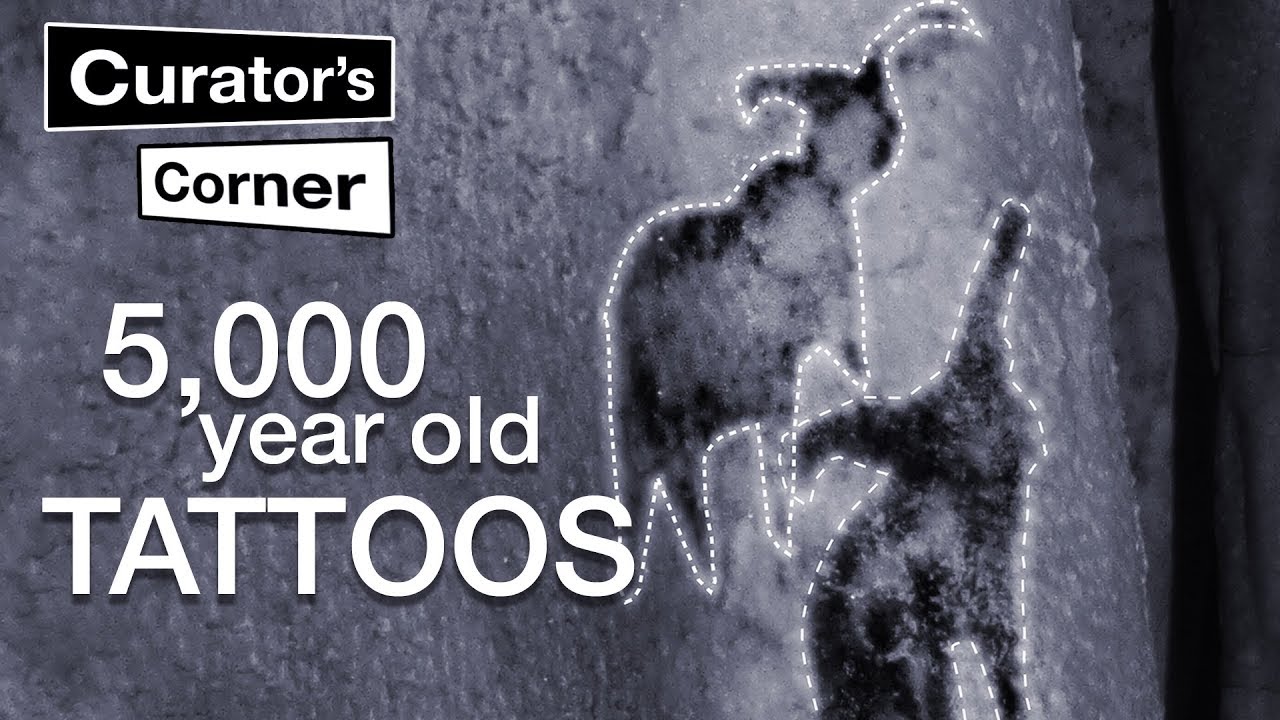
Can you describe the tattoos used in other ancient cultures and how they differ?
Among the numerous ancient cultures who appear to have used tattooing as a permanent form of body adornment, the Nubians to the south of Egypt are known to have used tattoos. The mummified remains of women of the indigenous C-group culture found in cemeteries near Kubban circa 2000-15000 B.C.E. were found to have blue tattoos, which in at least one case featured the same arrangement of dots across the abdomen noted on the aforementioned female mummies from Deir el-Bahari. The ancient Egyptians also represented the male leaders of the Libyan neighbors circa 1300-1100 B.C.E. with clear, rather geometrical tattoo marks on their arms and legs and portrayed them in Egyptian tomb, temple and palace scenes.
/https://tf-cmsv2-smithsonianmag-media.s3.amazonaws.com/filer_public/08/03/0803c12a-2b83-428e-a99d-81ac3a6d4d93/pazyryk-tattoo.jpeg)
The Scythian Pazyryk of the Altai Mountain region were another ancient culture which employed tattoos. In 1948, the 2,400-year-old body of a Scythian male was discovered preserved in ice in Siberia, his limbs and torso covered in ornate tattoos of mythical animals. Then, in 1993, a woman with tattoos, again of mythical creatures on her shoulders, wrists and thumb and of similar date, was found in a tomb in Altai. The practice is also confirmed by the Greek writer Herodotus circa 450 B.C.E., who stated that amongst the Scythians and Thracians “tattoos were a mark of nobility, and not to have them was testimony of low birth.”
Accounts of the ancient Britons likewise suggest they too were tattooed as a mark of high status, and with “divers [sic] shapes of beasts” tattooed on their bodies, the Romans named one northern tribe “Picti,” literally “the painted people.”
/https://tf-cmsv2-smithsonianmag-media.s3.amazonaws.com/filer_public/92/da/92dac6e3-d4c8-449b-b273-b63f9a844a6d/phiale_painter_arv_1014_2_thracian_woman_with_sword_killing_orpheus_-_draped_youth_02.jpeg)
Yet amongst the Greeks and Romans, the use of tattoos or “stigmata“ as they were then called, seems to have been largely used as a means to mark someone as “belonging” either to a religious sect or to an owner in the case of slaves or even as a punitive measure to mark them as criminals. It is therefore quite intriguing that during Ptolemaic times when a dynasty of Macedonian Greek monarchs ruled Egypt, the pharaoh himself, Ptolemy IV (221-205 B.C.E.), was said to have been tattooed with ivy leaves to symbolize his devotion to Dionysus, Greek god of wine and the patron deity of the royal house at that time. The fashion was also adopted by Roman soldiers and spread across the Roman Empire until the emergence of Christianity, when tattoos were felt to “disfigure that made in God’s image” and so were banned by the Emperor Constantine (C.E. 306-373).
We have also examined tattoos on mummified remains of some of the ancient pre-Columbian cultures of Peru and Chile, which often replicate the same highly ornate images of stylized animals and a wide variety of symbols found in their textile and pottery designs. One stunning female figurine of the Nazca culture has what appears to be a huge tattoo right around her lower torso, stretching across her abdomen and extending down to her genitalia and, presumably, once again alluding to the regions associated with birth. Then on the mummified remains which have survived, the tattoos were noted on torsos, limbs, hands, the fingers and thumbs, and sometimes facial tattooing was practiced.
/https://tf-cmsv2-smithsonianmag-media.s3.amazonaws.com/filer_public/16/c2/16c2b1c3-8a3f-47ba-a7c8-1aa60fb4a37b/nazca_tattoo_figurine3.jpg)
With extensive facial and body tattooing used among Native Americans, such as the Cree, the mummified bodies of a group of six Greenland Inuit women 1475 C.E. also revealed evidence for facial tattooing. Infrared examination revealed that five of the women had been tattooed in a line extending over the eyebrows, along the cheeks and in some cases with a series of lines on the chin. Another tattooed female mummy, dated 1,000 years earlier, was also found on St. Lawrence Island in the Bering Sea, her tattoos of dots, lines and hearts confined to the arms and hands.
/https://tf-cmsv2-smithsonianmag-media.s3.amazonaws.com/filer_public/94/bd/94bd2fee-80f3-4407-bdbf-04251c781085/chiribaya__tattoo_head.jpg)
Evidence for tattooing is also found amongst some of the ancient mummies found in China’s Taklamakan Desert circa 1200 B.C.E., although during the later Han Dynasty (202 B.C.E.-C.E. 220), it seems that only criminals were tattooed.
Japanese men began adorning their bodies with elaborate tattoos in the late 3rd century. The elaborate tattoos of the Polynesian cultures are thought to have developed over millennia, featuring highly elaborate geometric designs, which in many cases can cover the whole body. Following James Cook’s British expedition to Tahiti in 1769, the islanders’ term “tatatau” or “tattau,” meaning to hit or strike, gave the west our modern term “tattoo.” The marks then became fashionable among Europeans, particularly so in the case of men such as sailors and coalminers, with both professions which carried serious risks and presumably explaining the almost amulet-like use of anchors or miner’s lamp tattoos on the men’s forearms.
What about modern tattoos outside of the western world?
Modern Japanese tattoos are real works of art, with many modern practioners, while the highly skilled tattooists of Samoa continue to create their art as it was carried out in ancient times, prior to the invention of modern tattooing equipment. Various cultures throughout Africa also employ tattoos, including the fine dots on the faces of Berber women in Algeria, the elaborate facial tattoos of Wodaabe men in Niger and the small crosses on the inner forearms which mark Egypt’s Christian Copts.
/https://tf-cmsv2-smithsonianmag-media.s3.amazonaws.com/filer_public/ad/5d/ad5d5afd-90f5-4d52-8ecf-7ba7d5e00a5a/chiribaya_tattoo_hand.jpeg)
What do Maori facial designs represent?
In the Maori culture of New Zealand, the head was considered the most important part of the body, with the face embellished by incredibly elaborate tattoos or "moko," which were regarded as marks of high status. Each tattoo design was unique to that individual and since it conveyed specific information about their status, rank, ancestry and abilities, it has accurately been described as a form of ID card or passport, a kind of aesthetic bar code for the face. After sharp bone chisels were used to cut the designs into the skin, a soot-based pigment would be tapped into the open wounds, which then healed over to seal in the design. With the tattoos of warriors given at various stages in their lives as a kind of rite of passage, the decorations were regarded as enhancing their features and making them more attractive to the opposite sex.
Although Maori women were also tattooed on their faces, the markings tended to be concentrated around the nose and lips. Although Christian missionaries tried to stop the procedure, the women maintained that tattoos around their mouths and chins prevented the skin becoming wrinkled and kept them young; the practice was apparently continued as recently as the 1970s.

.jpg)
Why do you think so many cultures have marked the human body and did their practices influence one another?
In many cases, it seems to have sprung up independently as a permanent way to place protective or therapeutic symbols upon the body, then as a means of marking people out into appropriate social, political or religious groups, or simply as a form of self-expression or fashion statement.
Yet, as in so many other areas of adornment, there was of course cross-cultural influences, such as those which existed between the Egyptians and Nubians, the Thracians and Greeks and the many cultures encountered by Roman soldiers during the expansion of the Roman Empire in the final centuries B.C.E. and the first centuries C.E.. And, certainly, Polynesian culture is thought to have influenced Maori tattoos.
/https://tf-cmsv2-smithsonianmag-media.s3.amazonaws.com/accounts/headshot/Sonja_headshot.png)