
A Smithsonian magazine special report
Union Colonel Phil Sheridan’s Valiant Horse
A young war-horse helped Phil Sheridan win the day in the Shenandoah Valley and, made famous by a poem, helped Abraham Lincoln win re-election
The taxidermist set Winchester's head slightly lifted, ears cocked and a forehoof poised — the picture of the old campaigner listening for the rumble of a distant fight. Winchester is magnificent; 16 hands high, jet black and wearing a general's saddle trappings, he stands in the Hall of Armed Forces History at the Smithsonian's National Museum of American History.
He was a big gelding who caught the eye of a Union colonel, a swarthy Irishman from rural Ohio with long arms, short legs and an unforgettable bullet-shaped head. Phil Sheridan named the horse Rienzi, after the Mississippi town in which Sheridan's troops had been encamped, and rode him over the next three years through 45 engagements including 19 pitched battles and two cavalry raids. Along the way, Rienzi became so famous that he was briefly a factor in the Presidential election of 1864 and a staple of patriotic entertainment for veterans, Republicans and schoolchildren for a half-century.
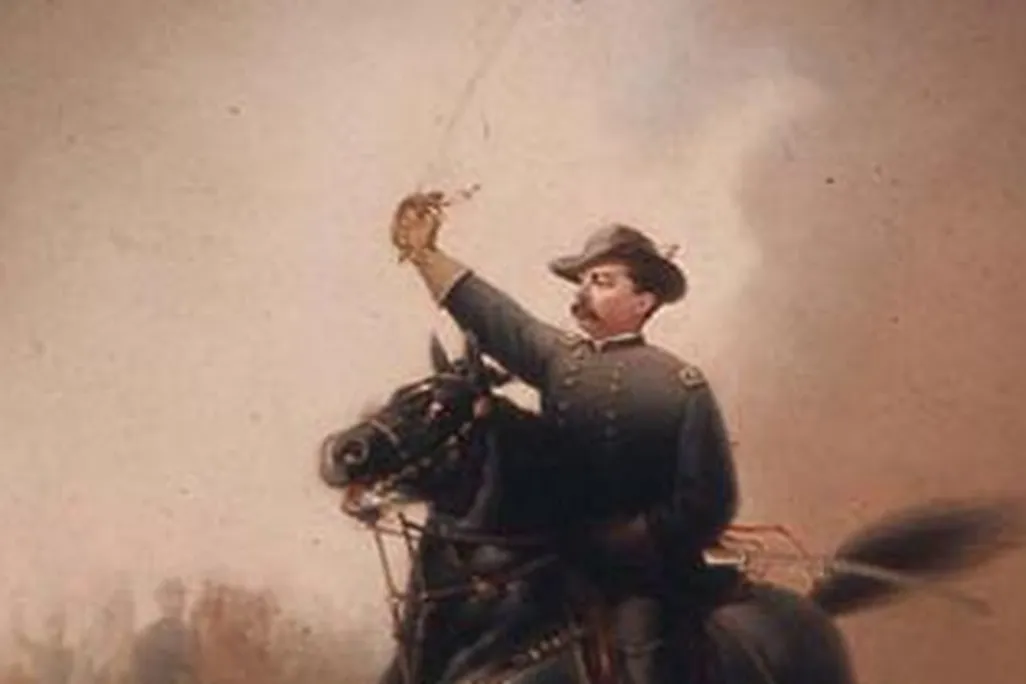
A poem, "Sheridan's Ride," was written by a minor painter and versifier named Thomas Buchanan Read. It was used shamelessly to promote the Northern war effort. Whatever its literary flaws, Read's poem captured one image indelibly — a powerful horse carrying a determined man into battle.
They must have been a sight, the horse who measured 5 feet 8 at the shoulder and his master who stood 5 feet 5 in his boots. Soldiers snickered that "Little Phil" shinnied up his saber to Rienzi's saddle, but there were no snickers on October 19, 1864, when horse and rider appeared through the smoke at Cedar Creek to stem certain defeat in the Shenandoah Valley. Sheridan's army had been surprised at dawn and driven from their camp by Jubal Early's Confederate veterans. Returning from Washington, Sheridan had spent the night up the valley in Winchester and awoke to distant gunfire. The Confederate assault had smashed the Union left, sending survivors pelting up the valley turnpike toward Winchester. The Union center made a brief stand, then fell back, nervously awaiting Early's next charge.
Sheridan and Rienzi, meanwhile, were heading south from Winchester, toward the sound of the guns. After cresting a ridge, Sheridan recalled, "there burst upon our view the appalling spectacle of a panic-stricken army . . . throngs of unhurt but utterly demoralized [men] and baggage wagons by the score, all pressing to the rear. . . ."
Sheridan dashed forward, waving his hat so the troops would see him. Some cheered and found new heart. Some kept running. But the rolling sound of cheering followed Sheridan and the well-lathered Rienzi as the general rode up to a rise where a few rattled Union commanders had gathered.
He quickly took verbal reports. Then wheeling Rienzi, he jumped a rail barricade, rode forward and turned to face the men behind him. "Men, by God, we'll whip them yet," he bellowed. "We'll sleep in our old camps tonight." The troops jumped forward, roaring. A private who saw Sheridan ride into sight remembered thinking, "No more doubt or chance for doubt existed; we were safe, and every man knew it."
Twelve days later in Cincinnati, Tom Read was talking with James Murdoch, a matinee idol scheduled to read patriotic verse at a war benefit that evening. Read's brother-in-law walked in, carrying Harper's Weekly with a battlefield sketch by Thomas Nast of Sheridan riding Rienzi toward Cedar Creek. "Buck, there's a poem in that picture," he said.
Read regarded poetry as a sideline to painting. On a visit to Boston he had met Longfellow and was inspired to add versifying to his repertoire. In 1853 Read left for Italy to crank out portraits and allegorical paintings, as well as a 276-page verse narration about the American Revolution.
The outbreak of the Civil War saw him hurrying back to Cincinnati to offer his rhetorical services to a local general, Lew Wallace, of subsequent Ben Hur fame. As a staff volunteer, recruiter and anti-Copperhead propagandist, Read sometimes also helped James Murdoch with his inspirational platform work. Looking at Sheridan's picture in Harper's, the actor wondered if Read might attempt something topical for that evening's performance.
Read bristled, "Do you suppose I can write a poem to order?" Nonetheless he shut himself in his study and, by noon, called for his wife to copy "Sheridan's Ride" out fair.
That night, Murdoch uncorked the verse that would gallop across a nation and through countless poetry collections for children yet unborn. To keep up suspense, at the end of each verse, Sheridan was closer to the battle: "Up from the South at break of day, / Bringing to Winchester fresh dismay, / The affrighted air with a shudder bore, / The terrible grumble and rumble and roar, / Telling the battle was on once more, / And Sheridan twenty miles away."
"Sheridan's Ride" was a timely sensation. The election of 1864 had been hanging in the balance. People were tired of the war. In Chicago, the "Peace" Democrats had put up George B. McClellan, hoping the onetime military figure with an aversion to battle would appeal to an electorate that also seemed to be sick of Abraham Lincoln.
Only Sheridan's victories in the Shenandoah looked undimmed in Republican war politics. In August, Grant ordered Sheridan to smash Early's army and make sure the Shenandoah never harbored another rebel force. By early October, Sheridan had already whipped Early twice, and his forces were burning the valley's crops. "A crow," he reported, "would have had to carry its rations if it had flown across the valley."
But Early's masterful attack at Cedar Creek nearly unseated Sheridan — and with him, Lincoln. When Rienzi delivered Sheridan in the nick of time, the Republican Party was eternally grateful. Read made the debt explicit: "Here is the steed that saved the day / By carrying Sheridan into the fight / From Winchestergtwenty miles way!"
"Widely read and recited, the piece made a fine recruiting and electioneering appeal," according to Civil War historian Shelby Foote. On Election Day, Horace Greeley's influential New York Tribune called it "a magnificent lyric" and ran the seven stanzas of "Sheridan's Ride" on page one. It is impossible to know how many votes Read's verses delivered to Lincoln, but in New York, every vote was critical. Lincoln carried the state by fewer than 7,000 votes and Connecticut by 2,000.
Lincoln's re-election was safe, but the war still had five fearful months to run. Now Rienzi got fully "stretched out," as newspapers reprinted Read's poem. "The thing they seem to like best about it," said Sheridan, "is the horse." He graciously acknowledged his debt in a letter to Read. "Your genius has put us into the same boat for a long journey, and we must try and take along the black horse."
Read had yet to cash in on his poem; the newspapers, the Republicans and the platform elocutionists had helped themselves. Read felt that only a painted version of "Sheridan's Ride" by his hand would yield real return. In 1865 Sheridan, posted to New Orleans to keep a baleful eye on French moves in Mexico, agreed to pose with Rienzi.
Read spent a month in New Orleans doing preliminary sketches. Then he finished painting his self-proclaimed masterpiece in Italy. "There may be poets who would write a better poem than 'Sheridan's Ride,'" he wrote, "but could the same man paint a better picture? There may be painters who could produce a better picture, but could the same artist write a better poem?"
Read launched into plans to issue the painting as a color lithograph suitable for framing.
But he did not have long to enjoy his profits. Heading home in 1872, a cold he caught on the Liverpool docks turned to pneumonia at sea. In New York a week later, he died at age 50.
Rienzi was next, although by then Sheridan had officially renamed him Winchester. He had carried the general to Appomatox Court House, there to wait outside, nervously twitching his tail as always, while, as Sheridan looked on, Lee and Grant brought the Civil War to a close.
When the old war-horse died in 1878, he was stuffed (or "mounted" as taxidermists insist) and presented to the military museum on Governor's Island in New York Harbor.
Ten years later, Sheridan, too, was dead, at 57. He was only 33 at Cedar Creek, and a long Army career took him from enforcing Reconstruction in the South to observing the Franco-Prussian War to fighting the Indian Wars on the Great Plains. He wound up in 1888 as Commander in Chief of the Army.
Adverse critical reaction to "Sheridan's Ride" eventually set in. Picky historians kept pointing out that Sheridan's route from Winchester to Cedar Creek was more like 12 miles than Read's 20. They claimed that Sheridan couldn't have ridden hell-for-leather along a road choked with a defeated army. But the ride was for real, and Rienzi/Winchester was no fake.
When a fire damaged the Governor's Island museum in 1922, an unharmed Winchester was given an Army escort as far as the Smithsonian in Washington. At the New York farewell ceremony, the 22nd Infantry Band played Civil War melodies. Bertram Isaacs, the grandson of a Grand Army of the Republic dignitary, recited "Sheridan's Ride." Then the old veterans stood up and gave Winchester a rousing cheer. The day was bright again before their eyes: "Hurrah for Sheridan! / Hurrah, hurrah, for horse and man!"