• Smithsonian
    Institution
  • Smithsonian
    Journeys
  • Smithsonian
    Store
  • Smithsonian
    Channel
  • goSmithsonian
    Visitors Guide
  • Air & Space
    magazine

Smithsonian.com

  • Subscribe
  • Home
  • History & Archaeology
  • People & Places
  • Science & Nature
  • Arts & Culture
  • Travel
  • Photos
  • Videos
  • Games & Puzzles
  • Blogs
  • History & Archaeology

The Object at Hand

A great Shawnee warrior and statesman, Tecumseh united Western tribes in 1812 to fight the encroaching settlers. He lost the war and his life but is much honored in our history.

  • By Bil Gilbert
  • Smithsonian magazine, July 1995, Subscribe


Tweet

Article Tools

 
  • Comments (1)
  • Font
  • Email
  • RSS
  • Print
  • Single Page
  • Related Topics

    Sculpture

    Military Leaders

    Artifacts

    War of 1812

    American West

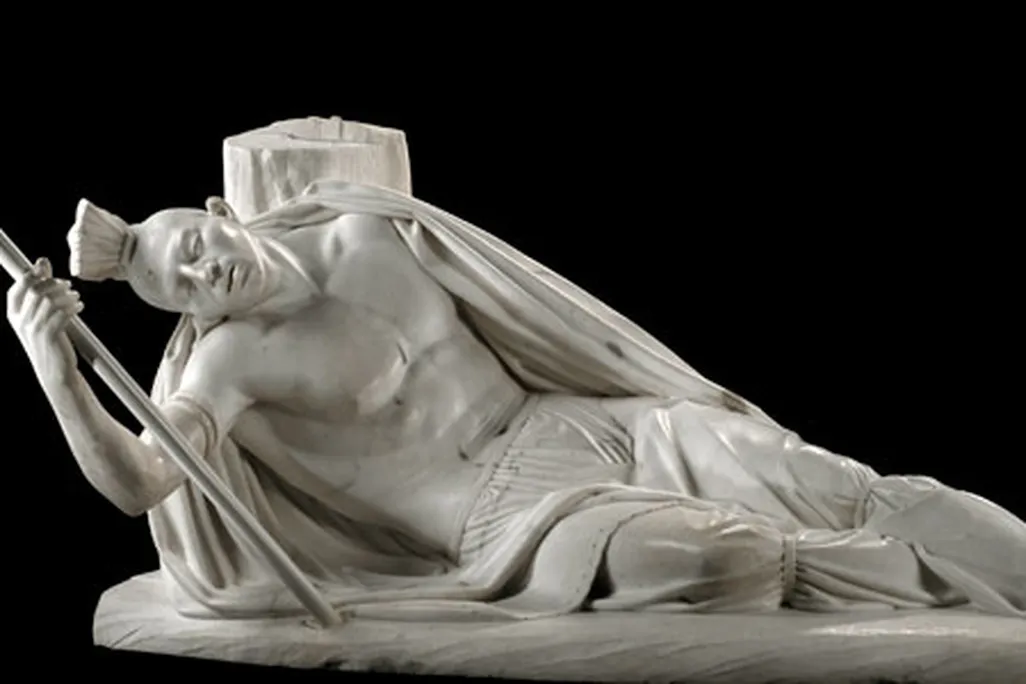
    At the end of a long gallery in the Smithsonian's National Museum of American Art there is a ton of marble that, after nearly 20 years of intermittent work, was completed in 1856 by Frederick Pettrich, a German-born, Italian-trained sculptor. The subject is a reclining, heroically proportioned man whose dignified and noble demeanor is unaffected by a bullet hole in the right temple. If the wound and a tomahawk held in the right hand are overlooked, the figure could be that of one of the champions of classical legend — an expiring Hector or Siegfried — who so engaged romantic artists of 19th-century Europe. In fact, the gleaming white sculpture is entitled The Dying Tecumseh, but any resemblance to the mortal Shawnee leader of that name is entirely coincidental. He died in battle and was disfigured by enemy soldiers 25 years before Pettrich began this work. While alive he posed for no known portrait. Nevertheless it is singularly appropriate that this is an imaginary figure, for no one else of Tecumseh's race and few of any other have had such a powerful and abiding impact on the collective American imagination.

    The real Tecumseh was born circa 1768 in southern Ohio at the beginning of a sporadic but ferociously fought war that did not end until — and largely because — he was killed in 1813. In this conflict his Shawnee, the Miami, the Potawatomi and other nations of the Great Lakes and Ohio Valley region sought to defend themselves against the white settlers pioneering westward across the Appalachians.

    Tecumseh was a warrior at 15; later he became a renowned field commander and a charismatic orator. By the early 1800s he had conceived of a Pan-Indian federation. In this union he hoped old tribal rivalries would be set aside so that the indigenous people of the Great Lakes and Mississippi Valley could act as one in resisting the advancing whites. From a base on the Tippecanoe River in northern Indiana, he traveled from Canada to the Gulf of Mexico promoting this federation. His ambition was probably an impossible one; the Indian population of this territory was then less than 100,000 and that of the United States nearly seven million. Still, rumors of what he was up to greatly alarmed many frontier whites, including William Henry Harrison, the federal governor of the Indiana Territory. Formerly a Regular Army officer, Harrison negotiated with Tecumseh face-to-face on two occasions and assessed him as "one of those uncommon geniuses who spring up occasionally to produce revolutions and overturn the established order of things."

    In the fall of 1811 Harrison gathered a thousand men and, when Tecumseh was away, made a preemptive strike against his base on the Tippecanoe. After a brief fight several hundred garrison warriors withdrew from the village. The so-called Battle of Tippecanoe was, in effect, the first engagement of the War of 1812. In that war Tecumseh fought alongside the British because, unlike the Americans, they were not invading Indian lands. In August 1812 Tecumseh, leading a multitribal group of warriors, and a combined force of Canadian militia and British regulars surrounded Detroit. Fearing imminent massacre by "hordes of howling savages," the aging and ailing Brig. Gen. William Hull surrendered Detroit and his 2,000-man army (Smithsonian, January 1994).

    Tecumseh's warriors soon struck deep into the United States, attacking forts and sending terrified settlers fleeing back toward the Ohio River. Harrison, called back to command U.S. forces in the West, spent nearly a year converting militiamen into passable professional soldiers. In the fall of 1813 he invaded Ontario. The British general, Henry Procter, retreated in panic. Fighting almost continuously for five days, Tecumseh and 600 warriors screened the British retreat, but on October 5 Harrison caught up with Procter at the Thames River near Moraviantown. The British general ignominiously fled; after a single American volley all his regular troops surrendered. Tecumseh meanwhile positioned his exhausted men in a patch of swampy woodland and told them he would retreat no farther. Having finished the British, Harrison sent dragoons and infantry into these thickets. After an hour of fierce fighting Tecumseh was killed, or presumably so. At least he was never again seen alive. For all practical purposes the Indian resistance movement ended in the Northwest. But the process that led to the Dying Tecumseh sculpture had already commenced.

    The first year of the War of 1812 was a humiliating one for the United States. The nation's political and military leaders badly needed a gaudy victory to restore public morale and their own reputations. Not much could be done with the wretched General Procter. But the defeated Indians were another matter. The first battle reports — later embellished in bloody detail — claimed Harrison's brave boys had overcome 3,000 superb warriors led by the great Tecumseh. Naturally the public was eager to know which American hero had brought down this mighty Shawnee champion. Satisfying that curiosity was — and still is — complicated by what might be called the habeus corpus problem.

    Warriors who survived the battle told various stories. They had been forced to leave Tecumseh's body on the field. They had carried him off, either mortally wounded or dead, and buried him in a secret place that whites would never find. As for the Americans, none of those who first overran Tecumseh's position were acquainted with him. But they found an impressive-looking dead Indian who they were convinced was Tecumseh. Some cut strips of skin from this body, later tanning them for razor strops and leather souvenirs. When people arrived who did know him, some said the battered corpse was indeed Tecumseh's. Others said it was not. Even Harrison could not positively identify it.

    Nevertheless a number of Americans were to claim that they had personally vanquished the Shawnee leader. Most prominent was Richard Johnson, a Kentucky politician who fought at the Thames as a cavalry commander. Whether or not he was indeed "The Man Who Killed Tecumseh," a great many of his constituents believed he was. With supporters chanting "Rumpsey Dumpsey, Rumpsey Dumpsey, Colonel Johnson killed Tecumseh," Johnson was first elected to the U.S. Senate and then, in 1836, to the Vice Presidency. With a little help from another catchy jingle, "Tippecanoe and Tyler Too," William Henry Harrison became President four years later.


    At the end of a long gallery in the Smithsonian's National Museum of American Art there is a ton of marble that, after nearly 20 years of intermittent work, was completed in 1856 by Frederick Pettrich, a German-born, Italian-trained sculptor. The subject is a reclining, heroically proportioned man whose dignified and noble demeanor is unaffected by a bullet hole in the right temple. If the wound and a tomahawk held in the right hand are overlooked, the figure could be that of one of the champions of classical legend — an expiring Hector or Siegfried — who so engaged romantic artists of 19th-century Europe. In fact, the gleaming white sculpture is entitled The Dying Tecumseh, but any resemblance to the mortal Shawnee leader of that name is entirely coincidental. He died in battle and was disfigured by enemy soldiers 25 years before Pettrich began this work. While alive he posed for no known portrait. Nevertheless it is singularly appropriate that this is an imaginary figure, for no one else of Tecumseh's race and few of any other have had such a powerful and abiding impact on the collective American imagination.

    The real Tecumseh was born circa 1768 in southern Ohio at the beginning of a sporadic but ferociously fought war that did not end until — and largely because — he was killed in 1813. In this conflict his Shawnee, the Miami, the Potawatomi and other nations of the Great Lakes and Ohio Valley region sought to defend themselves against the white settlers pioneering westward across the Appalachians.

    Tecumseh was a warrior at 15; later he became a renowned field commander and a charismatic orator. By the early 1800s he had conceived of a Pan-Indian federation. In this union he hoped old tribal rivalries would be set aside so that the indigenous people of the Great Lakes and Mississippi Valley could act as one in resisting the advancing whites. From a base on the Tippecanoe River in northern Indiana, he traveled from Canada to the Gulf of Mexico promoting this federation. His ambition was probably an impossible one; the Indian population of this territory was then less than 100,000 and that of the United States nearly seven million. Still, rumors of what he was up to greatly alarmed many frontier whites, including William Henry Harrison, the federal governor of the Indiana Territory. Formerly a Regular Army officer, Harrison negotiated with Tecumseh face-to-face on two occasions and assessed him as "one of those uncommon geniuses who spring up occasionally to produce revolutions and overturn the established order of things."

    In the fall of 1811 Harrison gathered a thousand men and, when Tecumseh was away, made a preemptive strike against his base on the Tippecanoe. After a brief fight several hundred garrison warriors withdrew from the village. The so-called Battle of Tippecanoe was, in effect, the first engagement of the War of 1812. In that war Tecumseh fought alongside the British because, unlike the Americans, they were not invading Indian lands. In August 1812 Tecumseh, leading a multitribal group of warriors, and a combined force of Canadian militia and British regulars surrounded Detroit. Fearing imminent massacre by "hordes of howling savages," the aging and ailing Brig. Gen. William Hull surrendered Detroit and his 2,000-man army (Smithsonian, January 1994).

    Tecumseh's warriors soon struck deep into the United States, attacking forts and sending terrified settlers fleeing back toward the Ohio River. Harrison, called back to command U.S. forces in the West, spent nearly a year converting militiamen into passable professional soldiers. In the fall of 1813 he invaded Ontario. The British general, Henry Procter, retreated in panic. Fighting almost continuously for five days, Tecumseh and 600 warriors screened the British retreat, but on October 5 Harrison caught up with Procter at the Thames River near Moraviantown. The British general ignominiously fled; after a single American volley all his regular troops surrendered. Tecumseh meanwhile positioned his exhausted men in a patch of swampy woodland and told them he would retreat no farther. Having finished the British, Harrison sent dragoons and infantry into these thickets. After an hour of fierce fighting Tecumseh was killed, or presumably so. At least he was never again seen alive. For all practical purposes the Indian resistance movement ended in the Northwest. But the process that led to the Dying Tecumseh sculpture had already commenced.

    The first year of the War of 1812 was a humiliating one for the United States. The nation's political and military leaders badly needed a gaudy victory to restore public morale and their own reputations. Not much could be done with the wretched General Procter. But the defeated Indians were another matter. The first battle reports — later embellished in bloody detail — claimed Harrison's brave boys had overcome 3,000 superb warriors led by the great Tecumseh. Naturally the public was eager to know which American hero had brought down this mighty Shawnee champion. Satisfying that curiosity was — and still is — complicated by what might be called the habeus corpus problem.

    Warriors who survived the battle told various stories. They had been forced to leave Tecumseh's body on the field. They had carried him off, either mortally wounded or dead, and buried him in a secret place that whites would never find. As for the Americans, none of those who first overran Tecumseh's position were acquainted with him. But they found an impressive-looking dead Indian who they were convinced was Tecumseh. Some cut strips of skin from this body, later tanning them for razor strops and leather souvenirs. When people arrived who did know him, some said the battered corpse was indeed Tecumseh's. Others said it was not. Even Harrison could not positively identify it.

    Nevertheless a number of Americans were to claim that they had personally vanquished the Shawnee leader. Most prominent was Richard Johnson, a Kentucky politician who fought at the Thames as a cavalry commander. Whether or not he was indeed "The Man Who Killed Tecumseh," a great many of his constituents believed he was. With supporters chanting "Rumpsey Dumpsey, Rumpsey Dumpsey, Colonel Johnson killed Tecumseh," Johnson was first elected to the U.S. Senate and then, in 1836, to the Vice Presidency. With a little help from another catchy jingle, "Tippecanoe and Tyler Too," William Henry Harrison became President four years later.

    Frederick Pettrich began work on The Dying Tecumseh in 1837, doubtless much influenced by these political happenings. This was certainly the case with John Dorival, who in 1833 painted the immensely popular Battle of the Thames. In the foreground of an extremely busy battle scene, Johnson and Tecumseh are engaged in hand-to-hand combat. The former brandishes a pistol, sports a dragoon's tall stovepipe hat adorned with an ostrich plume and sits astride a splendid white charger. Tecumseh, on foot, appears to be about seven feet tall, overtopping Johnson's rearing horse. He wears a flowing headdress fabricated from the plumage of at least four or five eagles. Lithographic prints of Dorival's work were purchased and widely distributed by managers of Johnson's Vice Presidential campaign. Other paintings of this battle, quite similar in heroic detail and inaccuracy, came to decorate many a 19th-century barbershop and barroom.

    For reasons of obvious self-interest the conquerors of Tecumseh eulogized him first as a "red Hannibal-Napoleon" and then as a man of preternatural sagacity, courage and honor. Typically, the Indiana Centinel, published in Vincennes, editorialized: "Every schoolboy in the Union now knows that Tecumseh was a great man. His greatness was his own, unassisted by science or education. As a statesman, warrior and patriot, we shall not look on his like again.

    "A decade or so after his death Tecumseh had become The Noble — in fact the noblest — Savage. Towns, businesses and children — William Tecumseh Sherman, for one — were named for him. In my own youth, growing up in southern Michigan 30 miles to the west of the village of Tecumseh, it was still widely believed that his was the face that appeared on the "Indian Head" penny. I later learned that the model for this coin was the daughter of a U.S. Mint engraver, but legend generally overrides fact. In addition to sculptures, paintings, woodcuts and other pictographic works, hundreds and probably thousands of articles and books, occasional epic poems and dramas about Tecumseh have appeared since his death. And they continue. Tecumseh literature is now more voluminous than that devoted to William Henry Harrison or Richard Johnson, and nearly all of it is laudatory. Except for Robert E. Lee, sans peur et sans reproche, no other declared enemy of the United States has been so well regarded for so long as has Tecumseh.

    Praise for noble enemies — once they are safely out of the way — is part of a long heroic tradition. But with the passage of time the enduring interest in and admiration for Tecumseh has raised a question that has become more troublesome for many Americans. It is: "If Tecumseh and his cause were so noble, why was he killed and mutilated?"

    With this in mind it has occurred to me that the sculpture in the National Museum of American Art, the most massive of the many memorials to the man, could be retitled Tecumseh's Revenge.


    1 2 Next »

        Subscribe now for more of Smithsonian's coverage on history, science and nature.


    Related topics: Sculpture Military Leaders Artifacts War of 1812 American West


    Tweet Digg
     
    Comments (1)

    I read that for Tecumseh's face Pettrich used the cast taken after the warrior's death. Is that correct?

    Posted by Fedora Giordano on July 10,2010 | 03:37 PM

    Post a Comment


    Name: (required)

    Email: (required)

    Comment:

    Comments are moderated, and will not appear until Smithsonian.com has approved them. Smithsonian reserves the right not to post any comments that are unlawful, threatening, offensive, defamatory, invasive of a person's privacy, inappropriate, confidential or proprietary, political messages, product endorsements, or other content that might otherwise violate any laws or policies.


    Advertisement


    Popular Videos

    • Newest
    • Most Viewed

    Behind the Scenes of the Smithsonian App

    (01:28)

    Behind the Scenes at the World Orchid Convention

    (3:15)

    Playing the Unplayable Records

    (3:39)

    Introducing Ask Smithsonian

    (1:15)

    View All Newest Videos »

    Behind the Scenes at the World Orchid Convention

    (3:15)

    Playing the Unplayable Records

    (3:39)

    A Brief History of Chocolate

    (01:22)

    Mammoth vs. Mastodon

    View All Videos »

    Most Popular

    • Viewed
    • Emailed
    • Commented
    • Topics
    1. A Brief History of House Cats
    2. Revisiting The Rise and Fall of the Third Reich
    3. A Brief History of the Salem Witch Trials
    4. Who Was Cleopatra?
    5. Tattoos
    6. Gobekli Tepe: The World’s First Temple?
    7. Photos: The Best Facial Hair in the Civil War
    8. Women Spies of the Civil War
    9. The Monuments That Were Never Built
    10. The Oldest Modernist Paintings
    1. Revisiting The Rise and Fall of the Third Reich
    2. A Brief History of House Cats
    3. The Oldest Modernist Paintings
    4. Clarence Darrow: Jury Tamperer?
    5. God, Government and Roger Williams' Big Idea
    6. A Brief History of the Salem Witch Trials
    7. Diving for the Secrets of the Battle of the Atlantic
    8. Who Was Cleopatra?
    9. 44 Years Later, a Washington, D.C. Death Unresolved
    10. Henry Morton Stanley's Unbreakable Will
    1. A Brief History of House Cats
    2. Who Was Cleopatra?
    3. Women Spies of the Civil War
    4. Revisiting The Rise and Fall of the Third Reich
    5. A Brief History of the Salem Witch Trials
    6. Who Wrote the Dead Sea Scrolls?
    7. How Arlington National Cemetery Came to Be
    8. The Oldest Modernist Paintings
    9. Savoring Pie Town
    10. 1968 Democratic Convention

    View All Most Popular »

    Advertisement

    Follow Us

    Smithsonian Magazine
    @SmithsonianMag
    Follow Smithsonian Magazine on Twitter

    Sign up for regular email updates from Smithsonian.com, including daily newsletters and special offers.


    In The Magazine

    February 2012

    • Gold Fever
    • Mystique of the Mother Road
    • The Orchid Olympics
    • Mad for Dickens
    • Dickens' Secret Affair

    View Table of Contents »


    First Name
    Last Name
    Address 1
    Address 2
    City
    State   Zip
    Email

    Smithsonian Store

    Jefferson Bible
    Smithsonian Edition

    Get your own copy of this recently conserved treasure.

    Smithsonian Journeys

    Private Jet Tours

    Explore some of the most treasured and legendary places on Earth, aboard our private aircrafts.


    View full archiveRecent Issues


    • Feb 2012


    • Jan 2012


    • Dec 2011

    Newsletter

    Sign up for regular email updates from Smithsonian magazine, including free newsletters, special offers and current news updates.

    Subscribe Now

    About Us

    Smithsonian.com expands on Smithsonian magazine's in-depth coverage of history, science, nature, the arts, travel, world culture and technology. Join us regularly as we take a dynamic and interactive approach to exploring modern and historic perspectives on the arts, sciences, nature, world culture and travel, including videos, blogs and a reader forum.

    Explore our Brands

    • goSmithsonian.com
    • Smithsonian Air & Space Museum
    • Smithsonian Student Travel
    • Smithsonian Catalogue
    • Smithsonian Journeys
    • Smithsonian Channel
    • Site Map
    • Privacy Policy
    • Copyright
    • Member Services
    • About Smithsonian
    • Contact Us
    • Advertising
    • Subscribe
    • RSS
    • Topics

    Smithsonian Institution

    Produced by Clickability