
New Light on Stonehenge
The first dig in 44 years inside the stone circle changed our view of why—and even when—the monument was built
Editor’s Note: This article was adapted from its original form and updated to include new information for Smithsonian’s Mysteries of the Ancient World bookazine published in Fall 2009.
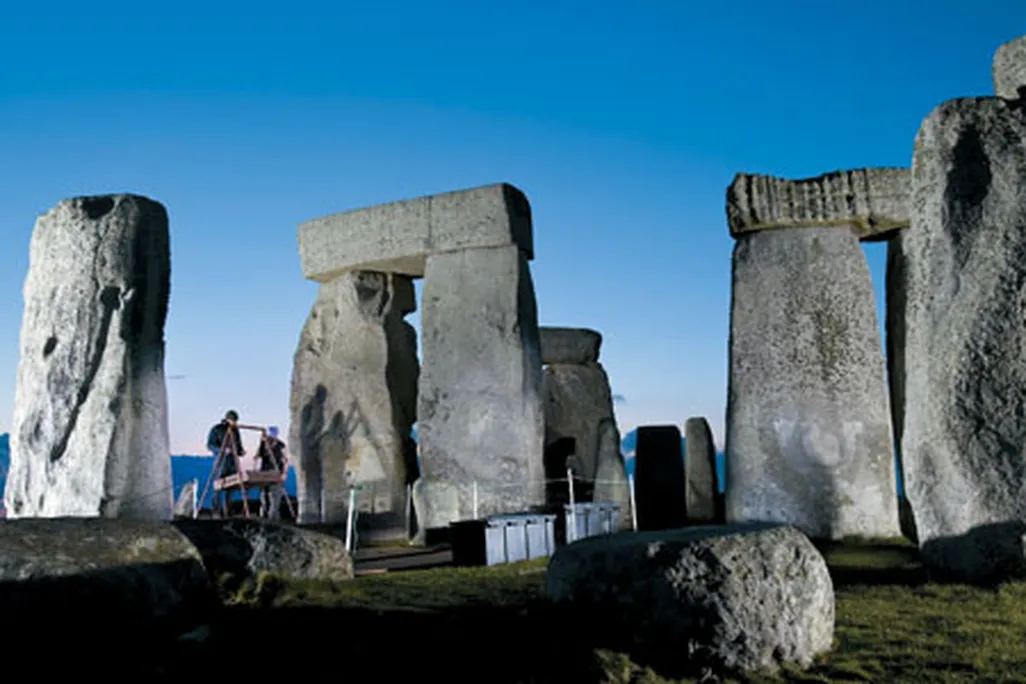
The druids arrived around 4 p.m. Under a warm afternoon sun, the group of eight walked slowly to the beat of a single drum, from the visitors entrance toward the looming, majestic stone monument. With the pounding of the drum growing louder, the retinue approached the outer circle of massive stone trilithons—each made up of two huge pillars capped by a stone lintel—and passed through them to the inner circle. Here they were greeted by Timothy Darvill, now 51, professor of archaeology at Bournemouth University, and Geoffrey Wainwright, now 72, president of the Society of Antiquaries of London.
For two weeks, the pair had been leading the first excavation in 44 years of the inner circle of Stonehenge—the best-known and most mysterious megalithic monument in the world. Now it was time to refill the pit they had dug. The Druids had come to offer their blessings, as they had done 14 days earlier before the first shovel went into the ground. “At the beginning we warned the spirits of the land that this would be happening and not to feel invaded,” said one of their number who gave his name only as Frank. “Now we’re offering a big thank-you to the ancestors who we asked to give up knowledge to our generation.”
The Druids tossed seven grains of wheat into the pit, one for each continent, and offered a prayer to provide food for the world’s hungry. The gesture seemed fitting, given the nature of the excavation; while other experts have speculated that Stonehenge was a prehistoric observatory or a royal burial ground, Darvill and Wainwright are intent on proving it was primarily a sacred place of healing, where the sick came to be cured and the injured and infirm restored.
Darvill and Wainwright’s theory rests, almost literally, on bluestones—unexceptional igneous rocks, such as dolerite and rhyolite—so called because they take on a bluish hue when wet or cut. Over the centuries, legends have endowed these stones with mystical properties. The British poet Layamon, inspired by the folkloric accounts of 12th-century cleric Geoffrey of Monmouth, wrote in A.D. 1215:
The stones are great;
And magic power they have;
Men that are sick;
Fare to that stone;
And they wash that stone;
And with that water bathe away their sickness.
We now know that Stonehenge was in the making for at least 400 years. The first phase, built around 3000 B.C., was a simple circular earthwork enclosure similar to many “henges” (sacred enclosures typically comprising a circular bank and a ditch) found throughout the British Isles. Around 2800 B.C., timber posts were erected within the enclosure. Again, such posts are not unusual—Woodhenge, for example, which once consisted of tall posts arranged in a series of six concentric oval rings, lies only a few miles to the east.
Archaeologists have long believed that Stonehenge began to take on its modern form two centuries later, when large stones were brought to the site in the third and final stage of its construction. The first to be put in place were the 80 or so bluestones, which were arranged in a double circle with an entrance facing northeast. “Their arrival is when Stonehenge was transformed from a quite ordinary and typical monument into something unusual,” says Andrew Fitzpatrick of Wessex Archaeology, a nonprofit organization based in Salisbury.
The importance of the bluestones is underscored by the immense effort involved in moving them a long distance—some were as long as ten feet and weighed four tons. Geological studies in the 1920s determined that they came from the Preseli Mountains in southwest Wales, 140 miles from Stonehenge. Some geologists have argued that glaciers moved the stones, but most experts now believe that humans undertook the momentous task.
The most likely route would have required traversing some 250 miles—with the stones floated on rafts, then pulled overland by teams of men and oxen or rolled on logs—along the south coast of Wales, crossing the Avon River near Bristol and then heading southeast to the Salisbury Plain. Alternatively, the stones may have come by boat around Land’s End and along the south coast of England before heading upriver and finally overland to Stonehenge. Whatever the route and method, the immensity of the undertaking—requiring thousands of man-hours and sophisticated logistics—has convinced Darvill and Wainwright that the bluestones must have been considered extraordinary. After all, Stonehenge’s sarsens—enormous blocks of hard sandstone used to build the towering trilithons—were quarried and collected from the Marlborough Downs a mere 20 miles to the north.
The two men have spent the last six years surveying the Preseli Mountains, trying to ascertain why Neolithic people might have believed the stones had mystical properties. Most were quarried at a site known as Carn Menyn, a series of rocky outcrops of white-spotted dolerite. “It’s a very special area,” says Wainwright, himself a Welshman. “Approaching Carn Menyn from the south you go up and up, then all of a sudden you see this rampart composed of natural pillars of stone.” Clearly, Carn Menyn inspired the ancients. Gors Fawr, a collection of 16 upright bluestones arranged in a circle, sits at the bottom of a Carn Menyn hill.
But Darvill and Wainwright say the real turning point came in 2006, when the pair looked beyond Carn Menyn’s rock formations and began studying some springs around the base of the crags, many of which had been altered to create “enhanced springheads”—natural spouts had been dammed up with short walls to create pools where the water emerged from the rock. More important, some of the springheads were adorned with prehistoric art.
“This is very unusual,” says Wainwright. “You get springs that have funny things done to them in the Roman and Iron Age periods, but to see it done in the prehistoric period is rare, so we knew we were on to something.” In his history of Britain, Geoffrey of Monmouth noted that the medicinal powers of Stonehenge’s stones were stimulated by pouring water over them for the sick to bathe in. Indeed, many of the springs and wells in southwest Wales are still believed to have healing powers and are used in this way by local adherents to traditional practices. As Wainwright recalls, “The pieces of the puzzle came together when Tim and I looked at each other and said, ‘It’s got to be about healing.’”
Once the archaeologists concluded that the ancients had endowed the Carn Menyn rocks with mystical properties, “franchising” them to Stonehenge made sense. “Its intrinsic power would seem to be locked into the material from which it was made and, short of visiting Carn Menyn, which might not have been always feasible, the next best step would have been to create a shrine from the powerful substance, the stone from Carn Menyn itself,” says Timothy Insoll, an archaeologist at the University of Manchester. He has documented similar behavior in northern Ghana, where boulders from the Tonna’ab earth shrine—similarly invested with curative properties—have been taken to affiliated shrines at new locations.
Evidence that people made healing pilgrimages to Stonehenge also comes from human remains found in the area, most spectacularly from the richest Neolithic grave ever found in the British Isles. It belonged to the “Amesbury Archer”—a man between 35 and 45 years old who was buried about five miles from Stonehenge between 2400 and 2200 B.C. with nearly 100 possessions, including an impressive collection of flint arrowheads, copper knives and gold earrings.
The bones of the Amesbury Archer tell a story of a sick, injured traveler coming to Stonehenge from as far away as the Swiss or German Alps. The Archer’s kneecap was infected and he suffered from an abscessed tooth so nasty that it had destroyed part of his jawbone. He would have been desperate for relief, says Wessex Archaeology’s Jacqueline McKinley.
Just 15 feet from where the Amesbury Archer was buried, archaeologists discovered another set of human remains, these of a younger man perhaps 20 to 25 years old. Bone abnormalities shared by both men suggest they could have been related —a father aided by his son, perhaps. Had they come to Stonehenge together in search of its healing powers?
Remarkably, although Stonehenge is one of the most famous monuments in the world, definitive data about it are scarce. In part, this is because of the reluctance of English Heritage, the site’s custodian, to permit excavations. Current chronologies are based largely on excavations done in the 1920s, buttressed by work done in the ’50s and ’60s. “But none of these excavations were particularly well recorded,” says Mike Pitts, editor of British Archaeology and one of the few people to have led excavations at Stonehenge in recent decades. “We are still unsure of the detail of the chronology and nature of the various structures that once stood on the site.”
To strengthen their case for Stonehenge as a prehistoric Lourdes, Darvill and Wainwright needed to establish that chronology with greater certainty. Had the bluestones been erected by the time the Amesbury Archer made his pilgrimage to the megaliths? Establishing the timing of Stonehenge’s construction could also shed light on what made this site so special: with so many henges across Britain, why was this one chosen to receive the benedictions of the bluestones? Such questions could be answered only by an excavation within Stonehenge itself.
Darvill and Wainwright were well placed for such a project. Wainwright had been English Heritage’s chief archaeologist for several years. In 2005, Darvill had worked with the organization on a plan for research at the monument— “Stonehenge World Heritage Site: An Archaeological Research Framework”—which made the case for small-scale, targeted excavations. Following these guidelines, Darvill and Wainwright requested official permission for the archaeological equivalent of keyhole surgery in order to study part of the first bluestone setting on the site.
And so, under an overcast sky blanketing Salisbury Plain and under the watchful eye of English Heritage personnel and media representatives from around the world, Darvill and Wainwright’s team began digging in March 2008. Over the previous weekend, the team had set up a temporary building that would serve as a base for operations and marked out the plot to be excavated. Next to the site’s parking lot a newly erected marquee broadcast a live video feed of the action—and offered a selection of souvenir T-shirts, one of which read, “Stonehenge Rocks.”
The trench that Darvill and Wainwright marked out for the excavation was surprisingly small: just 8 by 11 feet, and 2 to 6 feet deep in the southeastern sector of the stone circle. But the trench, wedged between a towering sarsen stone and two bluestones, was far from a random choice. In fact, a portion of it overlapped with the excavation carried out by archaeologist Richard Atkinson and colleagues in 1964 that had partially revealed (though not for the first time) one of the original bluestone sockets and gave reason to believe that another socket would be nearby. In addition, Bournemouth University researchers had conducted a ground-penetrating radar survey, providing further assurance that this would be a productive spot.
Wainwright had cautioned me that watching an archaeological dig was like watching paint dry. But while the work is indeed slow and methodical, it is also serene, even meditative. An avuncular figure with a white beard framing a smiling, ruddy face, Wainwright joined Bournemouth University students operating a large, clattering sieve, picking out everything of interest: bones, potsherds and fragments of sarsen and bluestone.
Some days a strong wind blew through the site, creating a small dust bowl. Other days brought rain, sleet and even snow. As material was excavated from the trench and sifted through the coarse sieve, it was ferried to the temporary building erected in the parking lot. Here other students and Debbie Costen, Darvill’s research assistant, put the material into a flotation tank, which caused any organic matter—such as carbonized plant remains that could be used for radiocarbon dating—to float to the surface.
By the end of the excavation, contours of postholes that once held timber poles and of bedrock-cut sockets for bluestones were visible. In addition, dozens of samples of organic material, including charred cereal grains and bone, had been collected, and 14 of these were selected for radiocarbon dating. Although it would not be possible to establish dates from the bluestone sockets themselves, their age could be inferred from the age of the recovered organic materials, which are older the deeper they are buried. Environmental archaeologist Mike Allen compared the positions and depths of the bluestone sockets with this chronology. Using these calculations, Darvill and Wainwright would later estimate that the first bluestones had been placed between 2400 and 2200 B.C.—two or three centuries later than the previous estimate of 2600 B.C.
That means the first bluestones were erected at Stonehenge around the time of the Amesbury Archer’s pilgrimage, lending credence to the theory that he came there to be healed.
Among other finds, the soil yielded two Roman coins dating to the late fourth century A.D. Similar coins have been found at Stonehenge before, but these were retrieved from cut pits and a shaft, indicating that Romans were reshaping and altering the monument long after such activities were supposed to have ended. “This is something that people haven’t really recognized before,” says Darvill. “The power of Stonehenge seems to have long outlasted its original purpose, and these new finds provide a strong link to the world of late antiquity that probably provided the stories picked up by Geoffrey of Monmouth just a few centuries later.”
As so often happens in archaeology, the new findings raise nearly as many questions as they answer. Charcoal recovered by Darvill and Wainwright—indicating the burning of pine wood in the vicinity—dates back to the eighth millennium B.C. Could the area have been a ritual center for hunter-gatherer communities some 6,000 years before the earthen henge was even dug? “The origins of Stonehenge probably lie back in the Mesolithic, and we need to reframe our questions for the next excavation to look back into that deeper time,” Darvill says.
The new radiocarbon dating also raises questions about a theory advanced by archaeologist Mike Parker Pearson of the University of Sheffield, who has long suggested that Stonehenge was a massive burial site and the stones were symbols of the dead—the final stop of an elaborate funeral procession by Neolithic mourners from nearby settlements. The oldest human remains found by Parker Pearson’s team date to around 3030 B.C., about the time the henge was first built but well before the arrival of the bluestones. That means, says Darvill, “the stones come after the burials and are not directly associated with them.”
Of course it’s entirely possible that Stonehenge was both—a great cemetery and a place of healing, as Darvill and Wainwright willingly admit. “Initially it seems to have been a place for the dead with cremations and memorials,” says Darvill, “but after about 2300 B.C. the emphasis changes and it is a focus for the living, a place where specialist healers and the health care professionals of their age looked after the bodies and souls of the sick and infirm.” English Heritage’s Amanda Chadburn also finds the dual-use theory plausible. “It’s such an important place that people want to be associated with it and buried in its vicinity,” she says, “but it could also be such a magical place that it was used for healing, too.”
Not everyone buys into the healing stone theory. “I think the survey work [Darvill and Wainwright are] doing in the Preseli hills is great, and I’m very much looking forward to the full publication of what they’ve found there,” says Mike Pitts. “However, the idea that there is a prehistoric connection between the healing properties of bluestones and Stonehenge as a place of healing does nothing for me at all. As far as I’m concerned, it’s a fairy story.” Pitts also wants to see more evidence that people suffering from injuries and illness visited Stonehenge. “There are actually very few—you can count them on one hand—human remains around and contemporary with Stonehenge that haven’t been cremated so that you could see what injuries or illnesses they might have suffered from,” he says. “For long periods in the Neolithic we have a dearth of human remains of any kind.”
For his part, Wainwright believes that no theory will ever be fully accepted, no matter how convincing the evidence. “I think what most people like about Stonehenge is that nobody really knows why it was built, and I think that’s probably always going to be the case,” he says. “It’s a bloody great mystery.”
/https://tf-cmsv2-smithsonianmag-media.s3.amazonaws.com/filer/stonehenge_2.jpg)
/https://tf-cmsv2-smithsonianmag-media.s3.amazonaws.com/filer/stonehenge_main_520.jpg)
/https://tf-cmsv2-smithsonianmag-media.s3.amazonaws.com/filer/stonehenge_3.jpg)
/https://tf-cmsv2-smithsonianmag-media.s3.amazonaws.com/filer/stonehenge_10.jpg)
/https://tf-cmsv2-smithsonianmag-media.s3.amazonaws.com/filer/stonehenge_9.jpg)
/https://tf-cmsv2-smithsonianmag-media.s3.amazonaws.com/filer/stonehenge_5.jpg)
/https://tf-cmsv2-smithsonianmag-media.s3.amazonaws.com/filer/stonehenge_6.jpg)
/https://tf-cmsv2-smithsonianmag-media.s3.amazonaws.com/filer/stonehenge_4.jpg)
/https://tf-cmsv2-smithsonianmag-media.s3.amazonaws.com/filer/stonehenge_7.jpg)
/https://tf-cmsv2-smithsonianmag-media.s3.amazonaws.com/filer/stonehenge_8.jpg)