
Gobekli Tepe: The World’s First Temple?
Predating Stonehenge by 6,000 years, Turkey’s stunning Gobekli Tepe upends the conventional view of the rise of civilization
/https://tf-cmsv2-smithsonianmag-media.s3.amazonaws.com/accounts/headshot/SQJ_1604_Danube_Contribs_02.jpg)
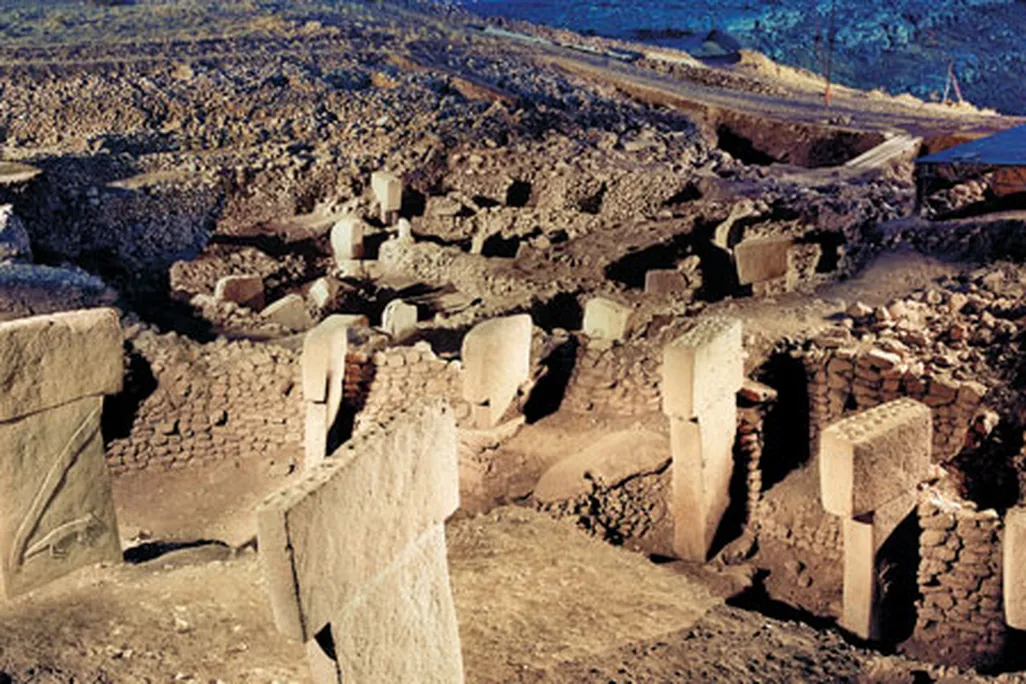
Six miles from Urfa, an ancient city in southeastern Turkey, Klaus Schmidt has made one of the most startling archaeological discoveries of our time: massive carved stones about 11,000 years old, crafted and arranged by prehistoric people who had not yet developed metal tools or even pottery. The megaliths predate Stonehenge by some 6,000 years. The place is called Gobekli Tepe, and Schmidt, a German archaeologist who has been working here more than a decade, is convinced it's the site of the world's oldest temple.
"Guten Morgen," he says at 5:20 a.m. when his van picks me up at my hotel in Urfa. Thirty minutes later, the van reaches the foot of a grassy hill and parks next to strands of barbed wire. We follow a knot of workmen up the hill to rectangular pits shaded by a corrugated steel roof—the main excavation site. In the pits, standing stones, or pillars, are arranged in circles. Beyond, on the hillside, are four other rings of partially excavated pillars. Each ring has a roughly similar layout: in the center are two large stone T-shaped pillars encircled by slightly smaller stones facing inward. The tallest pillars tower 16 feet and, Schmidt says, weigh between seven and ten tons. As we walk among them, I see that some are blank, while others are elaborately carved: foxes, lions, scorpions and vultures abound, twisting and crawling on the pillars' broad sides.
/https://tf-cmsv2-smithsonianmag-media.s3.amazonaws.com/filer/gobeklitepe_nov08_11.jpg)
/https://tf-cmsv2-smithsonianmag-media.s3.amazonaws.com/filer/e5/36/e536f6f2-8173-47fa-99bb-441b8b82c494/42-29760342.jpg)
/https://tf-cmsv2-smithsonianmag-media.s3.amazonaws.com/filer/aa/b8/aab8ee02-1a89-4ad9-a1f6-069dadd070cd/42-29760339.jpg)
/https://tf-cmsv2-smithsonianmag-media.s3.amazonaws.com/filer/0d/4f/0d4f0232-37cf-467d-a7b2-12145aaf90f7/42-29760334.jpg)
/https://tf-cmsv2-smithsonianmag-media.s3.amazonaws.com/filer/88/e5/88e5d5cc-a457-42d5-8568-3dcf72066ca4/42-29761916.jpg)
/https://tf-cmsv2-smithsonianmag-media.s3.amazonaws.com/filer/fb/38/fb3819fc-ef33-41de-9fb1-5e0a974f7f76/42-29761928.jpg)
/https://tf-cmsv2-smithsonianmag-media.s3.amazonaws.com/filer/a1/ea/a1ea550c-5500-48c0-a03d-3f600d0b23e8/42-29761940.jpg)
/https://tf-cmsv2-smithsonianmag-media.s3.amazonaws.com/filer/24/55/2455ed38-5b85-4d19-a6dc-bddfc0e2f493/42-29761943.jpg)
Schmidt points to the great stone rings, one of them 65 feet across. "This is the first human-built holy place," he says.
From this perch 1,000 feet above the valley, we can see to the horizon in nearly every direction. Schmidt, 53, asks me to imagine what the landscape would have looked like 11,000 years ago, before centuries of intensive farming and settlement turned it into the nearly featureless brown expanse it is today.
Prehistoric people would have gazed upon herds of gazelle and other wild animals; gently flowing rivers, which attracted migrating geese and ducks; fruit and nut trees; and rippling fields of wild barley and wild wheat varieties such as emmer and einkorn. "This area was like a paradise," says Schmidt, a member of the German Archaeological Institute. Indeed, Gobekli Tepe sits at the northern edge of the Fertile Crescent—an arc of mild climate and arable land from the Persian Gulf to present-day Lebanon, Israel, Jordan and Egypt—and would have attracted hunter-gatherers from Africa and the Levant. And partly because Schmidt has found no evidence that people permanently resided on the summit of Gobekli Tepe itself, he believes this was a place of worship on an unprecedented scale—humanity's first "cathedral on a hill."
With the sun higher in the sky, Schmidt ties a white scarf around his balding head, turban-style, and deftly picks his way down the hill among the relics. In rapid-fire German he explains that he has mapped the entire summit using ground-penetrating radar and geomagnetic surveys, charting where at least 16 other megalith rings remain buried across 22 acres. The one-acre excavation covers less than 5 percent of the site. He says archaeologists could dig here for another 50 years and barely scratch the surface.
Gobekli Tepe was first examined—and dismissed—by University of Chicago and Istanbul University anthropologists in the 1960s. As part of a sweeping survey of the region, they visited the hill, saw some broken slabs of limestone and assumed the mound was nothing more than an abandoned medieval cemetery. In 1994, Schmidt was working on his own survey of prehistoric sites in the region. After reading a brief mention of the stone-littered hilltop in the University of Chicago researchers' report, he decided to go there himself. From the moment he first saw it, he knew the place was extraordinary.
Unlike the stark plateaus nearby, Gobekli Tepe (the name means "belly hill" in Turkish) has a gently rounded top that rises 50 feet above the surrounding landscape. To Schmidt's eye, the shape stood out. "Only man could have created something like this," he says. "It was clear right away this was a gigantic Stone Age site." The broken pieces of limestone that earlier surveyors had mistaken for gravestones suddenly took on a different meaning.
Schmidt returned a year later with five colleagues and they uncovered the first megaliths, a few buried so close to the surface they were scarred by plows. As the archaeologists dug deeper, they unearthed pillars arranged in circles. Schmidt's team, however, found none of the telltale signs of a settlement: no cooking hearths, houses or trash pits, and none of the clay fertility figurines that litter nearby sites of about the same age. The archaeologists did find evidence of tool use, including stone hammers and blades. And because those artifacts closely resemble others from nearby sites previously carbon-dated to about 9000 B.C., Schmidt and co-workers estimate that Gobekli Tepe's stone structures are the same age. Limited carbon dating undertaken by Schmidt at the site confirms this assessment.
The way Schmidt sees it, Gobekli Tepe's sloping, rocky ground is a stonecutter's dream. Even without metal chisels or hammers, prehistoric masons wielding flint tools could have chipped away at softer limestone outcrops, shaping them into pillars on the spot before carrying them a few hundred yards to the summit and lifting them upright. Then, Schmidt says, once the stone rings were finished, the ancient builders covered them over with dirt. Eventually, they placed another ring nearby or on top of the old one. Over centuries, these layers created the hilltop.
Today, Schmidt oversees a team of more than a dozen German archaeologists, 50 local laborers and a steady stream of enthusiastic students. He typically excavates at the site for two months in the spring and two in the fall. (Summer temperatures reach 115 degrees, too hot to dig; in the winter the area is deluged by rain.) In 1995, he bought a traditional Ottoman house with a courtyard in Urfa, a city of nearly a half-million people, to use as a base of operations.
On the day I visit, a bespectacled Belgian man sits at one end of a long table in front of a pile of bones. Joris Peters, an archaeozoologist from the Ludwig Maximilian University in Munich, specializes in the analysis of animal remains. Since 1998, he has examined more than 100,000 bone fragments from Gobekli Tepe. Peters has often found cut marks and splintered edges on them—signs that the animals from which they came were butchered and cooked. The bones, stored in dozens of plastic crates stacked in a storeroom at the house, are the best clue to how people who created Gobekli Tepe lived. Peters has identified tens of thousands of gazelle bones, which make up more than 60 percent of the total, plus those of other wild game such as boar, sheep and red deer. He's also found bones of a dozen different bird species, including vultures, cranes, ducks and geese. "The first year, we went through 15,000 pieces of animal bone, all of them wild. It was pretty clear we were dealing with a hunter-gatherer site," Peters says. "It's been the same every year since." The abundant remnants of wild game indicate that the people who lived here had not yet domesticated animals or farmed.
But, Peters and Schmidt say, Gobekli Tepe's builders were on the verge of a major change in how they lived, thanks to an environment that held the raw materials for farming. "They had wild sheep, wild grains that could be domesticated—and the people with the potential to do it," Schmidt says. In fact, research at other sites in the region has shown that within 1,000 years of Gobekli Tepe's construction, settlers had corralled sheep, cattle and pigs. And, at a prehistoric village just 20 miles away, geneticists found evidence of the world's oldest domesticated strains of wheat; radiocarbon dating indicates agriculture developed there around 10,500 years ago, or just five centuries after Gobekli Tepe's construction.
To Schmidt and others, these new findings suggest a novel theory of civilization. Scholars have long believed that only after people learned to farm and live in settled communities did they have the time, organization and resources to construct temples and support complicated social structures. But Schmidt argues it was the other way around: the extensive, coordinated effort to build the monoliths literally laid the groundwork for the development of complex societies.
The immensity of the undertaking at Gobekli Tepe reinforces that view. Schmidt says the monuments could not have been built by ragged bands of hunter-gatherers. To carve, erect and bury rings of seven-ton stone pillars would have required hundreds of workers, all needing to be fed and housed. Hence the eventual emergence of settled communities in the area around 10,000 years ago. "This shows sociocultural changes come first, agriculture comes later," says Stanford University archaeologist Ian Hodder, who excavated Catalhoyuk, a prehistoric settlement 300 miles from Gobekli Tepe. "You can make a good case this area is the real origin of complex Neolithic societies."
What was so important to these early people that they gathered to build (and bury) the stone rings? The gulf that separates us from Gobekli Tepe's builders is almost unimaginable. Indeed, though I stood among the looming megaliths eager to take in their meaning, they didn't speak to me. They were utterly foreign, placed there by people who saw the world in a way I will never comprehend. There are no sources to explain what the symbols might mean. Schmidt agrees. "We're 6,000 years before the invention of writing here," he says.
"There's more time between Gobekli Tepe and the Sumerian clay tablets [etched in 3300 B.C.] than from Sumer to today," says Gary Rollefson, an archaeologist at Whitman College in Walla Walla, Washington, who is familiar with Schmidt's work. "Trying to pick out symbolism from prehistoric context is an exercise in futility."
Still, archaeologists have their theories—evidence, perhaps, of the irresistible human urge to explain the unexplainable. The surprising lack of evidence that people lived right there, researchers say, argues against its use as a settlement or even a place where, for instance, clan leaders gathered. Hodder is fascinated that Gobekli Tepe's pillar carvings are dominated not by edible prey like deer and cattle but by menacing creatures such as lions, spiders, snakes and scorpions. "It's a scary, fantastic world of nasty-looking beasts," he muses. While later cultures were more concerned with farming and fertility, he suggests, perhaps these hunters were trying to master their fears by building this complex, which is a good distance from where they lived.
Danielle Stordeur, an archaeologist at the National Center for Scientific Research in France, emphasizes the significance of the vulture carvings. Some cultures have long believed the high-flying carrion birds transported the flesh of the dead up to the heavens. Stordeur has found similar symbols at sites from the same era as Gobekli Tepe just 50 miles away in Syria. "You can really see it's the same culture," she says. "All the most important symbols are the same."
For his part, Schmidt is certain the secret is right beneath his feet. Over the years, his team has found fragments of human bone in the layers of dirt that filled the complex. Deep test pits have shown that the floors of the rings are made of hardened limestone. Schmidt is betting that beneath the floors he'll find the structures' true purpose: a final resting place for a society of hunters.
Perhaps, Schmidt says, the site was a burial ground or the center of a death cult, the dead laid out on the hillside among the stylized gods and spirits of the afterlife. If so, Gobekli Tepe's location was no accident. "From here the dead are looking out at the ideal view," Schmidt says as the sun casts long shadows over the half-buried pillars. "They're looking out over a hunter's dream."
Andrew Curry, who is based in Berlin, wrote the July cover story about Vikings.
Berthold Steinhilber's hauntingly lighted award-winning photograhs of American ghost towns appeared in Smithsonian in May 2001.
/https://tf-cmsv2-smithsonianmag-media.s3.amazonaws.com/accounts/headshot/SQJ_1604_Danube_Contribs_02.jpg)