Content ID:
Field:


  • About Smithsonian
  • Email Updates
  • Member Services
  • Shop
  • Archive
Smithsonian.com
  • Smithsonian Institution
  • Smithsonian Channel
  • goSmithsonian
  • Air & Space magazine
  • Home
  • History & Archaeology
  • People & Places
  • Science & Nature
  • Arts & Culture
  • Travel
  • Photos & Videos
  • Games & Puzzles
  • Subscribe
  • Archaeology
  • Biography
  • Today in History
  • U.S. History
  • World History
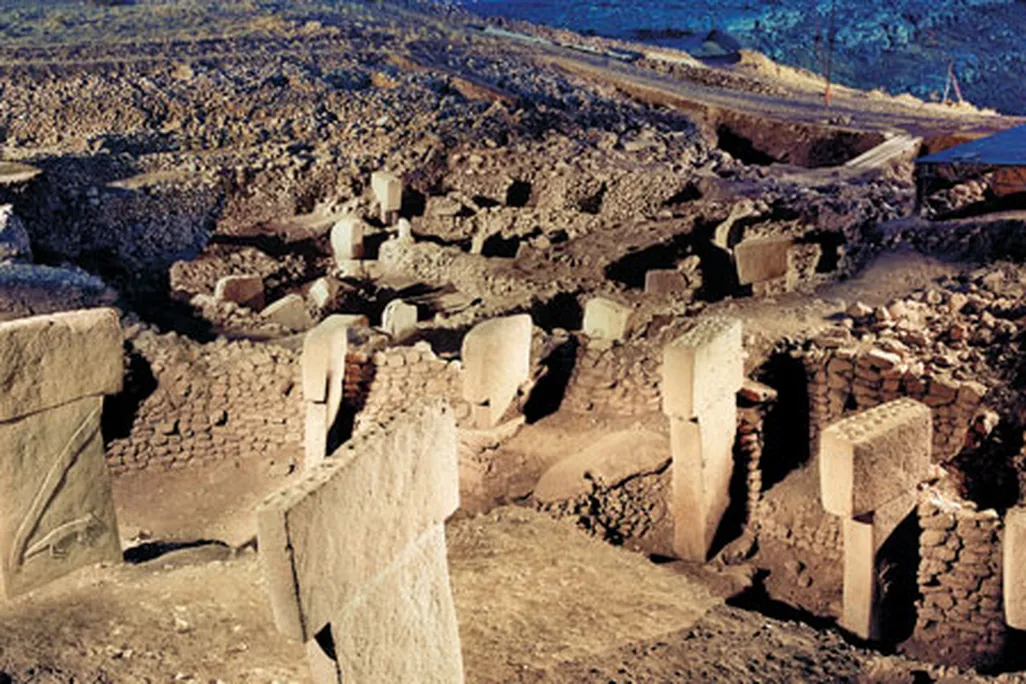
Gobekli Tepe Now seen as early evidence of prehistoric worship, the hilltop site was previously shunned by researchers as nothing more than a medieval cemetery.

Berthold Steinhilber

  • History & Archaeology

Gobekli Tepe: The World’s First Temple?

Predating Stonehenge by 6,000 years, Turkey's stunning Gobekli Tepe upends the conventional view of the rise of civilization

  • By Andrew Curry
  • Photographs by Berthold Steinhilber
  • Smithsonian magazine, November 2008

Article Tools

  • Font
  • Share/Save/Bookmark Share
  • Email
  • Print
  • Digg Digg
  • Comments
  • StumbleUpon StumbleUpon
  • RSS
  • Reddit Reddit

    Related Topics

    Archaeology

    Rituals and Traditions

    Neolithic

    Turkey

    Places of Worship

    Photo Gallery

    Gobekli Tepe

    Gobekli Tepe: The World’s First Temple?

    Explore more photos from the story

    More from Smithsonian.com
    • Andrew Curry on "The World's First Temple?"
    • New Light on Stonehenge

    Six miles from Urfa, an ancient city in southeastern Turkey, Klaus Schmidt has made one of the most startling archaeological discoveries of our time: massive carved stones about 11,000 years old, crafted and arranged by prehistoric people who had not yet developed metal tools or even pottery. The megaliths predate Stonehenge by some 6,000 years. The place is called Gobekli Tepe, and Schmidt, a German archaeologist who has been working here more than a decade, is convinced it's the site of the world's oldest temple.

    "Guten Morgen," he says at 5:20 a.m. when his van picks me up at my hotel in Urfa. Thirty minutes later, the van reaches the foot of a grassy hill and parks next to strands of barbed wire. We follow a knot of workmen up the hill to rectangular pits shaded by a corrugated steel roof—the main excavation site. In the pits, standing stones, or pillars, are arranged in circles. Beyond, on the hillside, are four other rings of partially excavated pillars. Each ring has a roughly similar layout: in the center are two large stone T-shaped pillars encircled by slightly smaller stones facing inward. The tallest pillars tower 16 feet and, Schmidt says, weigh between seven and ten tons. As we walk among them, I see that some are blank, while others are elaborately carved: foxes, lions, scorpions and vultures abound, twisting and crawling on the pillars' broad sides.

    Schmidt points to the great stone rings, one of them 65 feet across. "This is the first human-built holy place," he says.

    From this perch 1,000 feet above the valley, we can see to the horizon in nearly every direction. Schmidt, 53, asks me to imagine what the landscape would have looked like 11,000 years ago, before centuries of intensive farming and settlement turned it into the nearly featureless brown expanse it is today.

    Prehistoric people would have gazed upon herds of gazelle and other wild animals; gently flowing rivers, which attracted migrating geese and ducks; fruit and nut trees; and rippling fields of wild barley and wild wheat varieties such as emmer and einkorn. "This area was like a paradise," says Schmidt, a member of the German Archaeological Institute. Indeed, Gobekli Tepe sits at the northern edge of the Fertile Crescent—an arc of mild climate and arable land from the Persian Gulf to present-day Lebanon, Israel, Jordan and Egypt—and would have attracted hunter-gatherers from Africa and the Levant. And partly because Schmidt has found no evidence that people permanently resided on the summit of Gobekli Tepe itself, he believes this was a place of worship on an unprecedented scale—humanity's first "cathedral on a hill."

    With the sun higher in the sky, Schmidt ties a white scarf around his balding head, turban-style, and deftly picks his way down the hill among the relics. In rapid-fire German he explains that he has mapped the entire summit using ground-penetrating radar and geomagnetic surveys, charting where at least 16 other megalith rings remain buried across 22 acres. The one-acre excavation covers less than 5 percent of the site. He says archaeologists could dig here for another 50 years and barely scratch the surface.

    Gobekli Tepe was first examined—and dismissed—by University of Chicago and Istanbul University anthropologists in the 1960s. As part of a sweeping survey of the region, they visited the hill, saw some broken slabs of limestone and assumed the mound was nothing more than an abandoned medieval cemetery. In 1994, Schmidt was working on his own survey of prehistoric sites in the region. After reading a brief mention of the stone-littered hilltop in the University of Chicago researchers' report, he decided to go there himself. From the moment he first saw it, he knew the place was extraordinary.

    Unlike the stark plateaus nearby, Gobekli Tepe (the name means "belly hill" in Turkish) has a gently rounded top that rises 50 feet above the surrounding landscape. To Schmidt's eye, the shape stood out. "Only man could have created something like this," he says. "It was clear right away this was a gigantic Stone Age site." The broken pieces of limestone that earlier surveyors had mistaken for gravestones suddenly took on a different meaning.

    Six miles from Urfa, an ancient city in southeastern Turkey, Klaus Schmidt has made one of the most startling archaeological discoveries of our time: massive carved stones about 11,000 years old, crafted and arranged by prehistoric people who had not yet developed metal tools or even pottery. The megaliths predate Stonehenge by some 6,000 years. The place is called Gobekli Tepe, and Schmidt, a German archaeologist who has been working here more than a decade, is convinced it's the site of the world's oldest temple.

    "Guten Morgen," he says at 5:20 a.m. when his van picks me up at my hotel in Urfa. Thirty minutes later, the van reaches the foot of a grassy hill and parks next to strands of barbed wire. We follow a knot of workmen up the hill to rectangular pits shaded by a corrugated steel roof—the main excavation site. In the pits, standing stones, or pillars, are arranged in circles. Beyond, on the hillside, are four other rings of partially excavated pillars. Each ring has a roughly similar layout: in the center are two large stone T-shaped pillars encircled by slightly smaller stones facing inward. The tallest pillars tower 16 feet and, Schmidt says, weigh between seven and ten tons. As we walk among them, I see that some are blank, while others are elaborately carved: foxes, lions, scorpions and vultures abound, twisting and crawling on the pillars' broad sides.

    Schmidt points to the great stone rings, one of them 65 feet across. "This is the first human-built holy place," he says.

    From this perch 1,000 feet above the valley, we can see to the horizon in nearly every direction. Schmidt, 53, asks me to imagine what the landscape would have looked like 11,000 years ago, before centuries of intensive farming and settlement turned it into the nearly featureless brown expanse it is today.

    Prehistoric people would have gazed upon herds of gazelle and other wild animals; gently flowing rivers, which attracted migrating geese and ducks; fruit and nut trees; and rippling fields of wild barley and wild wheat varieties such as emmer and einkorn. "This area was like a paradise," says Schmidt, a member of the German Archaeological Institute. Indeed, Gobekli Tepe sits at the northern edge of the Fertile Crescent—an arc of mild climate and arable land from the Persian Gulf to present-day Lebanon, Israel, Jordan and Egypt—and would have attracted hunter-gatherers from Africa and the Levant. And partly because Schmidt has found no evidence that people permanently resided on the summit of Gobekli Tepe itself, he believes this was a place of worship on an unprecedented scale—humanity's first "cathedral on a hill."

    With the sun higher in the sky, Schmidt ties a white scarf around his balding head, turban-style, and deftly picks his way down the hill among the relics. In rapid-fire German he explains that he has mapped the entire summit using ground-penetrating radar and geomagnetic surveys, charting where at least 16 other megalith rings remain buried across 22 acres. The one-acre excavation covers less than 5 percent of the site. He says archaeologists could dig here for another 50 years and barely scratch the surface.

    Gobekli Tepe was first examined—and dismissed—by University of Chicago and Istanbul University anthropologists in the 1960s. As part of a sweeping survey of the region, they visited the hill, saw some broken slabs of limestone and assumed the mound was nothing more than an abandoned medieval cemetery. In 1994, Schmidt was working on his own survey of prehistoric sites in the region. After reading a brief mention of the stone-littered hilltop in the University of Chicago researchers' report, he decided to go there himself. From the moment he first saw it, he knew the place was extraordinary.

    Unlike the stark plateaus nearby, Gobekli Tepe (the name means "belly hill" in Turkish) has a gently rounded top that rises 50 feet above the surrounding landscape. To Schmidt's eye, the shape stood out. "Only man could have created something like this," he says. "It was clear right away this was a gigantic Stone Age site." The broken pieces of limestone that earlier surveyors had mistaken for gravestones suddenly took on a different meaning.

    Schmidt returned a year later with five colleagues and they uncovered the first megaliths, a few buried so close to the surface they were scarred by plows. As the archaeologists dug deeper, they unearthed pillars arranged in circles. Schmidt's team, however, found none of the telltale signs of a settlement: no cooking hearths, houses or trash pits, and none of the clay fertility figurines that litter nearby sites of about the same age. The archaeologists did find evidence of tool use, including stone hammers and blades. And because those artifacts closely resemble others from nearby sites previously carbon-dated to about 9000 B.C., Schmidt and co-workers estimate that Gobekli Tepe's stone structures are the same age. Limited carbon dating undertaken by Schmidt at the site confirms this assessment.

    The way Schmidt sees it, Gobekli Tepe's sloping, rocky ground is a stonecutter's dream. Even without metal chisels or hammers, prehistoric masons wielding flint tools could have chipped away at softer limestone outcrops, shaping them into pillars on the spot before carrying them a few hundred yards to the summit and lifting them upright. Then, Schmidt says, once the stone rings were finished, the ancient builders covered them over with dirt. Eventually, they placed another ring nearby or on top of the old one. Over centuries, these layers created the hilltop.

    Today, Schmidt oversees a team of more than a dozen German archaeologists, 50 local laborers and a steady stream of enthusiastic students. He typically excavates at the site for two months in the spring and two in the fall. (Summer temperatures reach 115 degrees, too hot to dig; in the winter the area is deluged by rain.) In 1995, he bought a traditional Ottoman house with a courtyard in Urfa, a city of nearly a half-million people, to use as a base of operations.

    On the day I visit, a bespectacled Belgian man sits at one end of a long table in front of a pile of bones. Joris Peters, an archaeozoologist from the Ludwig Maximilian University in Munich, specializes in the analysis of animal remains. Since 1998, he has examined more than 100,000 bone fragments from Gobekli Tepe. Peters has often found cut marks and splintered edges on them—signs that the animals from which they came were butchered and cooked. The bones, stored in dozens of plastic crates stacked in a storeroom at the house, are the best clue to how people who created Gobekli Tepe lived. Peters has identified tens of thousands of gazelle bones, which make up more than 60 percent of the total, plus those of other wild game such as boar, sheep and red deer. He's also found bones of a dozen different bird species, including vultures, cranes, ducks and geese. "The first year, we went through 15,000 pieces of animal bone, all of them wild. It was pretty clear we were dealing with a hunter-gatherer site," Peters says. "It's been the same every year since." The abundant remnants of wild game indicate that the people who lived here had not yet domesticated animals or farmed.

    But, Peters and Schmidt say, Gobekli Tepe's builders were on the verge of a major change in how they lived, thanks to an environment that held the raw materials for farming. "They had wild sheep, wild grains that could be domesticated—and the people with the potential to do it," Schmidt says. In fact, research at other sites in the region has shown that within 1,000 years of Gobekli Tepe's construction, settlers had corralled sheep, cattle and pigs. And, at a prehistoric village just 20 miles away, geneticists found evidence of the world's oldest domesticated strains of wheat; radiocarbon dating indicates agriculture developed there around 10,500 years ago, or just five centuries after Gobekli Tepe's construction.

    To Schmidt and others, these new findings suggest a novel theory of civilization. Scholars have long believed that only after people learned to farm and live in settled communities did they have the time, organization and resources to construct temples and support complicated social structures. But Schmidt argues it was the other way around: the extensive, coordinated effort to build the monoliths literally laid the groundwork for the development of complex societies.

    The immensity of the undertaking at Gobekli Tepe reinforces that view. Schmidt says the monuments could not have been built by ragged bands of hunter-gatherers. To carve, erect and bury rings of seven-ton stone pillars would have required hundreds of workers, all needing to be fed and housed. Hence the eventual emergence of settled communities in the area around 10,000 years ago. "This shows sociocultural changes come first, agriculture comes later," says Stanford University archaeologist Ian Hodder, who excavated Catalhoyuk, a prehistoric settlement 300 miles from Gobekli Tepe. "You can make a good case this area is the real origin of complex Neolithic societies."

    What was so important to these early people that they gathered to build (and bury) the stone rings? The gulf that separates us from Gobekli Tepe's builders is almost unimaginable. Indeed, though I stood among the looming megaliths eager to take in their meaning, they didn't speak to me. They were utterly foreign, placed there by people who saw the world in a way I will never comprehend. There are no sources to explain what the symbols might mean. Schmidt agrees. "We're 6,000 years before the invention of writing here," he says.

    "There's more time between Gobekli Tepe and the Sumerian clay tablets [etched in 3300 B.C.] than from Sumer to today," says Gary Rollefson, an archaeologist at Whitman College in Walla Walla, Washington, who is familiar with Schmidt's work. "Trying to pick out symbolism from prehistoric context is an exercise in futility."

    Still, archaeologists have their theories—evidence, perhaps, of the irresistible human urge to explain the unexplainable. The surprising lack of evidence that people lived right there, researchers say, argues against its use as a settlement or even a place where, for instance, clan leaders gathered. Hodder is fascinated that Gobekli Tepe's pillar carvings are dominated not by edible prey like deer and cattle but by menacing creatures such as lions, spiders, snakes and scorpions. "It's a scary, fantastic world of nasty-looking beasts," he muses. While later cultures were more concerned with farming and fertility, he suggests, perhaps these hunters were trying to master their fears by building this complex, which is a good distance from where they lived.

    Danielle Stordeur, an archaeologist at the National Center for Scientific Research in France, emphasizes the significance of the vulture carvings. Some cultures have long believed the high-flying carrion birds transported the flesh of the dead up to the heavens. Stordeur has found similar symbols at sites from the same era as Gobekli Tepe just 50 miles away in Syria. "You can really see it's the same culture," she says. "All the most important symbols are the same."

    For his part, Schmidt is certain the secret is right beneath his feet. Over the years, his team has found fragments of human bone in the layers of dirt that filled the complex. Deep test pits have shown that the floors of the rings are made of hardened limestone. Schmidt is betting that beneath the floors he'll find the structures' true purpose: a final resting place for a society of hunters.

    Perhaps, Schmidt says, the site was a burial ground or the center of a death cult, the dead laid out on the hillside among the stylized gods and spirits of the afterlife. If so, Gobekli Tepe's location was no accident. "From here the dead are looking out at the ideal view," Schmidt says as the sun casts long shadows over the half-buried pillars. "They're looking out over a hunter's dream."

    Andrew Curry, who is based in Berlin, wrote the July cover story about Vikings.

    Berthold Steinhilber's hauntingly lighted award-winning photograhs of American ghost towns appeared in Smithsonian in May 2001.


    1 2 3


    Related topics: Archaeology Rituals and Traditions Neolithic Turkey Places of Worship


    Additional Sources

    "Seeking the Roots of Ritual" by Andrew Curry, Science, January 18, 2008

     
    Comments

    This is a triumph for the archaeologists. Finding a temple older than the Stone Henge is something for the books. But, there must be a temple somewhere else that might even give us a greater thrill than this find in Turkey. Opening the eyes of our universe is the work of archaeologists and there are still unexplored sites around the world waiting to be discovered. So keep digging till every last one is found.

    Posted by Kenneth T. Tellis on October 24,2008 | 02:29PM

    What a fascinating find. I would think that the circle of ring was to establish a calender to mark positions of Sun and starts and hence predict seasons. Find of wheat nearby shows an agriculture based society and they may have built and observatory on a high point to avoid getting shadows from any other tall structure or trees or walls/rocks etc. The vicinity to Syria definitely points to a very early stage of astrology as we know it today. Many symbols carved such as Lion, Scorpio etc are astrological symbols. I would like to know more details about this project. Whom can I contact? Sincerely, Anjali Fields Ph. D. (Mechanical Engg.), M.S. (Physics)

    Posted by Dr. Anjali Fields on October 24,2008 | 02:29PM

    Incredible, but I strongly doubt that it was the world's "first" temple. Maybe the oldest to have survived. I'm sure there were many wooden temples that did not survive the ages.

    Posted by Carl on October 24,2008 | 02:36PM

    I noticed that some of the hieroglyphs appear to have some similarities to Egyptian symbols, while others do not>???

    Posted by troy canfield on October 24,2008 | 02:37PM

    This is so exciting! I'd like to know the theories about this find from other anthropologists such as Dr.Marija Gimbutas and Dr.Riane Eisler. The male anthropologists seem to look at finds like these through the lens of our current society. These early cultures were earth centered and honored the Source of life as female. How will this affect their interpretation? All the symbols seem connected with death; it does point to a burial place.

    Posted by Marti Matthews on October 24,2008 | 02:42PM

    That was a nice discovery. I'm really amazed how these things happen, but it only shows that men was given by God that knowledge to make such great things. Praise God!

    Posted by MariaPriscilla Sanchez on October 24,2008 | 02:44PM

    This ancient site may have something to do with the ancient extinct race of the Iberi people of the Caucasus.

    Posted by George on October 24,2008 | 02:45PM

    This article is absolutely marvelous. I've been studying ancient sites of Persepolis and Pasargadae in Persia (where I was born). Is there a way that I can get more articles on this archeologist's works? Many thanks, Raha Lane

    Posted by Raha Lane on October 24,2008 | 02:52PM

    I wonder if this site's purpose may have been to draw the attention of death, or at least the essence or spirit of these deadly creatures depicted, and keep them "trapped" at this site. A burial place can hold death well for a long time; no one would want to live there, of course.

    Posted by Michael Teegarden on October 24,2008 | 02:57PM

    Still, I muse on how even 11,000 years ago (roughly 9,000 B.C.) could be called 'Oldest'. How anyone, especially of scientific (not subject to overly emotional, but verifiable) bent could make such a claim. The claim has got to be 'Oldest found to date'. I suppose emotion, which is understandable in humans, and chasing a name that lives after, which too, many men, including he writing this is prey to, is culprit. Still, still, I wish we late, extant (Twenty-first Century) iterations would grab from whatever sense of the last: not 100,000 or so years of Homo-sapiens, but just the last 50,000 of what science has suggested 'our late ancestors came from'; that 'they had all the equipment: spiritual, mental, physical, etc. we who live now have', and not go off, as I see it, half-dug.

    Posted by Joseph Duvernay on October 24,2008 | 02:59PM

    Greetings, This was a great find. It is in ordinance of the worlds very first map which is located in England. The map has the tigris river, Armenia Asyria and Mesopethania. This also clarifies that Armenians were amoung the first people on earth even before the Africans.

    Posted by Chevy on October 24,2008 | 02:59PM

    Absolutely wonderful! I have been reading Zecharia Sitchin's "The Earth Chronicles" for many months now and given the fact that much conjecture is included, as must be in this type of interpretation, your article on Gobekli Tepe fits perfectly into the search for our earth's history and our possible beginnings. Thank you for fostering more interest in our ancient past. I wish we could see more of your articles on the national news channels. By learning where we came from and how we have presently arrived could possibly show us the way of our future destination. Maybe future generations can learn from historical research and take different paths to futher advance mankind and its continuing evolution, not degrade it! Keep up the great work!

    Posted by Janie Love on October 24,2008 | 03:03PM

    This is very interesting to me the birds sort of look like ostridges. Do the stones have holes in the top? The picture looks like some do, I wonder if a roof may had been attached or sonething! I would love to have a job doing this! It's too cool!

    Posted by Debbie Oneal on October 24,2008 | 03:03PM

    Nice.. But I doubt if it is THE Oldest.. It could be oldest discovered yet. I think it is just another way of grabbing attention of the media.

    Posted by Mandar Joshi on October 24,2008 | 03:04PM

    Fascinating find; but the claim of this being the 'first' temple is a bit of a stretch. There are ancient records of even older temples in India and China.

    Posted by Prabhu on October 24,2008 | 03:07PM

    The similarity between the monuments of Gobekli Tepe and Stonehenge appear too great to ignore. An upright rock(s) balancing an overhead rock(s) looms like some sort of primordial memory. Why this particular shape is repeated between cultures separated by thousands of years seems as interesting as the monuments themselves.

    Posted by paul wilson on October 24,2008 | 03:08PM

    It is sad that the article talks about the "site in Turkey". 6000 years ago there was no Turkey. 600 years ago there was no Turkey. This site is ARMENIAN. Just another example of how history is being rewritten! It's a shame. At least the Western scientific world should be more specific to acknowledge the fact that Urfa was the creddle of the Armenian civilization. Too sad, that's all.

    Posted by Gevorg on October 24,2008 | 03:09PM

    Wonderful article on a fascinating and important site. I hope that the archaeologists receive proper funding and that a visitor's center can be built in order to protect the site and educate. Beautiful photographs of the carvings.

    Posted by Luny on October 24,2008 | 03:09PM

    The current turkish land used to belong to the Armenians so this means it's NOT a turkish temple because they havent really owned that land back than.. So ITS THE ARMENIANS TEMPLE !!!!

    Posted by vanik on October 24,2008 | 03:14PM

    Its a good article, but you still need independent verification of the age of the burial site. It mentions that stone implements (whether they are flint, or knives, or whatever) resemble those found in another site, where the artifacts in the other site radiocarbon date to 11000 B.C. Okay, so how does prove that Gobekli Tepe dates around 11000 B.C.? If there are wood fragments, pottery shards, or some other type of carbon-based item at Gobekli, then test these to establish the date. Although undiscovered sites with monumental architecture probably pre-date our discovered (and well-known) archaeological sites, you still need to independently verify the dates. - Omar W. Rosales J.D. http://www.elementalshaman.com

    Posted by Omar W. Rosales on October 24,2008 | 03:15PM

    Turkey? do you really think that mongols who destroyed some of the worlds oldest heritages have a history as old as this? It's very sad, this site is Armenian and you must address it properley to people and nation who contributed many many things to humankind's civilization. if you search in what today call's it self Turkey, you may find that it has nothing on its own, all of the wonderfull sites belong to Armenians, Greeks, Asurians, Urartu's and etc. i hope they will correct the title no one can stole other nations heritage and culture this easily as Turks are trying to do . . .

    Posted by George on October 24,2008 | 03:18PM

    I am so excited to know about this temple. It is amazing that people thousands years ago without any advanced tools had such a great power and intelligence to create such a thing. But my heart is tumbled, when I read that the site is on Turkey. That area once, actually before 1915, was part of ancient Armenia and I am so sad that how can be possible that a nation and its history be vanished at once and ignored. I am not telling that this temple or its builders are related to my people, I am just wishing that I could read this news and see the "Armenia" word instead of Turkey in the news line. Once in Urfa were living Armenians and they were killed and deported during 1915 genocide. I hope that one day the world will recognize that the majority part of Eastern Turkey was part of ancient Armenia. With huge respect to all people who reveals the histories mysteries.

    Posted by Verjineh on October 24,2008 | 03:18PM

    Wow, this temple was built before the Turks even settled the area called "Turkey" today. This temple could very likely have been built by historical Armenians since they settled in the area at the time. Very nice find.

    Posted by Harry on October 24,2008 | 03:20PM

    Amazing article! I cannot believe the historical treasures we sit on in Turkey. So few people even know the existence of such a site here. The oldest I have seen in Turkey was the Karain Cave aroung Antalya, but along with Çatalhöyük, Göbekli Tepe is now on the list of places to see in Anatolia.

    Posted by ITIR TOKSOZ on October 24,2008 | 03:22PM

    This is indeed an interesting find. Let us not politicise this by saying whether this is Armenian or Turkish or something else, just let it be what it is...a common past of all mankind. Let's study this and see what we come up with about our ancestors. Gary

    Posted by Gary Mansfield on October 24,2008 | 03:25PM

    I believe this find is antedeluvian in nature. More and more, archaeologists are uncovering sites that were destroyed in the biblical flood. Without getting overly religious on you, can you not consider the possibility to humor me?

    Posted by gonzoe on October 24,2008 | 03:29PM

    Amazing article! I have learnt so much and now Göbekli Tepe is on my list of places to see in TR. Yet it is so sad to see that the origins of such an important discovery is being abused for politics by some commentators. There were no nationalities 11.000 years ago, the article talks about a hunter-gatherer society's place of worship. It just happens to be in Turkey today, that is what the article says. Irredentism makes people so blind that they are unable to appreciate that this is such a precious legacy, treasure for the entire humanity. Ms. Itir Toksöz (Ph.D- International Relations),

    Posted by ITIR TOKSOZ on October 24,2008 | 03:29PM

    This is on the armenian soil the turks destroyed in 1915. So it belongs to the armeinains.

    Posted by gevorg on October 24,2008 | 03:33PM

    Seems to me like the Bible is correct after all. If Noah's ark landed in the Mountains of Turkey and Russia, then Noah would have built a temple for him and his family to offer sacrifices to God.

    Posted by Joseph on October 24,2008 | 03:36PM

    Turkish site? How can it be a turkish site, 11000 years ago no turk existed, turks originated from mongol- tatars and came to invade the mesopotamia in late 600 AD. It's a temple created by armenians who owned the land. Amazing!

    Posted by Kristina on October 24,2008 | 03:37PM

    Dear Gentle People: The information you have shared about this exciting discovery may well signal the dawn of an entirely new approach to archaeology, anthropology, and the study of human social and intellectual beginnings with respect to man as "thinker/wonderer." Thank you! My sincere respects and warm congratulations to all who are engaged in this work. Yours truly, Philip Grinslade

    Posted by Philip Grinslade on October 24,2008 | 03:39PM

    THis is on the armenian soil that the turkish destroyed in 1915. so it should be the oldest ARMENIAN TEMPLE.

    Posted by Raffi on October 24,2008 | 03:39PM

    This is an amazing discovery and it is so nicely described by the author. It is absolutely a must-see place and will be added to my list of places to see in TR. Yet, it is quite sad to see that an important discovery like this is being politicized above by some of the commentators. 11.000 years ago, there were no nationalities, the site belonged to a hunter-gatherer society and it happens to be in Turkey today. The article describes just the location of it and does not refer to it as Turkish. It belongs to a time when human beings were not even settled down :)I am amazed at the comments declaring the site to belong to some nation. I feel more like this is a great legacy for the entire humanity that we should treasure. Yours Truly, Ms. ITIR TOKSOZ, Ph.D (International Relations)

    Posted by ITIR TOKSOZ on October 24,2008 | 03:40PM

    The Armenians inhabited this area for thousands of years. Why does the author of the article not assume or speculate this ancient temple is Armenian?

    Posted by unisky on October 24,2008 | 03:43PM

    This is, indeed, an exciting discovery. I just wonder which religion will claim it first and desecrate it by turning it into a religious war-zone by bloody fighting with all the other religions who will take interest in equally drastic claims that this is the valediction of all their fanatic dreams that their religion is more viable than the other?

    Posted by S. P. on October 24,2008 | 03:43PM

    The "prehistoric people" wer the ARMENIANS....obviously

    Posted by Gore on October 24,2008 | 03:45PM

    How wonderful to find yet another piece of the puzzle, will we ever know the whole truth? The grandness and the greatness of our earth in the past is still atotal and absolute mystery, wonderful.

    Posted by tracy Maclean on October 24,2008 | 03:45PM

    Why do they consider this the oldest site. It is not clear - is it through carbon dating or what?

    Posted by Ellen on October 24,2008 | 03:49PM

    dis is ancient armenias old temple. not turkish old temple.

    Posted by yeg on October 24,2008 | 03:51PM

    Just goes to show how very little we know about the past. And how soo much of what we think we know is conjecture. Dating objects seems to be an unsure science to say the least. I am glad for the find,but skeptical of the date.

    Posted by Cj Metzger on October 24,2008 | 03:53PM

    It proves that once again Armenians are the oldest civilization on earth. Cause we all know their was no turkey 6,000 years ago it was Armenia. Eastern Turkey is ancesteral Armenian land, Armenian people are the rightful owners of that land.

    Posted by Sam on October 24,2008 | 03:54PM

    To my fellow Armenian advocates, I am also Armenian, 1st generation. Although I appreciate your enthusiasm regarding this and many other findings regarding our people, please review your posting for grammatical and spelling errors before actually posting. The worst thing to do is to be perceived as being illiterate. Second, please do not express anger toward the scientists for this discovery or at the author of the article. After all, they can only write what they know of. They do not know that most of Turkey's land did actually belong to the Empire of Armenia, then later the Republic of Armenia, because they have been blinded with politics. They do not know that the Ancient Turkish people did not have a land they could call their own, and that the Armenian people gave them a place to call home. They do not know that Ottoman Empire killed millions of Armenians and took their ancient land, well they might know but don't want to admit it or do anything about it. They do not know that history books link the ancient civilization of Ur to present day Armenia. If they knew all of this, they would state in the article that the excavation was done in present day Turkey, but during ancient times, this location belonged to an ancient civilization linked to the Armenian people. So please, give credit to the Scientists for this discovery. And also, give credit to governments such as France, who openly recognize the Armenian Genocide by the Turkish government. Make your voice heard so that more countries like France around the world recognize the Armenian Genocide as an actual Genocide, then one day this new found discovery, including the biblically important Mt. Ararat and all the land associated with them, will be returned back to Armenia. Do not fire back with harsh words and actions, as this will only bring you to the same level as the Turkish Government that almost exterminated our Armenian people.

    Posted by Gevork Mkrtchyan on October 24,2008 | 03:59PM

    its a beutiful country with beutiful history i think theres alot more to discover in turkey beutiful people beutiful history but america is the best!

    Posted by salih on October 24,2008 | 03:59PM

    I am surprised that nobody has thought that this might be where Eden, the birthplace of humanity, was. It certainly sounds similar. It WAS considered a paradise and near the Tigris and Eurphrates. Also, the age is not far off. Just interesting.

    Posted by ERIC on October 24,2008 | 04:04PM

    I have read through all of these comments and would like to say to everyone out there who keeps bullishly insisting this is an Armenian site: Who cares! Can't we all just agree that this is a wonderful find that could lead us to more knowledge about our ancestry as humans and not our ancestry viewed through the narrow scope of imagined boundaries? In the grand scheme of things, these invisible borders and who ruled the land inside them is moot. What they accomplished as a people, now that's something to talk about!

    Posted by Isaiah Hickman on October 24,2008 | 04:07PM

    Interesting how the "T" shaped monuments are arranged and carved on. Many seem carved on the stem, but not the top. Like the tops are holding captive the creatures carved below. I wonder if the stems are hollowed out to hold something then capped off with the top rock of the tee.

    Posted by Scott on October 24,2008 | 04:11PM

    SOUTHEAST PART OF TURKEY WHERE THE DISCOVERY TOOK PLACE WAS THE LAND OF ARMENIA, LETS NOT FORGET THAT PEOPLE.

    Posted by ERIK K. on October 24,2008 | 04:12PM

    Urfa Was and is a part of Armenian Heritage, 6,000 plus years ago, the area in question was called Armenia <<<<<<<<< thank you.... The same culture and nation that Noah Chose....

    Posted by Nick on October 24,2008 | 04:21PM

    Very cool! Although, I do think that there may be another temple that's older...

    Posted by Dano on October 24,2008 | 04:28PM

    its so amazing that you discover this thing i love oldest site because i want to be a historian someday im a filipino live at Philippines manila, someday i want to be a archeologist and discover the uncover secret of the earth

    Posted by mark on October 24,2008 | 04:29PM

    Thank you for this wonderful article and dazzling pictures of this amazing archeological site! Great work!!

    Posted by CB on October 24,2008 | 04:29PM

    I was looking at a picture of a monastery with Mt. Ararat in the background. By the looks of where "Belly Hill" is located, I can't help but wonder about a possible connection between the two.

    Posted by Hank Devigne on October 24,2008 | 04:30PM

    I wonder if the stones are laid out to coincide with the sun,moon or other heavenly bodies. This could be were the research began for Stonehenge. Over the course of 6,000 years the process and knowledge could have been refined and migrated to what we see at Stonehenge. Vary interesting anyway.

    Posted by Pat Ebnit on October 24,2008 | 04:33PM

    I don't understand why researchers seem to leap to the conclusion that every megalithic site is a religious site. Governmental building share the same characteristics as religious structures. It makes more sense for the rings to be clan gathering structures with the largest for combined meetings than to assign some form of mysticism to the structures. Indeed,they may have been a combination structure. However there is no reason to think that religion played a major part in the neolithic hunter-gather society. It seems to me that they would be far more pragmatic than that.

    Posted by amblinal on October 24,2008 | 04:37PM

    Looking at the art work on the pillars, I wonder if the artwork corresponds with constellations. This would take observation over time. Also, it would be interesting to study the carvings collectively, to see if they are all part of some larger story. I find the bird with outstretched wings very interesting in the fact that there is a disk above the wings; the sun or moon perhaps? What was/were the artist(s) trying to say? What do we know of other cultures around the area? Wow, to be involved in a study like this would be absolutely fascinating!!

    Posted by Ben on October 24,2008 | 04:48PM

    The Turks did not invade Armenia until a thousand years ago. The Armenians may not be able to lay claim to this site since their history in the region cannot be confirmed beyond three millenia. But the Turks and Turkey certainly cannot claim this site as having anything to do with them other than the fact that they have stolen it from the Armenians who, in turn may have stolen it from others who came before them. In any case, to be historically and politically correct, the site should be referred to as something other than a Turkish site. It is certainly not Turkish, as neither are any other artifacts found in the region that are more than a thousand years old.

    Posted by Henrik Manoochehri on October 24,2008 | 04:51PM

    It is really dumb to call it "Turkish" since Turks cae into the region in the 12th century from Central Asia... It is either Armenian or some other peoples....

    Posted by Hozan on October 24,2008 | 04:55PM

    interesting but these pictures look more to me like the result of a tramatic event like a big explosion and the only thing left stuck in gorund are the support beams that more likly held up a bridge of some sort :))

    Posted by thumper on October 24,2008 | 04:59PM

    I believe these temples would be Armenian, not Turkish, since Armenians settled those lands long before the Turks even existed! But apparantly history is being re-written, seeing as to how all of a sudden Armenian-built temples are being called Turkish. I see everyone has conveniently forgotten how the Turks came to possess those lands to begin with.

    Posted by Ani on October 24,2008 | 05:01PM

    This is a great find for archeology. It is a shame that some people are not reasonable when hatred shadows the facts. It is also disappointing that some people are referring to the site as Armenian site. Great Find For Turkey and humanity.

    Posted by Ebru on October 24,2008 | 05:03PM

    Interesting discovery but why so confident its the first? @Gevork: There was no Armenia 6000 years ago either.

    Posted by BlackMoorWithBigSword on October 24,2008 | 05:04PM

    This is an interesting article which goes back to 11,000 years. I congratulate the archeologist who found this site.

    Posted by Ziya Akkor on October 24,2008 | 05:14PM

    These stone circles, as the ones at Stonehinge, bear an eriee resemblence to the stucture built in Germany during WWII for the anti-gravity experiments. This is very far fetched, but food for thought when a society goes from hunter-gather to agragian in only 500 years. The are is prone to earthquakes and could explain the difference in the heights of the top of the stones. But it sheds new light on our thinking complete with evidence and great photos.

    Posted by eric m. lough on October 24,2008 | 05:16PM

    I know of a groupe in Nova Scotia that had a religion over 10000 years old based on mathematics that was practiced for 3000 years. the math is accurate to 30 decimal places plus and minus and 150% more accurate than the best we have. I have been able to define trig to seven decimal places to a point that tangent 90 is finite. also the Medicine Wheel of Wyoming is high tech mathematics and is the same math by the same people that did the math on the great Pyramid of Egypt 2000 years before it was built. by the way this is under copyright since 1991 and my mentor for three years was a PHD of research mathematics.just thought you would like to know the western world had some advanced people. Question: Why are the Persian Rugs a 1000 miles so to speak from the great Pyramid of Egypt and the Navajo Rugs a 1000 miles from the great Pyramid of Mexico when both Rugs depict high tech math when only a few could read the math in function of numbers and SqRt. by the way the Navajo Sine wave points to the second Eye in mathematics and is noticed on the back of a Dollar Bill.

    Posted by James Bays on October 24,2008 | 05:18PM

    This is truly fascinating. Even if you dont beleive. The Biblical Garden of Eden was located in this area. So, people were definately in this area for quite some time. This may be where the people civilized after being expelled. It could very well be the outer limits of the Garden itself.

    Posted by John M. Chandler on October 24,2008 | 05:20PM

    Not surprising at all. Sites older than this will be found. All of us here in the modern age seem to think we are at some kind of pinnacle, but let us be humbled by those who came before. They could build temples but could not yet farm or write. That is simply amazing. Civilization is moving backward and forward in time. Perhaps we need to reconsider our notion of "civilized." Then maybe we will see the value of traditional and indigenous cultures, ancient spirituality, and, dare I say it, our existence as animals on this planet.

    Posted by Mike Leaser on October 24,2008 | 05:21PM

    This is a great find and not far away from CARAHUNGE in southern Armenia which is an observatory 7-8000 years old, I wouldn't be surprised if they are all connected all the way to CARNAC and STONEHENGE.Garbis ( Check Carahunge.com )

    Posted by garbis on October 24,2008 | 05:21PM

    This is a great news for me for two reasons. I am a Persian and maternally, my family comes from the Caucasus regions near/between Black & Caspian seas. I wonder whether these people who made such temples and I share some close genome! I am also a Geneticist/Scientist and any such findings just make my day! Keep on the good work! Btw, regarding the ' credit' of the site, of course there was no Turkey back then, but certainly there was no Armenia either. Persians can claim this to be their thing if we are going to go by such historical claims, this region was perhaps under the Persian rule the longest out of all the major civilizations mentioned. But when these people lived in this place, they were neither of these ethnicities. Persians, Turks, Armineans & etc all had similar gene pooles to these people MOST likely. That is all we can assume at this point.

    Posted by Sara S on October 24,2008 | 05:24PM

    As an Armenian History Professor I am ashamed of the comments made by other Armenians. Let's go back and read the history, again. We were not a civilization before...Read and learn. Shame on us.Let's not be jealous like little kids.

    Posted by Jonathan Avram Carpathian on October 24,2008 | 05:26PM

    This is so beautiful. It needs to be saved and shown to people who visit there. No one except God knows how old it is. The works standing alone almost look like a cross. How about that! Why do men continue to say they know how old something is? One day you will be surprised to find out, you are all very incorrect. Thanks for sharing.

    Posted by Merrie on October 24,2008 | 05:27PM

    As usual, there are so many variables here to be considered that one cannot make a truly indefensible choice. Carbon dating, for example, has been proven to be quite fallible (sometimes missing the mark by thousands of years), and it is also curious that no one has discovered any surviving habitats in the surrounding area. I do not wish to dismiss this absolutely stunning find, and I hope it is as advertised; however, it has often been the fault of many archaeologists that they do not gather conclusive evidence before making their claims (usually under duress, like having to produce something -- anything -- to please their respective universities and secure their tenures). I can only hope that time WILL tell!

    Posted by Greg on October 24,2008 | 05:32PM

    Actually Urfa is a city with a Kurdish majority. It's located in Turkey's Kurdistan though the Turks don't recognize the Kurds.

    Posted by Alan on October 24,2008 | 05:33PM

    In India there are temples nearly 20,000 years old that are recorded with carbon dating.....Hindu has been recorded as early as 33,000 BC

    Posted by Marekh Patel on October 24,2008 | 05:37PM

    Hey Vanik, I am Armenian too, but this is even before the Armenians were there if it is from 9,000 B.C. I don't think there is any history of Armenians or any ancestral predecessor prior to 3000 to 2000 B.C. I don't think there is actually any current ethnicity that you can attribute to that area at that time. Sorry, not 11,000 B.C.

    Posted by Mr. Manoogian on October 24,2008 | 06:04PM

    Well what does the light race (white People) call or consider a temple- a place of worship right - as is said here for this article. Anyway if this is true then consider the native american first people of this take over and what is now called North America - in this I say a place of worship was at times a place found on high buttes usually to recieve a vision that came from that of the spirits comming from that of the spirit world, or heaven to the light races understanding. Anyway - here and about and throughout this stolen and and long purposley forget treaties land - A person will find what are looked as something like a crop circle - these are called medicine wheel circles on the ground - they are a form of rocks on the ground in a circle and at times a cross in the middle looking like a sliced pie cut in four quarters evenly. In the center is a small opened spot, in which a person would sit to seek a vision or get healed at times - some of these "temples" are still created today for ceremony and use. Well if the native american peoples still do this - I am sure other people of a nation still carry out some what part of thier tradition - after all - (the teachings of yesterday are here today for tommorows next generation 08191969(c))- As a Dakota (Sioux) I am proud to know we still carry out our traditions.

    Posted by stoneskyman on October 24,2008 | 06:05PM

    The carvings have strikingly similar appearance to those depicted in the cave paintings in Europe. Take note of the position of the feet and tail of the lion, and the wings of the vulture. They look awkward. This could be dismissed as poor artistry, but a more likely explanation is that these represent animals as they lie dead. This fits Schmidt's theory of hunter/gatherer society. It also suggests a belief system similar to Native American spirituality. The preponderance of animal bones at the site may well have been the offerings to the spirit of the animals, to give thanks or to hasten the animals journey into the afterlife. The complexity of the site indicates a well-established and widespread religion. It's likely that it had a large number of devotees that spent years (if not their lives) maintaining and expanding this holy ground. Somehow they were supported by the far-flung tribes of hunter/gatherer followers. It is truly fascinating.

    Posted by Joseph Grundy on October 24,2008 | 06:06PM

    Excellent. Nothing more fascinating than to know who our forefathers might have been. But why did such old civilizations build temples to God, or gods? Did they have religion in those old days? Has the concept of religion, and of God, or gods always been there in the human mind? If man evolved from apes, when did the idea of religion, and God and a house of or for God, or gods, originate? Why did they build such majestic structures for GOD, but none for themselves?

    Posted by Jalees Faruqui - From Pakistan on October 24,2008 | 06:17PM

    Thia site, which consists of several layers of Stonehenge-type monuments, one on top of the other, reminds me a little of the "Troy" that Schliemann excavated. In that case, several cities had been built, one on top of the other. The whole many-layered "Troy" complex was under a mound named "Hissarlik." Curiously, Schliemann found gold objects in the excavation. I don't know how he knew where to look, but it's odd that no one had found them earlier, in the ruins of a deserted city. An American Indian tribe built an earthen pyramid near Cahokia, Illinois, across the Mississippi from St. Louis. Other pyramids were built by the Indians in Mexico. http://www.crystalinks.com/united_states.html http://www.sacred-destinations.com/usa/cahokia.htm The Babylonians built high earthen towers, that they named "ziggurats." Those "Hanging Gardens of Babylon" were one of the "Seven Wonders of the Ancient World." Jerry Baker http://reykr.livejournal.com

    Posted by Jerry Baker on October 24,2008 | 06:30PM

    I read the article and I am amazed about the discovery. I am excited as to how it could be possible for men to build such a temple 11,000 years ago without advanced tools. But the thing which is concerns me is the location of the temple. The news says the temple is located in Turkey near Urfa. I am so sad that how it is possible to ignore one nation,s history. There was no "Turkey" even 600 years ago. The majority of Eastern Turkey was Armenian's land. Urfa was one of Armenian's city where lived Armenians before 1915. I wish one day the world will realize the truth. I have a great respect toward people who discover and reveal the history mysteries.

    Posted by verjineh on October 24,2008 | 07:06PM

    Fascinating article, but, like other correspondents, I too would like to know more about how the presumptive archeological age was dated. What sort of tools does Klaus Schmidt believe were used by the builders to carve these stones to reproduce other life forms? Also, it would be very nioce if other familiar modern day forms coulc be included in the photos to help us gain a sense of size, like a human being or a metric ruler of some sort. Finally, what is that large lighted city in the immediate background lighting the night sky in the first photo on page 54 - 55?

    Posted by J. Kenneth Herd on October 24,2008 | 07:44PM

    It is the garden of eden, even the writer said it without realizing what he said. It is in the right place and it is something of huge religious importance, therefore, the reason for what it is and where. The Bible says Eden was destroyed in the great flood, the same flood of Gilgamesh and the location is perfect. This could be the greatest religous discovery since ever!

    Posted by Thomas Petty on October 24,2008 | 08:41PM

    So... what is the relation of this article with turks or armenians?and what ancient armenia are you talking about?some armenians lived in urfa but the land was always part of the ottoman empire.and now,urfa is part of Turkey...Go google it..My opinion about the title is that it is written so to make the article more attractive as almost all others do... in fact as other authors wrote...it cannot be the first,but the one remaining intact today...by the way,that region has hundreds of ruins to be digged out waiting for archaeologists

    Posted by sakalson on October 24,2008 | 10:02PM

    I agree. The discovery is amazing and interesting. Let put in this way. Some people politicize their comments. Let me be honest and clear. There were no nationality back 11,000 years ago. The problem is that when historians find any historian place in Turkey, they never mention the ancient people who lived on that lands. As an armenian I also can't be silent when I see this ignorance. There is no proof whether this temple was built by Armenians or not. Armenians were lived on that lands for thousands years. They even were living until 1915. We just want to be heard and at least historians should accept this truth.

    Posted by Raffi on October 24,2008 | 10:28PM

    Assuming that the age of the site is correct, this must be one of the first such sites around the world as the last ice has retreated from these altitudes around the world about 13000 years ago, the same time that the land bridge from Siberia to Alaska had collapsed. The site is old, and incredible as it seems. There might be others, perhaps in India or China.. and maybe as old although very unlikely because these dates are too old for these two so called "ancient countries" of the world, which themselves had incredible more recent cultures. But finding a site like this as old here makes a lot of sense as this area is at the cross-roads of human migrations (starting from Africa to Asia or Europe) and really the cradle of civilizations. Urfa really is the city of prophets, as we knew it. The people constructed this site were the ancestors of all of us, not one or another. Any people living at one site loose 95% of their genes in 1,000 years due to migrations. People living 13,000 years ago surely did not know and did not care about Armenia (which is a Roman name, by the way, and Romans lived around here about 2,000 yrs ago although others also resided around the same general area) or Turkey, or Arabia. The site belongs to the whole humanity, all of "Our" ancestors, not exclusively some others who happened to have lived there 5,000 yrs or 10,000 yrs afterwards. Finding Neanderthals, for example, in Germany does not make these people Germans, they were people living there at the time. That is what makes it so exciting. Let's enjoy it together for our next generations' sake. Finally, I would congratulate the excavating team and its leader Dr. Klaus Schmidt for his keen eyes and care, for revealing for us such a fantastic "gift". M.S. Prof of Science and Technology with interest in human technological evolution.

    Posted by Mehmet Sarikaya on October 25,2008 | 01:06AM

    A truly fantastic discovery written in an exhilarating article. Thank you! However, is it not distasteful to read the armenian onslaught of land claims by your armenian readers. I first thought of calling this a chip on the shoulder, but that does not do justice to the situation: they are carrying the whole log of hatred. This is pitiful because what a burden this is to carry through one's only life. More importantly, such responses do not belong in such an esteemed scientific platform. We will be willing to encounter such claims in an appropriate platform and set the record straight; but not here!...Surely, words we utter or write tells all about who we really are! You judge!

    Posted by Ibrahim H Caglayan, PhD Mech Eng on October 25,2008 | 02:41AM

    Bravo Klaus Schmidt! This site pre-dates Stonehenge by an entire 6000 years. That in my eyes makes it the oldest discovered site in the world. Some of the carvings remind me of the Mayan carvings in Mexico. Not just a Medieval Site afterall! Keep up the good work!

    Posted by Katherine Hall on October 25,2008 | 04:11AM

    If it were not for foolish turf wars/greed, the world would be in much better shape and so would those of us who live here. Most of us are carrying within us at least a few genes inherited from those who built that marvelous space 10,000 years ago. There were only a few people on the planet then. Did they too worry about whose turf was whose? I understand there have been a few cultures in history who have shared, have lived cooperatively, have ensured that everyone had what they needed, would even take in and care for people from the other side of the valley. I delight with the Turks for this wonderful discovery on what is their turf in 2008. They are the one who are dealing with the strangers in their midst during this long excavation process. They, and the Syrians, will profit from the possible increase in tourism. However, we will all profit from the increased knowledge of our roots as human beings on planet earth. We only have one world. It did not end with "the flood". We shared in the beginning. Let us try the gift of sharing lest we create an unpleasant end.

    Posted by Dorothy Parshall on October 25,2008 | 09:06AM

    "Some cultures have long believed the high-flying carrion birds transported the flesh of the dead up to the heavens." This is the origin of the widespread idea that angels have wings.

    Posted by Louise Tremblay Cole on October 25,2008 | 10:56AM

    Reference to this site as "in Turkey" is no more than an aid to finding the area on a standard map. The culture that created this wonder predates the Turks, the Armenians, and every other ethnic group we have a name for.

    Posted by Louise Tremblay Cole on October 25,2008 | 11:03AM

    One poster above made a point that needs to be repeated: 11,000 years ago there was NO ARMENIA as well as no Turkey. There were no nationalities at all. The article accurately describes the LOCATION of the momument. "Yet, it is quite sad to see that an important discovery like this is being politicized above by some of the commentators. 11.000 years ago, there were no nationalities, the site belonged to a hunter-gatherer society and it happens to be in Turkey today. The article describes just the location of it and does not refer to it as Turkish. It belongs to a time when human beings were not even settled down :)I am amazed at the comments declaring the site to belong to some nation. I feel more like this is a great legacy for the entire humanity that we should treasure. Yours Truly, Ms. ITIR TOKSOZ, Ph.D (International Relations)"

    Posted by paula on October 25,2008 | 12:00PM

    I want to make clear. In my comment I didn't claim that the temple belongs to Armenian. I just said that Turkey's eastern part was Armenian's. Don't be confused. There is no proof that who made the temple. It was 11,000 years ago. I am sad that why my people should be killed and their lands be occupied by Turks. Armenians were living on that lands since thousands years ago until 1915. I wish that there wasn't genocide and Armenians continued to live on their historical lands. I have great respect toward the people who discovered such a great masterpiece.

    Posted by Verjineh on October 25,2008 | 02:25PM

    Fascinating article. I am astounded on a regular basis when I hear people who are convinced they understand ancient history with certainty. Discoveries like this should serve to humble us and help us realize how very little we know about our origins.

    Posted by Ray on October 25,2008 | 06:51PM

    That one picture shows twelve stones in a ring. Is it possible the roots of astrology goes back that far?

    Posted by Jimmy on October 25,2008 | 07:07PM

    Isn't it interesting the precision of the rock cuts and carvings? Incredible for a stone age people to be able to make something that precise without metal tools. Someone compared this to stonehenge well, I have to differ. The craftsmanship here is a whole other order when compared to SH.

    Posted by Thomas Petty on October 25,2008 | 07:51PM

    The article was fascinating. I read it in the hard copy magazine but wanted to send it to a friend with whom I traveled in Syria. I'm glad I came on line as most of the comments were interesting as well. Do you ever have the author come back on line and reply to the most important questions? I think that would be a great feature for this site. You could even do an interview with him and post the video. But those who argued re which country.....how provincial, how 20th and 21st century. How can we learn so much about the world but not just be part of the world?

    Posted by Joan on October 25,2008 | 09:22PM

    To all jealous Armenians, This place belongs to Turkiye now and will always does so forever!!! Anyone who wants to visit this place has to come to Turkiye and show his / her passport at Turkish borders. Thanks for the archaeologists who contributed to this great job.

    Posted by Tamer on October 26,2008 | 07:13AM

    I found this article and all the comments very interesting and stimulating. I plan on doing some research on my own...please keep me posted on relating stories...this is a fascinating site and I would like to learn more about it.

    Posted by Ms. Silva B. on October 26,2008 | 11:13PM

    The SIOUX are also ARMENIAN descendent. The map has the tigris river, Armenia Asyria and Mesopethania. This also clarifies that Armenians were amoung the first people on earth even before the Africans.

    Posted by Michael Vincent on October 27,2008 | 04:15AM

    How does he know this is the first temple ever? How?

    Posted by Werner on October 27,2008 | 04:23AM

    I am so very happy and grateful to be living in a land where we have inherited a history that predates any culture (Turk, Armenian, Arabian, etc...). This is a gift that as a Turk, I must learn from and share with the rest of the world. I know that I (as a Turk) cannot take credit for this temple. No one can take credit for this temple. It is a find that I think defines us as who we are in the 21st century. It is a rare window that shows us where we came from. Shame on ANY culture that attempts to take credit for this find.

    Posted by Ozan Isinak on October 27,2008 | 07:55AM

    It is intriguing to imagine the directions and distances of migrations of the hunter-gatherers in this region. Did those of Urfa travel northward from Mesopotamia along the Tigris, as the ice sheets melted? Od did they, instead, travel northward from Africa along the eastern shore of the Mediterranean? Is there any archeological evidence linking the Gobleki Tepe monument builders to other ancient groups in the larger region? Very likely, there were seasonal migrations, perhaps lengthy ones, as the hunter-gatherers followed their prey into warmer and/or wetter climes. Also intriguing is speculation on whether the site was or was not religious in nature, if indeed religious beliefs existed at the time of the site's construction.

    Posted by Don Dubay on October 27,2008 | 11:45AM

    Mr. Ozan Isinak. You are proud to be a turk. I am proud to be an Armenian. NO ONE can claim that the temple is belong to any nationality. It is wrong that any armenians attempt to take credit to this find. It is abvious. But please just go and read the history. During WWI and WWII many armenians were killed and many forced to leave their homeland. Today you are proud to live on that land where once my people and my ancestors were living. Your ancestores make a home for you and for your people by taking others life and destroying their history. At least as a human feel armenians pain and accept the truth. I would like to know your opinion too.

    Posted by Verjineh on October 27,2008 | 02:37PM

    What an extraordinary find! However (though the contemporary archaological establishment is loathe to admit), major structures from the Giza Plateau predate even this find. Edgar Cayce described them to be constructed by Atlantean Refugees circa 10,500 in the Age of Leo. But let the scientists have their fun, for what it's worth...

    Posted by Doctor Sparkles on October 27,2008 | 10:07PM

    Mr Manoogian- Thank you for your comment!!! Armenians, Turks, Kurds we are all part of the same civilization, civilization of human kind. Just read this wonderful artical about a great discovery without getting political.

    Posted by sevda baran on October 28,2008 | 01:13PM

    Dr Sparkles: Someday there may be actual evidence for the "lost continent of Atlantis" and other of Edgar Cayce's speculations. Until then, archaeologists and other scientists should not be expected to "admit" to anything so lacking in evidence.

    Posted by Mr. Mainer on October 29,2008 | 03:25PM

    We know that Armenia used to be a great nation, and it was, alongside Ethiopia, the first nation to accept Christianity as a state religion. with all the sadness and anger that this great nation had to suffer throughout generations, we should always ask ourselves why nations like Armenia ceased to exist all together? How did they fall into the hands of barbarians? What did they do wrong to anger God, so that they were given to those non-believers like the Turks? I think we all need to search for the reason why it happened to the Armenians, if we all peace loving Christians would like to see back the Armenia we knew 2000 to 3000 years ago. We need Armenia! FYI: the Biblical Garden Of Eden lies in Ethiopia, around Lake Tana -- the source of the river Nile.

    Posted by Abram on October 29,2008 | 07:37PM

    pretty pathetic that people are trying to assert their ethnicity over ruins that are more than 10,000 years old

    Posted by Irina on October 30,2008 | 07:37AM

    they will have to call in the archaeoastronomers; it seems that no ancient sites were built without celestial phenomena in mind

    Posted by Irina on October 30,2008 | 07:40AM

    Thank you very much for providing information on this beautiful and fantastic discovery that may chanhge the flow of the history.

    Posted by John Gokcen on October 31,2008 | 09:16AM

    Stonehenge was not the earliest known before this discovery.
    The oldest is in Malta Ggantija

    "Their makers erected the two Ġgantija temples during the Neolithic Age (c. 3600-2500 BC), which makes these megalithic temples more than 5500 years old and some of the world's oldest man-made religious structures. "

    http://en.wikipedia.org/wiki/%C4%A0gantija

    Posted by Infonote on November 1,2008 | 11:09AM

    Turkey is the richest arceological land of the world. Here we have 18 different cilizations from cave age to modern Turkish Republic. Next to Gobekli Tepe open air pligrimage temple, there are numbers of eraliest known villages, and cities excaveted in different parts of the contry. This year 144 teams (over hundred are international) are working on different sites.. Visiting this land, the creadle of western cilizations at the sites and museums with great comfort see and study earliest of all artifacts men ever made...

    Posted by ugur ayyildiz on November 2,2008 | 05:21AM

    I agree with Janie Love -- this temple is consistent with (and perhaps identified in) Zecharia Sitchin's "The Earth Chronicles." Perhaps this is more evidence of the Nefilim/Annunaki?

    Posted by Regina on November 3,2008 | 10:52AM

    I don't know. Very exciting and eye-opening if it is genuine. Something about it doesn't seem quite right to me. More investigation into the finds, as well as parallels in "alternative" histories is called for.

    Posted by Owl Socks on November 9,2008 | 12:38AM

    Wow, this discovery really brought all the nutbags out of hiding. It's strange that such an ancient site should trigger such a wide variety of delusions.

    Posted by Querent on November 9,2008 | 01:42AM

    Isn't Tapeh/Tepe a Persian/Aryan/Iranic-origin word absorbed by the Turkomongols who invaded the region (ancient Media) just a few centuries ago?

    Posted by Rick on November 9,2008 | 02:14AM

    The purpose of the site seems to be pretty obvious. The dead were exposed to nature in a cermonial manner, and the local scavengers disposed of the bodies. There is no mention of astronomical orientation of the stone pillars, although it would be predictable. An orientation to Orion would be particularly intersting to search for, as well as the North Star and lunar paths. The T stones sound like Taulas. Evidence for correlation of lunar and solar years should be sought at the site.

    Posted by benb on November 9,2008 | 04:37AM

    Certainly, it is not the oldest anything. It is what it is. It is clearly not Armenian. Clearly not Turkish. Making ethnic claims for this site is childish, as we know so little of this time. Armenia is as temporal as Turkish. Tribal cultures understand that clan and society behavior (rituals and objects) were the "first" religions. R Gordon Wasson in "Divine Mushroom of Immortality" makes the carefully argued case that the first religion was a consequence of the ingestion of a mushroom called "soma" about 12,000 years ago in the Siberian region. 12,000 years ago tribal Native Americans had highly organized clans and societies and many powerful rituals and ritual objects. Their worship space has always been the raw in nature and many of the ancient tribal cultures were not given to constructing "temples" but had highly organized religious and spiritual practices. Interesting discovery, another broken piece of time in our huge collection of broken pieces. Making all these assumptions is just entertainment, not fact.

    Posted by Turtle Heart on November 9,2008 | 08:27AM

    The idea that the Sioux are of Armenian descent is strangely wrong. The Sioux are a ceremonial migration of the Cherokee just some 700-800 years ago. I am Ahnishinabeg, Ojibway and a keeper of sacred objects and ceremonies. We know our own history very well, thank you. It runs back, unbroken in terms of the ceremonial structure, some 12,000 years. Archaeologists dig around in the trash and ruins. What they find is often interesting. each new find shows how wrong many earlier theories were, which will be shown in this case as well. It is just a detail, not a whole story. Modern people are mostly clueless, since they interpret such ancient finds in terms of present-day psychology, politics and religious bias (such as all the claims by the "Armenians") and are unable to look at the data as the people who were there at that time looked at it. The many misinterpretations of Chaco Canyon culture for 80 years or more is a perfect example of this.

    Posted by Turtle Heart on November 9,2008 | 08:35AM

    @BlackMoorWithBigSword and others. You are right. This has nothing to do with Armenia which is another Johnny-Come-Lately in this time scale. All the Armenians blame Turkey which did not exist in 1915. It was the dying act of the defunct Ottoman Empire. Time marches on and leaves things behind including this fascinating site. How long ago were the constellations named? Here, we have a lion, a scorpion and other things.

    Posted by Daniel Tillmanns on November 9,2008 | 08:57AM

    Stunning! A find of enormous consequence. Just the photos presented offer a great wealth of fascinating data. The architectural scale and layout are just astonishing. And the iconography! One sees analogs to Egyptian and Mesopotamian symbology and style—a glance confirms a connection—though so much earlier these must undoubtedly have been a source. The style of working and the shapes seem unique in archaeology. The way some of the pillars narrow at the base recalls ancient carvings from the Mediterranean isles, and the pillars worked at the edges and some of the animal figures echo prehistoric Olmec tombs, nearly as old. The mind reels and the spirit soars. Klaus Schmidt deserves world reknown and respect I thank him. truly a treasure for all humankind In delighted awe, Lance Lough

    Posted by Lance Lough on November 9,2008 | 10:27AM

    the hand of Dordogne, France on the rock ceiling grotto – a hand traces of black and red pigment endlessly drip down to a large salmon caught with a hook – carefully carved into clenched mouth tomorrows frozen forever by works of man

    Posted by Zyskandar A. Jaimot on November 9,2008 | 11:50AM

    Lots of silly comments here. One thing is for sure, China and India had advanced civilizations much further back than 11 thousand years ago so the "world's first temple" headline was used to grab attention and it did. From all I have studied that claim is false, humans have had culture much longer than this.

    Posted by Jeff Gomez on November 9,2008 | 05:45PM

    The Standing Stones recently found in Turkey are AMAZING! There is a new 21st Century artwork called STARHENGE that is being proposed in ARIZONA!!! Check out the plan and astonishing photos by Googling: www.starhenge.net

    Posted by Two Hawks on November 9,2008 | 05:55PM

    This is so awe inspiring, it's really from a dream sequence, and I can't reach into vocabulary to express the primal emotion that this place evokes. I have to speak to the exhausting Ethnic food fight that has dominated the comment here. We are looking at something that has risen from the dawn of time, this is not Armenian or Turkish or anything we have a name for. You have not let yourself see what you are looking at. I like the comment concerning the attached roof. It does look like these T forms once held something up. Maybe thatch, and there may have been wooden floors, walls, etc. We could be looking at the skeletal remains of a building. It does all look ceremonial, and there is a real sense of design in the stonework. Really throws new light on the old childhood notions of primitive cavemen. These people were expressive and sophisticated. I am another reader who would love to be working on this site.

    Posted by Jeanne in Rhode Island on November 9,2008 | 07:22PM

    You have to consider this site within it's location and time continuum. Since it is being dated to 11,000 years ago, it predates the Black Sea Deluge that Robert Ballard of Wood's Hole confirmed as 7,000 years old. http://en.wikipedia.org/wiki/Black_Sea_Flood Due to it's location in southeastern Anatolia, it would be on a direct geographic line between the now-flooded Southern Black Sea plain and the Tigris-Euphrates Valley. Since agriculture was developed between 10-15,000 years ago, Both areas would have been prime candidates for Neolithic agriculture. It would also provide the avenue for the stories of the Black Sea Deluge to filter over to the Tigris-Euphrates spawning the Gilgamesh and Noah stories.

    Posted by Ishmael on November 9,2008 | 08:02PM

    In the paragraph beginning, "Schmidt returned a year later..." is that a typo within it where it says, "And because those artifacts closely resemble others from nearby sites previously carbon-dated to about 9000 B.C., Schmidt and co-workers estimate that Gobekli Tepe's stone structures are the same age. Limited carbon dating undertaken by Schmidt at the site confirms this assessment."? Should it instead have said, "Gobekli Tepe's stone structures are **at least** the same age?" Because, from the statement in the article, it's not clear whether the structure is actually 11,000 years old, or 9,000 years old, or even younger. Also, the earlier part of the paragraph seems to distinguish Gobekli Tepe from "nearby sites of about the same age," whereas the statement as written does not.

    Posted by mdtoorder on November 9,2008 | 11:16PM

    I agree with J. Kenneth Herd: There is nothing in any of the magnificent photos to give us a sense of the scale of the stones. It would have been so easy and so helpful to include a human being, such as archaeologist Klaus Schmidt, in one of the photos, standing next to one of the megaliths!

    Posted by Bruce N. Deppa on November 10,2008 | 07:48AM

    "This is the first human-built holy place." While I understand his enthusiasm for his find, this is almost certainly not true. Perhaps what he means is "this is the oldes human-built holy place yet discovered" - a horse of an altogether different color.

    Posted by Robert Lewis on November 10,2008 | 08:29AM

    ETHNIC FOOD FIGHT??? Ha-ha-ha! ...that is exactly what has been going on here. Silly at times, but entertaining. Still, some people have offered insightful and heartfelt wonder in response to these curious stone circles. Truly, the ancient standing "T" blocks of Gobekli Tepe are something to marvel at. Did you guys check out starhenge.net on google.com? It is pretty impressive too. The tradition of constructing standing stones lives on. The process is not merely a dead thing of the past. We humans still have the urge to stand up stones in our effort to touch the stars. -Two Hawks

    Posted by Two Hawks on November 10,2008 | 08:57AM

    THE ARTICLE TELLS US ABOUT A GREAT DISCOVERY BUT SOME IDIOTS KEEP ON CLAIMING THAT THE SITE ONCE BELONGED TO ARMENIANS...SO WHAT?? DOES IT MAKE IT MORE VALUABLE..I THINK YOU THE ARMEIANS ARE IN SOME KIND AN INFERIORITY COMPLEX..

    Posted by Korhan on November 10,2008 | 01:13PM

    Wonderful that the sense of adventure and the eagerness to further mankind thirst for knowledge and finding things that enlighten countless minds across the world over, it is a wonderful article but, I do have my doubts that it is the oldest temple to be found yet. North to the mountains and South of the first frost lies a land below itself covered in green and rocks look there and one will find wonders never seen, as to open new life's and hearts of all is the grandest that will ever be. ---PUIII--- there is a saying " for those who sit and do nothing are quite satisfied, but for those who do not sit and do nothing are the sole benefactors of the world" --WS--

    Posted by Pablo Uribe III on November 10,2008 | 07:00PM

    Some have commented how the folks that built these stones got them so flat. Ya got to remember, they had a LOT of time on their hands. It's easy for me to think that they simply kept grinding, sanding,whatever they used which must have been similar to what the Egyptians used to square their blocks. They had eyes. It probably didn't take them too long to figure out a rock sits on another rock longer when there are flat mating surfaces present. And why does this have to be a "temple" or related to a "god." What were THEY thinking, feeling. experienceing? We'll probably never know. I like to think outside the religious box when there's no blatent religous evidence. The 12 pieces. Was this leftover significance from Atlantis?

    Posted by Fulper Cave man on November 10,2008 | 10:39PM

    We may want to entertain the possibility that we are all wrong. What we may be looking at here are the remnants of a civilization that pre-dated the deluge - possibly a high civilization, or one influenced or sponsored by a high civilization. This place was most probably covered by the debris of the deluge rather than emerging from it. Science was involved here. We need to get out of our own way and think beyond our pre-conceptions of history, science, ethnicity, and religion to understand how and why this place came to exist.

    Posted by John Flomer on November 10,2008 | 11:52PM

    I think the discovery of Gobekli tepe is an extaordanary find and that you did a great job in your Nov. 2008 issue reporting this. Whether it is actually a tempel or what is yet to be seen. It is quite possable that it is in fact that basis for the stories of the Garden of Eden as it would have fit the stories discriptions almost to the letter. Several peoples' comments are directed negatively towards whether or not it is the oldest place of worship/rituals, or just the oldest known. In truth, no one alive today knows for sure what it was built or used for. It is all speculation. The fact of the matter is it's the oldest man built structure found to date, it's hugh, and it diserves a lot more study. I look forward to reviewing any further reports on Gobekli Tepe you may publish. Keep up the good work.

    Posted by Robert L. Harvey on November 11,2008 | 12:27AM

    Just a few comments regarding some other people's comments. 1) The site IS in Turkey. Yes, present day Turkey, which did not exist 11 millenia ago, but still, if you were to report the precise location, you would say Turkey anyway. 2) The site can hardly be associated with any of the many historically attested groups inhabiting that place before the Turks came. Neither Armenians nor Greeks (who are both of Indo-European descent) nor any Turks were there 11,000 years ago (well, most probably). 3) The site most certainly isn't the oldest temple ever built by anatomically modern people. It's just the oldest unearthed so far...

    Posted by Petusek on November 11,2008 | 08:07AM

    One thing REALLY bothers me about this report. All the pictures lack anything to give an idea of the scale of these stones. Some of the pictures, the stones could be somewhere between 2 feet and 200 feet tall for all I can tell.

    Posted by Brian on November 11,2008 | 09:57AM

    Interesting article. I wonder it is very plausible that right under our noses are even older structures. Just north of Baghdad there is an ancient structure that the locals call the Ziggurat. According to many archeologists from the nearby universities it was built approximately 8000 years ago (not sure if that is by the Muslim calendar or the Julian Calendar). Saddam Hussein's cabinet actually made a very half baked attempt at rebuilding the site (unfortunately the project was built over the original.) Thankfully for the most part that site has been left alone for the most part as have many of the other truly historical sites around Iraq. I believe there are many more of these sites all over the middle east which is why I cannot wait until peace and order are restored to the region so exploration of the area can begin again.

    Posted by Craig S. on November 11,2008 | 11:12AM

    These sorts of artifacts are of course not nearly as old as claimed. The bible clearly refutes these wild and illogical claims. It is a manifestation of the greatness of God's wisdom that so many 'scientists' in the employ of the enemy should believe such silliness.

    Posted by Elder John Williams on November 11,2008 | 05:09PM

    What tools did they use to dress those stones so smoothly? It seems that mere flint would not do the job - and how many man hours would it take to complete just one of them? There are mire questions to be answered than 'Turkish' or 'Armenian' - these monoliths were built by HUMAN BEINGS.

    Posted by David Adams on November 11,2008 | 05:25PM

    Two comments: First, this is a truly incredible find! The oldest place of worship - and if it's not the oldest, just share with us all where the oldest one is, please! And use the modern name for the place, so we can find it on a map... Second: there are a real bunch of BB-stackers posting comments here...

    Posted by Robert on November 11,2008 | 08:46PM

    I think the most unscientific statements from the "scientists" involved, are all the speculation without foundation about what the site meant to its builders. The most scientifically honest thing for them to say about why the site was built would have been: "we have no idea".

    Posted by Tom P. on November 11,2008 | 09:30PM

    Quote "I believe there are many more of these sites all over the middle east which is why I cannot wait - until peace and order are restored to the region so exploration of the area can begin again." Are you a cat? I'm hopeful for peace too - but given the recent 4000 years of fighting it seems even eight more lifetimes won't be enough. (sigh...)

    Posted by Fulper Cave Man on November 11,2008 | 10:24PM

    Gee, put the word "Temple" in a headline and all the crazies come out to play. Or is it the location that brought all the loons in from the cold? Armchair experts, gotta love 'em. Is there anyone here with an actual interest in the science of archeology and the history of the ancient world or are you all just a buch of nutjobs? Someone even mentioned Atlantis! That was priceless.

    Posted by Twinkie on November 12,2008 | 10:46PM

    Jane Jacobs was a famous writer about cities and their development. Around 1970 she wrote that agriculture was certainly an outgrowth of cities, not the other way around. As I recall, her book "The Economy of Cities" explains why this would be the case, but I may have the wrong book. It would be nice to see her get credit for being right about the development of agriculture. I hope her final book, Dark Age Ahead, does not also turn out to be so accurate.

    Posted by Dan B on November 12,2008 | 11:03PM

    Clearly this is a fake. Or to be more exact, these carvings are not that old. Stilistically there is no way these animals could have been carved in limestone in that fashion and have been preserved the way they are shown. They can indeed be medieval, however. But perhaps someone from Armenia can shed some light on the connotation of these animals in the Armenian cultural background?

    Posted by Thomas van Putten on November 13,2008 | 12:39AM

    The Bosnian pyramids at Visočica Hill have been ridiculed as merely pyramid shaped hills; yet, they were visited by Condoleeza Rice soon after discovery. Maybe it is time to do a serious excavation effort at site after all, as the artifacts also found seem to be contemporary with this finding: http://en.wikipedia.org/wiki/Bosnian_pyramids.

    Posted by no on November 13,2008 | 12:54AM

    Urfa is a KURDISH city. This site is certainly an armenian HOLY temple based on the fact that they were a bunch of lunatic pagans!

    Posted by Wong chu sen on November 13,2008 | 02:35AM

    Although it is impossible to know why the temple is the way it is it occurs to me that being hunter gatherers they are not used to buildings so the columns may represent something else. Perhaps a holy forest, the columns representing trees and the animals ... maybe forest spirits associated with death. So you can imagine a ritual procession through this forest of death to some sanctuary in the centre. Perhaps. Also fascinating that these people learned to work monuments so quickly, though they were of course familiar with stone on the smaller scale ... I suppose we forget how proficient with stone they must have been, a legacy stretching back hundreds of thousands of years. What I get from this is the understanding that even 11,000 years ago the world was nowhere as simple as we would like to pretend it was. Almost a different world.

    Posted by Peter Y. on November 13,2008 | 04:19AM

    Interesting, But this temple is not Turkish, not even Armenian, since those peoples are just newcomers, occupiers, and oppressors! This temple is definitely ancient Finno-Ugrian!!! (har har)

    Posted by arl on November 13,2008 | 04:46AM

    Fantastic discovery ; but for all we know, this might well be the deluxe john of those days. Maybe if it were reported this way, it would prevent the onslaught of lunatics on this page. Who would fight for some toilets ?

    Posted by mauve on November 13,2008 | 06:26AM

    It's amazing how much happened before we came along. There were entire civilizations, stories, romances, wars and drama that we know nothing about, but if we did, they would probably be amazing. I wonder, our own global village is but a few hundred years old. 11,000 years from now, if the future finds us like we found the Gobekli Tepe, what would they know about us? Would they know our culture, what we thought? Our Internet Forums? They would know as much about us as we know about the people at the time of Gobekli Tepe. They may find out the physical things, but they can never understand our spirit and soul. It's just awesome to think of our Brothers and Sisters living and feeling the same things that we do 11,000 years ago!

    Posted by Bhagwad Jal Park on November 13,2008 | 07:54AM

    Anyone knows the coordinates to find it with Google Earth?

    Posted by Jan on November 13,2008 | 08:08AM

    Amazing discovery that, along with the comment "world's oldest", demonstrates perfectly just how much we think we understand as a species - and how little we actually do.

    Posted by Politank on November 13,2008 | 09:17AM

    It gives me laughs to see how such an important discovery only fuels up some people's inferiority complex. This belongs to the humanity guys, not to a particular ethnic group, please grow up.

    Posted by Ali on November 13,2008 | 10:58AM

    Dear Armenians: Please get a GRIP! There was no Armenia 11,000 years ago. Nor was there a Turkey, or any other country, political unit, or people that currently exist today! Geez.

    Posted by Forbes on November 13,2008 | 12:49PM

    A temple separated from residential areas is surprising in the old world. Should we be looking to the Mayans as an analogue? If I understand correctly their cities were intermittently occupied ritual sites?

    Posted by David Bofinger on November 13,2008 | 03:39PM

    Well my friends, if you go and check for the RA material (LAW OF ONE) you can learn a lot from ancient civilizations, this material was channeled in 1984 and there's a line where it declares: ".......... Three of the positively-oriented of the Atlantean groups left this geographical locus before that devastation, placing themselves in the mountain areas of what you call Tibet, what you call Peru, and what you call Turkey." TIBET (Shaolin secrets) PERU (Maccu Piccu/Incas/Nazca/etc) TURKEY (well.. now we know)

    Posted by Alvaro Talavera on November 13,2008 | 03:45PM

    An article I noted from a year ago:

    Gene study supports single main migration across Bering Strait

    http://www.eurekalert.org/pub_releases/2007-11/uomh-gss112607.php

    This migration is purported to have taken place 12,000 years ago, in roughly the same time frame. I think there was a lot going on at that point in human history, but as the article states, this was 6,000 years before the invention of a written language we recognize, so there are more blanks than clues.

    http://www.wired.com/wired/archive/15.01/khipu.html

    Claims of "oldest" or "first" are not to be taken seriously.

    Posted by Allan on November 13,2008 | 09:55PM

    Before you pro-Armenian types get too excited, remember that the Armenians came from Phrygia, some ways to the west, and they originally came from the Balkans. Which is not to say there might not have been Armenian ancestors (by way of intermarriage with the Phrygian colonists), but they wouldn't have been Armenian as we know it. No, more likely the builders were Proto-Hittites or even Proto-Sumerians. (They obviously couldn't have been Turkish, but that's really more a question of geography than credit anyway.)

    Posted by Brian X on November 14,2008 | 11:09AM

    Drill, drill, drill. Well, dig, dig, dig. Awesome. I wish I could visit the site if even from a mile away.

    Posted by Mito on November 14,2008 | 04:06PM

    Only man could have created something like this? Hmm, I'm thinking how could man possibly create something like this at that time, especially with no evidence of human remains in the area.

    Posted by Steve on November 14,2008 | 04:10PM

    First - Congratulations on such a TERRIFIC find! Second - Folks, there were ZERO countries, cities, etc. during that time period. Third - Please dig under the Sphinx's right foot down far enough to the records chamber entrance. Let's prove or disprove its existence once and for all. Ground penetrating radar definitely reveals a chamber. Lastly - I admire everyone in the archaeological community for their patience and persistence in the face of such ENORMOUS odds. God Speed!

    Posted by Dr. Grant on November 14,2008 | 04:13PM

    The round shape of Stonehenge has always reminded me of pictures of the round huts and tents built by those few remaining cultures who truly lived by hunting and gathering. Actually, a round shape is the most efficient for a single dwelling, giving the most enclosed space for a given amount of wall and roof materials. Modern, square rooms only become efficient when several of them are built together so that walls are shared. Stone circles always scream to me of a time when we could all share the same space; before we started packing together. Like most animals, however, humans must have had to fight each other over hunting grounds. Imagine the first groups of people to struggle with agriculture. Did they hope it would finally bring peace?

    Posted by Pamela on November 14,2008 | 04:46PM

    To introduce a modest note of twilightzone-paranormal speculation: Has Edgar Cayce or other psychics predicted such a discovery or the existence of such a "culture"? :) Were these probably the remnant stragglers from Atlantis?

    Posted by Raj on November 14,2008 | 05:04PM

    Amazing discovery. The carvings are unbelievable. One more piece in the big puzzle. Cavemen were a lot brighter than we used to think. The archeologists are reading way too much into it (as always). Don't they ever wonder what a coincidence it is that the "oldest" signs of civilization happen to be in the arid areas without access to timber as an abundant building material? (For the Armenians and Turks fighting to be the founders of civilization.... Trois Freres Cave is much older than this site. It's dated 13-15k years ago, this is hardly the birthplace of civilization)

    Posted by Patrick Powell on November 14,2008 | 05:41PM

    My first gut reaction was that this was a gathering place for wandering tribes of people, like nomads do even now in places. The "signs" almost seem to be saying, "This is where the scorpion tribal leaders will stay for the event." That is, of course, a lot of effort for such, but it is just a hunch anyway.

    Posted by Kris Harrison on November 14,2008 | 05:59PM

    Several more thoughts to share: 1. Round structures are stronger and less likely to be blown over or shaken down. 2. If a group of people stand around a fire - they stand in a circle. Heat radiates in a circle. 3. In a lush land with plenty of natural food, hunting and gathering is easier than agriculture... but only until the population increases faster than it can spread out. The only real advantage of raising food is that more people can live in a given area. Farming is more work than hunting but less than fighting for more land once a given space is hunted out.

    Posted by Pamela on November 14,2008 | 06:06PM

    Schmidt must be the pride of archeologists the world over after claiming, "This is the first human-built holy place..." I have read articles referencing this quote on numerous main stream media sites where his statement failed to elicit so much as a smirk. Another proud day for journalism too! Herr Schmidt was either misquoted... or missed class the day they taught archeology, epistemology and logic during his university years. Maybe he cut himself shaving with Occam's razor that morning... Jeff Bryce Seattle, WA USA

    Posted by Jeffery Bryce on November 14,2008 | 06:28PM

    For those who write about how wonderful it would be to help with this incredible archaeological dig, please know that you are ALREADY involved and helping. If you so choose, you may become researchers and students of archaeology, in your own way. Through the Internet, we become thoughtful armchair scientists. We may take on the mission of collectively decoding and understanding the nature and true purpose of this extraordinary site -- and we have a lot to add. So dream. Think. Postulate. Question. Consider. Get involved. And help solve the riddle of Gobekli Tepe. Together, with the combined literally tens of thousands of years of experience we all share, we can add a lot to the understanding of this site and of the people who built it.

    Posted by Thomas on November 14,2008 | 06:31PM

    Abrahams'city of Ur- "And your descendant's shall be as the stars in the sky, and the grains of sand on the beach." The fertile "belly valley" from where civilization flowed. I love it! And then as we swarmed into the cities, future archaeologists will see the Starbucks, McDonalds and Popeyes and Taco Bells that became our cultural icons.

    Posted by Kimberly C. Wade on November 14,2008 | 07:16PM

    There is no such thing as a biblical flood. We know now that climate change has existed for millions of years. During that time we now know that the Canadian Shield melted and flooded the oceans which in turn flooded continents - it wasn't an act of a made up person, it was nature. Consider that people still worship a rock that fell from the heavens - a meteorite..lol! Seriously, they thought volcanoes had humans trapped in them and that it was God. That stuff is all made up by humans who were scared, they didn't know anything about the world or why they were there so they worshipped the sun and moon and animals for crying out loud. Get over it, no one is coming to save you. We had paradise and we destroyed it, this was it so enjoy what's left of it because once we are gone, another civilization will rise from the ashes and hopefully they'll be far more intelligent than we have been.

    Posted by kate on November 14,2008 | 08:21PM

    This fits perfectly with God's word the bible, about where "civilization" was born. Exactly where he said, by the Euphrates, and Abraham was from UR. About 11,500 years ago - near the beginning of time. Science will never disprove that. And nearly every major archeological find proves more correct historicity of the bible. Jesus said, "They have eys, but not see, ears but not hear. Some people's "science" takes more faith to believe than God'd word and proof right in front of their eyes. Bible also says, "The Heavens declare the majesty of God, so that no man has any excuse, not to believe."

    Posted by David Forman on November 14,2008 | 08:43PM

    Making stones flat is not difficult at all, even with large ones. It certainly helps that the stone in used here was fairly soft. Simply chip the monument slabs with harder stones until they are in the general shape desired. Then leave one flat on the ground, throw a little sand or hard grit on it.. then put the other stone on top of it. Slide the top stone around for enough hours, and abrasion between the two stones will eventually flatten both of them. This is apparent in millstones, which have existed for thousands of years. For hunter/gatherers with many thousands of years experience in stone-tool making, this was quite possibly a known method of smoothing stone surfaces. Just scale it up for monuments, as many other later cultures did. BTW.. Do this with glass, moving the top plate in a circular motion, and eventually you will have two matching concave/convex pieces of glass. That is how early magnifying and telescope lenses were ground.

    Posted by R. Reader on November 14,2008 | 09:34PM

    This is a very exciting find but how can anyone really know whether or not it was the first temple ever built? They can't, so they shouldn't make such grandiose claims.

    Posted by Jerad on November 14,2008 | 11:24PM

    My goodness, please stop with the silly Armenian claims. There was no such thing as an Armenian 11,000 years ago. Yes, maybe the Armenians can trace their lineage back to this area but guess what, so could many other groups of people. The human population was not very large back then.

    Posted by Jerad on November 14,2008 | 11:31PM

    While this is an exciting piece of news, I find Schmidt's claims that this is the "first temple" rather arrogant. It may well be the oldest site of its kind found to date but the hardly makes it the "first" of its kind. He will only be able to maintain that claim until someone finds an older site. Likewise, I have to question his method for dating. While the stones tested may very well be somewhere between 9,000 and 11,000 years old, that doesn't necessarily mean that the images were carved into them 9,000 to 11,000 years ago. From all appearances it could well be a site where sacrifices were taken to be splayed on the circular alter and carried off to some pagan god by the wild beasts depicted on the stones. That would account for it being on the hillside as well. It reminds me of the Lapp or Sámi sacrificial sites or the sites where people were taken to suffer judgment for their transgressions.

    Posted by Kix on November 15,2008 | 12:09AM

    It's fun to speculate what the site was dedicated to. Perhaps they thought animals had their own gods too and by building a temple honoring the creatures that had impact on their lives they hoped to appease the animal gods, and that by doing so this might bring them less of the harmful ones and more of the helpful. Like the article says, speculating is a true exercise in futility. Who knows what went on in the minds of these people, but it sure must be fun to speculate.

    Posted by Engstfeld on November 15,2008 | 12:43AM

    This hill with the singularly rounded top ...was it covered up with dirt for a special purpose? A "high place" which needed to be put out of commission? It has the look and feel of evil practices done here. Historic it may be but not wholesome. I am grateful to have seen it.

    Posted by Terri D. on November 15,2008 | 01:45AM

    To give all of you how believe in the Bible a frame of time. The age of the site is 5000 years before God made the Adam and Eve or the Earth.

    Posted by Dale on November 15,2008 | 03:51AM

    while someone might have mentioned this (I didn't read every comment), the biblical account of Abraham takes on interesting overtones. Aside from the paganism his culture was immersed in at the time (although the Bible doesn't mention that specifically, it's a good guess), the location (traditionally and generally) of biblical Ur, and the geography have interesting implications. I think it also shows how Abraham was willing -- if saddened -- in the biblical account of God's ordering him to sacrifice Isaac: the fertility traditions and human sacrifice were not unusual.any thoughts? (no I am not a loony, just a biblical scholar and archeological amateur; I don't discount the Bible just because some scientists diss it today).

    Posted by Jack on November 15,2008 | 04:16AM

    What is the alignment of the stones? Could they be indicating migration seasons by alignment with the sunrise or planet Venus?

    Posted by Loey on November 15,2008 | 04:25AM

    This temple is obviously of Armenian origin, as we were the original inhabitants of the Fertile Crescent, and the fathers of all civilization. Moreover, we predated all other peoples of the world, to include the Persians, Turks, Nubians, Israelites, Sioux, Hittites, Hattians, moslems, Kurds, Zoroastrians, Egyptians, Ethiopians and everyone else. This area should simply be known as "Occupied Armenia" rather than Turkey. There are Armenian ruins from every age that are scattered throughout all of Asia Minor (called "Ionia" by the invading Greeks, and "Anatolia" by the invading Romans). The assertions of the Turks, Kurds, Iranians and Syrians are merely calculated to reinforce their criminal occupation of Armenian lands. Our empire extended from Asia Minor throughout the Caucuses, up into what is now known as Georgia, Russia, Ukraine and Belarus, eastward as far as India, and south as far as Ethiopia. This is our temple and the rest of you are merely squatters.

    Posted by Mikel Derbabian on November 15,2008 | 04:32AM

    Could this be the REAL tower of Babel? Although not made of bricks and tar it is still man-made, obviously reaches the heavens, and, if the history is accurate, this could be the first civilization speaking one language, of one mind.

    Posted by Ed Riesner on November 15,2008 | 08:14AM

    Makes you wonder how many other buried civilizations are out there, and have been buried away not by the elements but by scientist. Well here is proof this site is not the only one that supports the theory human civilization is far older than we have been led to believe.

    Posted by angel on November 15,2008 | 08:20AM

    I'm skeptical. Without organic materials, how are they carbon-dating this site?

    Posted by Richard on November 15,2008 | 08:40AM

    I am amazed, but not surprised at the antiquity of this site. Over and over, sages and spiritual luminaries, like Sri Aurobindo for example, has told us that human culture and civilization is way older than we suppose and accept nowadays. This is also corroborated by the Piri Reis map with the contour of an Antarctic continent that has been covered by ice for the last 9,000 years; meaning somehow a civilization perfectly mapped the coast of Antarctica before that. This can be explained by the theory of earth crust displacement that was accepted by non-other than Einstein when he went out of his way to write an introduction to Hapgood's book on this principle in 1952. In this theory it was possible that Antarctica was at that time at the height of today's Argentina, thus devoid of ice.

    Posted by Alfredo Delregato on November 15,2008 | 09:17AM

    What I find odd is how the structures resembles crosses (crucifix's) minus the head. Also, 11,000 years ago is too far back to assume Christianity in any form, but it would fit with the whole SONS OF GOD and 72 RULERS for 72 nations timeline...and then the flood. So, hey...ya never know.

    Posted by Asia Minota on November 15,2008 | 11:34AM

    Humanity amazes, despite this great even we have Armenian vs. Turk. When will we stop beating stone, copper, bronze,iro,and steel into weapons and simply see the greatness of man without the need to murder each other over who or whom and beliefs. This is an extradinory find, oh that we could learn from history and not be condemed to repeat it.

    Posted by John of Lincoln on November 15,2008 | 12:08PM

    As advanced a group as humans like to think they are it never ceases to amaze me at how quickly they regress into laying claim to things or dividing into sub-groups. No wonder so many so called civilizations died off. We will probably continue to find objects, sites, whatever that predate others. Given what we know about plate tectonics most of what predates all of these are probably long churned under and lost forever. Will mankind ever learn to relish what we are diversity and all or find our more recent history being dug up by some beings attempting to determine what happened to us? Sites like these serve to give us a frame of reference concerning advancement but little else in terms of our origin.

    Posted by Patrick on November 15,2008 | 01:49PM

    wonderfull find, congradulations. Some wonder why the ancients did not leave more detail history, I beleive they did and this and other finks like it is their way of telling the story. we simple have to learn how to relate it to our time and undeerstanding. and without a dought someday we will.

    Posted by Eugene Burrow on November 15,2008 | 03:22PM

    Has anybody thought about this? Look at the intricate carvings and large scale! This was a clearly sophisticated site that obviously took advanced architecture and engineering skills to build, yet it was before before farming?? What's wrong with this picture?? I think archaeologists need to rethink their theories a bit! This site was not built by stone age hunter gatherers! This is clear evidence that there were advanced civilizations in so called "prehistoric times"! Anyone ever heard of Atlantis or Lemuria?

    Posted by P Grandahl on November 15,2008 | 06:01PM

    Congratulations on the find! very interesting. History holds so much, mixed together like some vegtable soup. maybe in the far past people did not have hard political boundries and wars over race and resources. I often wonder if things are so much different today than they were then? I suspect I will never fully know or understand the scope of the answer. I am delighted that we as humans continue to search for answers to better understand ourselves and move forward in our own time.

    Posted by Keith Hass on November 15,2008 | 09:38PM

    This could be a continuing trend in the thought that Modern man has been around longer than first believed. I think we will see much older civilizations with more elevated technologies. This is just the start. Keep digging!

    Posted by Tom Hoffman on November 16,2008 | 10:46AM

    Wonderful story, but it is as seen though the eyes of a reporter and a researcher that is speculating. I blame the reporter the most for the over reaching in the conclusions, science reporters should have some training in science. It certainly appears to be a pre-agrarian structure, but with a little more effort on carbon dating and other linkages are really necessary before making those suggestions in any scientific forum. I believe the researcher is heading that way, but the reporter didn't understand the difference between speculation and a well supported theory. It is a very interesting and even ground breaking story. I want to believe, help my unbelief with a few more facts.

    Posted by David Sparkman on November 16,2008 | 11:49AM

    The rash assumptions made by Herr Schmidt and others are odd. Something done on this scale, especially when the more elaborate portions are also the oldest as has elsewhere been reported, can hardly have been the "first" ancient "temple". Likewise, why do archaeologists insist that writing did not come into use until thousands of years later? They do not know that that is true. Why not be satisfied to say that that is the oldest evidence found "to date"? This does not necessarily reverse the accuracy of the theory that domestication occurred first. How were so many fed if not by farming products? How could a "hunter-gatherer" culture have spared so many young and strong hunters to take the time to travel to and build such a large installation? Perhaps mankind became sophisticated long before some of us want to believe.

    Posted by D. Hyman on November 16,2008 | 07:12PM

    How are they so quick to label this the site of a pre-historic temple? It seems more like a library or classroom layout. Does modern man look down so much so on pre-historic or ancient man that they assume mankind has always had the urge to learn? If you had no viable language to teach your children how to hunt or how to gather food, why not draw pictures...and why not place rocks from which you have learned to carve/draw upon to use for teaching? Is teaching someone how to hunt considered worship? Maybe the residents of this "temple" were artists. Don't get rituals confused with worship.

    Posted by Dreifort on November 17,2008 | 07:50AM

    Great article, horrible comments. It's disheartening to find so much ignorance, anger and rabid ideology amongst people reading the Smithsonian. Some need only to read the article to find the answer to some of their complaints. Others take advantage of ambiguity in the English language to lambast the article (such as complaints about the usage of ‘first temple’, there’s a difference between a temple and an altar or shrine). Then some others use their religion, atheism, or political ideology to pervert the findings. My condolences Mr. Curry but don’t take it to heart you did a great job, as have the archeologist.

    Posted by JS Bryan on November 17,2008 | 08:44AM

    This temple was from the Neolithic period and the culture of that priod was Kebarans or Natufian, not Armenians, which was much later; nor is it of "Turkish culture."

    Posted by DMK on November 17,2008 | 02:55PM

    When I was young I wanted to be an archeologist. Never got there but I do enjoy reading about the discoveries of others. Thanks for your tenacity regarding the past. It can help us in the future.

    Posted by JEANNE ASKHAM on November 17,2008 | 03:07PM

    Gobekli Tepe suggests to me, in at least one of the photos, an astrological calendrical alignment of monumental carved stones, based on a Lunar mathematical system, where thirteen stones are arranged in a circle. The two inner pillars might symbolize the male/female duality, the creation principle. The specific renderings of the scorpion and the lion, as well as other animals specific to their zodiac, suggest a dedication to the relationship of the stars to the sequential seasonal rhythms. This man made hillock land form, like England's Avebeury Hill, was begun and generationally increased in size, as the descendants of the originators recreated and re-established their sacred connection to the cosmos. I suggest that if visitors to the site were permitted to dowse the standing stones, they might discover, as I have in a large Medicine Wheel that I created, a ring shaped field of energy passing through the ring of stones. If this is found to be so, I further suggest that this site was a place of healing, and that healings and attunements to celestial forces were experienced within the space between the two "parent" stones in the center. The ancestral Armenians would then have been the preceptors of all energy healing modalities, such as those that now are enjoying a renaissance; i.e., Reiki, Tong Ren, neo-Druidism, ChiGong, Wicca, laying on of hands, etc. Respectfully, Marshall Rosenthal, MA Cultural Anthropology, Syracuse University, NY, Usui-Tibetan and Karuna Reiki Master/Teacher.

    Posted by Marshall Rosenthal on November 17,2008 | 05:01PM

    Two points 1) 11,000 years ago, there was no Turky or Armina. Get over it. The point of the article is that this is likely the place that ALL civilization started. 2) The author argues that it is THE oldest (discovered or not), as there was really no organized civilization before this capable of working togeather to build anything of significant size.

    Posted by Jeff on November 18,2008 | 12:09PM

    ~ That is no "Temple". That place was described in some detail in the Sumerian texts. It is the place where the Earth's indigenous wild animals were domesticated. To confirm or disprove my assertion, I would suggest that extensive DNA testing be done on the numerous animal remains there. I predict that there will be found large gaps/jumps in the DNA sequences of each species in step with the time the animals were cast aside. The animals were not "sacrifices", they were just carrying defective and or undesirable genes. ~

    Posted by Jim Bell on November 18,2008 | 01:51PM

    Excellent article, Mr. Curry. The ignorance shown in most of the comments saddens me, but I hope you will continue reporting on Dr. Schmidt's work, I would be interested to learn what else the excavation uncovers. Perhaps this was some sort of funeral ground, where bodies were left for wild beasts to devour? The megaliths may have been covered with warding symbols of death, or perhaps they represented spirit guides, as the very animals that may eat the flesh of the dead and return them to the heavens and the earth. If it were periodically cleaned, and the bones removed and burned or scattered, that would explain why only fragments remain, then as people scattered earth over the site after sweeping up the bones, it would gradually rise higher and higher, swamping the megaliths, and requiring the construction of new ones? Just an idle thought that occurred to me, it will be good to see what other secrets this site reveals.

    Posted by Christopher L. Wood on November 18,2008 | 07:26PM

    It is not a Turkish temple, it is not an Armenian temple--it is a HUMAN temple!

    Posted by Michael on November 18,2008 | 08:23PM

    Unfortunately I must agree with a previous comment: that this may not be the most ancient temple?, maybe, found to date. How on earth; with such mega discoveries going on in our universe and on our own planet can a true man of science proclaim: " THIS IS THE OLDEST TEMPLE EVER BUILT BY MAN". Oh; the discoveries that will be made in the future will most likely astound us and just as physics is being turned on its head; our understanding of our distant past is in for a real transformation. Stan Cape

    Posted by sTAN cAPE on November 19,2008 | 07:50AM

    So there were no Cave Men! Forget about hunter gatherers. Genesis account of long life spans of 960 years of the Antediluvians are true, and their drowned kingdoms and monuments are what you are digging up. Human beings are a Fallen Race. Genesis 4 : 22 22 Zillah also had a son, Tubal-Cain, who forged all kinds of tools out of bronze and iron.

    Posted by Lalitha Jacob on November 19,2008 | 09:47AM

    Gobekli Tepe changes everything archaeologists discovered so far and it is considered the most important archaeological find in recent history. Klaus Schmidt, the man who first discovered Gobekli Tepe says the carvings might be the first human representation of gods. ------------------- Sally Influencer

    Posted by reenasally on November 19,2008 | 08:15PM

    Looking at the wonderful excavation and work of Claus Scmidt and his team, I am reminded of a possible, and doubtless partial explanation of such 'temples' or stones and their purpose. Many of the earliest neolithic structures, or dolmens,display arrangement of vertical base pillars topped by a further, usually horizontal slab. Archaeology assumes these are the remains of a supporting structure, wooden , rubble or earthen, usually buried underground. This was doubtless true of most of these sites. But in the case of the the 'stand-alone' pllars, reminiscent, at least in the photograph ,of those at Gobekli Tepe, this explanation appears weak. Assuming the earliest forms of religious activity were inspired by humankind's response to the cycle of life and death,these structures do seem remarkably apt for the display and offering of the deceased,to whatever gods peopled the neolithic heavens , arranged singly or within a cyclical,'astronomical' pattern . The carvings of Gobekli Tepe ,vultures especially, could perhaps be seen in this light. The practice of 'sky burial' is found in societies ancient and modern throughout the world, the 'Towers of Silence', and the tree burials of some native American cultures being perhaps the best known. It is possible to conjecture further , when looking at a 'table structure ' such as that of Poulnabrone in Ireland or Marayoon in Kerala,that the initial exposure of a body to the elements placed it beyond the reach of ground scavengers, to permit dessication or disintegration, while invisible to ordinary mortal eyes. A sacred process ,this could have been succeeded by some kind of ceremony, and the interment of what remained with a ceremonial completion of the burial mound. Many such monuments were subsequently in use for centuries, if not millennia, their original purpose altered and changed along with the cultures that they served, and the form of burial or disposal practiced.

    Posted by Christopher Dawes on November 20,2008 | 03:46AM

    To those who put comments that have nothing to do with the article: This temple is in Turkey. It has nothing to do with whether Armenians lived there or not. So Deal with it. Write your ideas and comments on an article about the Armenians who were killed/deported/massacred/died, not an article on archeology.

    Posted by Murat Onur on November 22,2008 | 10:07AM

    I dont see why would this find be a temple at all from that early times.Would somebody finally take time and use the resources to dig into the history of Hun's please?One will be surprised how far their history goes back and what a wast area they were living on from Asia to England.Did anybody heard of the biggest Empire which wasnt the Roman but the Hun's?Even China just discovering that their remains of the oldest settlements arent Chinese in origin.Check out the Hungarian language people.2Mil word.The oldest written language which was craved into stone and just been found in Hungary predates any other finds by a couple of thousands years.The way this language is being spoken these days are much different from how it was spoken thousands of years ago.The old language sounded way too close to the Turkish.Todays names of the towns in the middle-east are very familiar to Hungarian language and most of them could be located in Hungary even today. I just hope the people with the knowledge and resources will not follow the dogmatic teaching they have received in the school but use common sense and do a real research when they run into a find like this one.

    Posted by Sandor Rab on November 23,2008 | 10:46AM

    The people of Gobekli Tepe, for whatever reason, attempted to cover the site and abandoned it. I wonder if perhaps they were in the same frame of mind as I, after reading most of the comments herein. I shudder to think what some future civilization would extract from perusing this section of present-day man's most informative scientific journal! Someone hand me a shovel.

    Posted by Roger True on November 28,2008 | 08:00PM

    "Prehistoric people would have gazed upon herds of gazelle and other wild animals; gently flowing rivers, which attracted migrating geese and ducks; fruit and nut trees; and rippling fields of wild barley and wild wheat varieties such as emmer and einkorn. "This area was like a paradise," It looks like a desert now. Did it get that way from climate change, constant abuse by people or? What happened? Around a lot of old sites, there aren't any trees i.e. Easter Island, Stonehenge, etc. Maybe they were all cut down making temples and only the stones remain. Seems like where ever man has been for any length of time, the land is really depleted. See the book "Soil and Civilization".

    Posted by Kerry Searle on November 29,2008 | 02:26AM

    Incredibly siignificant find> Congradualtions to Mr. Schmidt for not accepting conventional wisedom. The photos were beautiful BUT there is nothing in them that gives me a sense of the scale of the monoliths. There does not seem to be any sense of scalle in the photo gallery either. Are they Stonehenge size or gravestone size.? A person next to them is all that would be needed of course. Great work! Bill Kelso

    Posted by William kelso on November 30,2008 | 07:14AM

    Like one of the earlier posters, I also need clarification about when the site was backfilled: was it closer to 8000 BCE or 7000 BCE? Anyone?

    Posted by Robert Dobbin on December 16,2008 | 10:21PM

    Anatolia, Asia Minor or todays Turkey is a piece of land where many different civilizations lived ...The article does not say that the site is Turkish...It is in todays Turkey....I do not see any reason to politicise this article...Before Armenians there were other civilizations and before them other and before them other and this goes on and on...The only thing Turkey will gain from this is the income that the site will generate from related tourism activities...thats all...Both Turkish and Armenian people lost their lives because of the conflict in 1915... Some Armenian groups rebelled and as a result The Ottoman Empire retaliated and exiled many Armenians...I think both sides should be sorry that such a clash happened..and not repeat such an unfortunate happening...and I wish Armenians were not blaming Turkish people because of a war that took place during the Ottoman Empire times.....The site belongs to humantiy..It is our common heritage..We should focus on what we can learn from this amazing finding...

    Posted by Oruro Tiwanaku on December 19,2008 | 04:03PM

    I was so excited I erroneously posted my comment on the accompanying article, the interview with the article's author. I was fortunate to almost accidentally visit this site in May, 2008. There were no officials present, only the watchman, the land owner, I was led to believe. He did a good job--not letting me into the excavation area. Nevertheless, I was utterly captivated by the exposed articles. I can see inches of excavation progress from the last season of work. This is the site to watch as it develops. My thanks to the Smithsonian Magazine for the article.

    Posted by James K. Gronsand on December 23,2008 | 11:15AM

    This is a truly fascinating article. We are ALL Africans, bleached to be Chinese, Japanese, Indian, Kurd, Armenian, Turk, Arab, Slav... Oh, I am so very sorry for those I did not list... Uzay Sezen

    Posted by Uzay Sezen on December 23,2008 | 10:13PM

    WOW! Any updates?!! Thx, T + L

    Posted by tom + lin on December 29,2008 | 07:28PM

    wow!

    Posted by lennies on January 9,2009 | 05:00PM

    NOT! Temples would have had figures of gods, this doesn't. Hasn't any of these guys figured out the construct is a coral/trap? once the bottom filled with manure they'd just raise it up a level. Some Native American tribes built similar structures.

    Posted by Aliza on January 9,2009 | 07:27PM

    This is a find of great historic significance. The idea the neolithic man could organize himself into large groups for such a monumental work and at a time which predates even the development of pottery is surprising indeed. Although what, if any, rituals were carried on at this site will probably remain a matter of conjecture, it is still amoving experience too view the place where religion in some sense first began to be practised in the world.

    Posted by Himanshu Bhatnagar on January 11,2009 | 07:41AM

    I have to add my comment, in light of all the preceding concerns about which people did this.

    To understand human relationships, count your ancestors, 2 parents, 4, 8, 16, 32, 64, 128, 256, ...

    That simple progression attains to 1,099 trillion in 1,000 years. We all share the same ancestors, given any time-depth over 1,000 years!

    MORE:
    The 1,099 Trillion Principle.
    How many ancestors do we have?
    http://jqjacobs.net/anthro/ancestors.html

    "We ALL" built Göbekli Tepe.

    Posted by James Q. Jacobs on January 11,2009 | 10:08AM

    Looking at the stones and the carvings, it kind of seems that they were not intended to be the most important feature of the site. If it had been a temple, one would expect to find more intense, attention-grabbing visuals to adorn the stones (and, perhaps, some kind of central altar).There're too many stones; there's too much stuff carved on them; there's too little intensity/action to the carved figures of animals. In Short, all of this looks decorative.Something to add atmosphere to the proceedings - not to be at their centre.That's why I agree with the theories of this being a clan gathering place (or even an early palace). Then again, the "horizontal slab placed upon a vertical stone" setup makes one wonder. Could a horizontal stone and a vertical stone play separate informational roles (and yet, complement each other)? Could a veritcal slab contain some kind of,well, mathematical calculation, and the horizontal - it's result? Could a vertical slab contain a story, and the horizontal - it's moral? (Btw,I seem to notice, that one of the T-shaped obelisks in the photos is not made out of two separate parts, but, instead, appears to be a single stone, made into a T-shape. Wonder what that shape's significance might've been?) About the Armenian-vs-Turk debate - it is, of course, saddening. But, from the posts I've red, it does not seem, that most Armenian posters are really concerned with claiming the temple as the work of their ancestors, or going on about their culture's ancientness. Instead, some of the wording in the article has opened wounds, left by Turkish actions in 1915 - events that don't seem to get due international recognition. True, the theme does not relate to the article's subject matter, but - the Armenians do have the right to remind the world of those events, this forum included. Without taking this into account, the "Let's stop arguing and start cherishing our common heritage" argument sounds somewhat watery and phoney..

    Posted by Chapaev on January 26,2009 | 03:56AM

    Urfa is the historical territory of Armenia.
    It locolized in Armenian Highland.
    In Armenian Highland is another temple called Qarahunje.
    It locolized in Vayots Dzor region of Republic of Armenia.
    It may be called as ancestor of Stone - (in armenian qar-, in old brit language too) Hendge (hunch- in armenian voice). this tample dating to 6000 BC.
    So we can say that Portasar (Gobekli tepe in armenian) is the ancestor of Qarahunje. And Qarahunje is ancestor of Stonehendge.
    The southern part of Armenian Highland is the northern part of Golden Crescent.
    Small information about this land and Armenians.
    The geographyc localization of Indo Europian languages is Armenian Highland. In nowdays the oldest Indo European language is armenian.
    You can look this linkes and find some intersting information about it.
    _____________
    http://elementy.ru/news/430614
    http://www.utexas.edu/cola/centers/lrc/iedocctr/ie-lg/
    _____________
    P.S. Greek calledAnatolia (in greek it means East, it means territory which locolized eastern from greek cities), only central part of Asia Minor (the Ankira region).
    It's great mistake to call all parts of Asia Minor as a Anatolia.

    Posted by Tigran on January 30,2009 | 05:53AM

    Nabta Playa is as old, if not older.

    Posted by mary on January 30,2009 | 06:16PM

    The thing that astonished me most about Gobekli Tepe was some of the strong similarities of design that it shares with the megalithic complexes of the Boyne valley,Eire. Although the Boyne valley cairns were built circa 5000 B.C, they have carvings that repeat many of the designs used at Gobekli Tepe, I am referring to the markings,lozenges, chevrons etc that appear alongside the animal totems, also the drystone walling technique. The most surprising thing is the sophistication of the construction here. It is also tantalising to imagine how these ideas migrated.

    Posted by Gary Hill on February 12,2009 | 11:14AM

    This is the subject of world history nothing else. 6000 years ago there is no Armenia nor Armenian. You people do not make this magnificent historical discovery of the mankind a political subject. This is world heritage. Therefore it should contribute to the world peace. Judging an ancient subject with a 90 years old SO CALLED subject is so ridiculous. Maybe Syrian maybe Persian maybe Arabian maybe else. Maybe at that time there was no such discrimination. It is obvious that Turks and Turkish civilization changing the world since their move out of Asia.

    Posted by Gokhan GENC on February 14,2009 | 03:13PM

    When I first read the article, I too was most excited by the site and implications. With time however, I find myself more and more unconvinced on the basis of a scientific approach. First, the dating at the site needs to be corroborated by reliable and verifiable techniques and by a second research team. Secondly, the construction of the structure required a fairly high degree of social organization, as evidenced by other structures near Stonehenge. Random groups of hunter gatherers could not accomplish the language and engineering skills. Schmidt presents no such evidence. Thirdly, Stonehenge is not an isolated site, but one of many megaliths that are present in England, Ireland and Scotland. Why is this one solitary? Next,why has the layering of the stone circles not been adequately discussed? It is unique and uncharacteristic. Finally (and most bothersome) the artwork on the stones --the carvings and friezes--represents a skillfulness and imagery that is unlike anything in the Neolithic period. A spiral is far more prominent in early carvings. I believe all this leads to two possible conclusions: first, Gobekli Tepe represents an advanced, unknown culture that is distinct from virtually all other sites of the time. Or two, it is a hoax. The verdict is far from in.

    Posted by Lawrence Mohr on February 22,2009 | 01:41PM

    Just a couple of quick comments on this article. 1. The T symbol shows up many times or as one of the photos suggests the shape is similar to a hammer. The same shape appears on the stones at stone henge. I have found Native American artifacts that suggest that the T or Hammer was a small asteroid (or large if it hit the earth and causes a plume that goes high into the sky. The fact that the hill could be the navel of the earth would suggest that if it was the site of a meteor impact, the plume could represent an umbilical cord to heaven. The path of the asteroid may well be indicated on some of the megaliths and it appears that there is a scratched line across a lion or "Leo" in astonomy. Point 2. When one builds such a site, no one in their right mind would bury it. It's too much work. Only nature would do such a thing and it fits with the time period of an impact that would have raised enough dust to cover the site naturally. I would suggest as I would also suggest about stone henge that there was a flying star in the shape of a hammer or "T" that was caught by Earth's gravity and it may well have circled many many times before finally coming down. Ego Stone Henge and this Site too were tracking the object to know when it would be seen next and if if was going to fall from the sky.

    Posted by keith snyder on February 24,2009 | 12:22AM

    Greetings: As important as this find is, I will be writing by snail mail as well, to make sure at least it is read. I have written 80 works, and among them are several which address the language problem of "being before language," and that of pure symbol. I took the simple approach of looking at the various groups of letters, of various cultures, looked at designs, sequence, patterns, and then, so to speak struck out before written texts (a Sumerian bill for wheat was the first writing. Figures.) As it gets further and further back in time, there is a curious and obvious simplicity, and randomly here and there, it is as if the idea that is connected with the symbol, says one word. Combine the symbols, the ideas, and you have a brief complex idea. Try Stonehenge for example. In my book, Art and Mystery in the Ancient World, there are 35 simple expressions because of the various combinations. (60 blue stones arrived, buried, and then dug up, indicate a . . .ancient letter "X," or later "S." Angle of the U shape center piece is not about the Summer Soltice, as they note it was "off." It is more about "looking over things, a letter "E".) I have spoken with some professors on the topic, and it is beyond their learning at the moment, but several text books are among the 80 so they can catch up. Of course, new mysterious writings, religious mostly, are the easiest to decipher, as they come from the same 36 point system. The Gobekli Tepe site from the pictures alone have said three things, but there is obviously more, and it is definitely challenging. The hill, the pillars, the shapes are standard stuff. Burial may relate to an early Hindu custom, but it is on a smaller scale. My funny bone says it was just a restaurant. Ill get back with you by letter. I would like to include a comment observation on the site in the book. I wish me luck.

    Posted by michael stone on February 25,2009 | 07:02AM

    Did you notice the pictures on the pillars!? Gobekli Tepe seems to be an ancient astronomical observatory. The current scientific party line is that the zodiac was not developed until the late Babylonian period around 600-700BC and precession was not discovered until 127 BC. However, the recent finding at Gobekli Tepe suggests it may have started much earlier. As you know Gobekli Tepe is carbon dated to approx. 10,000 BC - almost 12,000 years ago! The megalithic pillars contain bas-relief of many of the animals (like fox and boar) common to myth and folklore that dates to pre-history. Among the animals found are a lion (Leo), bull, (Taurus) and scorpion (Scorpios). There is also a bird with a sun like object on its wing similar to Egyptian art of 7000 years later - indicating motion of the sun. This is how precession is measured over the long term - by the motion of the sun through the constellations on a fixed solar date such as the equinox or solstice. Much work remains to be done to see if this was a purpose of the site. Love to know the specific orientation of each pillar and how these relate to the constellations on those pillars. My understanding is the carbon dating is solid. Lots to learn from this site. Walter Cruttenden Author “Lost Star of Myth and Time”

    Posted by Walter Cruttenden on February 26,2009 | 05:44PM

    I've only just heard of this site and I've been prompted to find out more. Looking at the t-shapes I can't help being reminded of the Minoan double-headed axe, especially here at 15-20 secs in: http://www.youtube.com/watch?v=YBfxUq6Z1KM I would also like more evidence of deliberate burial: if the transition to agriculture did indeed turn the lush landscape to dust, surely this would be impossible to prove?

    Posted by Kate Martinson on February 27,2009 | 06:29PM

    I have only today heard of Gobekli Tepe in a uk newspaper and I am sad. Sad on two levels, one a personal one, in that I am only finding out about it today when I have visited SanliUrfa on two previous occasions and didn't know to go an extra little way to see what is obviously a wonderful site & sight! Sad on the other level that previous correspondants on this site chose to argue as to who it belongs to. It belongs to me - to you - to humankind -it is part of our worlds' history. Why are you squabbling? At the moment this area of the world is called Turkey. At times in the past it has been called other names - so what! I accept how painful the past is for Armenians, but consider those other areas until more recent times which were called Turkey, and other areas of the world which are still trying to establish their current identity. By today's name Troy is in Turkey, Nemrut Dagi is in Turkey, Ephesus is in Turkey, Cyprus is still in a conflict -divided, Babylon is in Iraq, this entire 'world' between the edges of Europe and Asia has always been fluid, possibly even before the Armenians? ...... and so it goes on - who says who's border it is going to 'end' up in, and when might that be?! I am speaking from layperson terms and of my enjoyment of the world that I live in, and I'm sure many scholars/nationals can contradict &/or correct me - but this belongs to me too! Please! I ask you - enjoy it's discovery as I am, and hopefully on my next visit I will see it's delights and not gripes!

    Posted by Ann Howes-Can on February 28,2009 | 07:36AM

    The article displays a truly amazing find - however - how many older or contemporary "digs" will uncover even more amazing finds near the Indus River Valley (India)or along the Yangtse River Basin (China).

    Posted by Craig Eugene on February 28,2009 | 04:09PM

    Why do we presume and state" Prehistoric people who had not as yet developed metal tools or pottery". Does anyone think that all these carvings were done with a stick no matter how soft one says the limestone is. If the stone is that soft, the weather would erode it. c.Kenneth Carter 2/28/09

    Posted by C. Kenneth Carter on February 28,2009 | 05:14PM

    Beyond the amazement and those first obvious questions, I am now wondering at the social structure that could have driven so many, for so long... it seems this was the construct of many peoples. And given the assumptions of tribal nature and size, are we seeing a unification of many tribes? Something powerful kept them of one mind.

    Posted by Barry Blust on March 1,2009 | 03:57AM

    Would it be nice if we also discover the Fortress of Solitude of Superman underneath all that. I say it's an Hoax ! Wouldn't lime stone be so brittle that it would NOT have survived or got to us in such mint condition. 11k of time will erode anything - why nhy not these pillars ? What catastrophy hid them from us for so long but preserve them also for so long ? Pompei had ashes and it is documneted - why wasn't this one ??? I always say when it's too nice...............

    Posted by iratam on March 1,2009 | 04:32AM

    Great finding, may be it is more true that oldest discovered temple... It is also funny to claim, that this land was Armenian, and those tempers were armenian made. I think there were nothing named as armenian at bc. 9000.

    Posted by ivan pedersen on March 1,2009 | 11:12AM

    stop this silly argument over whether gobekli tepe is turkish or armenian.Given the similarity between this site and stonehenge i would say it is obviously a british constrution.And that is probabably a very good reason for conquest of that region as we are rather prone to that sort of thing over here,rothschilds permitting.

    Posted by gary richardson on March 1,2009 | 12:58PM

    Though I am living in Turkey, unfortunately I read this study just today and started reading related articles. As old as 11.000 years old massive upright stones on which finely carved figures being found at a time when ancestors of humans were thought to be hunters without much social capability. It is shocking and this world heritage will revise our history understanding and should make people to think on many prejudices we have on prehistoric life. By the way, I need to mention the peculiar feeling I left with while reading some comments. Claiming they were of this or that nation is really banal, though there is no such indication in the article. Science has no place for prejudice, but objective truth.

    Posted by Hilmi Yigit on March 1,2009 | 03:59PM

    This is a wonderful and important discovery. Otherwise, what is implied in some of the comments might be plain scary: archeologists who did not know that Turkey is a very new country and nation and also people insisting that this is an Armenian temple, when in fact we don't know which people lived in the area over 11,000 years ago (we only know there were not Turks). There might have been Iberi, Greek, Etruscs (as we still don't know from where these people come), Proto-Latins or a group of people we don't even know about. Turkey is full of historical vestigies created by other people, mainly Greeks and Armenians. And yes, these old sites can NOT be reffered as Turkish. I continue to be surprised with the mainstream arheology which seems to be very in a box. Let's imagine something happens with one of our modern cities or towns. What will be left after 11,000 years and what the arheology conclusion will be? "Primitive society and hunters" as they will be able maybe to find a few chicken bones in my house but no evidence of agriculture (but landscaping)? Will that mean I was a hunter? (the kind hunting for a nice chicken at the local grocery store would qualify? Apparently so, as no scene of hunting and no hunting tools discovered around will not pose a question mark to the mainstream arheology) Mayans believed that there were a few worlds and we know about Noah. And we all know about Atlantida. Would be possible to start looking to all these old marvels from two perspectives: a primitive civilization built them OR a developed civilization done it? Yours truly,the neolitical hunter

    Posted by Rodica on March 1,2009 | 11:28PM

    The original, authentic and right name of this Kurdish place is Girê Navokê, and not "gobekli tepe".

    Posted by Kurt on March 3,2009 | 02:05AM

    By Turkish Tepe Team we are known as the "Tepe Girls" and we have been working extensively on this project for quite some time now. It hasn'e always been easy but our "Uncle Gozleme" has been right there from start, pushing us to achieve. We can't wait to return to the "Tep" next dig season with "Schmidty" and the gang Love the Tepe Girls

    Posted by The Picture Editors of the Gobekli Project Australia on March 3,2009 | 04:03PM

    Guys, could you please translate the names, for the rest of us, non Turks or Kurds? I only know that Tepe means hill in Turkish (and there are plenty of them around). But what about 'Gobleki" and "Gire Navoke"? "Gire", if similar to the Greek word, would mean a circle, something which rotates. Thank you

    Posted by Rodica on March 4,2009 | 06:59AM

    Hi, Gobekli Tepe means Belly Hill (or Hill with belly). Thats a great find. By the way, I had chance to read some of the comments above and unfortunately people still thinking this kind of things in their national views. I thihk its fair to say that its belong to all of us just to understand our very exsistence and civilisation. All it say we all belong to a same ancestry!

    Posted by abu on March 6,2009 | 05:56PM

    I am very pleased to see in this day and age that seems dedicated to modern technological advancements that we are still finding new discoveries about the past. This uncovering of what could be the oldest temple found to date proves that there still remain countless landmarks and facts about our history that we know little about. It is easy to get caught up in the lightning fast innovation of the technological age, but it is still important to learn how we got to this age. This article provides some excellent examples of how new discoveries about the past can completely change widely held beliefs. It mentions that the commonly belief belief preceding this discovery was that tribes learned to farm before they settled down and created communities. Yet, through analyzing the evidence at the site, some are starting to rethink that notion. I think it's absolutely fascinating that in this day and age we can still learn new things about our past. As easy as it is to want to focus strictly on modern innovations to progress effectively as a society, I think it is important to also pay attention to the past. The more we know about the past, the more we know about what societies have been through and how they dealt with challenges. We can consider their successes and failures and learn from them. Additionally, there is the possibility of building modern innovations on models of the past that we don't yet know about. The knowledge we gain can only be beneficial.

    Posted by Brett Smith on March 8,2009 | 09:18PM

    Enough of this nationalism. There were no turkish people living there 9000BC, there were no armenians living there 9000BC. Now shut up.

    Posted by Henning on March 9,2009 | 04:04PM

    Goblekli Tepe presents a important discovery of sophisticated organisation, craftsmanship, stone work and building skills on the northern perimeter of the area centred upon Damascus, where bioarchaeologists have narrowed down the search for the location of the earliest domesticated crops and animals, dated to around 9,500 BC.

    The dates at Gobekli Tepe so far do not suggest anything earlier than 9,000 BC and there is no evidence of domesticated crops or animals at this site, which being high up on the plateau in a mountainous region, and would have been unsuitable for agriculture at that time.

    It does however have many of the features which would have been left by a party of angels and watchers from the Kharsag (Sumerian head enclosure) settlement 25 miles west of Damascus in the Rachaiya Basin South, Lebanon.

    Called much later the Garden of Eden, Kharsag provides today the remains of the Great Watercourse (which went out of Eden to water the gardem via sluices and irrigation channels - not rivers), a dam, a reservoir, a flat basin of rich soil which could be irrigated, together with all the other topographical features, which are described in the Sumeriah Kharsag Epics recovered by the University of Pennsylvania expedition to Nippur (near Bagdad) in 1897.

    It is the probable links between Gobekli Tepe and Kharsag, which will assist in the breakthough towards understanding that a small group of survivors from global catastrophe brought the technologies required for civilisation to start again to this area.

    see www.goldenageproject.org.uk

    Edmund Marriage - Patrick Foundation

    Posted by Edmund Marriage on March 10,2009 | 07:37AM

    I am of middle eastern decent. But my excitement and joy over this find is not because of my heritage. It is because we are witnessing something from our 'humanity past'. This can bring a chance for enlightenment to all of us. Lets watch and learn what these excavations can tell us. To argue over whose land it is....is missing the point. Perhaps the saying " when the student is ready the teacher will come" just might apply here. I am ready....you must be too or I don't think this would capture you interest, so lets enjoy and appreciate the uncovering of these stones.

    Posted by Maxine Poulton on March 13,2009 | 10:49PM

    Maybe the animals on the stones represent constellations of stars, making the stones a form of zodiac.

    Posted by Gern Blanston on March 16,2009 | 05:24PM

    Wow, what a find! And for Turkey, that's like winning the loto.. Sounds like neighboring countries are steeming with envy..

    Posted by Wlad on March 17,2009 | 12:09PM

    There won't be an Armenia, Turkey, Persia or Kurdistan 12000 years time. Don't you think about that? You are nothing and noone in earths history! Why don't you broad your mind and stop ruled by hatred and viciousness. Gobekli Tepe is a facinating discovery! More they dig, more we learn.

    Posted by ARIN on March 20,2009 | 06:01PM

    Can everyone please just relax? Can all the Armenians (and I'm saying this as one of you) realize that this site has absolutely nothing whatsoever to do with us, our ancestors or history. Yes, genocide happened. Yes, a lot of ignorant people exist who are not aware of this or just deny it completely. But, Gobekli Tepe is not ours, it is not the Turk's, or anyone else's. It belongs to the world and the shared history of all human beings. Fighting to gain recognition of the genocide is necessary, but this is not the place to do it.

    Posted by Marina on March 27,2009 | 10:40PM

    WoW! What an amazing discovery. I look forward to hearing more about it. It may be a much more practical site than a temple of religion. It occurred to me that with the wealth of prey animal bones found there, showing the marks of butchering, perhaps it was a communal site to take your kills, butcher them, and even perhaps store them for use later, such as over the winter time when hunting was more difficult. This would insure a growing community always had available food, but would not necessitate domestication of wild animals. Soil would be added probably every season to freshen the site in preparation for the hunting season. This would of course build up over time. It likely had wooden walls to make it an enclosure. This type of thing would of course attract lots of predator animals such as vultures, lions, foxes, etc. So maybe the drawings were meant to repel those animals. Scorpions of course hold the power of death, and could be seen as a protector. It would be interesting to find out if they had originally been coloured, perhaps looking for traces of pigment would be a good idea. The drawings are also curiously not very lively, especially in comparison to the Lascaux cave paintings. In fact, the animals often look limp, perhaps even dead. Maybe the "message" to predators was "if you come here you will die, so stay away". This theory also supports the lack of finds of domestic human activity, and lack of religious items. They may have used the area to butcher and/or store, then continued on to their home area. I feel the insertion of religion into the actual finds may be a bit premature.

    Posted by Lynn on March 31,2009 | 03:43PM

    It is amazing to see a site being discovered, and sure it will lead to further analysis concerning the rituals of the ancients.. PS: I can not believe how so many people can be so ignorant to regard this place with nationality; the temple being talked of predates any kind of nationality... And the referance to the map is about its current location.

    Posted by Gurkan Özturan on April 4,2009 | 07:37PM

    It is a great discovery, which should tell so much about our past as human beings. Archeology is such a field that requires so much sophisticated thinking. But, it is also so obvious from some of the comments (given here especially by the people claiming that the temple should be recognized as the temple of the amcient armenians) that findings in this field can also excite great deal of stupidity in some people.

    Posted by gurcan bicken on April 4,2009 | 08:59PM

    Ha ha.. Now, let us share the irony about who this land belongs: Turks, kurds, persian, arabs, greeks, armenians etc. who populate the area.. Come on boys and girls, be a bit mote scientific. These peoples in that area share the same gene pool and there were not nations just 300 yrs ago.. Some of thepoints of view are ironical here.. Now that land belongs to Turkey makes this place actually Turkish and we can only talk about Turkish findings.. Difficult to digest for some, but this is the fact..

    Posted by Adrian on April 4,2009 | 11:13PM

    How about the animals are all the little cats and little foxes and bulls that would soon be DOMESTICATED. A TESTAMENT TO THE CHANGE THAT WAS HAPPENING ...

    Posted by leonard Nash on April 12,2009 | 02:20PM

    Thank you Mr. Schmidt for your hard work with this very interesting discovery. I am sure it will change how many view the history of man.

    Posted by Mark from Michigan, USA on April 14,2009 | 05:02PM

    Gobekli Tepe is a truly wonderful place. I find the Armenia/Turkey argument completely fatuous, as it is quite likely that both moved into the lands of a completely different people. I do not, for one moment accept Klaus Schmidt's assertion that 'this is the first human-built holy place', although I do accept his work as superb. If nothing else, the beast which no-one seems to be able to identify is not the work of a 'hunter-gatherer yokell', done at the end of a season, when all are gathered at the place. It is a sophisticated work of statuary, and obviously the work of a professional. It must also have been done, even with softish limestone, as well as, at best, a horn chisel, over a long period. It leaves open the possibility that a 'permanent cadre' remained there for the rest of the year. I don't want to go down the mystery/priesthood avenue, although I suppose there must have been something of that. Also, there seems to be something of a hang-up about hunter-gatherers. There seems to be nothing else until the so-called 'Neolithic Revolution'. Hunting/horticulture, or herding/horticulture, or the possibilty thereof, seems to have no real mention. If I am incorrect here, would someone reading this site please put me on the right track. What I am left with is that this site is the successor of one, or even many more such sites. Klaus Schmidt's baby is very much a Wunderkind, but I suspect that other Kinder wait to be discovered. If anyone reading this site knows of any kind of corpus which collects the many early sites which seem to be there, apart from the 'spacemen' sites, I'd be very grateful for a pointer. My address is mike.hancox@tiscali.co.uk. I suspect we were all somewhat more than we thought we were.

    Posted by Mike from Cartmel on April 21,2009 | 01:28PM

    the map places this site squarely in the center of traditional Kurdish territory, in reality the currents of time and human emigration have clouded the ethnic make up of the builders of this incredible site to such an extent that it's impossible to assign them any current ethnogenic grouping beyond the most general and even that would only be conjecture.

    armenians and turks... get over yourselves

    Posted by shoey on April 21,2009 | 04:37PM

    What a stupid discussion. Armenian or Turkish or Kurdish or whatever. This is an amazing finding for mankind. This may change the history of mankind. Maybe there were no cavemen, or no unconscious hunter groups. from the beginig of the history everything for life was thought to man. the discussion above is a shame for us. I recommend you to see this temple not to discus in such a stupid manner. I saw them from very close.they are very fantastic.

    Posted by balb on April 22,2009 | 01:45PM

    This find clearly shows that mankind "fell" from grace and de-volved,not evolved.

    Posted by Tom on May 4,2009 | 08:14AM

    The article reveals an important site that requires serious work and analysis. Conjecture is interesting but not the domain of serious science. I look forward to reading about the site in future years.

    Posted by Bob S on May 6,2009 | 03:49PM

    The Nephilim? Flood covered sediment? Village?

    Posted by Shane Snider on May 24,2009 | 08:00AM

    I think rather too much is being made of this discovery. The hoary age of the monument is remarkable as with other such sites in the area but we should have expected such sites to exist and I have no doubt that more will come to light. Such creations are merely extensions of the sort of creativity and spirituality that are already evident in cave and rock carving, painting and sculpture from much earlier periods in Europe and elsewhere. Man is a creative and 'spiritual' species and both facets of the human psyche have and will always be employed to try to make sense of the world in which we live from the materials to hand. If this site is ritualistic in nature as seems likely, is it as historically and culturally as important as evidence of a sense of an afterlife in the mind of the Neanderthal? I don't think so. I am not underestimating this discovery, it represents extremely important evidence in the understanding of the cultural evolution of mankind. But that is all it is, evidence of a step along the way, a step that we laready knew had been taken. It is not evidence of a revolution nor a nameplate for the Garden of Eden!

    Posted by Thomas David Roberts on May 25,2009 | 04:06AM

    The arguments that some of the people on this forum are having regarding Armenia and Turkey are wholly irrelevant and reflect a lack of understanding about the true importance of this site. This site is 11,000 years old - before there was even the notion of having nations or countries or borders. This site belongs to humanity, and reflects the change in our culture/brains that led us from being hunter gatherers to settled peoples and who eventually created the civilisation we have today. I would like to visit this site before I die, it is the most incredible find I have read about, bar none.

    Posted by Julian Boyle on May 25,2009 | 05:10AM

    Would someone please explain to me just how these things were carved? This goes back so far in antiquity and since there were no tools capable of cutting rock (eg.pyramids ). Just how did these ancient people cut out these things and move them with such precision????????????? There is a whole lot more to this story than we are told.

    Posted by D Danitz on May 27,2009 | 10:40PM

    The earliest Temple yet discovered! What a wonderful find, and an inspiring article to read. I am inclined to disagree, however, with the notion that "Civilization" started when people began to live in cities. I believe that civilization began when people invented methods of remembering their finds or history. When a gorup of families, who had traveled together for generations, began to pass on their culture or knowledge of shelter building, tool manufacture, food gathering, hunting, and, dare I say, medicine, songs, stories, music, and ethics, etc. At the point when people began too pass along, to their tribe, what they had learned from their ancesters, as well as what they had discovered during their lives, we have a civilzation. Just because a group of people are nomadic, does not mean they are barbarians or uncivilized. Civilization started long before 15,000 BCE.

    Posted by Thomas on May 31,2009 | 11:13PM

    Amazing site. The only thing I see more amazing is the obvious war still being raged over the origins of this ancient site. The claim whether it's Armenian is like the Druids claiming Stonehenge. Would that make the Armenians kin to the Druids? Until you're able to visit the site AT THE TIME the first individual bumped the first rock on the site for whatever reason, you're better discussing how many angels will fit on the head of a pin. Politicizing this site based upon a commentators remark of current location is silly. That mentality is what continues to fuel the stupid war of (take your pick).

    Posted by Jane on June 3,2009 | 03:52PM

    Do any of the animal images corespond to constelatrions ? Whilst the idea that the animal images are of scavenger type animals that might strip the corpse ritually carying it to the sky of gods has any thought been given to a particular region of the sky and could the scorpian like image provide a key ? Is thier any consideration to what the hut like images are ? could they be rough representaTIONS OF THE roof entered dwellings of chatal huyack where the eagle image is common?

    Posted by j kearney on June 8,2009 | 09:14AM

    Comment after stupid irrelevant comment!!!

    Try reading the article before posting and do some research.

    This is an archeological discovery it has nothing to do with politics or geopolitics or lost civilisations that never existed. There is nothing documented that is older in India or China - or for that fact anywhere else at the moment that is published. This is to date the oldest discovered complex stone built site (of this age) undergoing excavation in the world.

    There is almost certainly no connection with other much later civilisations as sighted by posters above for example the Egyptians or Minoans or even Stonehenge. Please note Stonehenge's earliest dating is around 3100BC. As sighted in the Article above there is approximately 6000 years between two sites and no archeological connection between the two. The only sites that contain similar discoveries are local to the area - some these of the these are Nevalı Çoriand, Çayönü and Nahal Hemar. Çatalhöyük (dates to approximately 7500BC) seems to contain some similar iconography however, this is an urban site with integrated places of worship and the architecture appears to be vastly different.

    One of the few suppositions that could be made based on this site is that there may be earlier sites displaying earlier subtypes of the same building styles and techniques - If they have Survived. What is remarkable about this site as stated before is its survival and it's deliberate burial.

    The site chronology at Gobekli Tepe has been established using Carbon 14 dating techniques and Lithic analysis.

    Posted by Zakmann on June 9,2009 | 05:12AM

    Did anybody read the VERY significant point that there was no sign of any settlement. Permanent or temporary, people leave signs like cooking fires, trash heaps, and the other debris of life. This site has zero-zip-nada! It " gives me furiously to think" that it is a much greater mystery. No fields of early wheat, no other signs of permanence except the stones (up to 16 tons)with some VERY good detailed figures on them. the photos in Smithsonian mag were great, full of detail and symbology. Check it out!

    Posted by Larry Hoskinson on June 16,2009 | 12:11AM

    Again, kudos to Schmidt and friends - like KV5 this will surely be remembered as one of the "tipping points" in archaeology and physical anthropology.

    I would however encourage all readers to research the material implicit in the many scientific papers already published on the site before indulging in amusing irrelevancies.

    For example, some were contending that the site was plainly a hoax by virtue of the fact that exposed limestone (which is comparatively soft) would have eroded away the artistic details denoted in the many pictures published of the excavation. True, but for the fact that the site was plainly buried under a deliberately man-made mound; thereby preserving said details.

    The additional conjecture about it being a modern hoax 'since metal tools didn't exist' is equally droll. Limestone is a perfectly viable medium which can be worked handily with either a deer antler (and a great deal of elbow grease), or rounded stream pebbles of varying dimensions. Indeed, limestone is so soft that striking it with a steel chisel is more likely to sheer off bits you'd prefer remain! Talk to your sculptor friends; they will verify this.

    Although I'm sure all nationalistic arguments are well-meant and germane to the geopolitical environment in which Gobekli Tepe (under whatever name you choose) survives, it should be noted that nothing like Turkey or Armenia existed in any form 9,000 B.C. There are perfectly good forums for such political views to be aired before concerned and appreciative readers - it is a shame to waste the enthusiasm and vigor of these points in what by all accounts is a dispassionate archaeological forum.

    I for one will champion the preservation and exploration of this site (and any additional sites nearby). That is of course presuming that they do not fall prey to submersion through the region's very real need for water development under the Southeastern Anatolia Development Project (GAP).

    Carry on!

    Posted by David Lovering on July 7,2009 | 09:40PM

    I understand the Armenian point of view - and though I find it inappropriate in this context, I applaud their indignation and pugnacity. Genocide can do this to a nation of people, no? I am hopeful more sites are found soon, and a base of reference is established to spur greater understanding of our grandfathers. Fantastic carvings.

    Posted by brian nagle on July 13,2009 | 12:24PM

    TO Debbie Oneal

    Regarding to Ostrich resemblance, I am not sure the certainty of the resemblance, however, There is an extinct animal called Arabian Ostrich which we can only find the drawings and bones.

    So there is a chance for this resemblance.

    Posted by Orkun on July 15,2009 | 04:50AM

    It is very disappointment to see that people still look for some ethnic connection, ethnic distinction.

    so what? aren't all the human beings are coming from same ? Adam and Eve and the creation of God? ( of course many may disagree , but this is my belief)

    some say , urfa is armanian , some say urfa is turkish some say urfa assuryian , biblical records say urfa is the birth place of Abraham... Which one is true.. there is one true fact that we are somehow all linked to eachother even if we do not eachother or their color or ethnicity..

    So let's please not pollute this discovery with the racial, national and political conflicts and issues.

    Regards to All

    Posted by Orkun Akar on July 15,2009 | 05:46AM

    Congratulations to the Kurdish nation on this discovery of a magnificant culture so many years ago

    Posted by Sheila Mosley on July 15,2009 | 02:14PM

    The standing stones are representations of people, the uprights have arms and hands carved in relief. Ref: 'The Incredible Human Journey', BBC films. And genetic analysis has shown that this is the place where wheat was first grown. The site also tells us how quickly people could move, once the ice was retreating within a short time after the date of Gobeklii Tepe, people were living in Southern England.

    Posted by john hall on July 23,2009 | 01:11PM

    Gobekli Tepe is truly a world heritage site. As many have written any time one sees the sort of executed stone work at this site it indicates an on going tradition rather than a seed point. The megaliths do not point to a start up technology in stone but rather a high point for that time. A plausible rationale for the rarity of this find, from the time period, is "cultural" continuity in places such as the Fertile Crescent. Additionally, the changes in stone ages would have brought on a huge paradigm shift. It is known that the only reason this site exists at all is that it was buried. It is possible that many others were not. The points previously made of great temples made of wood in this time period seems almost undeniable given this site's great work in stone and the accessible forests that must have existed.

    If Hattusha is probably not associated with modern/existing regional cultures any claim beyond that point, in the past, would seem to be wishful thinking. One other translation I have heard for Gobekli Tepe is "hill with a naval" it is possible that this is a holdover from a remnant "cultural memory" as a place of emergence in origin mythology.

    This site needs massive funding for accelerated discovery.

    Posted by M. L. Johnson on July 25,2009 | 01:28PM

    A non-archaeologist opinion of Gobekli Tepe!

    The so called educated are often blinded by their own knowledge! They usually look for what they are trained to look for. Temple? Maybe, but you have to accept the theory they had developed a formal religion?

    More likely an educational place, early Colosseum, or a gathering place. A place where their children learned the names of the animals, stories of the animals, bragging of the hunt, what to fear, the world around them. A place of entertainment where the stories of their ancestors were passed on by the elders. The world as they saw it, attempted explanations for the unexplainable things they feared, discussions of their superstitions, flood stories, earth quake stories, wars, etc.

    Not to mention the place was built like a fort and on a hill like forts usually are.!

    Posted by Jake on August 9,2009 | 10:39AM

    Hunters describing hunters. That is a description of affinity.

    Posted by A Human Being on August 26,2009 | 11:18AM

    This information is all new to me , and I find it most overwhelming.

    Roy

    Posted by Roy L Malveaux on August 27,2009 | 07:55AM

    The report on the finds in this area explain the continuing interest by current external agencies in the north Iran/Iraq/Turkey [land of Nod]homelands. There will be more to find-just hope that the population are allowed to hear about these. I would disagree with the theory of it being ' a temple'. Agreeing with 'Jake Aug 9th 2009-Why this pre-occupation, by archaeologists, of declaring newly dug up/out remains, as temples? What is wrong with a 'university', or 'museum', or 'alternative living spaces' or 'we don't know...yet'

    Posted by Chris Stansfield on August 30,2009 | 03:14AM

    We humans have expressed on planet earth for over seven billion years. There have been thousands of civilizations on our planet, erased by the realities of nature...pole tumbles, ice ages, plate changes and human actions. Our now is just a continuation of our journey, our return to our true eternal expressions,children of eternal perfection. I agree with those who hold that this is the latest " oldest discovery ", there are many , many more to be discovered.

    Posted by raul valenzuela on September 12,2009 | 08:57PM

    what a remarkable find!!!we must all be happy that in every passing years new discovery has been found,it helps us learn and know how we truly live our lives during that times..so no need to argue about who's who ..but instead let us be thankful to all those people doing the hardwork just to find new things for the benifits of all of us!!!and let me say "thanks"for another wonderful discovery!!!

    Posted by Salvador Ebreo on September 18,2009 | 04:49PM

    " Comment after stupid irrelevant comment!!! [...] Zakmann"

    Thanks Zakmann for saying it clear as it is. Man... this is more than ancient history, this is 11,000 years ago, just a week or two after the end of Ice Age. There were NO Turks, Armenians, or anything like that in those times.

    The people who lived around this site and built these structures so long ago, have since been wiped away, they have been dispersed like dust in the wind, and they have "melted" a long time ago into the whole common blood of humanity.

    Saying that politicizing this find is utterly foolish is an understatement.

    Posted by Luc Mtl on September 21,2009 | 08:15PM

    I seriously wonder if allowing comments by anybody on scientific articles is such a good idea.

    Posted by Luc Mtl on September 21,2009 | 08:29PM

    The comment made by "Kate" in November last year was perfect. I intend to print it, frame it and hang it on the wall. Well done Kate.

    Posted by Terence Griffiths on October 6,2009 | 07:07AM

    It is most unfortunate that small minded special interest groups, be they Armenians or women, are trying to pervert this marvellous discovery. But then so are local tour guides in Urfa

    Posted by Bill on October 27,2009 | 02:15PM

    I'm very interested in these findings, and I'm sure there will be other finds that predate these. What would Zacharia Sitchin have to say of these findings.

    Posted by Maria Smith on November 11,2009 | 08:32PM

    I LIKE TO CONTACT YOU PEOPLE BECAUSE I KNOW THE NAMES OF GOD AND GODDESSES OF URFA GOBEKALI. YAGIESH THANKS

    Posted by yagieshwar t on November 13,2009 | 04:36AM

    I visited this site in October and seeing it and actually reading about it are two different things...I highly recommend anyone who is interested in this to visit in the Spring.

    Posted by Pam on November 18,2009 | 07:24AM

    Post a Comment


    Name: (required)

    Email: (required)

    Comment:


    Advertisement


    Most Popular Video

    • Newest
    • Most Viewed
    Coral Reef Spawn

    How Coral Reefs Spawn

    Watch coral reefs reproduce in a flurry of carefully-timed action

    Flipping Out Over Pinball

    David Silverman has collected more than 800 pinball machines to preserve their history

    Sing Along to the Messiah

    Sing Along to the Messiah

    The story within Handel's famous piece is what drives its enduring popularity

    A Rare Look at Tucker Cars

    A Rare Look at Tucker Cars

    Collector David Cammack owns three of the 43 remaining cars in existence designed by Preston Tucker

    The Residents of Arlington Cemetery

    The Residents of Arlington Cemetery

    While President Kennedy may be one of the best known gravesites in Arlington, there are many other notable Americans buried there

    The Ju/Hoansi Tribe in Action

    The Ju/'Hoansi Tribe in Action

    Over the course of 50 years, John Marshall filmed the African tribe, tracking how their nomadic culture slowly died out

    Watch the Geckos Tail Flip

    Watch the Gecko's Tail Flip

    Leopard geckos can shed their tail to distract predators, and the tails can leap up to 3 cm in one jump

    A Final Takeoff

    A Final Takeoff

    Watch one of Amelia Earhart's final takeoffs

    Most Popular

    • Viewed
    • Emailed
    • Commented
    1. Ten Notable Apocalypses That (Obviously) Didn’t Happen
    2. Tattoos
    3. A Brief History of the Salem Witch Trials
    4. Top Ten Places Where Life Shouldn't Exist... But Does
    5. Wolves and the Balance of Nature in the Rockies
    6. 28 Places to See Before You Die—the Taj Mahal, Grand Canyon and More
    7. John Brown's Day of Reckoning
    8. How Arlington National Cemetery Came to Be
    9. Evolution in the Deepest River in the World
    10. Ethiopia's Exotic Monkeys
    1. Ten Notable Apocalypses That (Obviously) Didn’t Happen
    2. How Arlington National Cemetery Came to Be
    3. Crawling Around with Baltimore Street Rats
    4. Memoirs of a World War II Buffalo Soldier
    5. Ethiopia's Exotic Monkeys
    6. Invasion of the Longhorn Beetles
    7. 28 Places to See Before You Die—the Taj Mahal, Grand Canyon and More
    8. The Surprising Satisfactions of a Home Funeral
    9. Boise, Idaho: Big Skies and Colorful Characters
    10. Terra Cotta Soldiers on the March
    1. How Arlington National Cemetery Came to Be
    2. Evolution in the Deepest River in the World
    3. Artist William Wegman
    4. Ten Notable Apocalypses That (Obviously) Didn’t Happen
    5. A Brief History of the Salem Witch Trials
    6. The Rescue of Henry Clay
    7. Man Ray’s Signature Work
    8. Memoirs of a World War II Buffalo Soldier
    9. From Brooklyn to Worthington, Minnesota
    10. Rain Forest Rebel

    - - - Advertisements - - -


    Join Us

    Facebook

    Facebook

    Become a fan of Smithsonian magazine's official Facebook page!

    Twitter

    Follow Smithsonian magazine on Twitter

    In The Magazine

    December 2009 Issue Cover

    December 2009

    • Wildlife Trafficking
    • Hallelujah
    • The Pyramid Man
    • Glee Mail
    • Savoring Puebla

    View Table of Contents »

    Smithsonian magazine presents

    6th Annual Smithsonian Photo Contest Winners

    Out of more than 17,000 entries contributed from around the world, Smithsonian and its readers select the year's best

    • Smithsonian Store
    • Smithsonian Journeys

    Kokeshi Dolls

    Item No. 85070

    Antarctica: Aboard National Geographic Explorer

    Journey to Antarctica to experience this otherworldly and unparalleled wilderness up close. (Jan 7 - 21, 2010)


    View full archiveRecent Issues

    • December 2009 Issue Cover
      Dec 2009

    • November 2009 Issue
      Nov 2009

    • October 2009 Issue Cover
      Oct 2009

    Newsletter

    Sign up for regular email updates from Smithsonian magazine, including free newsletters, special offers and current news updates.

    Subscribe Now

    About Us

    Smithsonian.com expands on Smithsonian magazine's in-depth coverage of history, science, nature, the arts, travel, world culture and technology. Join us regularly as we take a dynamic and interactive approach to exploring modern and historic perspectives on the arts, sciences, nature, world culture and travel, including videos, blogs and a reader forum.

    Explore our Brands

    • goSmithsonian.com
    • Smithsonian Air & Space Museum
    • Smithsonian Institution
    • Smithsonian Catalogue
    • Smithsonian Journeys
    • Smithsonian Channel
    • Site Map
    • Privacy Policy
    • Copyright
    • About Smithsonian
    • Contact Us
    • Advertising
    • Reader Panel
    • Subscribe
    • RSS
    • Topics

    Smithsonian Institution

    Produced by Clickability