
Who Was Cleopatra?
Mythology, propaganda, Liz Taylor and the real Queen of the Nile
/https://tf-cmsv2-smithsonianmag-media.s3.amazonaws.com/accounts/headshot/amy.png)
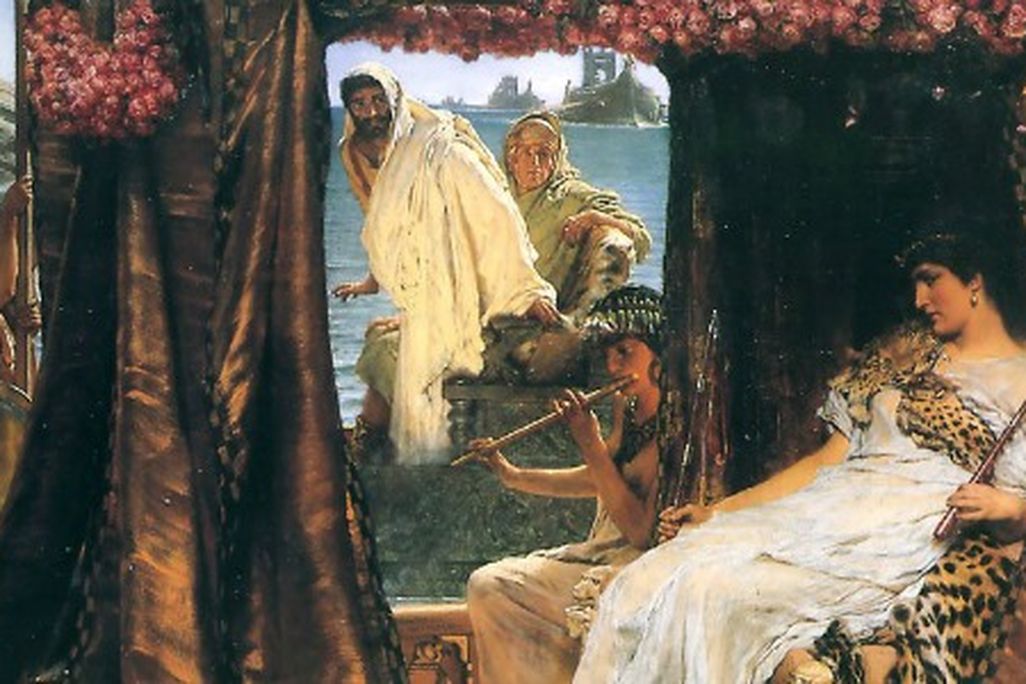
The struggle with her teenage brother over the throne of Egypt was not going as well as Cleopatra VII had hoped. In 49 B.C., Pharaoh Ptolemy XIII—also her husband and, by the terms of their father's will, her co-ruler—had driven his sister from the palace at Alexandria after Cleopatra attempted to make herself the sole sovereign. The queen, then in her early twenties, fled to Syria and returned with a mercenary army, setting up camp just outside the capital.
Meanwhile, pursuing a military rival who had fled to Egypt, the Roman general Julius Caesar arrived at Alexandria in the summer of 48 B.C., and found himself drawn into the Egyptian family feud. For decades Egypt had been a subservient ally to Rome, and preserving the stability of the Nile Valley, with its great agricultural wealth, was in Rome's economic interest. Caesar took up residence at Alexandria's royal palace and summoned the warring siblings for a peace conference, which he planned to arbitrate. But Ptolemy XIII's forces barred the return of the king's sister to Alexandria. Aware that Caesar's diplomatic intervention could help her regain the throne, Cleopatra hatched a scheme to sneak herself into the palace for an audience with Caesar. She persuaded her servant Apollodoros to wrap her in a carpet (or, according to some sources, a sack used for storing bedclothes), which he then presented to the 52-year old Roman.
The image of young Cleopatra tumbling out of an unfurled carpet has been dramatized in nearly every film about her, from the silent era to a 1999 TV miniseries, but it was also a key scene in the real Cleopatra's staging of her own life. "She was clearly using all her talents from the moment she arrived on the world stage before Caesar," says Egyptologist Joann Fletcher, author of a forthcoming biography, Cleopatra the Great.
/https://tf-cmsv2-smithsonianmag-media.s3.amazonaws.com/filer/Cleopatra-and-Caesar-Jean-Leon-Gerome715.jpg)
/https://tf-cmsv2-smithsonianmag-media.s3.amazonaws.com/filer/cleopatra_death.jpg)
/https://tf-cmsv2-smithsonianmag-media.s3.amazonaws.com/filer/Cleopatra-movie-Elizabeth-Taylor715.jpg)
/https://tf-cmsv2-smithsonianmag-media.s3.amazonaws.com/filer/cleopatra_coin.jpg)
/https://tf-cmsv2-smithsonianmag-media.s3.amazonaws.com/filer/Cleopatra-631.jpg)
/https://tf-cmsv2-smithsonianmag-media.s3.amazonaws.com/filer/cleopatra-painting-before-suicide715.jpg)
/https://tf-cmsv2-smithsonianmag-media.s3.amazonaws.com/filer/statue-of-cleopatra-dead715.jpg)
/https://tf-cmsv2-smithsonianmag-media.s3.amazonaws.com/filer/Cleopatras-death-by-asp-Guido-Cagnacci715.jpg)
Like most monarchs of her time, Cleopatra saw herself as divine; from birth she and other members of her family were declared to be gods and goddesses. Highly image-conscious, Cleopatra maintained her mystique through shows of splendor, identifying herself with the deities Isis and Aphrodite, and in effect creating much of the mythology that surrounds her to this day. Though Hollywood versions of her story are jam-packed with anachronisms, embellishments, exaggerations and inaccuracies, the Cleopatras of Elizabeth Taylor, Vivien Leigh and Claudette Colbert do share with the real queen a love of pageantry. "Cleopatra was a mistress of disguise and costume," says Fletcher. "She could reinvent herself to suit the occasion, and I think that's a mark of the consummate politician."
When Cleopatra emerged from the carpet—probably somewhat disheveled, but dressed in her best finery—and begged Caesar for aid, the gesture won over Rome's future dictator-for-life. With his help Cleopatra regained Egypt's throne. Ptolemy XIII rebelled against the armistice that Caesar had imposed, but in the ensuing civil war he drowned in the Nile, leaving Cleopatra safely in power.
Though Cleopatra bore him a son, Caesar was already married, and Egyptian custom decreed that Cleopatra marry her remaining brother, Ptolemy XIV. Caesar was assassinated in 44 B.C., and with her ally gone Cleopatra had Ptolemy XIV killed to prevent any challenges to her son's succession. To solidify her grip on the throne, she dispatched her rebellious sister Arsinoe as well. Such ruthlessness was not only a common feature of Egyptian dynastic politics in Cleopatra's day, it was necessary to ensure her own survival and that of her son. With all domestic threats removed, Cleopatra set about the business of ruling Egypt, the richest nation in the Mediterranean world, and the last to remain independent of Rome.
What kind of pharaoh was Cleopatra? The few remaining contemporary Egyptian sources suggest that she was very popular among her own people. Egypt's Alexandria-based rulers, including Cleopatra, were ethnically Greek, descended from Alexander the Great's general Ptolemy I Soter. They would have spoken Greek and observed Greek customs, separating themselves from the ethnically Egyptian majority. But unlike her forebears, Cleopatra actually bothered to learn the Egyptian language. For Egyptian audiences, she commissioned portraits of herself in the traditional Egyptian style. In one papyrus dated to 35 B.C. Cleopatra is called Philopatris, "she who loves her country." By identifying herself as a truly Egyptian pharaoh, Cleopatra used patriotism to cement her position.
Cleopatra's foreign policy goal, in addition to preserving her personal power, was to maintain Egypt's independence from the rapidly expanding Roman Empire. By trading with Eastern nations—Arabia and possibly as far away as India—she built up Egypt's economy, bolstering her country's status as a world power. By allying herself with Roman general Mark Antony, Cleopatra hoped to keep Octavian, Julius Caesar's heir and Antony's rival, from making Egypt a vassal to Rome. Ancient sources make it clear that Cleopatra and Antony did love each other and that Cleopatra bore Antony three children; still, the relationship was also very useful to an Egyptian queen who wished to expand and protect her empire.
Though some modern historians have portrayed Cleopatra as a capable, popular Egyptian leader, we tend to imagine her through Roman eyes. During her lifetime and in the century after her death, Roman propaganda, most of it originating with her enemy Octavian, painted Cleopatra as a dangerous harlot who employed sex, witchcraft and cunning as she grasped for power beyond what was proper for a woman. The poet Horace, writing in the late first century B.C., called her "A crazy queen...plotting...to demolish the Capitol and topple the [Roman] Empire." Nearly a century later, the Roman poet Lucan labeled her "the shame of Egypt, the lascivious fury who was to become the bane of Rome."
After Roman tempers cooled, the Greek historian Plutarch published a more sympathetic biography. Cleopatra became a tragic heroine, with love of Antony her sole motivation. Over the next two millennia, countless paintings and dramatizations—including Shakespeare's Antony and Cleopatra and John Dryden's All for Love—focused on the fantastic details of her suicide after Octavian defeated Antony. We know almost certainly that Cleopatra, along with her two most trusted servants, killed herself on August 12, 30 B.C., to escape capture by Octavian. However, since the facts of her death were unclear even to the men who found the bodies, we will never know if it was the famous asp that killed the queen, or a smuggled vial of poison. The asp legend has prevailed, however, and the image of her death, more than anything else, gave Cleopatra immortality.
In February 2007, a recently discovered coin bearing a portrait of Cleopatra went on display at Newcastle University in England, sparking renewed interest in the queen and a debate about whether she was really as beautiful as we imagine. The coin, dated to 32 B.C., shows a rather homely Cleopatra with a large nose, narrow lips and a sharp chin. She looks nothing like Elizabeth Taylor. But ancient historians never characterized Cleopatra as a great beauty, and in her time she was not considered a romantic heroine. In his A.D. 75 Life of Antony, Plutarch tells us, "Her actual beauty...was not so remarkable that none could be compared with her, or that no one could see her without being struck by it, but the contact of her presence...was irresistible.... The character that attended all she said or did was something bewitching."
Cleopatra's beauty (or lack thereof) was irrelevant to the Romans who knew her and the Egyptian people she ruled. The real Cleopatra had charisma, and her sexiness stemmed from her intelligence—what Plutarch described as "the charm of her conversation"—rather than her kohl-rimmed eyes. Pharaoh Cleopatra VII was a brilliant leader, says Joann Fletcher. "She was one of the most dynamic figures the world has ever seen. And I don't think that's an exaggeration."
/https://tf-cmsv2-smithsonianmag-media.s3.amazonaws.com/accounts/headshot/amy.png)