
Marie Antoinette
The teenage queen was embraced by France in 1770. Twenty-three years later, she lost her head to the guillotine. (But she never said, “Let them eat cake”)
Late September sunlight filters onto the blue velvet furnishings of the jewel-box theater built for Marie Antoinette at Versailles. The painted, original backdrop depicts a rustic farmhouse hearth, and I can just imagine the young queen reveling in her role as a shepherdess while her witty friends and dull husband, French king Louis XVI, applaud politely.
At the time I was there, the theater was closed to most visitors (it is now open to the public from April 1 through October 31), and I wanted to take full advantage of my access. "Go ahead. Have a good, long look," said Christian Baulez, Versailles' chief conservator.
On the way out, Baulez, who has worked at the former royal palace for four decades, locked the gate with a heavy iron key. "From time to time, you have to visit a spot like the theater when there's no one else around to give the place a chance to trigger an emotional reaction," he said. "You're thinking about other things, then all of a sudden, you're totally surprised. It's a state of grace, an aura you sense—even after 40 years here."
/https://tf-cmsv2-smithsonianmag-media.s3.amazonaws.com/filer/2e/3d/2e3d4bac-f1e1-4527-b2fc-1b8e40d491ca/800px-marie_antoinette_young2.jpg)
/https://tf-cmsv2-smithsonianmag-media.s3.amazonaws.com/filer/bb/f3/bbf3026e-5c78-40f1-a03b-5dd5e3e5a06f/marie_antoinette_amusement_at_versailles.jpg)
/https://tf-cmsv2-smithsonianmag-media.s3.amazonaws.com/filer/a1/fe/a1fe4d3f-3489-469a-ad3e-7bf799b8cba4/800px-gautier-dagoty_-_marie-antoinette_1775.jpg)
/https://tf-cmsv2-smithsonianmag-media.s3.amazonaws.com/filer/marieantoinette_mother.jpg)
/https://tf-cmsv2-smithsonianmag-media.s3.amazonaws.com/filer/50/b3/50b3cf15-aa10-488b-855e-64391a9eb1f5/palais_de_justice_1858.jpg)
/https://tf-cmsv2-smithsonianmag-media.s3.amazonaws.com/filer/3b/f4/3bf4aa85-dd46-4661-ad32-00c9159b3041/jacques-louis_david_-_marie_antoinette_on_the_way_to_the_guillotine.jpg)
/https://tf-cmsv2-smithsonianmag-media.s3.amazonaws.com/filer/8d/54/8d542345-05d4-430c-b24f-0f8495659071/sf730.jpg)
/https://tf-cmsv2-smithsonianmag-media.s3.amazonaws.com/filer/95/1f/951ffcf9-724e-485e-981d-79b8093c72dd/e9202.jpg)
/https://tf-cmsv2-smithsonianmag-media.s3.amazonaws.com/filer/87/be/87be6a17-9a33-4c13-911e-705ebf51b0f2/e3239.jpg)
/https://tf-cmsv2-smithsonianmag-media.s3.amazonaws.com/filer/a6/99/a699c0a9-bd51-4151-8339-270afcb7651f/sf39040.jpg)
/https://tf-cmsv2-smithsonianmag-media.s3.amazonaws.com/filer/bc/8a/bc8a6a46-e93c-4682-b537-f077309de94f/sf39059.jpg)
I did not commune with Marie Antoinette's ghost, as some claim to have done. But I had to admit that there is a poignancy about the playhouse and its fantasy world. Less than a decade after the theater's inauguration in 1780, the curtain would come crashing down on the French monarchy and its Austrian-born queen, who seemed to grow in moral stature as she approached the guillotine.
With the possible exception of the Corsican-born Napoleon, another outsider who overstayed his welcome, no one haunts French history like the Hapsburg princess. The frivolous, high-spirited tomboy who arrived at Versailles at age 14 was quickly embraced by her subjects. Yet by the time of her execution 23 years later, she was reviled.
Thrust into a social and political hurricane, Marie Antoinette, biographer Stefan Zweig wrote in the 1930s, was "perhaps the most signal example in history of the way in which destiny will at times pluck a mediocre human being from obscurity and, with commanding hand, force the man or woman in question to overstep the bounds of mediocrity." Ultimately, even Marie Antoinette herself grasped how suffering gave her fortitude. "Tribulation first makes one realize what one is," the queen wrote in August 1791, soon after the royal family's failed escape attempt from their detention in Paris.
Marie Antoinette's fairy tale turned tragedy has spawned biographies, fictionalizations, operas, plays, ballets and memoirs. Even her hairdresser and her executioner published ghostwritten recollections. And, like the 300 gowns the queen ordered each year, the story is a perfect fit for Hollywood. The 1938 film Marie Antoinette, starring Norma Shearer and Robert Morley, is considered a classic of historical melodrama. Now, Sofia Coppola has directed a new interpretation, with Kirsten Dunst and Jason Schwartzman in the lead roles. Based largely on British biographer Antonia Fraser's 2001 biography, Marie Antoinette: The Journey, the new film, also called Marie Antoinette, was released in the United States last month. "I was struck by the fact that Louis and Marie were teenagers—he was 19 when he was crowned, she was 18—in charge of France at the most vulnerable time in its history," says Coppola. "I didn't set out on a campaign to correct the misperceptions about her; I just wanted to tell the story from her point of view."
Each year millions of visitors flock to Versailles and Fontainebleau, where the queen maintained a second palace, to admire her exuberant tastes in furniture and décor. But it is her furtive love life that arouses the deepest interest—and sympathy. Tarred by pamphleteers for sexual wantonness, she was actually rather prudish, at least according to her brother, Austrian emperor Joseph II. Despite a number of innocent flirtations, she deeply loved—probably with Louis' tacit approval, according to a confidante—only one man: Swedish military attaché Count Axel Fersen.
Although Marie Antoinette initially condescended to her husband, she eventually developed a genuine fondness for him. For his part, Louis was completely devoted to her and never took a mistress, exhibiting a restraint virtually unheard of in an 18th-century French king.
Whatever Marie Antoinette's faults—in addition to her renowned extravagance, she was unable to comprehend the French people's thirst for democracy—she did not respond to news that starving Parisians had no bread by saying: "Let them eat cake." According to Fraser, this monumental indifference was first ascribed, probably also apocryphally, to Maria Theresa, the Spanish princess who married Louis XIV more than a century before Marie Antoinette set foot in France. Still, for more than two centuries, historians have debated whether Marie Antoinette bore the blame for her fate or was a victim of circumstance. Although she remained a fervent supporter of absolute royal power and an unrepentant enemy of democratic ideals, her many acts of compassion included tending to a peasant gored by a stag and taking in a poor orphan boy and overseeing his education. "She was so happy at doing good and hated to miss any opportunity of doing so," wrote Madame Campan, the First Lady of the Bedchamber. The softhearted queen, it seems, hungered more for tenderness than power.
The opposite might be said of her mother, Austrian empress Maria Theresa, who regarded her eight daughters as pawns on the European chessboard, to be married off to seal alliances. She barely paused in her paperwork to give birth on November 2, 1755, to her 15th child, In France, Louis Auguste, the 11-year-old grandson of French monarch Louis XV, became a prime matrimonial candidate when, in 1765, his father, Louis Ferdinand, died, making the grandson heir to the throne. Within months, 10-year-old Antoine was unofficially pledged to Louis to cement the union of the Hapsburgs and Bourbons—bitter rivals since the 16th century.
Dispatched to Vienna in 1768 by Louis XV to tutor his grandson's future wife, the Abbé de Vermond encountered an easily distracted 13-year-old who could barely read or write her native German, much less French. But "her character, her heart, are excellent," he reported. He found her "more intelligent than has been generally supposed," but since "she is rather lazy and extremely frivolous, she is hard to teach." Blessed with thick, ash-blond hair, large, grayish blue eyes and a radiant complexion, Marie Antoinette possessed a delicate beauty, marred only slightly by a pouty Hapsburg lower lip.
For her May 1770 wedding, she was escorted to France amid an entourage that included 57 carriages, 117 footmen and 376 horses. Arriving in the forest of the royal château of Compiègne, some 50 miles northeast of Paris, the 14-year-old Antoine, now called by the more formal Marie Antoinette, impulsively dashed up to Louis XV ("Après moi, le déluge"), waiting with his grandson outside their carriage, and curtsied, instantly winning over the king, who kissed her. Perhaps intimidated by her forwardness, the 15-year-old bridegroom gave her a perfunctory kiss, then hardly glanced at her as she chatted away with the king on the ride to the château. The awkward, myopic heir apparent suffered from feelings of unworthiness, despite a facility for languages and a passion for history, geography and science.
Louis Auguste de Bourbon and Marie Antoinette were married on May 16, 1770, in the royal chapel at the palace of Versailles. The next day, news that the union had not been consummated spread through the court. It was only the beginning; by all accounts, the marriage went unconsummated for seven years. By this time, Louis XV had died (of smallpox, in 1774) and his teenage grandson had acceded to the most powerful throne in Europe.
After encouraging her daughter to "lavish more caresses" on her husband, Maria Theresa dispatched her son, Joseph II, as she put it, to "stir up this indolent spouse." Whatever he said apparently did the trick; in any case, the couple wrote to thank him. Many historians conclude that Louis suffered from phimosis, a physiological handicap that makes sex painful, and that he eventually had surgery to correct the problem. Biographer Fraser, however, contends that the pair were simply, as Joseph reported to his brother Leopold, "two complete blunderers."
Added to any sexual frustration Marie Antoinette may have felt was her homesickness ("Madame, My very dear mother," she wrote, "I have not received one of your dear letters without having the tears come to my eyes.") and her rebellion against court etiquette ("I put on my rouge and wash my hands in front of the whole world," she complained in 1770 of a daily ritual at which dozens of courtiers hovered). She sought escape in masked balls, opera, theater and gambling. "I am terrified of being bored," the 21-year-old queen confessed in October 1777 to her trusted adviser, Austrian ambassador Comte Florimond Mercy d'Argenteau.
Where Louis was indecisive, thrifty and over-serious, Marie Antoinette was quick to make up her mind, extravagant and lighthearted. He loved being alone, tinkering with locks; she craved the social whirl. When Louis went to bed, around 11 p.m., Marie Antoinette was just revving up for a night of festivities. By the time she awoke, around 11 a.m., Louis had been up for hours. "My tastes are not the same as the King's, who is only interested in hunting and his metal-working," the queen wrote to a friend in April 1775. And what exorbitant tastes she had! She bought a pair of diamond bracelets that cost as much as a Paris mansion. She sported towering bouffant hairdos, including the "inoculation pouf," a forbidding confection that featured a club striking a snake in an olive tree (representing the triumph of science over evil) to celebrate her success in persuading the king to be vaccinated against smallpox.
Informed of her daughter's behavior by Mercy, Maria Theresa fired off letter after letter warning Marie Antoinette to mend her ways. "You lead a dissipated life," the mother railed in 1775. "I hope I shall not live to see the disaster that is likely to ensue."
Cloistered in the luxury of Versailles, the royal couple was oblivious to their subjects' plight. A failed harvest had made the price of grain skyrocket, and mobs were rioting in the streets of Paris, demanding cheap bread. Crushing taxes were also taking their toll on the populace. Meanwhile, the queen gambled recklessly, ordered expensive jewelry and clothes and spent a fortune on creating her own private domain at Versailles—the Petit Trianon. The three-story neo-Classical château was originally built on the grounds of Versailles in 1762-68 by Louis XV for his mistress Madame de Pompadour. Louis XVI had given it to Marie Antoinette in June 1774, a few days after he became king, when she asked for a hideaway. ("This pleasure house is yours," he told her.) "She wanted a domain reserved for her intimate circle of friends," says Baulez, as we tour the Trianon. "But unfortunately, this exclusion made everyone else at court jealous." Palace gossip spun outrageous tales about "scandalous" and "perverse" goings-on at the Trianon, giving anti-monarchist pamphleteers material for salacious underground cartoons. How could the queen spend the nation's money, at a time of financial crisis, on her private hideaway, critics asked.
But Marie Antoinette seemed blind to the criticism. She directed architect Richard Mique and artist Hubert Robert to conjure up a sylvan fantasy of artificial streams, grottoes and winding paths. (During nighttime galas, a Temple of Love rotunda and a glass music salon were illuminated by wood fires hidden in trenches in the ground.) In 1784, the two designers created what, from the outside, appeared to be a hamlet (the Hameau) of cracked and tumbledown cottages, which, in fact, were appointed with comfortable couches, stoves and billiard tables. A working farm completed what Zweig satirized as "this expensive pastoral comedy," though tales of the queen herself herding sheep are false, Baulez insists. The overall effect of the Petit Trianon was—and remains—quaintly charming, but the total bill, including the Hameau, came to more than two million francs (the equivalent of more than $6 million today). To this day, the Petit Trianon—silk hangings, wall coverings, porcelain dinner services, furniture—bears Marie Antoinette's stamp, with flower-mad motifs in cornflower blue, lilac and green. "She loved ornamentation," says Baulez. "She wasn't interested in dignity, but the picturesque. She had the tastes of an actress, not an austerely regal queen."
In one salon is the exquisite harp Marie Antoinette played well enough to accompany Antonio Salieri, the Hapsburg court composer and Mozart rival she invited to visit. In an adjoining room, Baulez shows me the infamous pale blue boudoir with mirrored interior shutters that the queen could raise and lower at will. "People imagined mirrors surrounding a bed for secret trysts," he says, "but she was just trying to keep curious passersby from peering inside." Whatever trysts there were did not include Louis, who spent not a single night at the Petit Trianon, although he did occasionally pop by to read to himself in a little rowboat.
Fersen was the more frequent guest. The queen went so far as to furnish an apartment above hers for him. By October 1787, they were exchanging clandestine letters about such prosaic domestic details as where to put a stove. Unraveling the details of their relationship has kept biographers guessing for more than 200 years, largely because Fersen destroyed substantial portions of his journal and a great-nephew to whom his letters were entrusted censored some and suppressed others. "I can tell you that I love you," Marie Antoinette declared in one letter back to him.
They had met at a Paris opera ball in January 1774, when Fersen, the 18-year-old son of a wealthy Swedish nobleman, was making the grand tour. The young queen invited him to several balls at Versailles, but not long after, he left for England. Four years later he returned to the French court as a young military officer and, according to Comte Francois Emmanuel de Saint-Priest—Louis' future minister of the interior—"captured the queen's heart." In early 1779, Fersen signed on to fight on behalf of France in the American Revolution, in part perhaps to escape the queen's growing infatuation. When he returned to Versailles four years later, in June 1783, he wrote to his sister, swearing off marriage because: "I cannot belong to the only person to whom I want to belong, the one who really loves me, and so I do not want to belong to anyone." That summer, he visited Marie Antoinette nearly every day.
By now the 27-year-old queen—mother of a 4 1/2-year-old daughter, Marie Thérèse Charlotte,and a son, the Dauphin Louis Joseph Xavier, nearly 2—had blossomed into a full-figured beauty, with luminous eyes and a demeanor some saw as dignified, others as haughty. As a young princess, she had burst into tears when Mercy had pressured her to get involved in politics; now she scolded the French foreign minister for excluding Joseph II from the peace process with England, though to little effect.
Some two years later, around the time her second son, Louis Charles, was born, Marie Antoinette became the victim of one of the most byzantine swindles in history. A fortune hunter named Jeanne de Lamotte Valois persuaded the gullible Cardinal de Rohan that she was a close friend of the queen's—though Marie Antoinette had never heard of her. Lamotte's lover, Rétaux de Villette, forged letters purportedly from the queen imploring the cardinal to buy a necklace of 647 diamonds costing 1.5 million francs ($4.7 million today). Writing as the queen, de Villette said "she" was too embarrassed to ask Louis for so expensive a present and was relying on the gallant cardinal to obtain it for her. The queen would, of course, repay him.
After a clandestine meeting in the palace gardens with a woman hired by Lamotte to impersonate the queen, Rohan was hooked. When jewelers delivered the necklace to the cardinal, he gave it to Rétaux, disguised as the queen's footman. Lamotte's husband then smuggled it to London to be sold off in pieces. When the jewelers demanded payment in August 1785, Marie Antoinette was livid with rage and Louis ordered Rohan arrested.
The subsequent trial caused a sensation. The Paris Parliament defied the king's command to convict the duped cardinal and acquitted him. Lamotte was flogged, branded on her breast with a V for voleuse (thief) and tossed into prison. And though Marie Antoinette was not on trial, she might as well have been. "The queen was innocent," Napoleon observed years later, "and, to make sure that her innocence should be publicly recognized, she chose the Parliament of Paris for her judge. The upshot was that she was universally regarded as guilty."
The affair of the necklace provided further fodder for scandal-mongering pamphleteers and journalists already intent on portraying the queen as greedy and corrupt. From then on, she could do no right. Her embarrassment made Louis more vulnerable than ever. Beset by severe food shortages, weighed down by taxes, resentful of royal absolutism and inspired by the egalitarian example of an independent United States, French citizens were growing increasingly vocal in their demands for self-government. In May 1789, to avert the nation's impending bankruptcy (a series of wars, years of corruption and Louis' support of the American Revolution as a means of weakening England had depleted the French treasury), the king convened the Estates-General, an assembly of representatives of the clergy, nobility and commoners that had not met since 1614. As Marie Antoinette's carriage wound from the palace through the streets of Versailles to welcome the gathering, crowds along the way stood in sullen silence. In a sermon at the town's Church of Saint Louis, the Bishop of Nancy railed against the queen's profligate spending. (Dubbed Madame Deficit, the queen was increasingly blamed for the country's desperate financial situation, although she had in fact already cut back on personal expenses.) At the time of the Bishop's sermon, however, the 33-year-old mother was consumed with anxiety over her older son, the gravely ill Dauphin. Within a month, the 7-year-old prince would be dead of tuberculosis of the spine.
Historians trace the French Revolution to that summer of 1789. On July 14, some 900 Parisian workers, shopkeepers and peasants—fearing that the king, who at the queen's urging had moved a large number of troops to Versailles and Paris, would dissolve the representative National Assembly—stormed the Bastille prison to seize arms and ammunition. Marie Antoinette tried to convince her husband to put down the insurrection, but not wanting to provoke an all-out conflict, he refused, effectively ceding Paris to the revolutionaries. Comte Honoré de Mirabeau, leader of the increasingly anti-monarchist National Assembly, observed that the queen had become "the only man at court." In the weeks that followed, the Assembly did away with age-old privileges for the aristocracy and clergy, declared a free press, got rid of serfdom and proclaimed the Rights of Man.
A little before noon on October 5, a mob of several thousand market women, armed with pikes and sickles, set out from Paris' Hôtel de Ville (City Hall) on a 12-mile trek to Versailles to protest a lack of jobs and the high cost of bread. By evening, thousands more, some carrying guns, had joined them in front of the palace. After dithering over what to do, Louis finally decided to seek refuge in the distant Rambouillet château. But when his coachmen rolled out the royal carriages, the crowd cut the horses' harnesses, stranding him and his family.
Around five o'clock on the morning of the sixth, rebels surged toward the queen's bedroom, killing two guards. A terrified Marie Antoinette leapt out of bed and raced to the king's apartments. Louis, meanwhile, had dashed to her bedroom to rescue her, but finding her gone, doubled back with their son to join her and their daughter in the dining hall of his quarters. By this time, the Marquis de Lafayette, commander of the National Guard, had arrived with Guard troops and temporarily restored order.
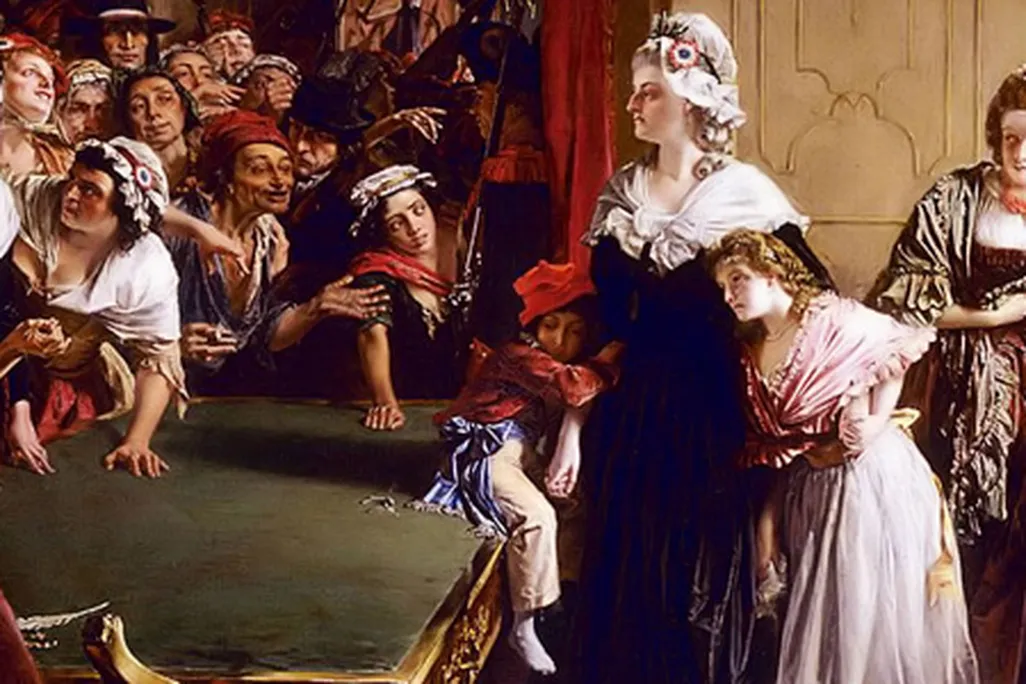
But the throng, swollen to some 10,000 people, began clamoring to take Louis to Paris. When someone cried out for the queen to show herself on the balcony, she stepped forward, curtsying with such aplomb that the mob grew silent, then burst into cries of "Long live the queen!" But Marie Antoinette sensed that the reprieve would be short-lived. Retreating inside, she broke down. "They are going to force us to go to Paris, the King and me, preceded by the heads of our bodyguards on pikes," she said. Her words proved prophetic. Within hours, the triumphant procession—indeed with the guards' heads on pikes—was escorting the captive royal family to the old Tuileries palace in the capital.
Although the king and queen were not locked in, and in theory could have left the palace had they chosen to do so, they withdrew into self-imposed seclusion. The king seemed unable to act. "Taking the place of her husband (whom everyone thrust contemptuously aside as an incurable weakling)," writes Zweig, Marie Antoinette "held council with the ministers and ambassadors, watching over their undertakings and revising their dispatches."
"She was decisive where he was indecisive," biographer Antonia Fraser says in a new PBS documentary Marie Antoinette. "She was courageous when he was vacillating." She dashed off letters in cipher and invisible ink to other European sovereigns, pleading with them to invade France and shore up the king's crumbling authority, but to no avail. Meeting secretly with Mirabeau in July 1790, she won the influential legislator over to the cause of preserving the monarchy. By December, however, she was devising a contingency plan to flee Paris for Montmédy, near the Austrian-controlled Netherlands. There the royal couple planned to mount a counterrevolution with troops under the command of Royalist general Francois-Claude Bouillé. When Mirabeau died in April 1791 without securing the Assembly's promise to retain Louis as king in a constitutional monarchy, Louis and Marie Antoinette put their plan into action. But instead of following Bouillé's advice to make the trip in two light carriages, the queen insisted on keeping the family together in a lumbering coach called a berlin, encumbered with a silver dinner service, a clothes-press, and a small wine chest. (Fersen had made the arrangements, even mortgaging his estate to pay for the carriage.) Late in the evening of June 20, 1791, the royal family, disguised as servants, slipped out of the capital. Fersen accompanied them as far as Bondy, 16 miles east of the Tuileries. While the horses were being changed, he pleaded with Louis to let him continue with the family rather than reuniting at Montmédy two days later as planned. Louis refused, perhaps, suggests biographer Evelyne Lever, because he thought it humiliating to be under the protection of his wife's lover. Also, Fraser says in the PBS film, Louis didn't want people to think a foreigner had helped them get away.
In Varennes, 130 miles east of Paris, a band of armed villagers accosted the king, who had been recognized inside the conspicuous berlin, and forced the royal entourage into a municipal official's house. When a small contingent of Royalist troops arrived to free them, Louis vacillated, then, fearing a confrontation with the steadily growing mob brandishing arms outside the house, declined the troops' help, choosing instead to wait for Bouillé. Had Fersen, a trained officer, been allowed to stay with the group, he might well have taken more decisive action and helped lead the family to safety. Instead, emissaries dispatched by the Assembly arrived with orders to return the family to Paris. Crowds of angry Parisians lined the streets as the king and queen were taken back to the Tuileries palace, where they were held captive by National Guardsmen. Louis was caricatured as a castrated pig, while the queen was portrayed as a wanton traitor.
The Assembly allowed Louis to remain as a figurehead on the throne to legitimize a proposed new constitution, but he had little actual political power. Meanwhile, at the same time Marie Antoinette was secretly lobbying moderate republicans in the Assembly for a constitutional monarchy, she was also writing to European rulers that the "monstreuse" constitution was "a tissue of unworkable absurdities" and the Assembly "a heap of blackguards, madmen and beasts." Although Louis privately detested the constitution, on September 14, 1791, he took an oath to uphold it, agreeing to share power with the elected Legislative Assembly.
In Stockholm, Fersen had persuaded the Swedish king to back a new escape attempt. In February 1792, the daring count—by now branded an outlaw for his role in the flight to Varennes—snuck into the heavily guarded palace and spent some 30 hours with the queen. Toward the end of his visit, Louis showed up and rejected Fersen's scheme for escape through Normandy. Around midnight of Fersen's second day, Marie Antoinette bade him farewell—for the last time.
In April, under pressure from the Assembly, Louis declared war on Austria, which was preparing to invade France to restore Alsace (occupied by the French) and obtain full liberty for the royal family. Rightly suspecting that the king and queen were plotting with the enemy, an armed mob stormed the Tuileries on August 10, killing more than a thousand guards and noblemen. Louis and his family fled on foot through a courtyard to the nearby Assembly building, where they begged the representatives for protection.
The Assembly, however, voted to have the king, queen, their son and daughter, and the king's sister Elisabeth locked up in the Temple tower, a forbidding medieval fortress in the center of Paris. On September 20, the new revolutionary National Convention, the successor to the Assembly, met for the first time. The following day they abolished the 1,000-year-old monarchy and established the Republic.
For the former royal family, now prisoners in the Temple tower, the next two months passed improbably in something like domestic tranquility. While the king schooled his 7-year-old son, Louis Charles, in the dramas of Corneille and Racine, the queen gave Marie Thérèse, 13, history lessons, played chess with her husband, did needlework and even sang at the harpsichord. Then, on November 20, Louis' letters to foreign powers plotting counterrevolution were discovered in a strongbox hidden in the Tuileries. Louis was taken from his family, locked up on the floor below them and, on December 26, put on trial. Maximilien Robespierre, a chief architect of the Revolution, and the fiery journalist Jean-Paul Marat were among the many radical leaders who testified against him during a three-week trial. "It is with regret that I pronounce the fatal truth," proclaimed Robespierre, "Louis must die, so that the country may live." After a unanimous vote by members of the Convention (with a few abstentions) that Louis had conspired against the state, members of the more moderate revolutionary faction argued that the former king should be confined until the end of the war with Austria, then sent into exile. Even English philosopher Thomas Paine, elected to the Convention as a hero of the American Revolution, pleaded for the royal family to be banished to America. But it was not to be. Louis, 38, was condemned to death on January 16, 1793. He was allowed to spend a few hours with his wife, son, daughter and sister before being led to the guillotine on January 21 and executed before a crowd estimated at 20,000.
Six months later, on August 2, the Widow Capet, as Marie Antoinette was now known, was transferred to the Conciergerie, a dank prison dubbed "death's antechamber." Louis' sister, Elisabeth, Marie Thérèse and Louis Charles remained in the Temple tower. Later that month, the queen recognized among her visitors a former officer, the Chevalier Alexandre de Rougeville, who dropped at her feet one or two carnations (accounts differ) containing a note that said he would try to rescue her. A guard spotted the note, and when public prosecutor Antoine Fouquier-Tinville learned that Royalists were scheming to free the former queen (the plan became known as the Carnation Plot), he moved to put her immediately on trial.
Emaciated and pale, Marie Antoinette maintained her composure at the trial, a grueling 32-hour ordeal carried out over two days. She responded with eloquence to the prosecutor's litany of accusations—she was guilty, he said, of making secret agreements with Austria and Prussia (which had joined with Austria in the war against France), of shipping money abroad to Louis' two younger brothers in exile and of conspiring with these enemies against France. Accused of manipulating the king's foreign policy, she coolly replied: "To advise a course of action and to have it carried out are very different things."
On the first day of the trial, the prosecution delivered a bombshell, presenting testimony by young Louis that he had sex with his mother and his aunt. (Caught masturbating by his jailer, the boy had invented the story to shift blame onto the two women.) The former queen summoned up a stirring denunciation. "Nature refuses to answer such a charge brought against a mother," she replied. "I appeal in this matter to all the mothers present in court." The prosecutor's ploy backfired as the audience reacted with abashed silence. But the trial's conclusion was foregone. With civil war threatening to destroy the new Republic, "Marie Antoinette was deliberately targeted," says Fraser in the PBS production, "in order to bind the French together in a kind of blood bond." Found guilty of treason, the former queen was sentenced to die.
On the eve of her execution, Marie Antoinette wrote a last letter, to her sister-in-law, entreating Elisabeth to forgive young Louis for his accusations and to persuade him not to try to avenge his parents' deaths. "I am calm," she reflected, "as people are whose conscience is clear." Before the former queen left prison the next morning, October 16, 1793, the executioner cut off her hair and bound her hands behind her. A priest counseled courage. "Courage?" Marie Antoinette shot back. "The moment when my ills are going to end is not the moment when courage is going to fail me."
As an open tumbrel cart carrying the condemned woman rolled through the streets to what is now the Place de la Concorde, Marie Antoinette, two weeks shy of her 38th birthday, but appearing far older, maintained a stoic pose, captured in Jacques-Louis David's harsh sketch (below) from the rue Sainte-Honoré. When the guillotine sliced off her head at 12:15 p.m., thousands of spectators erupted in cheers. Her body was placed in a coffin and tossed into a common grave in a cemetery behind the Church of the Madeleine.
Still imprisoned in the Temple tower, Louis Charles remained isolated from his sister and his aunt, who was also executed, in May 1794, as an enemy of the people. In June 1795, the 10-year-old boy, a king—Louis XVII to Royalists—without a country, died in the Temple tower, most likely of the same tuberculosis that had felled his elder brother. Six months later, his 17-year-old sister was returned to Austria in a prisoner exchange. She ultimately married her first cousin, the Duke d'Angoulême, and died childless at age 72 in 1851 outside Vienna.
Fersen became a trusted adviser to the Swedish king. But he never forgave himself for not saving the woman he loved on the flight to Varennes. "Why, ah why did I not die for her on the 20th of June?" he wrote in his journal. Nineteen years later, on June 20, 1810, a Stockholm mob, wrongly believing that he had poisoned the heir to the Swedish throne, beat him to death with sticks and stones. He was 54.
In April 1814, following Napoleon's exile to Elba, Louis' brother the Comte de Provence, then 58, returned from his own exile in England to assume the French throne as Louis XVIII. The following January, he had the bodies of his older brother and the queen disinterred and reburied in the Saint-Denis Cathedral near Paris, where idealized stone statues of the royal couple now kneel in prayer above the underground vault.
Marie Antoinette would likely have been perfectly happy to have played only a ceremonial part as queen. But Louis' weakness forced her to take a more dominant role—for which the French people could not forgive her. Cartoons depicted her as a harpy trampling the constitution. She was blamed for bankrupting the country, when others in the high-spending, lavish court bore equal responsibility. Ultimately, she was condemned simply for being Louis' wife and a symbol of tyranny. Thomas Jefferson, minister to France under Louis XVI, famously asserted that if Marie Antoinette had been cloistered in a convent, the French Revolution would never have taken place. Perhaps Jefferson goes too far. Certainly she became a scapegoat for nearly everything that was wrong with France's absolutist, dynastic system. But it's also clear that in their refusal to compromise, Louis and Marie Antoinette lost everything.
Based in France, Richard Covington writes on culture, history, science and the arts from his home near Versailles.