• Smithsonian
    Institution
  • Travel
    With Us
  • Smithsonian
    Store
  • Smithsonian
    Channel
  • goSmithsonian
    Visitors Guide
  • Air & Space
    magazine

Smithsonian.com

  • Subscribe
  • History & Archaeology
  • Science
  • Ideas & Innovations
  • Arts & Culture
  • Travel & Food
  • At the Smithsonian
  • Photos
  • Videos
  • Games
  • Shop
  • Archaeology
  • U.S. History
  • World History
  • Today in History
  • Document Deep Dives
  • The Jetsons
  • National Treasures
  • Paleofuture
  • Biography

The Swamp Fox

Elusive and crafty, Francis Marion outwitted British troops during the American Revolution

| | | Reddit | Digg | Stumble | Email |
  • By Amy Crawford
  • Smithsonian.com, July 01, 2007, Subscribe
View Full Image »
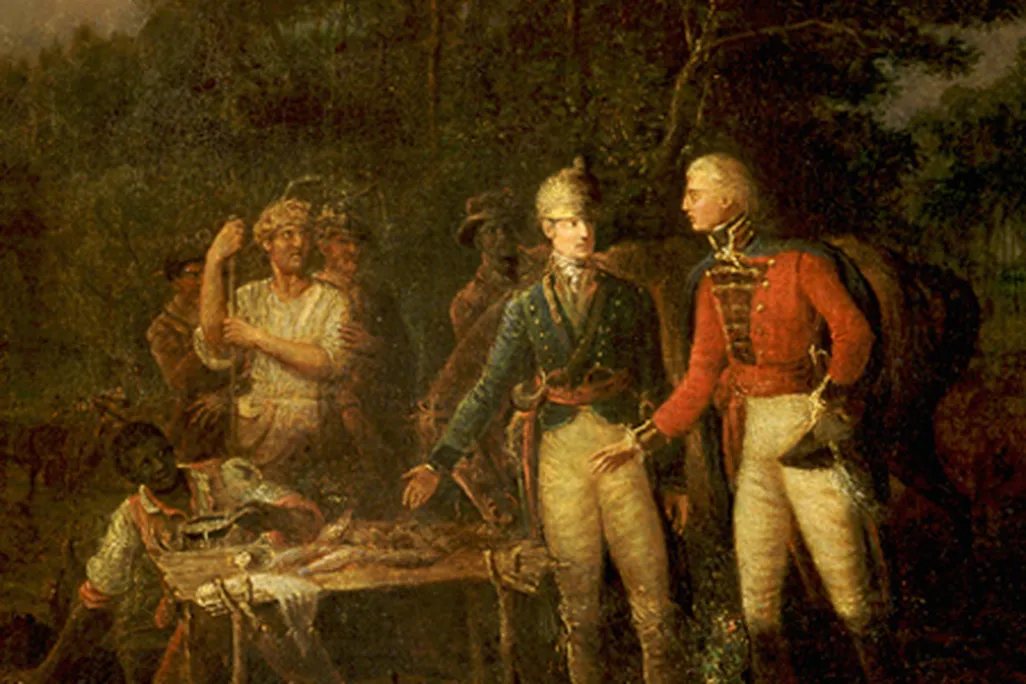
General Marion
General Marion Inviting a British Officer to Share His Meal (John Blake White)

In early 1781, Revolutionary War militia leader Francis Marion and his men were camping on Snow's Island, South Carolina, when a British officer arrived to discuss a prisoner exchange. As one militiaman recalled years later, a breakfast of sweet potatoes was roasting in the fire, and after the negotiations Marion, known as the "Swamp Fox," invited the British soldier to share breakfast. According to a legend that grew out of the much-repeated anecdote, the British officer was so inspired by the Americans' resourcefulness and dedication to the cause—despite their lack of adequate provisions, supplies or proper uniforms—that he promptly switched sides and supported American independence. Around 1820, John Blake White depicted the scene in an oil painting that now hangs in the United States Capitol. In his version, the primly attired Redcoat seems uncomfortable with Marion's ragtag band, who glare at him suspiciously from the shadows of a South Carolina swamp.

The 2000 movie The Patriot exaggerated the Swamp Fox legend for a whole new generation. Although Francis Marion led surprise attacks against the British, and was known for his cunning and resourcefulness, Mel Gibson played The Patriot's Marion-inspired protagonist as an action hero. "One of the silliest things the movie did," says Sean Busick, a professor of American history at Athens State University in Alabama, "was to make Marion into an 18th century Rambo."

Many of the legends that surround the life and exploits of Brigadier General Francis Marion were introduced by M. L. "Parson" Weems, coauthor of the first Marion biography, The Life of General Francis Marion. "I have endeavored to throw some ideas and facts about Genl. Marion into the garb and dress of a military romance," Weems wrote in 1807 to Peter Horry, the South Carolina officer on whose memoir the book was based. Weems had also authored an extremely popular biography of George Washington in 1800, and it was he who invented the apocryphal cherry tree story. Marion's life received similar embellishment.

Fortunately, the real Francis Marion has not been entirely obscured by his legend—historians including William Gilmore Simms and Hugh Rankin have written accurate biographies. Based on the facts alone, "Marion deserves to be remembered as one of the heroes of the War for Independence," says Busick, who has written the introduction to a new edition of Simms' The Life of Francis Marion, out in June 2007.

Marion was born at his family's plantation in Berkeley County, South Carolina, probably in 1732. The family's youngest son, Francis was a small boy with malformed legs, but he was restless, and at about 15 years old he joined the crew of a ship and sailed to the West Indies. During Marion's first voyage, the ship sank, supposedly after a whale rammed it. The seven-man crew escaped in a lifeboat and spent a week at sea before they drifted ashore. After the shipwreck, Marion decided to stick to land, managing his family's plantation until he joined the South Carolina militia at 25 to fight in the French and Indian War.

Most heroes of the Revolution were not the saints that biographers like Parson Weems would have them be, and Francis Marion was a man of his times: he owned slaves, and he fought in a brutal campaign against the Cherokee Indians. While not noble by today's standards, Marion's experience in the French and Indian War prepared him for more admirable service. The Cherokee used the landscape to their advantage, Marion found; they concealed themselves in the Carolina backwoods and mounted devastating ambushes. Two decades later, Marion would apply these tactics against the British.

In 1761, after his militia had defeated the area Cherokees, Marion returned to farming. He was successful enough to purchase his own plantation, Pond Bluff, in 1773. In 1775, Marion was elected to the first South Carolina Provincial Congress, an organization in support of colonial self-determination. After the Battles of Lexington and Concord on April 19, 1775, the Provincial Congress voted to raise three regiments, commissioning Marion a captain in the second. His first assignments involved guarding artillery and building Fort Sullivan, in the harbor of Charleston, South Carolina. When he saw combat during the Battle of Fort Sullivan in June 1776, Marion acted valiantly. But for much of the next three years, he remained at the fort, occupying the time by trying to discipline his troops, whom he found to be a disorderly, drunken bunch insistent on showing up to roll call barefoot. In 1779, they joined the Siege of Savannah, which the Americans lost.

Marion's role in the war changed course after an odd accident in March of 1780. Attending a dinner party at the Charleston home of a fellow officer, Marion found that the host, in accordance with 18th-century custom, had locked all the doors while he toasted the American cause. The toasts went on and on, and Marion, who was not a drinking man, felt trapped. He escaped by jumping out a second story window, but broke his ankle in the fall. Marion left town to recuperate in the country, with the fortunate result that he was not captured when the British took Charleston that May.


In early 1781, Revolutionary War militia leader Francis Marion and his men were camping on Snow's Island, South Carolina, when a British officer arrived to discuss a prisoner exchange. As one militiaman recalled years later, a breakfast of sweet potatoes was roasting in the fire, and after the negotiations Marion, known as the "Swamp Fox," invited the British soldier to share breakfast. According to a legend that grew out of the much-repeated anecdote, the British officer was so inspired by the Americans' resourcefulness and dedication to the cause—despite their lack of adequate provisions, supplies or proper uniforms—that he promptly switched sides and supported American independence. Around 1820, John Blake White depicted the scene in an oil painting that now hangs in the United States Capitol. In his version, the primly attired Redcoat seems uncomfortable with Marion's ragtag band, who glare at him suspiciously from the shadows of a South Carolina swamp.

The 2000 movie The Patriot exaggerated the Swamp Fox legend for a whole new generation. Although Francis Marion led surprise attacks against the British, and was known for his cunning and resourcefulness, Mel Gibson played The Patriot's Marion-inspired protagonist as an action hero. "One of the silliest things the movie did," says Sean Busick, a professor of American history at Athens State University in Alabama, "was to make Marion into an 18th century Rambo."

Many of the legends that surround the life and exploits of Brigadier General Francis Marion were introduced by M. L. "Parson" Weems, coauthor of the first Marion biography, The Life of General Francis Marion. "I have endeavored to throw some ideas and facts about Genl. Marion into the garb and dress of a military romance," Weems wrote in 1807 to Peter Horry, the South Carolina officer on whose memoir the book was based. Weems had also authored an extremely popular biography of George Washington in 1800, and it was he who invented the apocryphal cherry tree story. Marion's life received similar embellishment.

Fortunately, the real Francis Marion has not been entirely obscured by his legend—historians including William Gilmore Simms and Hugh Rankin have written accurate biographies. Based on the facts alone, "Marion deserves to be remembered as one of the heroes of the War for Independence," says Busick, who has written the introduction to a new edition of Simms' The Life of Francis Marion, out in June 2007.

Marion was born at his family's plantation in Berkeley County, South Carolina, probably in 1732. The family's youngest son, Francis was a small boy with malformed legs, but he was restless, and at about 15 years old he joined the crew of a ship and sailed to the West Indies. During Marion's first voyage, the ship sank, supposedly after a whale rammed it. The seven-man crew escaped in a lifeboat and spent a week at sea before they drifted ashore. After the shipwreck, Marion decided to stick to land, managing his family's plantation until he joined the South Carolina militia at 25 to fight in the French and Indian War.

Most heroes of the Revolution were not the saints that biographers like Parson Weems would have them be, and Francis Marion was a man of his times: he owned slaves, and he fought in a brutal campaign against the Cherokee Indians. While not noble by today's standards, Marion's experience in the French and Indian War prepared him for more admirable service. The Cherokee used the landscape to their advantage, Marion found; they concealed themselves in the Carolina backwoods and mounted devastating ambushes. Two decades later, Marion would apply these tactics against the British.

In 1761, after his militia had defeated the area Cherokees, Marion returned to farming. He was successful enough to purchase his own plantation, Pond Bluff, in 1773. In 1775, Marion was elected to the first South Carolina Provincial Congress, an organization in support of colonial self-determination. After the Battles of Lexington and Concord on April 19, 1775, the Provincial Congress voted to raise three regiments, commissioning Marion a captain in the second. His first assignments involved guarding artillery and building Fort Sullivan, in the harbor of Charleston, South Carolina. When he saw combat during the Battle of Fort Sullivan in June 1776, Marion acted valiantly. But for much of the next three years, he remained at the fort, occupying the time by trying to discipline his troops, whom he found to be a disorderly, drunken bunch insistent on showing up to roll call barefoot. In 1779, they joined the Siege of Savannah, which the Americans lost.

Marion's role in the war changed course after an odd accident in March of 1780. Attending a dinner party at the Charleston home of a fellow officer, Marion found that the host, in accordance with 18th-century custom, had locked all the doors while he toasted the American cause. The toasts went on and on, and Marion, who was not a drinking man, felt trapped. He escaped by jumping out a second story window, but broke his ankle in the fall. Marion left town to recuperate in the country, with the fortunate result that he was not captured when the British took Charleston that May.

With the American army in retreat, things looked bad in South Carolina. Marion took command of a militia and had his first military success that August, when he led 50 men in a raid against the British. Hiding in dense foliage, the unit attacked an enemy encampment from behind and rescued 150 American prisoners. Though often outnumbered, Marion's militia would continue to use guerilla tactics to surprise enemy regiments, with great success. Because the British never knew where Marion was or where he might strike, they had to divide their forces, weakening them. By needling the enemy and inspiring patriotism among the locals, Busick says, Marion "helped make South Carolina an inhospitable place for the British. Marion and his followers played the role of David to the British Goliath."

In November of 1780, Marion earned the nickname he's remembered by today. British Lieutenant Colonel Banastre Tarleton, informed of Marion's whereabouts by an escaped prisoner, chased the American militia for seven hours, covering some 26 miles. Marion escaped into a swamp, and Tarleton gave up, cursing, "As for this damned old fox, the Devil himself could not catch him." The story got around, and soon the locals—who loathed the British occupation—were cheering the Swamp Fox.

Biographer Hugh Rankin described the life of Francis Marion as "something like a sandwich—a highly spiced center between two slabs of rather dry bread." After the war, Marion returned to the quiet, dry-bread life of a gentleman farmer. At 54, he finally married a 49-year old cousin, Mary Esther Videau. He commanded a peacetime militia brigade and served in the South Carolina Assembly, where he opposed punishing Americans who had remained loyal to the British during the war. Championing amnesty for the Loyalists was "among the most admirable things he ever did," says Busick. In 1790, Marion helped write the South Carolina state constitution, and then retired from public life. After a long decline in health, Francis Marion died at his plantation, Pond Bluff, on February 27, 1795.

Francis Marion never commanded a large army or led a major battle. Histories of the Revolutionary War tend to focus on George Washington and his straightforward campaigns in the North, rather than small skirmishes in the South. Nevertheless, the Swamp Fox is one of the war's most enduring characters. "His reputation is certainly well deserved," says Busick. Though things looked bad for the Americans after Charleston fell, Marion's cunning, resourcefulness and determination helped keep the cause of American independence alive in the South.

In December 2006, two centuries after his death, Marion made news again when President George W. Bush signed a proclamation honoring the man described in most biographies as the "faithful servant, Oscar," Marion's personal slave. Bush expressed the thanks of a "grateful nation" for Oscar Marion's "service…in the Armed Forces of the United States." Identified by genealogist Tina Jones, his distant relative, Oscar is the African-American cooking sweet potatoes in John Blake White's painting at the Capitol. Oscar likely "helped with the cooking and mending clothes, but he would also have fought alongside Marion," says Busick. "We have no way of knowing if Oscar had any say in whether or not he went on campaign with Marion, though I think it is safe to assume that had he wanted to run away to the British he could have easily done so." Historians know very little about Oscar, but the few details of his story add new interest to the Swamp Fox legend.


Single Page 1 2 Next »

    Subscribe now for more of Smithsonian's coverage on history, science and nature.


Related topics: American History Military Leaders American Revolution


| | | Reddit | Digg | Stumble | Email |
 

Add New Comment


Name: (required)

Email: (required)

Comment:

Comments are moderated, and will not appear until Smithsonian.com has approved them. Smithsonian reserves the right not to post any comments that are unlawful, threatening, offensive, defamatory, invasive of a person's privacy, inappropriate, confidential or proprietary, political messages, product endorsements, or other content that might otherwise violate any laws or policies.

Comments (127)

+ View All Comments

Is very honored to say that not only am I related to The Swamp fox, but also named after him. I am very proud of my middle and last name.

Posted by Jordan Marion on April 3,2013 | 10:21 AM

nice

Posted by max farter on February 5,2013 | 03:40 PM

thanks that helps a lot

Posted by seema on January 12,2013 | 02:58 PM

sweet character in history

Posted by joey kopp on December 18,2012 | 08:23 PM

i realy want to know how he died

Posted by on November 30,2012 | 10:58 AM

When was this published?

Posted by Michelle on November 27,2012 | 08:31 PM

I love Francis Marion. He was a true freedom fighter and awesome guerrilla leader. If he was still alive, I would totally love to appoint him as my commander of my militia guerrilla group in case if my country gets invaded by a foreign power, aliens, or zombies. God bless you Franics Marion.

Posted by Daniel Lee on November 17,2012 | 02:45 AM

that one guy looks wierdD:

Posted by bobby j on November 7,2012 | 03:51 PM

good information, very helpful

Posted by on November 7,2012 | 03:10 PM

I am distantly related to George Washington. I don't know how but my mom told me that I was. I am definitely going to research my ancestry!!!!!

Posted by star tracy on November 7,2012 | 02:13 PM

This was a very interesting article. I was amazed at the information provided. I enjoyed it and think it was very educational and i will recommend it to my future teachers.

Posted by star tracy on November 7,2012 | 01:36 PM

wow what so fine art it's very pretty

Posted by brandynero on October 15,2012 | 09:49 AM

this is not entirely currect information

Posted by homishami on October 12,2012 | 09:22 AM

Dear Sirs,i want to make tin soldiers depicting the soldiersand Indians of the Revolutionary War.i want more good pictures of the swampfox,perhaps from a hollywood movie.More action!Perhaps from movie stills?? ib

Posted by ian C.Bodger on September 20,2012 | 07:33 PM

+ View All Comments


Advertisement


Most Popular

  • Viewed
  • Emailed
  • Commented
  1. Myths of the American Revolution
  2. For 40 Years, This Russian Family Was Cut Off From All Human Contact, Unaware of WWII
  3. Seven Famous People Who Missed the Titanic
  4. Women Spies of the Civil War
  5. A Brief History of the Salem Witch Trials
  6. The History of the Short-Lived Independent Republic of Florida
  7. We Had No Idea What Alexander Graham Bell Sounded Like. Until Now
  8. Tattoos
  9. Gobekli Tepe: The World’s First Temple?
  10. The True Story of the Battle of Bunker Hill
  1. The Freedom Riders, Then and Now
  2. Uncovering Secrets of the Sphinx
  3. Abandoned Ship: the Mary Celeste
  4. Looking at the Battle of Gettysburg Through Robert E. Lee’s Eyes
  5. The Great New England Vampire Panic
  6. Seven Famous People Who Missed the Titanic
  7. Women Spies of the Civil War
  8. The Women Who Fought in the Civil War
  9. Document Deep Dive: The Heartfelt Friendship Between Jackie Robinson and Branch Rickey
  10. New Light on Stonehenge

View All Most Popular »

Advertisement

Follow Us

Smithsonian Magazine
@SmithsonianMag
Follow Smithsonian Magazine on Twitter

Sign up for regular email updates from Smithsonian.com, including daily newsletters and special offers.

In The Magazine

May 2013

  • Patriot Games
  • The Next Revolution
  • Blowing Up The Art World
  • The Body Eclectic
  • Microbe Hunters

View Table of Contents »


First Name
Last Name
Address 1
Address 2
City
State   Zip
Email


Travel with Smithsonian


Smithsonian Store

Stars and Stripes Throw

Our exclusive Stars and Stripes Throw is a three-layer adaption of the 1861 “Stars and Stripes” quilt... $65


View full archiveRecent Issues


  • May 2013


  • Apr 2013


  • Mar 2013

Newsletter

Sign up for regular email updates from Smithsonian magazine, including free newsletters, special offers and current news updates.

Subscribe Now

About Us

Smithsonian.com expands on Smithsonian magazine's in-depth coverage of history, science, nature, the arts, travel, world culture and technology. Join us regularly as we take a dynamic and interactive approach to exploring modern and historic perspectives on the arts, sciences, nature, world culture and travel, including videos, blogs and a reader forum.

Explore our Brands

  • goSmithsonian.com
  • Smithsonian Air & Space Museum
  • Smithsonian Student Travel
  • Smithsonian Catalogue
  • Smithsonian Journeys
  • Smithsonian Channel
  • About Smithsonian
  • Contact Us
  • Advertising
  • Subscribe
  • RSS
  • Topics
  • Member Services
  • Copyright
  • Site Map
  • Privacy Policy
  • Ad Choices

Smithsonian Institution