
The Ambush That Changed History
An amateur archaeologist discovers the field where wily Germanic warriors halted the spread of the Roman Empire
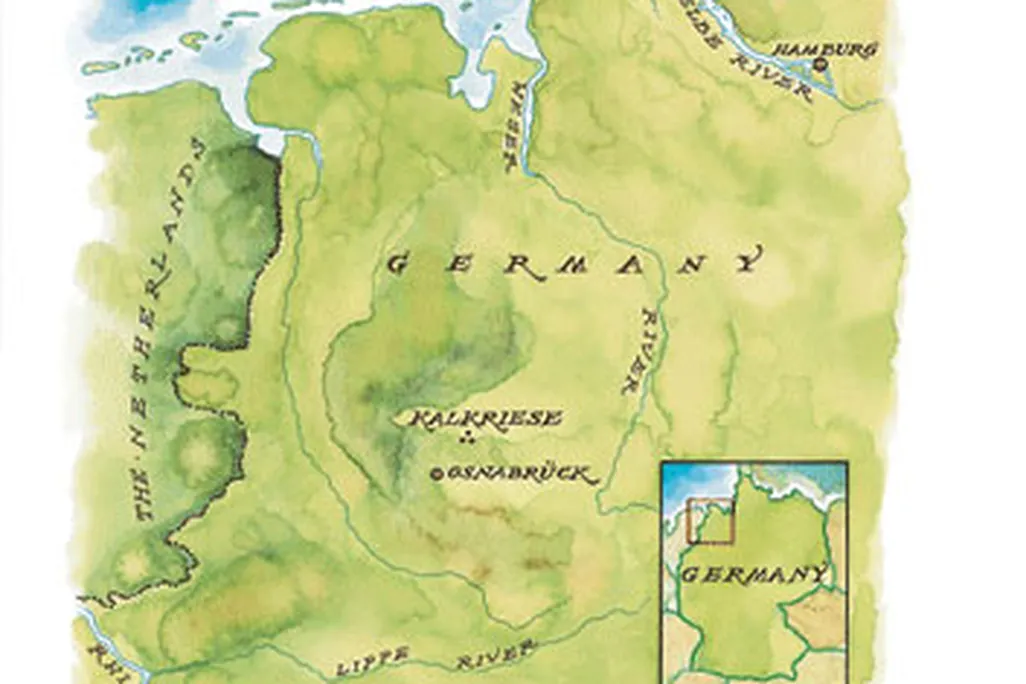
“This is the soil of 2,000 years ago, where we are standing now,” Susanne Wilbers-Rost was saying as a young volunteer pried a small, dark clod out of it. Wilbers-Rost, a specialist in early German archaeology, peered through wire-rimmed glasses, brushed away some earth, and handed an object to me. “You’re holding a nail from a Roman soldier’s sandal,” she said. Atrim, short-haired woman, Wilbers-Rost has worked at the site, which is ten miles north of the manufacturing city of Osnabrück, Germany, since 1990. Inch by inch, several young archaeologists under her direction are bringing to light a battlefield that was lost for almost 2,000 years, until an off-duty British Army officer stumbled across it in 1987.
The sandal nail was a minor discovery, extracted from the soil beneath an overgrown pasture at the base of Kalkriese (the word may derive from Old High German for limestone), a 350-foot-high hill in an area where uplands slope down to the north German plain. But it was further proof that one of the pivotal events in European history took place here: in A.D. 9, three crack legions of Rome’s army were caught in an ambush and annihilated. Ongoing finds—ranging from simple nails to fragments of armor and the remains of fortifications—have verified the innovative guerrilla tactics that according to accounts from the period, neutralized the Romans’ superior weaponry and discipline.
It was a defeat so catastrophic that it threatened the survival of Rome itself and halted the empire’s conquest of Germany. “This was a battle that changed the course of history,” says Peter S. Wells, a specialist in Iron Age European archaeology at the University of Minnesota and the author of The Battle That Stopped Rome. “It was one of the most devastating defeats ever suffered by the Roman Army, and its consequences were the most far-reaching. The battle led to the creation of a militarized frontier in the middle of Europe that endured for 400 years, and it created a boundary between Germanic and Latin cultures that lasted 2,000 years.” Had Rome not been defeated, says historian Herbert W. Benario, emeritus professor of classics at EmoryUniversity, a very different Europe would have emerged. “Almost all of modern Germany as well as much of the present-day CzechRepublic would have come under Roman rule. All Europe west of the Elbe might well have remained Roman Catholic; Germans would be speaking a Romance language; the Thirty Years’ War might never have occurred, and the long, bitter conflict between the French and the Germans might never have taken place.”
Founded (at least according to legend) in 753 b.c., Rome spent its formative decades as little more than an overgrown village. But within a few hundred years, Rome had conquered much of the Italian peninsula, and by 146 b.c., had leapt into the ranks of major powers by defeating Carthage, which controlled much of the western Mediterranean. By the beginning of the Christian Era, Rome’s sway extended from Spain to Asia Minor, and from the North Sea to the Sahara. The imperial navy had turned the Mediterranean into a Roman lake, and everywhere around the rim of the empire, Rome’s defeated enemies feared her legions—or so it seemed to optimistic Romans. “Germania” (the name referred originally to a particular tribe along the Rhine), meanwhile, did not exist as a nation at all. Various Teutonic tribes lay scattered across a vast wilderness that reached from present-day Holland to Poland. The Romans knew little of this densely forested territory governed by fiercely independent chieftains. They would pay dearly for their ignorance.
There are many reasons, according to ancient historians, that the imperial Roman legate Publius Quinctilius Varus set out so confidently that September in a.d. 9. He led an estimated 15,000 seasoned legionnaires from their summer quarters on the WeserRiver, in what is now northwestern Germany, west toward permanent bases near the Rhine. They were planning to investigate reports of an uprising among local tribes. Varus, 55, was linked by marriage to the imperial family and had served as Emperor Augustus’ representative in the province of Syria (which included modern Lebanon and Israel), where he had quelled ethnic disturbances. To Augustus, he must have seemed just the man to bring Roman civilization to the barbarous” tribes of Germany.
Like his patrons in Rome, Varus thought occupying Germany would be easy. “Varus was a very good administrator, but he was not a soldier,” says Benario. “To send him out into an unconquered land and tell him to make a province of it was a huge blunder on Augustus’ part.”
Rome’s imperial future was by no means foreordained. At age 35, Augustus, the first emperor, still styled himself “first citizen” in deference to lingering democratic sensibilities of the fallen RomanRepublic, whose demise—after the assassination of Caesar—had brought him to power in 27 b.c., following a century of bloody civil wars. During Augustus’ rule, Rome had grown into the largest city in the world, with a population that may have approached one million.
The German frontier held a deep allure for Augustus, who regarded the warring tribes east of the Rhine as little more than savages ripe for conquest. Between 6 b.c. and a.d. 4, Roman legions had mounted repeated incursions into the tribal lands, eventually establishing a chain of bases on the Lippe and Weser rivers. In time, despite growing resentment of the Roman presence, the tribes exchanged iron, cattle, slaves and foodstuffs for Roman gold and silver coins and luxury goods. Some tribes even pledged allegiance to Rome; German mercenaries served with Roman armies as far away as the present-day Czech Republic.
One such German soldier of fortune, a 25-year-old prince of the Cherusci tribe, was known to the Romans as Arminius. (His tribal name has been lost to history.) He spoke Latin and was familiar with Roman tactics, the kind of man the Romans relied on to help their armies penetrate the lands of the barbarians. For his valor on the field of battle, he had been awarded the rank of knight and the honor of Roman citizenship. On that September day, he and his mounted auxiliaries were deputized to march ahead and rally some of his own tribesmen to help in putting down the rebellion.
Arminius’ motives are obscure, but most historians believe he had long harbored dreams of becoming king of his tribe. To achieve his goal, he concocted a brilliant deception: he would report a fictitious “uprising” in territory unfamiliar to the Romans, then lead them into a deadly trap. A rival chieftain, Segestes, repeatedly warned Varus that Arminius was a traitor, but Varus ignored him. “The Romans,” says Wells, “thought they were invincible.”
Arminius had instructed the Romans to make what he had described as a short detour, a one- or two-day march, into the territory of the rebels.The legionnaires followed along rudimentary trails that meandered among the Germans’ farmsteads, scattered fields, pastures, bogs and oak forests. As they progressed, the line of Roman troops—already seven or eight miles long, including local auxiliaries, camp followers and a train of baggage carts pulled by mules—became dangerously extended. The legionnaires, wrote third-century historian Cassius Dio, “were having a hard time of it, felling trees, building roads, and bridging places that required it. . . . Meanwhile, a violent rain and wind came up that separated them still further, while the ground, that had become slippery around the roots and logs, made walking very treacherous for them, and the tops of the trees kept breaking off and falling down, causing much confusion. While the Romans were in such difficulties, the barbarians suddenly surrounded them on all sides at once,” Dio writes of the preliminary German skirmishes. “At first they hurled their volleys from a distance; then, as no one defended himself and many were wounded, they approached closer to them.” Somehow, the command to attack had gone out to the German tribes. “This is pure conjecture,” says Benario, “but Arminius must have delivered a message that the Germans should begin their assault.”
The nearest Roman base lay at Haltern, 60 miles to the southwest. So Varus, on the second day, pressed on doggedly in that direction. On the third day, he and his troops were entering a passage between a hill and a huge swamp known as the Great Bog that, in places, was no more than 60 feet wide. As the increasingly chaotic and panicky mass of legionnaires, cavalrymen, mules and carts inched forward, Germans appeared from behind trees and sand-mound barriers, cutting off all possibility of retreat. “In open country, the superbly drilled and disciplined Romans would surely have prevailed,” says Wells. “But here, with no room to maneuver, exhausted after days of hit-and-run attacks, unnerved, they were at a crippling disadvantage.”
Varus understood that there was no escape. Rather than face certain torture at the hands of the Germans, he chose suicide, falling on his sword as Roman tradition prescribed. Most of his commanders followed suit, leaving their troops leaderless in what had become a killing field. “An army unexcelled in bravery, the first of Roman armies in discipline, in energy, and in experience in the field, through the negligence of its general, the perfidy of the enemy, and the unkindness of fortune. . . . was exterminated almost to a man by the very enemy whom it has always slaughtered like cattle,” according to the a.d. 30 account of Velleius Paterculus, a retired military officer who may have known both Varus and Arminius.
Only a handful of survivors managed somehow to escape into the forest and make their way to safety. The news they brought home so shocked the Romans that many ascribed it to supernatural causes, claiming a statue of the goddess Victory had ominously reversed direction. The historian Suetonius, writing a century after the battle, asserted that the defeat “nearly wrecked the empire.” Roman writers, says Wells, “were baffled by the disaster.” Though they blamed the hapless Varus, or the treachery of Arminius, or the wild landscape, in reality, says Wells, “the local societies were much more complex than the Romans thought. They were an informed, dynamic, rapidly changing people, who practiced complex farming, fought in organized military units, and communicated with each other across very great distances.”
More than 10 percent of the entire imperial army had been wiped out—the myth of its invincibility shattered. In the wake of the debacle, Roman bases in Germany were hastily abandoned. Augustus, dreading that Arminius would march on Rome, expelled all Germans and Gauls from the city and put security forces on alert against insurrections.
Six years would pass before a Roman army would return to the battle site. The scene the soldiers found was horrific. Heaped across the field at Kalkriese lay the whitening bones of dead men and animals, amid fragments of their shattered weapons. In nearby groves they found “barbarous altars” upon which the Germans had sacrificed the legionnaires who surrendered. Human heads were nailed everywhere to trees. In grief and anger, the aptly named Germanicus, the Roman general leading the expedition, ordered his men to bury the remains, in the words of Tacitus, “not a soldier knowing whether he was interring the relics of a relative or a stranger, but looking on all as kinsfolk and of their own blood, while their wrath rose higher than ever against the foe.”
Germanicus, ordered to campaign against the Cherusci, still under the command of Arminius, pursued the tribe deep into Germany. But the wily chieftain retreated into the forests, until, after a series of bloody but indecisive clashes, Germanicus fell back to the Rhine, defeated. Arminius was “the liberator of Germany,” Tacitus wrote, “a man who, . . . threw down the challenge to the Roman nation.”
For a time, tribes flocked to join Arminius’ growing coalition. But as his power grew, jealous rivals began to defect from his cause. He “fell by the treachery of his relatives,” Tacitus records, in a.d. 21.
With the abdication of the Romans from Germany, the Kalkriese battlefield was gradually forgotten. Even the Roman histories that recorded the debacle were lost, sometime after the fifth century, during the collapse of the empire under the onslaught of barbarian invasions. But in the 1400s, humanist scholars in Germany rediscovered the works of Tacitus, including his account of Varus’ defeat. As a consequence, Arminius was hailed as the first national hero of Germany. “The myth of Arminius,” says Benario, “helped give Germans their first sense that there had been a German people that transcended the hundreds of small duchies that filled the political landscape of the time.” By 1530, even Martin Luther praised the ancient German chieftain as a “war leader” (and updated his name to “Hermann”). Three centuries later, Heinrich von Kleist’s 1809 play, Hermann’s Battle, invoked the hero’s exploits to encourage his countrymen to fight Napoleon and his invading armies. By 1875, as German militarism surged, Hermann had been embraced as the nation’s paramount historical symbol; a titanic copper statue of the ancient warrior, crowned with a winged helmet and brandishing his sword menacingly toward France, was erected on a mountaintop 20 miles south of Kalkriese, near Detmold, where many scholars then believed the battle took place. At 87 feet high, and mounted on an 88-foot stone base, it was the largest statue in the world until the Statue of Liberty was dedicated in 1886. Not surprisingly, the monument became a popular destination for Nazi pilgrimages during the 1930s. But the actual location of the battle remained a mystery. More than 700 sites, ranging from the Netherlands to eastern Germany, were proposed.
Amateur archaeologist Tony Clunn of Britain’s Royal Tank Regiment was hoping for a chance to indulge his interest when he arrived at his new posting in Osnabrück in the spring of 1987. (He had previously assisted archaeologists in England during his spare time, using a metal detector to search for traces of Roman roads.) Captain Clunn introduced himself to the director of the Osnabrück museum, Wolfgang Schlüter, and asked him for guidance. The British officer promised to turn over to the museum anything he found.
“In the beginning, all I had ever hoped to find was the odd Roman coin or artifact,” Clunn, who retired from the army with the rank of major in 1996, told me, as we sat drinking tea in a café next to the Varusschlacht (Varus Battle) Museum and Park Kalkriese, which opened in 2002. Schlüter had suggested that he try the rural Kalkriese area, where a few coins had already been found. Clunn planned his assault with a soldier’s eye to detail. He pored over old maps, studied regional topography and read extensively about the battle, including a treatise by 19th-century historian Theodor Mommsen, who had speculated that it took place somewhere near Kalkriese, although few agreed with him.
As Clunn drove around Kalkriese in his black Ford Scorpio, introducing himself to local farmers, he saw a landscape that had changed significantly since Roman times. Forests of oak, alder and beech had long since given way to cultivated fields and copses of pine. Stolid modern farm buildings with red-tile roofs stood in place of the huts of the ancient tribesmen. The Great Bog itself had disappeared, drained in the 19th century; it was now bucolic pastureland.
Using an old hand-drawn map he got from a local landowner, Clunn noted the locations of earlier coin finds. “The secret is to look for the easy route that people would have taken in ancient times,” he says. “No one wants to dig
a lot of unnecessary holes in the ground. So you look for the most logical spot to start searching—for example, a pass where a trail might narrow, a bottleneck.” Clunn focused on the area between where the Great Bog had been and Kalkriese Hill. As he walked, sweeping his metal detector from side to side, he noticed a slight elevation. “I sensed it was an old trackway, perhaps a path across the bog,” he says. He began following the elevation, working backward toward the hills.
Before long, a ringing in his earphones indicated metal in the earth. He bent over, carefully cut away a small square of turf with a trowel, and began to dig, sifting the peaty soil through his fingers. He dug down about eight inches. “Then I saw it!” Clunn exclaims. In his hand lay a small, round silvercoin, blackened with age—a Roman denarius, stamped on one side with the aquiline features of Augustus, and on the other, with two warriors armed with battle shields and spears. “I could scarcely believe it,” he says. “I was transfixed.” Soon he found a second denarius, then a third. Who lost these? He asked himself, and what had the coin carrier been doing—running, riding, walking? Before Clunn left the area for the day, he carefully logged the location of the coins on his grid map, sealed them in plastic pouches and restored the clods of dirt.
The next time Clunn returned to Kalkriese, his metal detector signaled another find: at a depth of about a foot, he discovered another denarius. This one, too, bore a likeness of Augustus on one side, and on the other, a bull with head lowered, as if about to charge. By the end of the day, Clunn had unearthed no fewer than 89 coins. The following weekend, he found still more, for a total of 105, none minted later than the reign of Augustus. The vast majority were in pristine condition, as if they had been little circulated when they were lost.
In the months that followed, Clunn continued his explorations, always turning over his finds to Schlüter. Along with coins, he discovered shards of lead and bronze, nails, fragments of a groma (a distinctive Roman road-surveying device) and three curious ovoid pieces of lead that German scholars identified as sling shot. “Slowly but surely a cohesive pattern began to emerge,” says Clunn. “There was every indication that a large contingent of people had splayed out from the area at the apex to the field, fleeing from an unknown horror.” Clunn began to suspect that he had found what was left of Varus’ lost legions.
Thanks to Schlüter’s contacts in German academia, the site was recognized, almost immediately, as a major discovery. Professional archaeologists under the direction of Schlüter and, later, Wilbers-Rost undertook systematic excavations. They were fortunate: sometime in the past, local farmers had covered the poor sandy subsoil with a thick layer of sod that had protected the undiscovered artifacts below.
Since the early 1990s, excavations have located battle debris along a corridor almost 15 miles long from east to west, and a little more than 1 mile from north to south, offering additional proof that it unfolded over many miles, before reaching its dreadful climax at Kalkriese.
Perhaps the most important single discovery was evidence of a wall 4 feet high and 12 feet thick, built of sand and reinforced by chunks of sod. “Arminius learned much from his service with the Romans,” says Wilbers-Rost. “He knew their tactics and their weak points. The wall zigzagged so that the Germans on top of it could attack the Romans from two angles. They could stand on the wall, or rush out through gaps in it to attack the Roman flank, and then run back behind it for safety.” Concentrations of artifacts were found in front of the wall, suggesting that the Romans had tried to scale it. The dearth of objects behind it testifies to their failure to do so.
The more the archaeologists excavated, the more they appreciated the immensity of the massacre. Clearly, Arminius and his men had scoured the battlefield after the slaughter and carried off everything of value, including Roman armor, helmets, gold and silver, utensils and weapons. Most of what archaeologists have unearthed consists of items the victors failed to notice, or dropped as they looted. Still, there have been some spectacular finds, including the remnants of a Roman officer’s scabbard and, most notably, a Roman standard-bearer’s magnificent silver face mask. They also uncovered coins stamped with the letters “VAR,” for Varus, which the ill-fated commander had awarded his troops for meritorious service.
In all, Wilbers-Rost’s team has found more than 5,000 objects: human bones (including several skulls gruesomely split by swords), spearheads, bits of iron, harness rings, metal studs, pieces of armor, iron nails, tent pegs, scissors, bells that once hung from the necks of Roman mules, a wine strainer and medical instruments. Many of these objects, cleaned and restored, are on display in the museum at the site. (Archaeologists also found fragments of bombs that Allied planes dropped on the area during World War II.)
Clunn, now 59, still works, as a staff officer, for the British military in Osnabrück. One recent afternoon, amid intermittent cloudbursts, he and I drove east from Kalkriese along the route that Varus’ army most likely followed on the last day of its harrowing march. We stopped at a low hill on the outskirts of the village of Schwagstorf. From the car, I could barely detect the rise in the ground, but Clunn assured me that this was the highest s ot in the vicinity. “It’s the only place that offers any natural defense,” he said. Here, he has found the same types of coins and artifacts that have been unearthed at Kalkriese; he hopes that future excavationswill determine that the battered Roman forces attempted to regroup here shortly before they met their doom. As we stood at the edge of a traffic circle and gazed across a cornfield, he added: “I’m convinced that this is the site of Varus’ last camp.”