• Smithsonian
    Institution
  • Travel
    With Us
  • Smithsonian
    Store
  • Smithsonian
    Channel
  • goSmithsonian
    Visitors Guide
  • Air & Space
    magazine

Smithsonian.com

  • Subscribe
  • History & Archaeology
  • Science
  • Ideas & Innovations
  • Arts & Culture
  • Travel & Food
  • At the Smithsonian
  • Photos
  • Videos
  • Games
  • Shop
  • Archaeology
  • U.S. History
  • World History
  • Today in History
  • Document Deep Dives
  • The Jetsons
  • National Treasures
  • Paleofuture
  • History & Archaeology

The Freedom Riders, Then and Now

Fighting racial segregation in the South, these activists were beaten and arrested. Where are they now, nearly fifty years later?
| | | Reddit | Digg | Stumble | Email |
  • By Marian Smith Holmes
  • Photographs by Eric Etheridge
  • Smithsonian magazine, February 2009, Subscribe
View More Photos »
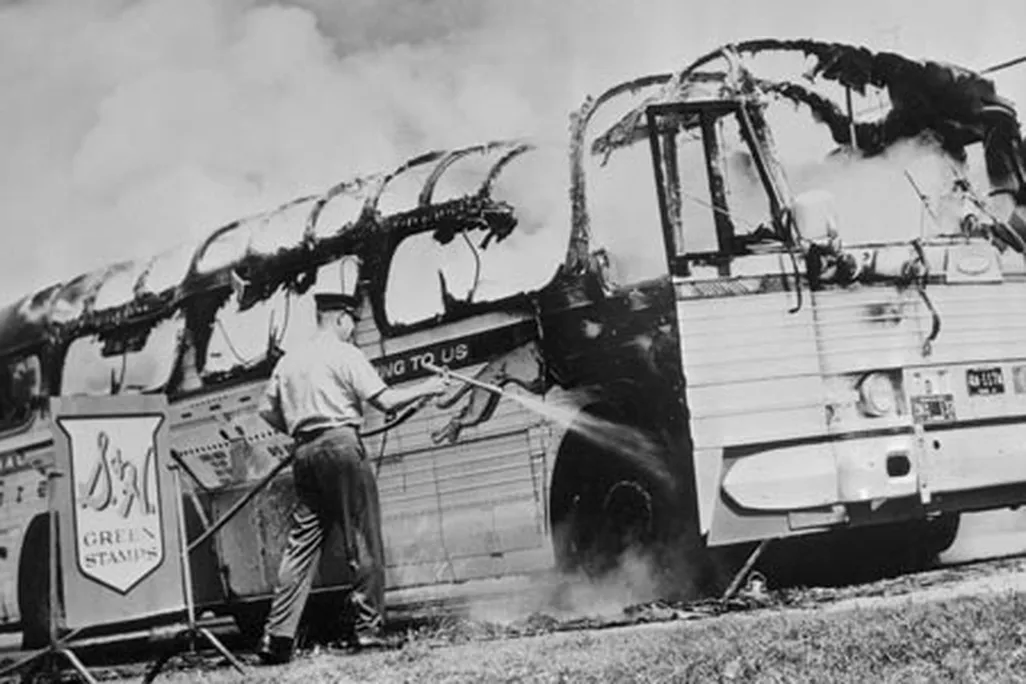
Mob attacks bus
After a mob attacked a bus with protesters in Alabama in 1961, hundreds more joined the cause. (Bettmann / Corbis)

Photo Gallery (1/10)

Mug shot of Georgia Congressman John Lewis

Explore more photos from the story


Video Gallery

Riding to Freedom

Related Links

  • Breach of Peace

Related Books

Breach of Peace: Portraits of the 1961 Mississippi Freedom Riders

by Eric Etheridge
Atlas & Co. (New York), 2008

Freedom Riders: 1961 and the Struggle for Racial Justice

by Raymond Arsenault
Oxford University Press (New York), 2006

Parting the Waters: America in the King Years 1954-1963

by Taylor Branch
Simon and Schuster (New York), 1988

Walking with the Wind: A Memoir of the Movement

by John Lewis with Michael D'Orso
Simon and Schuster (New York), 1988

More from Smithsonian.com

  • Portraits of Resistance
  • A Civil Rights Watershed in Biloxi, Mississippi

On Sunday, May 14, 1961—Mother's Day—scores of angry white people blocked a Greyhound bus carrying black and white passengers through rural Alabama. The attackers pelted the vehicle with rocks and bricks, slashed tires, smashed windows with pipes and axes and lobbed a firebomb through a broken window. As smoke and flames filled the bus, the mob barricaded the door. "Burn them alive," somebody cried out. "Fry the goddamn niggers." An exploding fuel tank and warning shots from arriving state troopers forced the rabble back and allowed the riders to escape the inferno. Even then some were pummeled with baseball bats as they fled.

A few hours later, black and white passengers on a Trailways bus were beaten bloody after they entered whites-only waiting rooms and restaurants at bus terminals in Birmingham and Anniston, Alabama.

The bus passengers assaulted that day were Freedom Riders, among the first of more than 400 volunteers who traveled throughout the South on regularly scheduled buses for seven months in 1961 to test a 1960 Supreme Court decision that declared segregated facilities for interstate passengers illegal.

After news stories and photographs of the burning bus and bloody attacks sped around the country, many more people came forward to risk their lives and challenge the racial status quo. Now Eric Etheridge, a veteran magazine editor, provides a visceral tribute to those road warriors in Breach of Peace: Portraits of the 1961 Mississippi Freedom Riders. The book, a collection of Etheridge's recent portraits of 80 Freedom Riders juxtaposed with mug shots from their arrests in 1961, includes interviews with the activists re-flecting on their experiences.

Etheridge, who grew up in Carthage, Mississippi, focuses on Freedom Riders who boarded buses to Jackson, Mississippi, from late May to mid-September 1961. He was just 4 years old at the time and unaware of the seismic racial upheaval taking place around him. But he well remembers using one entrance to his doctor's office while African-Americans used another, and sitting in the orchestra of his local movie theater while blacks sat in the balcony.

"Looking back," Etheridge says, "I can identify with what the white South African photographer Jillian Edelstein has said: 'Growing up white in apartheid South Africa entitled one to massive and instant privilege.' "

A few years ago, Etheridge, who lives in New York City and has worked for Rolling Stone and Harper's, began looking for a project to engage his budding photographic skills. During a visit with his parents in Jackson in 2003, he was reminded that a lawsuit had forced the Mississippi State Sovereignty Commission, an agency created in 1956 to resist desegregation, to open its archives. The agency files, put online in 2002, included more than 300 arrest photographs of Freedom Riders."The police camera caught something special," Etheridge says, adding that the collection is "an amazing addition to the visual history of the civil rights movement." Unwittingly, the segregationist commission had created an indelible homage to the activist riders.

Nearly 75 percent of them were between 18 and 30 years old. About half were black; a quarter, women. Their mug-shot expressions hint at their resolve, defiance, pride, vulnerability and fear. "I was captivated by these images and wanted to bring them to a wider audience," Etheridge writes. "I wanted to find the riders today, to look into their faces and photograph them again." Using the Internet and information in the arrest files, he tracked riders down, then called them cold. "My best icebreaker was: 'I have your mug shot from 1961. Have you ever seen it?' Even people who are prone to be cautious were tickled to even think that it still existed."


On Sunday, May 14, 1961—Mother's Day—scores of angry white people blocked a Greyhound bus carrying black and white passengers through rural Alabama. The attackers pelted the vehicle with rocks and bricks, slashed tires, smashed windows with pipes and axes and lobbed a firebomb through a broken window. As smoke and flames filled the bus, the mob barricaded the door. "Burn them alive," somebody cried out. "Fry the goddamn niggers." An exploding fuel tank and warning shots from arriving state troopers forced the rabble back and allowed the riders to escape the inferno. Even then some were pummeled with baseball bats as they fled.

A few hours later, black and white passengers on a Trailways bus were beaten bloody after they entered whites-only waiting rooms and restaurants at bus terminals in Birmingham and Anniston, Alabama.

The bus passengers assaulted that day were Freedom Riders, among the first of more than 400 volunteers who traveled throughout the South on regularly scheduled buses for seven months in 1961 to test a 1960 Supreme Court decision that declared segregated facilities for interstate passengers illegal.

After news stories and photographs of the burning bus and bloody attacks sped around the country, many more people came forward to risk their lives and challenge the racial status quo. Now Eric Etheridge, a veteran magazine editor, provides a visceral tribute to those road warriors in Breach of Peace: Portraits of the 1961 Mississippi Freedom Riders. The book, a collection of Etheridge's recent portraits of 80 Freedom Riders juxtaposed with mug shots from their arrests in 1961, includes interviews with the activists re-flecting on their experiences.

Etheridge, who grew up in Carthage, Mississippi, focuses on Freedom Riders who boarded buses to Jackson, Mississippi, from late May to mid-September 1961. He was just 4 years old at the time and unaware of the seismic racial upheaval taking place around him. But he well remembers using one entrance to his doctor's office while African-Americans used another, and sitting in the orchestra of his local movie theater while blacks sat in the balcony.

"Looking back," Etheridge says, "I can identify with what the white South African photographer Jillian Edelstein has said: 'Growing up white in apartheid South Africa entitled one to massive and instant privilege.' "

A few years ago, Etheridge, who lives in New York City and has worked for Rolling Stone and Harper's, began looking for a project to engage his budding photographic skills. During a visit with his parents in Jackson in 2003, he was reminded that a lawsuit had forced the Mississippi State Sovereignty Commission, an agency created in 1956 to resist desegregation, to open its archives. The agency files, put online in 2002, included more than 300 arrest photographs of Freedom Riders."The police camera caught something special," Etheridge says, adding that the collection is "an amazing addition to the visual history of the civil rights movement." Unwittingly, the segregationist commission had created an indelible homage to the activist riders.

Nearly 75 percent of them were between 18 and 30 years old. About half were black; a quarter, women. Their mug-shot expressions hint at their resolve, defiance, pride, vulnerability and fear. "I was captivated by these images and wanted to bring them to a wider audience," Etheridge writes. "I wanted to find the riders today, to look into their faces and photograph them again." Using the Internet and information in the arrest files, he tracked riders down, then called them cold. "My best icebreaker was: 'I have your mug shot from 1961. Have you ever seen it?' Even people who are prone to be cautious were tickled to even think that it still existed."

Most of the riders were college students; many, such as the Episcopal clergymen and contingents of Yale divinity students, had religious affiliations. Some were active in civil rights groups like the Congress of Racial Equality (CORE), which initiated the Freedom Rides and was founded in 1942 on Mahatma Gandhi's principle of nonviolent protest. The goal of the rides, CORE director James Farmer said as he launched the campaign, was "to create a crisis so that the federal government would be compelled to enforce the law."

The volunteers, from 40 states, received training in nonviolence tactics. Those who could not refrain from striking back when pushed, hit, spit on or doused with liquids while racial epithets rang in their ears were rejected.

As soon as he heard the call for riders, Robert Singleton remembers, he "was fired up and ready to go." He and his wife, Helen, had both been active in the National Association for the Advancement of Colored People and they took 12 volunteers with them from California. "The spirit that permeated the air at that time was not unlike the feeling Barack Obama has rekindled among the youth of today," says Singleton, now 73 and an economics professor at Loyola Marymount University in Los Angeles.

Peter Ackerberg, a lawyer who now lives in Minneapolis, said that while he'd always talked a "big radical game," he had never acted on his convictions. "What am I going to tell my children when they ask me about this time?" he recalled thinking. Boarding a bus in Montgomery, Alabama, "I was pretty scared," he told Etheridge. "The black guys and girls were singing....They were so spirited and so unafraid. They were really prepared to risk their lives." Today, Ackerberg recalls acquiescing and saying "sir" to a jail official who was "pounding a blackjack." Soon after, "I could hear the blackjack strike [rider C.T. Vivian's] head and him shrieking; I don't think he ever said 'sir.'"

John Lewis, then 21 and already a veteran of sit-ins to desegregate lunch counters in Nashville, was the first Freedom Rider to be assaulted. While trying to enter a whites-only waiting room in Rock Hill, South Carolina, two men set upon him, battering his face and kicking him in the ribs. Less than two weeks later, he joined a ride bound for Jackson. "We were determined not to let any act of violence keep us from our goal," Lewis, a Georgia congressman since 1987 and a celebrated civil rights figure, said recently. "We knew our lives could be threatened, but we had made up our minds not to turn back."

As riders poured into the South, National Guardsmen were assigned to some buses to prevent violence. When activists arrived at the Jackson bus depot, police arrested blacks who refused to heed orders to stay out of white restrooms or vacate the white waiting room. And whites were arrested if they used "colored" facilities. Officials charged the riders with breach of peace, rather than breaking segregation laws. Freedom Riders responded with a strategy they called "jail, no bail"—a deliberate effort to clog the penal facilities. Most of the 300 riders in Jackson would endure six weeks in sweltering jail or prison cells rife with mice, insects, soiled mattresses and open toilets.

"The dehumanizing process started as soon as we got there," said Hank Thomas, a Marriott hotel franchise owner in Atlanta, who was then a sophomore at Howard University in Washington, D.C. "We were told to strip naked and then walked down this long corridor.... I'll never forget [CORE director] Jim Farmer, a very dignified man ...walk­ing down this long corridor naked...that is dehumanizing. And that was the whole point."

Jean Thompson, then a 19-year-old CORE worker, said she was one of the riders slapped by a penal official for failing to call him "sir." An FBI investigation into the incident concluded that "no one was beaten," she told Etheridge. "That said a lot to me about what actually happens in this country. It was eye-opening." When prisoners were transferred from one facility to another, unexplained stops on remote dirt roads or the sight of curious onlookers peering into the transport trucks heightened fears. "We imagined every horror including an ambush by the KKK," rider Carol Silver told Etheridge. To keep up their spirits, the prisoners sang freedom songs.

None of the riders Etheridge spoke with expressed regrets, even though some would be entangled for years in legal appeals that went all the way to the Supreme Court (which issued a ruling in 1965 that led to a reversal of the breach of peace convictions). "It's the right thing to do, to oppose an oppressive state where wrongs are being done to people," said William Leons, a University of Toledo professor of anthropology whose father had been killed in an Austrian concentration camp and whose mother hid refugees during World War II. "I was aware very much of my parents' involvement in the Nazi resistance," he said of his 39-day incarceration as a rider. "[I was] doing what they would have done."

More than two dozen of the riders Etheridge interviewed went on to become teachers or professors, and there are eight ministers as well as lawyers, Peace Corps workers, journalists and politicians. Like Lewis, Bob Filner, of California, is a congressman. And few former Freedom Riders still practice civil disobedience. Joan Pleune, 70, of New York City, is a member of the Granny Peace Brigade; she was arrested two years ago at an anti-Iraq War protest in Washington, D.C. while "reading the names of the war dead," she says. Theresa Walker, 80, was arrested in New York City in 2000 during a protest over the police killing there the year before of Amadou Diallo, an unarmed immigrant from Guinea.

Though the Freedom Rides dramatically demonstrated that some Southern states were ignoring the U.S. Supreme Court's mandate to desegregate bus terminals, it would take a petition from U.S. Attorney General Robert Kennedy to spur the Interstate Commerce Commission (ICC) to issue tough new regulations, backed by fines up to $500, that would eventually end segregated bus facilities. Even after the order went into effect, on November 1, 1961, hard-core segregation persisted; still, the "white" and "colored" signs in bus stations across the South be- gan to come down. The New York Times, which had earlier criticized the Freedom Riders' "incitement and provocation," acknowledged that they "started the chain of events which resulted in the new I.C.C. order."

The legacy of the rides "could not have been more poetic," says Robert Singleton, who connects those events to the election of Barack Obama as president. Obama was born in August 1961, Singleton notes, just when the riders were languishing in Mississippi jails and prisons, trying to "break the back of segregation for all people, but especially for the children. We put ourselves in harm's way for a child, at the very time he came into this world, who would become our first black president."

Marian Smith Holmes is an associate editor.
Photographer Eric Etheridge maintains a Web site, breachofpeace.com, that publishes information about the Freedom Riders.


Single Page 1 2 3 Next »

    Subscribe now for more of Smithsonian's coverage on history, science and nature.


Related topics: American History Movement Leaders Civil Rights 1960s Alabama


| | | Reddit | Digg | Stumble | Email |
 

Add New Comment


Name: (required)

Email: (required)

Comment:

Comments are moderated, and will not appear until Smithsonian.com has approved them. Smithsonian reserves the right not to post any comments that are unlawful, threatening, offensive, defamatory, invasive of a person's privacy, inappropriate, confidential or proprietary, political messages, product endorsements, or other content that might otherwise violate any laws or policies.

Comments (22)

+ View All Comments

wow they are compleatly awsome!

Posted by on November 30,2012 | 02:34 PM

wow they are compleatly awsome!

Posted by on November 30,2012 | 02:34 PM

Are there any of the freedom riders that now reside in the DC / Baltimore area if so are they willing able to speak before High School students possibly as early as the beginning of the 2012-13 school year. If not do any of them answer questions from students via letter or e-mail.

Posted by Len Cutler on June 4,2012 | 08:29 AM

I am 56. I have never tried to read through tears before now. I was 5 years old when the bus was burned. Everything that I learn about that day...explains why my life was like it was. My life did n ot move foward,because of hatréd . I am a light skinned Italian American.God puts us where He wants us to be..RCP

Posted by on May 18,2012 | 09:49 AM

I watched a special on PBS on the Freedom Riders. It terrified me to watch it, I can't imagine the feelings of the riders living it. It was disturbing to know that we had fellow Americans that could have been so evil. All I can say is, if you can watch that and not come away profoundly affected, you're not human. God bless the freedom riders and what they did so that my kids don't have black friends or brown friends or yellow friends...they just have friends.

Posted by CINDY WILSON on February 14,2012 | 01:41 PM

I think that this is a great part of our history!

Posted by Miriam Russell on February 8,2012 | 06:48 PM

Can anyone tell me a list of the first 13 riders? I cant seem to find one anywhere!

Posted by Maddy on January 21,2012 | 05:26 PM

I am the founder and curator of the Jim Crow Museum, an anti-racism facility located at Ferris State University. We are both a real museum and a virtual museum, www.ferris.edu/jimcrow. We have a link called Question of the Month. Recently, we received a question about Eric Etheridge and the freedom riders and I would like to use Marian Smith's article to answer the question. How can I get permission to use the article found at http://www.smithsonianmag.com/history-archaeology/The-Freedom-Riders.html? Thank you for considering my request.

Posted by David Pilgrim on September 28,2011 | 02:46 PM

They've come a long way to strive to better everyone God Bless them all

Posted by O'Dontay McCullough on June 14,2011 | 11:18 AM

Growing up in new York I was just 4 years old. When the freedom riders were fighting and riding the buses for freedom - equal rights. I know this will be fight we will be fighting for so many more years to come. I learned history of america but never was this a topic. Thanks to my family. Who told us how it was when they were growing up. Passing down stories of how lucky we kids are to be able to play and go to school and not worry about racism. I thank you so much for all of those who have come before me and stepped up for freedom. I have meet one of the original freedom riders and sat a listen to him. A great change is at hand those who act boldly. "September 22nd"
I'm taken a trip on the greyhound bus line I'm riding the front sit to norlins Hallelujah I'm a travin, hallelujah ain't it fine, hallelujah im a travin,down freedoms main line.

Thank you all

Posted by Dolores on May 22,2011 | 04:01 PM

I enjoy reading this story i really picture what happen to those people.

Posted by majandra johnson on February 24,2011 | 02:30 PM

Hopefuly, an one who reads this will find and watch the excellent documentary "Freedom Riders" which will come out on the "American Experience" later this year (?). In it Bobby Kennedy speaks poignantly, saying "we might have a black President some day."
With our still segregated schools, our southern Republicans and t bag party, the U S still has many of the same repressive elements it did back when the freedom riders accomplished so much. Think National Guard at Kent State, think National Guard in Iraq.
I think the country has a great amnesia when it comes to honoring and remembering its truly great movements- like labor, civil rights, etc. We still are not a peaceful country and I hope the peace movement cvan grow and accomplish as much as did civil rights. It has to. Yet, real peace activists remain rare in the U.S. Maybe some day, a group like Jonah House in Baltimore will be recognized as they should, but for now, there are no magazine articles about them, and the media finds other "heroes" to put forward. Sad.
This country seems to create an atmosphere in which its true heroes are assassinated.

Posted by david eberhardt on May 10,2010 | 10:24 AM

I feel sorry for all people that us because of the color of our skin because Jesus loves us all the same he sees no color just the contents of the heart I love the people that hate me the most

Posted by melenia adams on February 1,2010 | 09:49 PM

I feel guilty that in the 60's I was in a word, private Catholic schools, secondary and post secondary, where the Beatles were more popular than Rev. Martin Luther King jr, who led many freedom marches through the South. I was about his age. I began to educate myself after his assasination. Since that date I have read so much about Civil Rights and how we came to be feared by whites since slavery. I am happy that our history is so open compared to the few paragraphs I learned in American history from school text books in the 60's. I read this article and I am awed of our black history. Thank you for putting it out there.

Posted by Joy R. Rees on February 15,2009 | 05:32 PM

+ View All Comments


Advertisement


Most Popular

  • Viewed
  • Emailed
  • Commented
  1. For 40 Years, This Russian Family Was Cut Off From All Human Contact, Unaware of WWII
  2. Seven Famous People Who Missed the Titanic
  3. Top Ten Demonstrations of Love
  4. The Battle Over Richard III’s Bones…And His Reputation
  5. Bodybuilders Through the Ages
  6. A Brief History of the Salem Witch Trials
  7. The Unsuccessful Plot to Kill Abraham Lincoln
  8. Gobekli Tepe: The World’s First Temple?
  9. Tattoos
  10. Harry Truman’s Adorable Love “List” to His Wife, Bess
  1. For 40 Years, This Russian Family Was Cut Off From All Human Contact, Unaware of WWII
  2. Faces of War
  3. A Brief History of the Honus Wagner Baseball Card
  4. Native Intelligence
  1. Abandoned Ship: the Mary Celeste
  2. To Be...Or Not: The Greatest Shakespeare Forgery
  3. The Beer Archaeologist
  4. The Swamp Fox
  5. For 40 Years, This Russian Family Was Cut Off From All Human Contact, Unaware of WWII
  6. The Battle Over Richard III’s Bones…And His Reputation
  7. The Making of Mount Rushmore
  8. America's True History of Religious Tolerance
  9. The Freedom Riders, Then and Now
  10. The American Football League's Foolish Club

View All Most Popular »

Advertisement

Follow Us

Smithsonian Magazine
@SmithsonianMag
Follow Smithsonian Magazine on Twitter

Sign up for regular email updates from Smithsonian.com, including daily newsletters and special offers.

In The Magazine

February 2013

  • The First Americans
  • See for Yourself
  • The Dragon King
  • America’s Dinosaur Playground
  • Darwin In The House

View Table of Contents »


First Name
Last Name
Address 1
Address 2
City
State   Zip
Email


Travel with Smithsonian


Smithsonian Store

Framed Lincoln Tribute

This Framed Lincoln Tribute includes his photograph, an excerpt from his Gettysburg Address, two Lincoln postage stamps and four Lincoln pennies... $40


View full archiveRecent Issues


  • Feb 2013


  • Jan 2013


  • Dec 2012

Newsletter

Sign up for regular email updates from Smithsonian magazine, including free newsletters, special offers and current news updates.

Subscribe Now

About Us

Smithsonian.com expands on Smithsonian magazine's in-depth coverage of history, science, nature, the arts, travel, world culture and technology. Join us regularly as we take a dynamic and interactive approach to exploring modern and historic perspectives on the arts, sciences, nature, world culture and travel, including videos, blogs and a reader forum.

Explore our Brands

  • goSmithsonian.com
  • Smithsonian Air & Space Museum
  • Smithsonian Student Travel
  • Smithsonian Catalogue
  • Smithsonian Journeys
  • Smithsonian Channel
  • About Smithsonian
  • Contact Us
  • Advertising
  • Subscribe
  • RSS
  • Topics
  • Member Services
  • Copyright
  • Site Map
  • Privacy Policy
  • Ad Choices

Smithsonian Institution