
Founding Fathers and Slaveholders
To what degree do the attitudes of Washington and Jefferson toward slavery diminish their achievements?
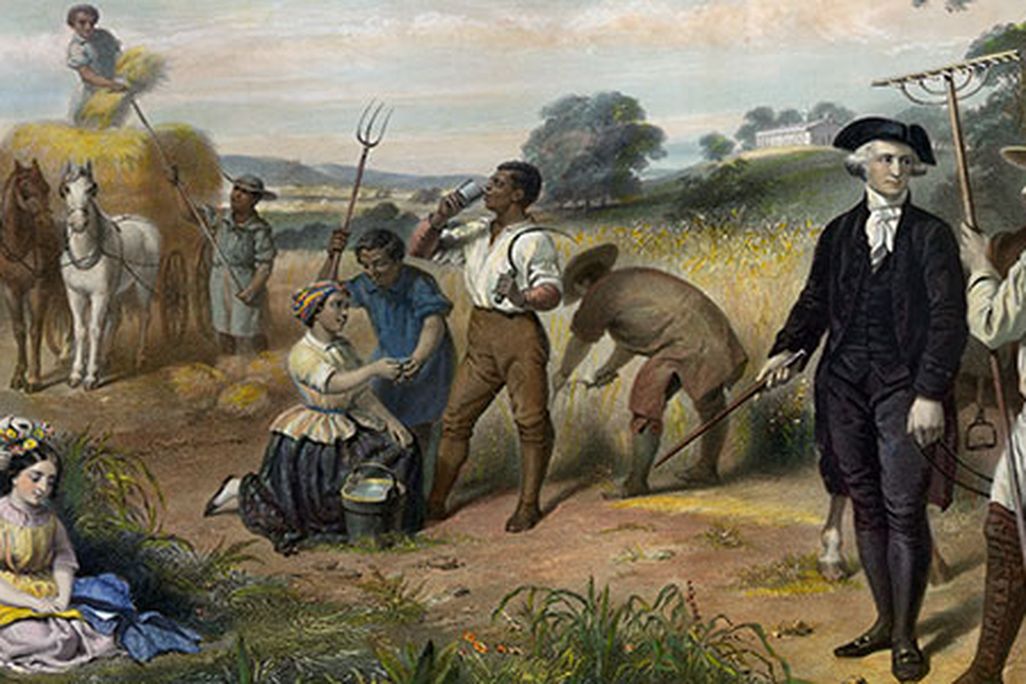
Americans in great numbers are rediscovering their founding fathers in such best-selling books as Joseph Ellis’ Founding Brothers, David McCullough’s John Adams and my own Undaunted Courage, about Lewis and Clark. There are others who believe that some of these men are unworthy of our attention because they owned slaves, Washington, Jefferson, Clark among them, but not Adams. They failed to rise above their time and place, though Washington (but not Jefferson) freed his slaves. But history abounds with ironies. These men, the founding fathers and brothers, established a system of government that, after much struggle, and the terrible violence of the Civil War, and the civil rights movement led by black Americans, did lead to legal freedom for all Americans and movement toward equality.
Let’s begin with Thomas Jefferson, because it is he who wrote the words that inspired subsequent generations to make the heroic sacrifices that transformed the words "All men are created equal" into reality.
In 1996 I was a visiting professor at the University of Wisconsin. The History Club there asked me to participate in a panel discussion on "Political Correctness and the University." The professor seated next to me taught American political thought. I remarked to her that when I began teaching I had required students to read five or six books each semester, but I had cut that back to three or four or else the students would drop my course. She said she had the same problem. She had dropped Thomas Jefferson’s writings from the required reading list.
"You are in Madison, being paid by the citizens of Wisconsin to teach their children American political thought, and you leave out Tom Jefferson?"
"Yes," she replied. "He was a slaveholder." More than half the large audience applauded.
Jefferson owned slaves. He did not believe that all were created equal. He was a racist, incapable of rising above the thought of his time and place, and willing to profit from slave labor.
Few of us entirely escape our times and places. Thomas Jefferson did not achieve greatness in his personal life. He had a slave as mistress. He lied about it. He once tried to bribe a hostile reporter. His war record was not good. He spent much of his life in intellectual pursuits in which he excelled and not enough in leading his fellow Americans toward great goals by example. Jefferson surely knew slavery was wrong, but he didn’t have the courage to lead the way to emancipation. If you hate slavery and the terrible things it did to human beings, it is difficult to regard Jefferson as great. He was a spendthrift, always deeply in debt. He never freed his slaves. Thus the sting in Dr. Samuel Johnson’s mortifying question, "How is it that we hear the loudest yelps for liberty from the drivers of Negroes?"
Jefferson knew slavery was wrong and that he was wrong in profiting from the institution, but apparently could see no way to relinquish it in his lifetime. He thought abolition of slavery might be accomplished by the young men of the next generation. They were qualified to bring the American Revolution to its idealistic conclusion because, he said, these young Virginians had "sucked in the principles of liberty as if it were their mother’s milk."
Of all the contradictions in Jefferson’s contradictory life, none is greater. Of all the contradictions in America’s history, none surpasses its toleration first of slavery and then of segregation. Jefferson hoped and expected that Virginians of Meriwether Lewis’ and William Clark’s generation would abolish slavery. His writing showed that he had a great mind and a limited character.
Jefferson, like all slaveholders and many other white members of American society, regarded Negroes as inferior, childlike, untrustworthy and, of course, as property. Jefferson, the genius of politics, could see no way for African-Americans to live in society as free people. He embraced the worst forms of racism to justify slavery.
In Notes on the State of Virginia, Jefferson describes the institution of slavery as forcing tyranny and depravity on master and slave alike. To be a slaveholder meant one had to believe that the worst white man was better than the best black man. If you did not believe these things, you could not justify yourself to yourself. So Jefferson could condemn slavery in words, but not in deeds.
At his magnificent estate, Monticello, Jefferson had slaves who were superb artisans, shoemakers, masons, carpenters, cooks. But like every bigot, he never said, after seeing a skilled African craftsman at work or enjoying the fruits of his labor, "Maybe I’m wrong." He ignored the words of his fellow revolutionary John Adams, who said that the Revolution would never be complete until the slaves were free.
Jefferson left another racial and moral problem for his successors, the treatment of Native Americans. He had no positive idea what to do with or about the Indians. He handed that problem over to his grandchildren, and theirs.
The author of the Declaration of Independence threw up his hands at the question of women’s rights. It is not as if the subject never came up. Abigail Adams, at one time Jefferson’s close friend, raised it. But Jefferson’s attitude toward women was at one with that of the white men of his age. He wrote about almost everything, but almost never about women, not about his wife nor his mother and certainly not about Sally Hemings.
So it is of particular irony to admit that Jefferson was as remarkable a man as America has produced. "Spent the evening with Mr. Jefferson," John Quincy Adams wrote in his diary in 1785, "whom I love to be with....You can never be an hour in the man’s company without something of the marvelous." And even Abigail Adams wrote of him, "He is one of the choice ones of the earth."
Jefferson was born rich and became well educated. He was a man of principle (except for slaves, Indians, and women). His civic duty was paramount to him. He read, deeply and widely, more than any other president of the United States except, possibly, Theodore Roosevelt. He wrote well and with more productivity and skill than any other president except, perhaps, Theodore Roosevelt. Wherever Jefferson sat was the head of the table. Those few who got to dine with him around a small table always recalled his charm, wit, insights, queries, explanations, gossip, curiosity, and above all else his laughter.
Jefferson’s range of knowledge was astonishing. Science in general. Flora and fauna specifically. Geography. Fossils. The classics and modern literature. Languages. Politicians of all types. Politics, state by state, county by county. International affairs. He was an intense partisan. He loved music and playing the violin. He wrote countless letters about his philosophy, observations of people and places. In his official correspondence, Jefferson maintained a level of eloquence not since equaled. I’ve spent much of my professional life studying presidents and generals, reading their letters, examining their orders to subordinates, making an attempt to judge them. None match Jefferson.
In spite of these rare abilities, Jefferson was not a hero. His great achievements were words. Except for the Louisiana Purchase, his actions as president fall short. But those words! He was the author of the Declaration of Independence. The second paragraph begins with a perfect sentence: "We hold these truths to be self-evident, that all men are created equal." Those words, as the historian Samuel Eliot Morison has said, "are more revolutionary than anything written by Robespierre, Marx, or Lenin, a continual challenge to ourselves, as well as an inspiration to the oppressed of all the world." Eventually, with Lincoln, who articulated and lived these truths, and slowly afterward, the idea made its progress.
Jefferson was the author of the Virginia Statute of Religious Freedom, a doctrine that spread throughout the United States. He is the father of our religious freedom. It is, next to the words of our independence, his greatest gift, save only perhaps our commitment to universal education, which also comes to us via Jefferson.
The Northwest Ordinance of 1787 was based on Jefferson’s "Report of a Plan of Government for the Western Territory" written three years earlier. In it, he made certain that when the populations of Ohio, Indiana, Illinois, Wisconsin, and Michigan were large enough, these and other territories would come into the Union as fully equal states. They would have the same number of senators and representatives as the original thirteen. They would elect their own governors, and so on. He was the first who had the thought that colonies should be equal to the thirteen original members of the Union. No one before him had proposed such a thing. Empires were run by the "mother country," with the king appointing the governors. It was Jefferson who decided that we wouldn’t do it that way in the United States. The territories would be states. He applied the principles of the Northwest Ordinance to the Louisiana Purchase territories, and by later extension to the West Coast. It was Jefferson who envisioned an empire of liberty that stretched from sea to shining sea.
Washington and Jefferson were both rich Virginia planters, but they were never friends. Washington did not have Jefferson’s IQ. He was not anywhere near as good a writer. He was not as worldly. He had less formal education than any subsequent president, except Abraham Lincoln. He towered over his contemporaries, literally so. He was a six-foot-three general; his soldiers averaged five-foot-eight. He was not a good general, or so his critics say. His army lost more battles than it won.
But Washington held the Continental Army together, "in being" as the military expression puts it, and he had a masterly judgment of when and where and how to strike the British in order to raise morale among his soldiers and throughout his country—perhaps most symbolic was his crossing the Delaware River at Christmastime in 1776, when in a lightning week of campaigning he picked off the British garrisons at Trenton and Princeton, taking many prisoners and valuable supplies. The next winter he spent with his soldiers in a freezing Valley Forge. From there, he directed the strategy of the war, turned the Revolutionary army from a ragtag collection into a solid regular army, forced the politicians in Congress to support him, and emerged as the one who would lead the nation through the Revolutionary War.
Washington’s character was rock solid. At the center of events for 24 years, he never lied, fudged, or cheated. He shared his army’s privations, though never pretended to be "one of the men." Washington came to stand for the new nation and its republican virtues, which was why he became our first president by unanimous choice and, in the eyes of many, including this author, our greatest.
Washington personifies the word "great." In his looks, in his regular habits, in his dress and bearing, in his generalship and his political leadership, in his ability to persuade, in his sure grip on what the new nation needed (above all else, not a king), and in his optimism no matter how bad the American cause looked, he rose above all others. He established the thought, "We can do it," as an integral part of the American spirit. He was indispensable, "first in war, first in peace, first in the hearts of his countrymen." Abigail Adams, again, so insightful in her descriptions, quoted John Dryden to describe Washington: "Mark his majestic fabric. He’s a temple sacred from his birth and built by hands divine."
Of the nine presidents who owned slaves, only Washington freed his. He resisted efforts to make him a king and established the precedent that no one should serve more than two terms as president. He voluntarily yielded power. His enemy, George III, remarked in 1796, as Washington’s second term was coming to an end, "If George Washington goes back to his farm, he will be the greatest character of his age." As George Will wrote, "the final component of Washington’s indispensability was the imperishable example he gave by proclaiming himself dispensable."
Washington was a slaveholder. In New Orleans, in the late 1990s, George Washington Elementary School was renamed Charles Richard Drew Elementary School, after the developer of blood-banking. I don’t see how we can take down the name of the man whose leadership brought this nation through the Revolutionary War and who turned down a real chance to be the first king of the nation.
"But he was a slaveholder," students sometimes say to me.
"Listen, he was our leader in the Revolution, to which he pledged his life, his fortune, and his honor. Those were not idle pledges. What do you think would have happened to him had he been captured by the British Army?
"I’ll tell you. He would have been brought to London, tried, found guilty of treason, ordered executed, and then drawn and quartered. Do you know what that means? He would have had one arm tied to one horse, the other arm to another horse, one leg to yet another, and the other leg to a fourth. Then the four horses would have been simultaneously whipped and started off at a gallop, one going north, another south, another east and the fourth to the west.
"That is what Washington risked to establish your freedom and mine."
Our nation’s capital abounds with commemorations of our president heroes, including the Lincoln, Jefferson and FDR memorials. The one that stands out is the WashingtonMonument, the tallest, most superbly designated, and most immediately recognized. It is our tribute to the man who won the Revolutionary War and who, as our first president, did more than anyone to create the republic. Jefferson extended it from the Mississippi River to the Rocky Mountains. Lincoln preserved it. Franklin Roosevelt led it to triumph in the greatest war ever fought. But it was George Washington who set the republican standard. So long as this republic lasts, he will stand first.
The Mall that stretches out from Washington’s monument has been the scene of controversy, protest, and persuasion, as it should be in a democracy. There, our national discord has been on display, and our national step-by-step progress demonstrated for. There, Martin Luther King, Jr., spoke the words that characterized and led the way to civil rights for African-Americans and all other Americans: "I have a dream." There, citizens, including my wife and I, gathered in huge numbers to protest the Vietnam War.
The WashingtonMonument and the Jefferson and Lincoln memorials remind us that greatness comes in different forms and at a price. Jefferson, by his words, gave us aspirations. Washington, through his actions, showed us what was possible. Lincoln’s courage turned both into reality.
Slavery and discrimination cloud our minds in the most extraordinary ways, including a blanket judgment today against American slave owners in the 18th and 19th centuries. That the masters should be judged as lacking in the scope of their minds and hearts is fair, indeed must be insisted upon, but that doesn’t mean we should judge the whole of them only by this part.
In his last message to America, on June 24, 1826, ten days before he died on July 4 (the same day that John Adams died), Jefferson declined an invitation to be in Washington for the 50th anniversary of the Declaration of Independence. He wrote, "All eyes are opened, or opening to the rights of man. The general spread of the light of science has already laid open to every view the palpable truth that the mass of mankind has not been born with saddles on their backs, nor a favored few booted and spurred, ready to ride them."
He died with hope that the future would bring to fruition the promise of equality. For Jefferson, that was the logic of his words, the essence of the American spirit. He may not have been a great man in his actions, or in his leadership. But in his political thought, he justified that hope.