
Eight Lessons for the Presidential Debates
What are the key do’s and don’ts the candidates should remember when campaigning for the White House?
As Joe Biden and Donald Trump prepare for the first of three presidential debates tonight, it's a good time to heed George Santayana’s famous warning: “Those who cannot remember the past are condemned to repeat it?”
Presidential debate history can be instructive. Reviewing some of the memorable moments—and debate debacles—from these televised showdowns provides a worthy primer in “debatiquette:” the proper dos and don’ts for successful debaters.
Before the coming of television, America’s most famous debates had taken place in 1858, pitting Abraham Lincoln against Stephen Douglas in an Illinois Senate race. Before that contest, Lincoln was seen as a country bumpkin. But with telegraphed reports appearing in newspapers, Lincoln emerged from the debates a nationally recognized figure who would become the Republican pick for president—winning the election in 1860.
Then, for the next 100 years: No debates.
Part of the reason was tradition. Candidates stuck to the tried and true “front porch” campaigns. Nominees sat at home on rockers, fielding softball questions from visiting journalists. Surrogates did the dirty work on the stump and openly partisan newspapers carried their messages.
With the railroad, came the “whistle stop” campaign, in which candidates offered a stump speech from a caboose and waved to the crowds before moving on to the next town.
The arrival of radio in the 20th century meant campaigning took to the airwaves. But there was still no great call for candidates to face off. And front-runners, including Franklin D. Roosevelt in his four campaigns, had no compelling reason to give an opponent equal standing. In 1934, the Communications Act actually complicated the idea of a two-man debate by requiring broadcasters to give an opportunity to all candidates, including those in minor parties. But in 1948, Thomas Dewey and Harold Stassen, two Republicans, met in a radio primary debate.
Television changed everything. Two televised “debates” of a sort took place in 1952 and 1956, both during the primaries. In 1952, contenders from both parties (or their representatives) took questions at the League of Women Voters convention. Two Democrats debated on television prior to the Florida primary in 1956, simply ignoring the “equal time” rule.
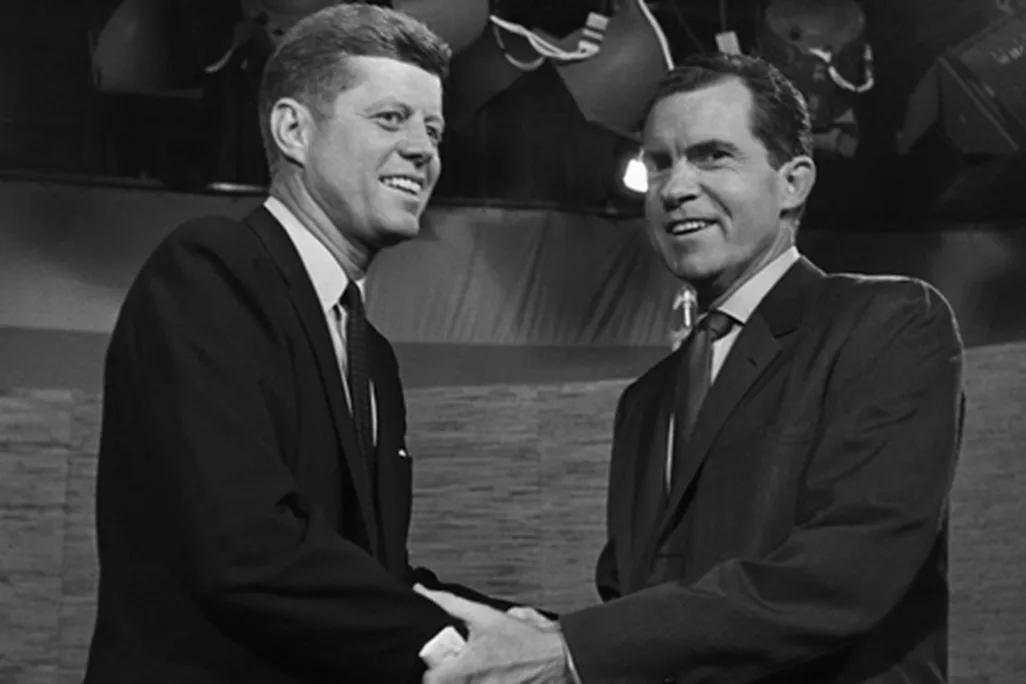
But in 1960, with television’s growing presence, Vice President Richard Nixon and Senator John F. Kennedy both saw an advantage in debates in a close race. Famed for the televised “Checkers Speech,” which saved his political life in 1952, and the “Kitchen Debate” in Moscow with Nikita Khrushchev in 1959, Nixon was confident about his television and debate skills. And to turn down the debate with Kennedy might, “have cost him politically in the new TV age,” noted Robert Dallek. More important, Congress complied by suspending the “equal time” rule to allow a two-man debate and keep out third party candidates.
The rest, as they say, is history.
Lesson 1: Lay off the Lazy Shave and Get Some Sun


The slightly unshaven look may work for Don Draper on “Mad Men,” but it was not a plus for Richard Nixon, as he learned in his historic confrontation with John F. Kennedy in the first presidential debate in 1960. Nixon had just come from a hospital stay. He had lost weight in the hospital and his suit looked ill fitting. He had also injured a knee and had to lean on the podium. To make matters worse, Nixon was given a heavy pancake makeup called “Lazy-Shave” to conceal his five o-clock shadow, making him appear even more pale and haggard. Chicago’s legendary Mayor, Richard Daley, reportedly said, “My God they’ve embalmed him before he even died.”
Few people recall any “sound bites” from that first night. But the junior Senator from Massachusetts looked rested and ready. Projecting youthful vigor, a tanned Kennedy, who had been in California, proved he could hold his own against the more experienced Nixon. Kennedy was America’s first “made for television” candidate and his small screen magic scored. Polls at the time showed he had turned a deficit into a lead after the first debate. The other three meetings were widely considered toss-ups.
Lesson 2: Be Sure You Can See Russia (and the Rest of Eastern Europe)

Lyndon B. Johnson and Richard Nixon had no interest in debating their opponents in the elections of 1964 to 1972. But after a 16-year hiatus, the presidential face-offs returned in 1976. In October that year, the debates resumed with a new loophole in the “equal time” rule: the FCC ruled that debates were “bona fide news events,” and if sponsored by an organization other than the networks, would be exempted. The League of Women Voters stepped in.
But Gerald Ford, the only president never elected president or vice president, learned a harsh lesson in geopolitics when, in the second debate with Jimmy Carter, he said, “There is no Soviet domination of Eastern Europe and there never will be under a Ford administration.”
When the incredulous moderator followed up, Ford repeated the assertion. With the Soviet Union controlling most of Eastern Europe since the end of World War II, Ford had unleashed a gaffe that didn’t clinch Carter’s victory that year. But his jaw-dropping statement seemed to give credence to the view that he was in over his head and confirmed his earlier words to Congress—“I’m a Ford not a Lincoln.” Years later, Ford would defend his words saying he hadn’t adequately explained that he meant that he believed that the Polish people would “throw the Soviet…forces out.”
The bottom line: “losing” a debate, especially with a whopper of a mistake, is probably more significant than actually “winning” it.
Lesson 3: Laughter is Not the Best Medicine If They Are Laughing at You [video]

Admiral James Stockdale was a highly decorated navy pilot who had been a prisoner-of-war in Vietnam along with future GOP presidential candidate Senator John McCain. When first named Ross Perot’s running mate in 1992, Stockdale was a “place holder” to qualify Perot for ballots until a more experienced running mate was found. But Perot stuck with the admiral, who attempted to introduce himself to a national audience by asking, “Who Am I? Why I am here?” His follow-up statement, “I am not a politician” got lost and he seemed befuddled. His gambit made Admiral Stockdale fodder for “Saturday Night Live.”
But Stockdale, who died in 2005 at age 81, later wrote defiantly that he had chosen his words that night very deliberately, inspired by the Stoic philosophy of rigorous self-discipline and individual responsibility that helped him survive four years in solitary confinement. His erudition was lost on late night comics.
Lesson 4: Leave Comedy to the Pros [video]

While on the subject of laughter, nothing is lamer than a stiff politician who can’t do punch lines. Most can’t. Ronald Reagan could and in a 1984 debate with Walter Mondale, he successfully defused the “age issue” when he said, “I want you to know that also I will not make age an issue of this campaign. I am not going to exploit, for political purposes, my opponent’s youth and inexperience.” Of course, Reagan came to politics with an advantage. He was a veteran actor who once co-starred with a chimp. He knew funny and could deliver his lines.
Lesson 5: Zingers Must Zing [video]

The corollary to the rule above is also a nod to Ronald Reagan’s skills. The
“Great Communicator” knew how to cut deep with a simple line. Running against the incumbent President Jimmy Carter in 1980, Reagan phrased his famous question, “Are you better off now then you were four years ago?” When Reagan told voters to ask themselves that question in his closing remarks – which meant Carter was unable respond on the spot—it sealed the debate as a Reagan victory.
But if you ask the question, as they always tell trial lawyers, make sure you know the answer. It was easy for Reagan: Carter’s four years had been plagued by oil shocks worsened when the Shah fell and the Iran hostage crisis began, recession, and high interest rates intended to drive down inflation.
Lesson 6: Compare Yourself to Titans at Your Own Risk

In the 1988 vice presidential debate, then Vice President Dan Quayle declared that he had as much experience as John F. Kennedy had when he ran for President. Quayle was left standing with a “deer-in-the-headlights” look when his opponent, Texas Senator Lloyd Bentsen, verbally undressed him: “I knew Jack Kennedy. Jack Kennedy was a friend of mine. Senator, you’re no Jack Kennedy.”
While Quayle’s following protest got lost, the exchange did nothing to alter the outcome. Bush-Quayle easily defeated the Dukakis-Bentsen ticket. But Bentsen, who died in 2006 at 85 and served as Treasury Secretary under President Clinton, had entered the presidential debate pantheon.
Lesson 7: Get Mad and Get Even

Sometimes attacking the messenger when you don’t like the message is a good idea. But that is not what happened in the 1988 debate, when moderator Bernard Shaw asked what Governor Michael Dukakis would do if his wife were raped and murdered. Dukakis didn't attack the question as tasteless and inappropriate.
Instead, Dukakis, already fighting an uphill battle against George H.W. Bush, tepidly replied with a textbook-ish defense of the death penalty. In a campaign in which the governor had already been tagged as being "soft on crime," thanks to the infamous "Willie Horton" advertisement --a reference to a convicted murderer furloughed from a Massachusetts prison who went on to commit rape and assault-- this was most definitely the wrong answer.
Lesson 8: You Are Always on Camera

Seated on a stool during a town hall-style, three-way debate in October
1992 against Bill Clinton and Ross Perot, President George H.W. Bush looked out of his element. But when the cameras caught him checking his wristwatch, it was a telling image. Although the Bush camp attempted to say that the president was trying to signal that Perot was being given too much time, that was not the image conveyed. The president looked like he wanted to be anywhere else than on that stage.
The Kennedy-Nixon debates transformed America’s presidential politics more than a half-century ago. Televised nationally to huge audiences, the series of four debates in 1960 cemented the critical role of the “boob tube” in selecting America’s Chief Executive.
Eight years later, as Nixon returned to run successfully against Hubert Humphrey, there were no debates. But television –and more importantly advertising—had changed everything. As a young Nixon campaign media advisor said, “This is the beginning of a whole new concept. This is the way they’ll be elected forevermore. The next guys will have to be performers.”
He was Roger Ailes, who launched the Fox News Network in 1996.
Kenneth C. Davis, author of Don’t Know Much About® History, has just published Don’t Know Much About® the American Presidents. He blogs regularly at www.dontknowmuch.com
© 2012 Kenneth C. Davis