• Smithsonian
    Institution
  • Travel
    With Us
  • Smithsonian
    Store
  • Smithsonian
    Channel
  • goSmithsonian
    Visitors Guide
  • Air & Space
    magazine

Smithsonian.com

  • Subscribe
  • History & Archaeology
  • Science
  • Ideas & Innovations
  • Arts & Culture
  • Travel & Food
  • At the Smithsonian
  • Photos
  • Videos
  • Games
  • Shop
  • New at the Smithsonian

How Much Water Is in a Cloud and More Questions From Our Readers

Imaginary numbers, Roy Lichtenstein and much much more
| | | Reddit | Digg | Stumble | Email |
  • By Smithsonian magazine
  • Illustration by Yutaka Houlette
  • Smithsonian magazine, April 2013, Subscribe
 
Ask Smithsonian
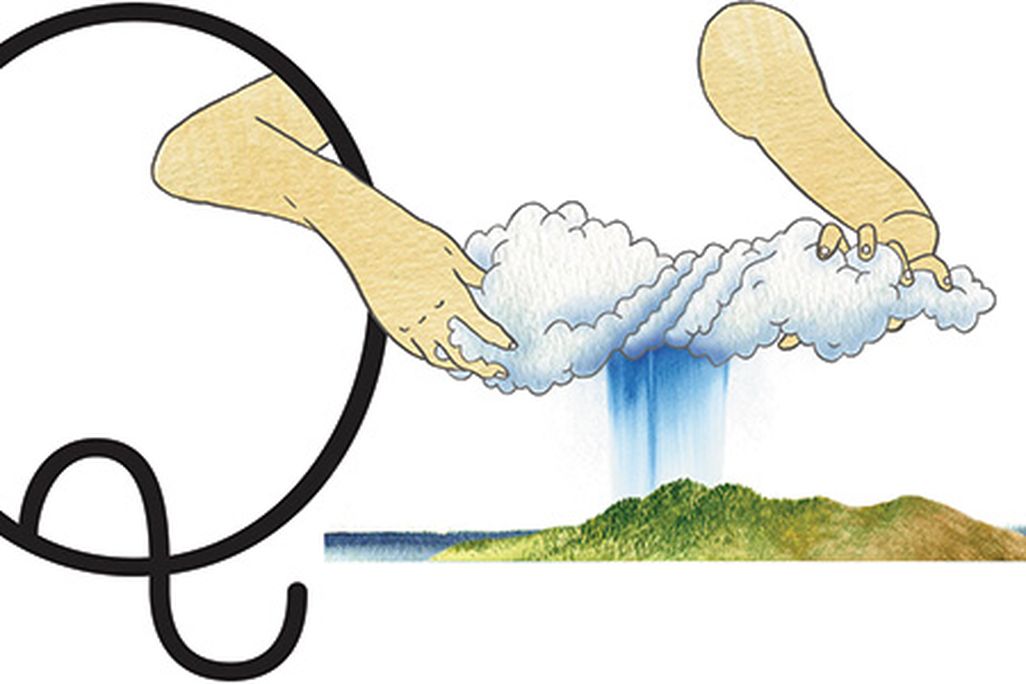
Ever wonder how much water is in a cloud? (Illustration by Yutaka Houlette)

How much water is in a cloud? What would be left if you squeezed the water out of it?
Jerry Jones
Eugene, Oregon

It depends on the cloud. A giant thunderhead may contain more than two billion pounds of water, but even a modest-sized cloud may contain water equivalent to the mass of a 747 jet. If you could squeeze the water out, the cloud would disappear. But you can’t. Some desert peoples use cloth “cloud catchers” to gather condensation and fill local water tanks for drinking and irrigation.
Doug Herman
Geographer, National Museum of the American Indian

What is the practical use of the imaginary number √–-1?
Kenneth A. Harris
Hugo, Minnesota

The number is “imaginary” in the mathematical sense (that is, its square is less than zero). Such numbers represent solutions to many algebraic equations, and they are central to describing the motion of waves in such practical areas as hydrodynamics and aerodynamics, electrical circuit design, quantum mechanics and the theory of heat conduction.
Peggy Aldrich Kidwell
Curator of Mathematics, National Museum of American History

Why did Roy Lichtenstein’s Cheese Head feature a slice of Swiss cheese as the subject’s head?
Steven J. Fenves
Rockville, Maryland

Lichtenstein was exploring Surrealist themes at the time (1977), and he may have been playing on The Son of Man, René Magritte’s famous 1964 portrait of a man with an apple all but covering his face. He may also have been making a joke when he replaced the head (brain) with Swiss cheese, but that’s speculation on my part.
Joann Moser
Senior Curator of Graphic Arts, Smithsonian American Art Museum

At night I can see the entire Andromeda Galaxy with its center bulge of light. Why can't I see the bulge of light at the center of our own galaxy, the Milky Way?
John Bresnahan
Dewey, Arizona

It’s because we view our galaxy from our solar system’s vantage point—that is, from within the galaxy. The center is very distant from us, and the space in between is filled with dust that obscures the bulge of stars associated with the galactic center. But we can see it with infrared light, which passes through the dust more easily.
Alyssa Goodman
Astrophysicist, Harvard-Smithsonian Center for Astrophysics

Do any nonhuman animals exhibit homosexual behavior?
Donald Putnam
Fallbrook, California

Yes; sex between animals of the same gender has been observed in hundreds of species, from penguins to guppies to bonobos, both in the wild and in captivity. In highly social species, individuals may exhibit same-sex sex if there’s a shortage of males or females. But researchers are still trying to determine why this behavior occurs, and they caution against using it to draw parallels between animals and humans.
Steven J. Sarro
Curator, National Zoological Park

Have a question for our curators? Ask now!


How much water is in a cloud? What would be left if you squeezed the water out of it?
Jerry Jones
Eugene, Oregon

It depends on the cloud. A giant thunderhead may contain more than two billion pounds of water, but even a modest-sized cloud may contain water equivalent to the mass of a 747 jet. If you could squeeze the water out, the cloud would disappear. But you can’t. Some desert peoples use cloth “cloud catchers” to gather condensation and fill local water tanks for drinking and irrigation.
Doug Herman
Geographer, National Museum of the American Indian

What is the practical use of the imaginary number √–-1?
Kenneth A. Harris
Hugo, Minnesota

The number is “imaginary” in the mathematical sense (that is, its square is less than zero). Such numbers represent solutions to many algebraic equations, and they are central to describing the motion of waves in such practical areas as hydrodynamics and aerodynamics, electrical circuit design, quantum mechanics and the theory of heat conduction.
Peggy Aldrich Kidwell
Curator of Mathematics, National Museum of American History

Why did Roy Lichtenstein’s Cheese Head feature a slice of Swiss cheese as the subject’s head?
Steven J. Fenves
Rockville, Maryland

Lichtenstein was exploring Surrealist themes at the time (1977), and he may have been playing on The Son of Man, René Magritte’s famous 1964 portrait of a man with an apple all but covering his face. He may also have been making a joke when he replaced the head (brain) with Swiss cheese, but that’s speculation on my part.
Joann Moser
Senior Curator of Graphic Arts, Smithsonian American Art Museum

At night I can see the entire Andromeda Galaxy with its center bulge of light. Why can't I see the bulge of light at the center of our own galaxy, the Milky Way?
John Bresnahan
Dewey, Arizona

It’s because we view our galaxy from our solar system’s vantage point—that is, from within the galaxy. The center is very distant from us, and the space in between is filled with dust that obscures the bulge of stars associated with the galactic center. But we can see it with infrared light, which passes through the dust more easily.
Alyssa Goodman
Astrophysicist, Harvard-Smithsonian Center for Astrophysics

Do any nonhuman animals exhibit homosexual behavior?
Donald Putnam
Fallbrook, California

Yes; sex between animals of the same gender has been observed in hundreds of species, from penguins to guppies to bonobos, both in the wild and in captivity. In highly social species, individuals may exhibit same-sex sex if there’s a shortage of males or females. But researchers are still trying to determine why this behavior occurs, and they caution against using it to draw parallels between animals and humans.
Steven J. Sarro
Curator, National Zoological Park

Have a question for our curators? Ask now!

    Subscribe now for more of Smithsonian's coverage on history, science and nature.


Related topics: Painting Animals Mathematics Weather Outer Space


| | | Reddit | Digg | Stumble | Email |
 

Add New Comment


Name: (required)

Email: (required)

Comment:

Comments are moderated, and will not appear until Smithsonian.com has approved them. Smithsonian reserves the right not to post any comments that are unlawful, threatening, offensive, defamatory, invasive of a person's privacy, inappropriate, confidential or proprietary, political messages, product endorsements, or other content that might otherwise violate any laws or policies.

Comments


Advertisement


Ask Smithsonian

Your questions answered by our experts

What Happened to the Wizard of Oz Costumes and More Great Questions From our Readers

Can Animals Decipher Colors and More Questions From Our Readers

How Long Can Turtles Stay Underwater and Other Questions From Our Readers

Most Popular

  • Viewed
  • Emailed
  • Commented
  1. How Long Can Turtles Stay Underwater and Other Questions From Our Readers
  2. How the Smithsonian is Coming to You
  3. Lost and Found Again: Photos of African-Americans on the Plains
  4. America’s Got a Case of Souvenir Mania
  5. Skateboard Culture and Other Seriously Amazing Smithsonian Exhibits Coming to a Museum Near You
  6. The Different Faces of Korean Heritage at the Portrait Gallery
  7. What Happened to the Wizard of Oz Costumes and More Great Questions From our Readers
  8. Baby Dell
  9. The Wild Bunch and More Are New Faces at the Portrait Gallery
  10. Listen to Doc Watson Picking Away at his Banjo

View All Most Popular »

Advertisement

Follow Us

Smithsonian Magazine
@SmithsonianMag
Follow Smithsonian Magazine on Twitter

Sign up for regular email updates from Smithsonian.com, including daily newsletters and special offers.

In The Magazine

May 2013

  • Patriot Games
  • The Next Revolution
  • Blowing Up The Art World
  • The Body Eclectic
  • Microbe Hunters

View Table of Contents »


First Name
Last Name
Address 1
Address 2
City
State   Zip
Email


Travel with Smithsonian


Smithsonian Store

Stars and Stripes Throw

Our exclusive Stars and Stripes Throw is a three-layer adaption of the 1861 “Stars and Stripes” quilt... $65


View full archiveRecent Issues


  • May 2013


  • Apr 2013


  • Mar 2013

Newsletter

Sign up for regular email updates from Smithsonian magazine, including free newsletters, special offers and current news updates.

Subscribe Now

About Us

Smithsonian.com expands on Smithsonian magazine's in-depth coverage of history, science, nature, the arts, travel, world culture and technology. Join us regularly as we take a dynamic and interactive approach to exploring modern and historic perspectives on the arts, sciences, nature, world culture and travel, including videos, blogs and a reader forum.

Explore our Brands

  • goSmithsonian.com
  • Smithsonian Air & Space Museum
  • Smithsonian Student Travel
  • Smithsonian Catalogue
  • Smithsonian Journeys
  • Smithsonian Channel
  • About Smithsonian
  • Contact Us
  • Advertising
  • Subscribe
  • RSS
  • Topics
  • Member Services
  • Copyright
  • Site Map
  • Privacy Policy
  • Ad Choices

Smithsonian Institution