• Smithsonian
    Institution
  • Travel
    With Us
  • Smithsonian
    Store
  • Smithsonian
    Channel
  • goSmithsonian
    Visitors Guide
  • Air & Space
    magazine

Smithsonian.com

  • Subscribe
  • History & Archaeology
  • Science
  • Ideas & Innovations
  • Arts & Culture
  • Travel & Food
  • At the Smithsonian
  • Photos
  • Videos
  • Games
  • Shop
  • Art
  • Design
  • Fashion
  • Music & Film
  • Books
  • Art Meets Science
  • Arts & Culture

Q&A: Chris Carter of "The X Files"

The creator and writer behind "The X-Files" reveals his inspiration for the sci-fi series and motivation behind the upcoming film.

| | | Reddit | Digg | Stumble | Email |
  • By Jesse Rhodes
  • Smithsonian.com, July 17, 2008, Subscribe
 
$Alt
(National Museum of American History)

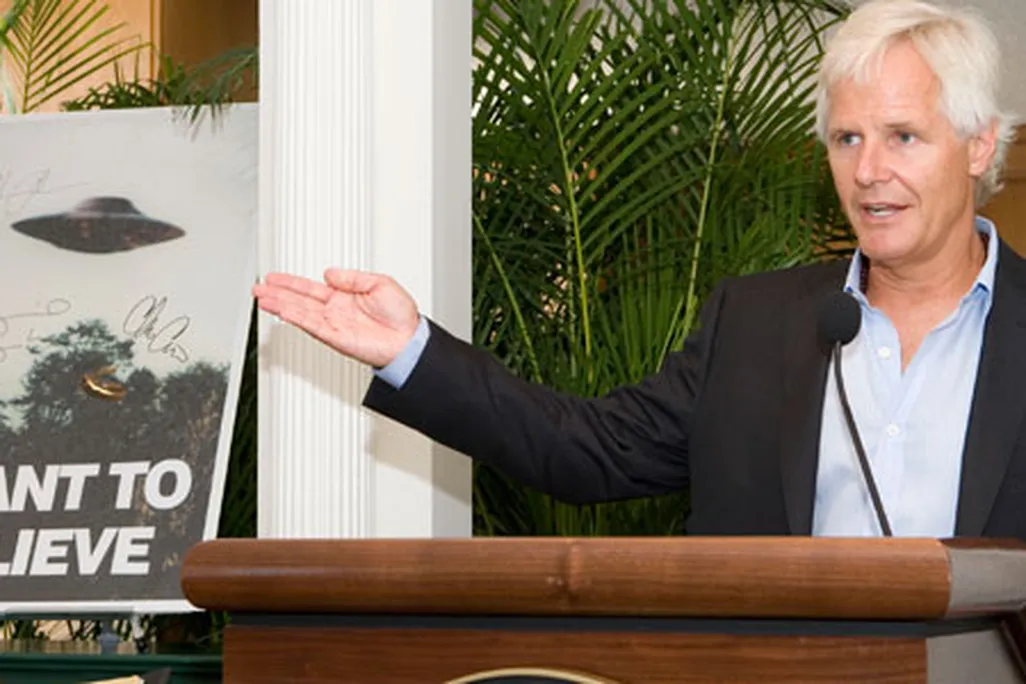
Chris Carter, creator and writer of The X-Files came to the Smithsonian's National Museum of American History to donate several props and posters—including the original pilot script—from the popular television sci-fi series. The items were courtesy of Carter, producer Frank Spotnitz and 20th Century Fox.

After the donation ceremony, Carter sat down with Smithsonian magazine's Jesse Rhodes to discuss the life of the series and the upcoming film The X-Files: I Want to Believe in theatres July 25, 2008.

Where did the "I Want to Believe" poster from Mulder's office come from?
It [the poster donated to the Smithsonian] came from Gillian Anderson's collection. All the rest of the original posters had been stolen or, I assume, destroyed.

The original graphic came from me saying, "Let's get a picture of a spaceship and put—Ed Ruscha-like—"I want to believe." I love Ed Ruscha. I love the way he puts text in his paintings. (I actually got to say to him, "I was inspired by you.") When I saw the [finished] poster I recognized the photograph because it came from a series of photographs taken in Europe by a guy named Billy Meier. And I said, "Did we get the clearance for that photograph?" And they said, "Oh, yes!" Ten years went by and all of a sudden I got a call from Fox legal: "We have an intellectual property lawsuit we have to depose you for." And there was a lawsuit and they had not done the proper clearance for that photograph.

While you were working on the show, did you ever have a sense that your creation was a major piece of American pop culture?
The first inkling was when James Wolcott wrote about it in The New Yorker and I figured that if someone at The New Yorker wrote glowingly about The X Files that it had made an impact in a place I consider to be something for the record. But beyond that, I have to tell you that other than the Nielsen ratings and other than X-Files references, I had no sense of its popularity and to this day I don't have a true sense of its popularity. Even if I see 300 X-Files fans together, I can't fathom—I cannot imagine—the audience itself. All I think about is the show and all I think about is why I like it and why I like to write it and why I like the characters and what I have to say through them.

What inspired you to write The X-Files?
All the shows from my childhood. All the scary shows: Alfred Hitchcock Presents, Night Gallery, Outer Limits. There was a particularly good show on when I was in my early teens called Kolchak: The Night Stalker starring Darren McGavin. They were two two-hour movies. They were fantastic. Scary. Those things were my inspiration in terms of entertainment. Silence of the Lambs was an inspiration. It's not a mistake that Dana Scully has red hair like Clarice Starling in The Silence of the Lambs. So there were a variety of inspirations. But the idea itself came out of my religious background and my interest in science. My brother is a scientist. He's a professor at MIT. He brought science fiction into my world. But I am a person of faith and so it's the combination of those two things.

Barring the episode titled "Jump the Shark," as a writer, do you think The X-Files ever "jumped the shark?"
I don't think X-Files jumped the shark and that tongue-in-cheek title was our way of lowering the boom on anybody who thought that it did. I think it was good till the end and I think that while it changed with the exit of David Duchovny, I believe that during that period there was excellent work done, excellent storytelling, and I'll stand by all nine years of the show.

The show has been out of production for six years. What are you hoping to achieve with the upcoming film?
It was an opportunity to give the fans of The X-Files what they wanted: more Mulder and Scully. It was also an opportunity for me, having stepped away from it, to look back at it and imagine what it might be six years later and how the series might be re-evaluated by the work that is done in this movie. [Hopefully] you can look back at [the series] and realize that it's not just a scary show, it's not just a suspense thriller. It's a show about two people who have built-in personal conflicts. One is a medical doctor, a scientist who is a religious person of the Catholic faith. The other one is a person of no particular religious faith who has a great passionate belief in something that I'll call spiritual or metaphysical, which is tantamount to a religious belief. And so you've got these warring ideas inside the characters and you've got them together in a way that, for me, addresses and asks a lot of the important questions about life itself.


Chris Carter, creator and writer of The X-Files came to the Smithsonian's National Museum of American History to donate several props and posters—including the original pilot script—from the popular television sci-fi series. The items were courtesy of Carter, producer Frank Spotnitz and 20th Century Fox.

After the donation ceremony, Carter sat down with Smithsonian magazine's Jesse Rhodes to discuss the life of the series and the upcoming film The X-Files: I Want to Believe in theatres July 25, 2008.

Where did the "I Want to Believe" poster from Mulder's office come from?
It [the poster donated to the Smithsonian] came from Gillian Anderson's collection. All the rest of the original posters had been stolen or, I assume, destroyed.

The original graphic came from me saying, "Let's get a picture of a spaceship and put—Ed Ruscha-like—"I want to believe." I love Ed Ruscha. I love the way he puts text in his paintings. (I actually got to say to him, "I was inspired by you.") When I saw the [finished] poster I recognized the photograph because it came from a series of photographs taken in Europe by a guy named Billy Meier. And I said, "Did we get the clearance for that photograph?" And they said, "Oh, yes!" Ten years went by and all of a sudden I got a call from Fox legal: "We have an intellectual property lawsuit we have to depose you for." And there was a lawsuit and they had not done the proper clearance for that photograph.

While you were working on the show, did you ever have a sense that your creation was a major piece of American pop culture?
The first inkling was when James Wolcott wrote about it in The New Yorker and I figured that if someone at The New Yorker wrote glowingly about The X Files that it had made an impact in a place I consider to be something for the record. But beyond that, I have to tell you that other than the Nielsen ratings and other than X-Files references, I had no sense of its popularity and to this day I don't have a true sense of its popularity. Even if I see 300 X-Files fans together, I can't fathom—I cannot imagine—the audience itself. All I think about is the show and all I think about is why I like it and why I like to write it and why I like the characters and what I have to say through them.

What inspired you to write The X-Files?
All the shows from my childhood. All the scary shows: Alfred Hitchcock Presents, Night Gallery, Outer Limits. There was a particularly good show on when I was in my early teens called Kolchak: The Night Stalker starring Darren McGavin. They were two two-hour movies. They were fantastic. Scary. Those things were my inspiration in terms of entertainment. Silence of the Lambs was an inspiration. It's not a mistake that Dana Scully has red hair like Clarice Starling in The Silence of the Lambs. So there were a variety of inspirations. But the idea itself came out of my religious background and my interest in science. My brother is a scientist. He's a professor at MIT. He brought science fiction into my world. But I am a person of faith and so it's the combination of those two things.

Barring the episode titled "Jump the Shark," as a writer, do you think The X-Files ever "jumped the shark?"
I don't think X-Files jumped the shark and that tongue-in-cheek title was our way of lowering the boom on anybody who thought that it did. I think it was good till the end and I think that while it changed with the exit of David Duchovny, I believe that during that period there was excellent work done, excellent storytelling, and I'll stand by all nine years of the show.

The show has been out of production for six years. What are you hoping to achieve with the upcoming film?
It was an opportunity to give the fans of The X-Files what they wanted: more Mulder and Scully. It was also an opportunity for me, having stepped away from it, to look back at it and imagine what it might be six years later and how the series might be re-evaluated by the work that is done in this movie. [Hopefully] you can look back at [the series] and realize that it's not just a scary show, it's not just a suspense thriller. It's a show about two people who have built-in personal conflicts. One is a medical doctor, a scientist who is a religious person of the Catholic faith. The other one is a person of no particular religious faith who has a great passionate belief in something that I'll call spiritual or metaphysical, which is tantamount to a religious belief. And so you've got these warring ideas inside the characters and you've got them together in a way that, for me, addresses and asks a lot of the important questions about life itself.

    Subscribe now for more of Smithsonian's coverage on history, science and nature.


Related topics: Television


| | | Reddit | Digg | Stumble | Email |
 

Add New Comment


Name: (required)

Email: (required)

Comment:

Comments are moderated, and will not appear until Smithsonian.com has approved them. Smithsonian reserves the right not to post any comments that are unlawful, threatening, offensive, defamatory, invasive of a person's privacy, inappropriate, confidential or proprietary, political messages, product endorsements, or other content that might otherwise violate any laws or policies.

Comments


Advertisement


Most Popular

  • Viewed
  • Emailed
  • Commented
  1. The Amazing Grace of Underwater Portraits
  2. Michael Pollan and Ruth Reichl Hash out the Food Revolution
  3. Never Underestimate the Power of a Paint Tube
  4. Real Places Behind Famously Frightening Stories
  5. How Posters Helped Shape America and Change the World
  6. The Story Behind Banksy
  7. When Did Girls Start Wearing Pink?
  8. Olympic Rowers, King Tut Lessons and More Books to Read This Month
  9. The Saddest Movie in the World
  10. Before There Was Photoshop, These Photographers Knew How to Manipulate an Image
  1. Most of What You Think You Know About Grammar Is Wrong
  1. Wayne Thiebaud Is Not a Pop Artist
  2. A Brief History of Chocolate
  3. A Woodstock Moment – 40 Years Later

View All Most Popular »

Advertisement

Follow Us

Smithsonian Magazine
@SmithsonianMag
Follow Smithsonian Magazine on Twitter

Sign up for regular email updates from Smithsonian.com, including daily newsletters and special offers.

In The Magazine

June 2013

  • The Mind on Fire
  • Burning Desire
  • 10 Epiphanies
  • Rocket Fuel
  • Accounting for Taste

View Table of Contents »


First Name
Last Name
Address 1
Address 2
City
State   Zip
Email


Travel with Smithsonian


Smithsonian Store

Stars and Stripes Throw

Our exclusive Stars and Stripes Throw is a three-layer adaption of the 1861 “Stars and Stripes” quilt... $65


View full archiveRecent Issues


  • Jun 2013


  • May 2013


  • Apr 2013

Newsletter

Sign up for regular email updates from Smithsonian magazine, including free newsletters, special offers and current news updates.

Subscribe Now

About Us

Smithsonian.com expands on Smithsonian magazine's in-depth coverage of history, science, nature, the arts, travel, world culture and technology. Join us regularly as we take a dynamic and interactive approach to exploring modern and historic perspectives on the arts, sciences, nature, world culture and travel, including videos, blogs and a reader forum.

Explore our Brands

  • goSmithsonian.com
  • Smithsonian Air & Space Museum
  • Smithsonian Student Travel
  • Smithsonian Catalogue
  • Smithsonian Journeys
  • Smithsonian Channel
  • About Smithsonian
  • Contact Us
  • Advertising
  • Subscribe
  • RSS
  • Topics
  • Member Services
  • Copyright
  • Site Map
  • Privacy Policy
  • Ad Choices

Smithsonian Institution