
A Record Find
How The Phantom of the Opera led me to a long-lost musical treasure in Paris
With 20 years' hindsight, it's easy to see that it was right there on the page, hiding in plain sight: "It will be remembered that, later, when digging in the substructure of the Opéra, before burying the phonographic records of the artist's voice, the workmen laid bare a corpse." Thus wrote Gaston Leroux in his horror classic, The Phantom of the Opera, first published in 1910.
As readers, we are naturally drawn to the last words of that sentence: "a corpse." Dead bodies—fact or fiction—get our attention. Based on the author's clues, the mind races to the crime scene: "the substructure of the Opéra." And so, in our haste to discover this poor unfortunate's identity, we overlook the most important words of the sentence: "before burying the phonographic records."
Few readers pick up a novel, especially a thriller, expecting a guidebook. They want to be swept away by plot and character; the story's setting is usually an afterthought. Novelists, however, know better. The best fiction is grounded, made real, by its sense of place.
So the question is not, what corpse?
It is, rather, what records?
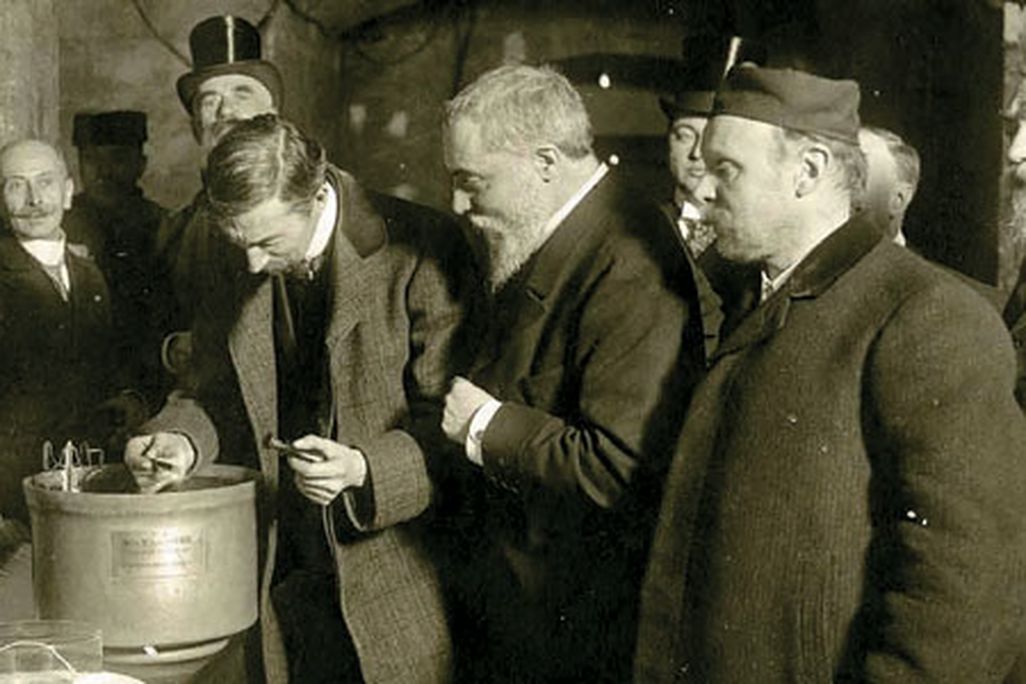
Music lovers around the world were stunned this past December when the Opéra National de Paris and the Bibliothèque Nationale de France announced a major discovery: a time capsule, dredged up from a subbasement of the Palais Garnier, which is also known as the Opéra. Carefully packed away inside two large metal urns was not just one phantom of the opera but many—24 gramophone discs featuring such long-dead artists as Nellie Melba, Adelina Patti, Emma Calvé and Enrico Caruso. In 1907, the discs had been entombed, like Aida's lovers, beneath a great architectural monument.
Though I am a music lover, I was not among the stunned, for, in 1987, I had rediscovered the room where the records had been cached. Several stories underground, far beneath the rush of traffic on the Place de l'Opéra, I spied a metal door bearing a dusty plaque that had to be wiped and illuminated before it could be read. "Gift of M. Alfred Clark, 28 June, 1907," it said in French. "The room in which are contained the gramophone records." I had bumped into it serendipitously, but I recognized it immediately—not for musical reasons, but for literary ones.
At the time, I was involved in two related projects: a biography of Andrew Lloyd Webber, whose sensational setting of The Phantom of the Opera had been the talk of London for a year, and, for Vanity Fair magazine, an article that featured Sarah Brightman, the Phantom's original Christine (and the then-Mrs. Andrew Lloyd Webber), posing in character around the Palais Garnier, where the novel is set and where the opera company staged its productions from 1875 to the opening of the Opéra de la Bastille in 1989.
The Garnier, now used largely for ballet, is one of the world's great buildings. Yes, the composer Debussy famously likened it to a cross between a railway station and a Turkish bath, but it remains one of the most daring, elegant representations of a now-lost Western European confidence in the power of its art. As a secular temple, it might be likened to the cathedral of Notre Dame, not far away; if the great Gothic cathedrals are "symphonies in stone," then the Garnier is nothing less than Faust by Gounod.
More to the point, it is as described by Leroux in his novel, from the rooftop graffiti of the frolicsome "rats" (apprentice ballet dancers) right down to the subterranean body of water, five stories below the street, that figures so prominently in Phantom. Which is why, when I spied that metal door, I knew at once what it was. Having just reread the novel, I instantly linked Leroux's buried phonographic records to the plaque's inscription.
Later, in the opera company's library in the Rotonde de l'Empereur, I asked Martine Kahane, then head librarian, if she knew about the room. She did not. She could tell me only that Clark (1873-1950) was an American pioneer in the transition from wax cylinders to discs who ran the Gramophone Company's offices in Paris. And so I reported my find in several places, including the Vanity Fair article, which appeared in February 1988, and in my biography of Lloyd Webber, published in 1989. "No one is exactly sure what is in this room," I wrote in Andrew Lloyd Webber: His Life and Works, "but it seems that the spot where [the Phantom] died...is a time capsule, not to be opened until 2007" that likely "contains a representative sample of [Clark's] company's wares of the period."
With several other music critics, I petitioned the opera company to unseal the room, in case the gramophone records, or whatever was in it, were in urgent need of preservation. Kahane told us that Clark's gift had come with conditions—one of which was that the room not be opened until 2007—and that the conditions would be observed.
And so the Garnier ghosts were left undisturbed for two more years, when workmen installing air conditioning in the building's basement stumbled across the room once more. At that point, Jean-Jacques Beclier, the opera company's technical supervisor, had the room opened. What he found were four urns containing recordings, two buried in 1907 and two more in 1912. Sure enough, one of the newer urns had been damaged, so all four were removed and transferred without fanfare to the custody of the Bibliothèque Nationale de France until their 100-year interments were up.
Opening the 1907 urns, each of which contains 12 discs, is going to be tricky. According to Elizabeth Giuliani, assistant to the director of the audio-visual department at the Bibliothèque Nationale, the shellac discs were separated by glass plaques, which themselves were kept from touching the surface of the discs by small glass cubes. The whole assemblage was then wrapped in cloth treated with asbestos, then placed inside copper urns, which were then put in urns made of lead. At least one of the urns is to be opened this month in a laboratory under strictly controlled conditions. Eventually the recordings will be transferred digitally and made commercially available by EMI, the successor to the Gramophone Company. Music lovers will once again hear the voices of the long dead singing the music of their time.
But in the meantime, the episode stands as a testament to Gaston Leroux's literary achievement—and raises an issue that has concerned me ever since I left music criticism to write novels and movies a decade ago: To what extent must fact be blended with fancy to create the willing suspension of disbelief? For me, a novel that is not about place is not much of a novel. It is instead a memoir of thinly veiled or nonexistent people wandering through a desolate and unreal landscape.
For why, after all, does The Phantom of the Opera still resonate? Surely not for its creaky plot, its standard-issue heroine, its wooden swain, its Svengali-like villain. Not even for its romance, although that is surely part of its charm. The love story between the beautiful soprano and the disfigured composer has been exploited by everyone from Lon Chaney in 1925 to Joel Schumacher in his 2004 movie version of the Lloyd Webber interpretation.
No, the reason we still read and watch Phantom is its setting: the Opéra itself. Above all, Phantom is a story of place. Firmly grounded in the soaring, underworldly glory of Charles Garnier's architectural masterpiece, it invites readers to partake of a mystery that, if not entirely real, is close enough. From Apollo's rooftop lyre to the mysterious lake 17 stories below, the building is as much a player—and is more lovingly observed—than any of the humans who live and love in its dark embrace.
What is Dickens without London, Mann without Lübeck and Davos? Could John Kennedy Toole's comic masterpiece, A Confederacy of Dunces, be set anywhere but New Orleans? Though we may forget the characters, it is the places that haunt our dreams and give birth to the stories. So here's to Gaston Leroux—not to his Phantom, but to his Opéra.
"I have prayed over his mortal remains, that God might show him mercy notwithstanding his crimes," the author muses after the discovery of the phantom's body at the end of the novel. "Yes, I am sure, quite sure that I prayed beside his body, the other day, when they took it from the spot where they were burying the phonographic records."
And yet the Phantom rose to live again, incarnated by Chaney and Claude Rains and Herbert Lom and and Michael Crawford and Gerard Butler. And now the real Opéra ghosts, Melba and Patti and Caruso, may soon be heard again in glorious song. Thanks to Leroux's eerily accurate sense of place.
Michael Walsh profiled Andrew Lloyd Webber for the October 2007 issue.